Garba Dress Guide 2026: Chaniya Choli, Kediyu, Jewellery and What to Wear Abroad
A practical Garba dress guide for women, men and kids: chaniya choli and dupatta, kediyu and kafni, mirror-work and bandhani, oxidised jewellery, juttis versus dancing barefoot, Navratri 2026 colours of the day, and how to stay comfortable at Garba nights in UK, US and Canadian halls in October.
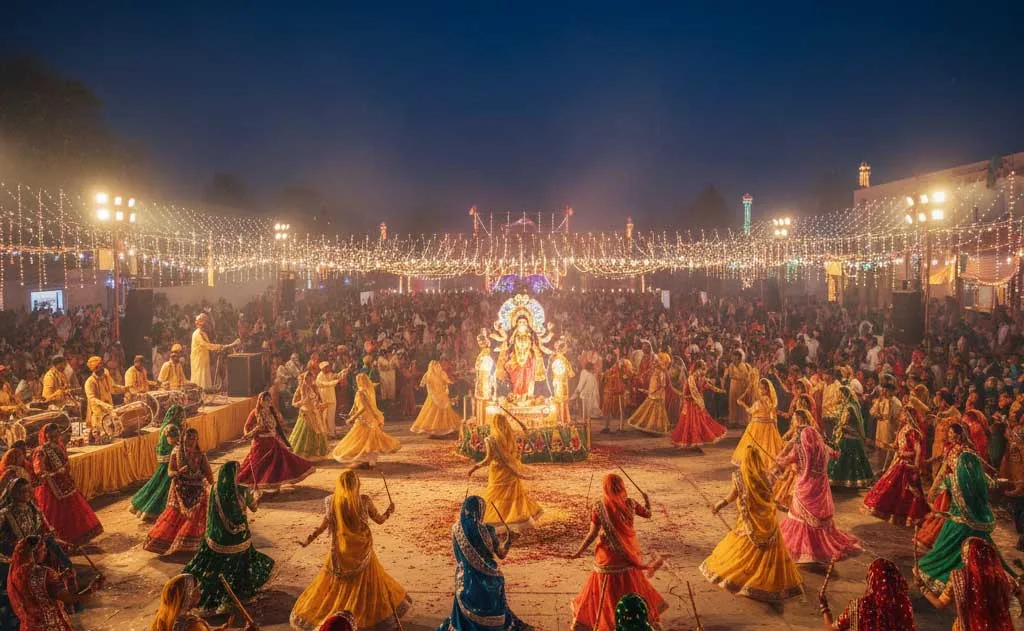
A practical Garba dress guide for women, men and kids: chaniya choli and dupatta, kediyu and kafni, mirror-work and bandhani, oxidised jewellery, juttis versus dancing barefoot, Navratri 2026 colours of the day, and how to stay comfortable at Garba nights in UK, US and Canadian halls in October.
Quick answer: For Garba, women traditionally wear a chaniya choli (a flared, often mirror-worked skirt, a fitted choli blouse and a dupatta); men wear a kediyu or a kurta/kafni with dhoti or churidar; kids wear smaller versions of the same. Add oxidised or silver-tone jewellery, choose footwear you can dance in (or none, if the venue allows), and dress for comfort over several hours of movement. Navratri 2026 runs from Sunday 11 to Monday 19 October in India (Drik Panchang), with Dussehra on Tuesday 20 October; many Garba nights abroad fall on the weekends of 10 to 11 and 16 to 18 October.
Half the joy of Garba is the colour: a whole circle of swirling skirts, mirrors catching the light, bangles and the clap of hands in rhythm. But first-timers, especially families abroad, often ask the same questions. What exactly is a kediyu? Can I wear shoes? Will I freeze walking to the car in a backless choli in October in Toronto? This guide answers them simply. If you are new to Garba itself, start with our Garba for beginners guide, and for the festival calendar see the Navratri 2026 NRI guide.
Garba dress for women: chaniya choli and dupatta
The classic Garba outfit for women is the chaniya choli, also called a ghagra choli or lehenga choli in other regions. It has three parts:
- Chaniya (skirt). A long, wide, flared skirt with many panels, so that it opens into a circle as you turn. Cotton and cotton-blend chaniyas are traditional for dancing; heavier fabrics look rich but become tiring after a few hours.
- Choli (blouse). A fitted blouse, often embroidered or mirror-worked, in styles from simple short sleeves to elaborate backs with ties. Choose a fit that lets you lift your arms fully for clapping.
- Dupatta (odhni). A long scarf, often draped over one shoulder or pinned across the body. For dancing, pin it securely so it does not slip off or tangle with a neighbour's hand during claps.
Many women also wear a kurti with a flared skirt or a dhoti-style pant for comfort, or an Indo-western top with a chaniya. Any of these are fine at most community Garba nights. At temple Garba, a full chaniya choli, salwar kameez or saree in a modest cut is the safest choice.
Garba dress for men: kediyu, kafni and kurta
The traditional Gujarati men's Garba outfit is the kediyu: a short, frock-like upper garment with a fitted chest and a gathered, flared waist that swings out as you spin. It is usually worn with a dhoti or with churidar-style fitted pants, and is often embroidered or set with small mirrors. Some kediyus come with a matching turban or a bandhani stole.
If a kediyu feels like too much, the easy alternatives are:
- Kafni or long kurta with churidar, pyjama or dhoti pants; plain cotton kurtas in the colour of the day are popular.
- Short kurta with a Nehru-style jacket, useful on colder nights abroad because the jacket can come off once you warm up.
- A bandhani or embroidered stole over a plain kurta adds instant Garba colour for very little effort.
Avoid long, heavy shawls or loose scarves that can swing into someone's face in a fast circle, and choose pants with some stretch or room at the knee.
Garba outfits for kids
Children's chaniya cholis and kediyus are made in the same styles, and kids love the twirl. A few practical points from parents:
- Choose soft cotton with a lining, as heavy mirror-work and sequins can scratch young skin.
- Keep the skirt or dhoti length above the ankle so small children do not trip.
- Use an elastic or adjustable waist; children grow fast and outfits get handed down.
- Skip loose jewellery for toddlers, which can be a choking hazard; a bindi sticker or a flower can be enough.
- Pack a T-shirt and pyjamas for the drive home, because most children fall asleep in the car.
For explaining the festival to children, see our parents' guide to explaining Navratri and Dussehra to children.
Mirror-work, bandhani and embroidery styles
Garba clothing draws on Gujarat's rich textile traditions. In general terms, the styles you will see most often are:
| Style | What it looks like | Good for |
|---|---|---|
| Mirror-work (abhla bharat) | Small round or shaped mirrors stitched into the fabric with colourful thread | Classic Garba look that catches the light |
| Kutchi embroidery | Dense, bright thread-work in geometric and floral motifs, associated with the Kutch region | Statement cholis, kediyus and jackets |
| Bandhani | Tie-dye with tiny dots forming patterns, traditional in Gujarat and Rajasthan | Dupattas, stoles and light chaniyas |
| Patchwork and appliqué | Pieces of printed and embroidered cloth stitched together | Colourful chaniyas with a folk feel |
| Block print and plain cotton | Simple printed or solid cotton | Long dancing nights and warm halls |
You do not need a costly piece of any of these. Machine-made versions are common, and many families keep one good set and change dupattas and accessories through the nine nights.
Jewellery and accessories
Garba jewellery is traditionally bold and folk-inspired. Oxidised or silver-tone jewellery is the most popular choice: large jhumkas, chokers or hasli-style neckpieces, a maang tikka, armlets, nose rings, anklets and stacks of bangles. Kamarbandh (waist belts), often with mirrors or ghungroo bells, are a favourite with dancers.
- Keep it secure. Hooks and loose pieces fall off in a fast circle. Use screw-back or clip earrings and pin the maang tikka.
- Mind your neighbours. Long dangling pieces and sharp-edged armlets can catch another dancer's dupatta or hand when you clap.
- Leave valuables at home. Gold and heirloom pieces are easy to lose on a crowded floor; folk-style costume jewellery is made for this.
- Hair. A braid or bun with flowers or a hair accessory stays tidy for hours; open hair gets hot quickly.
Footwear: juttis, mojaris or barefoot?
Traditionally, many people dance Garba barefoot, especially around the Mataji's image and at temple Garba, where shoes are left outside. Juttis and mojaris (flat embroidered leather or fabric slip-ons) are the traditional footwear when shoes are worn.
Abroad, Garba often happens in school gyms, community halls, university sports halls and temple halls, and each venue has its own rules. Some require clean, non-marking indoor shoes to protect a sports floor; some ask everyone to remove footwear; many do not allow outdoor shoes on the dance floor. Before you go:
- Check the organiser's footwear rule on their notice or social media page.
- Carry a pair of soft-soled flats, juttis or clean dance trainers in a bag, plus socks if bare feet are not allowed.
- Avoid heels: they hurt after an hour and can injure a neighbour's foot.
- If you dance barefoot on a hard floor, take short breaks; blisters come quickly on night two or three.
Comfort tips for long Garba nights abroad
In Gujarat, Navratri nights are usually warm. In October in the UK, Canada and the US Northeast they can be cold and wet outside, while a packed hall becomes hot within minutes. Dress in layers:
- Outer layer for the journey. A coat, shawl or cardigan for the car park and the queue, which you can leave at the coat area or in the car.
- Breathable base. Cotton or cotton blends breathe better than heavy synthetics under bright hall lights.
- Shorts or leggings under the chaniya for comfort, modesty when spinning, and warmth outside.
- A small bag. Water bottle, safety pins, a spare dupatta pin, plasters for blisters, hair ties and any medicines.
- Fasting dancers. If you are keeping a Navratri fast, eat and drink according to your vrat before dancing and pause if you feel dizzy. See our Navratri vrat recipes.
For city listings of where families gather, see our Navratri 2026 USA city-by-city guide, the UK city-by-city guide and the Canada city-by-city guide.
Matching the Navratri colour of the day
Many devotees, especially in Maharashtra and increasingly among Garba-goers worldwide, wear a different colour on each day of Navratri. This is a popular modern custom rather than a scriptural rule, and lists vary. Per the weekday rule used on our Navratri 2026 colours list, the 2026 colours are:
| Day (India) | Date | Goddess | Colour |
|---|---|---|---|
| Day 1 | Sunday 11 October 2026 | Shailaputri | Orange |
| Day 2 | Monday 12 October 2026 | Brahmacharini | White |
| Day 3 | Tuesday 13 October 2026 | Chandraghanta | Red |
| Day 4 | Wednesday 14 October 2026 | Kushmanda | Royal blue |
| Day 5 | Thursday 15 October 2026 | Skandamata | Yellow |
| Day 6 | Friday 16 October 2026 | Katyayani | Green |
| Day 7 | Saturday 17 October 2026 | Kalaratri | Grey |
| Day 8 | Sunday 18 October 2026 | Mahagauri | Purple, pink or peacock green (lists differ) |
| Day 9 | Monday 19 October 2026 | Siddhidatri | Purple, pink or peacock green (lists differ) |
An easy trick: wear a neutral or multicoloured chaniya choli or kurta and change only the dupatta, stole or turban to match the day.
Sustainable Garba: rent, swap and reuse
Garba outfits are worn a few nights a year, so there is no need to buy new every season.
- Swap within your community. Many families and temple groups abroad informally swap children's outfits that have been outgrown.
- Rent a heavier outfit for one special night instead of buying it.
- Restyle. Pair last year's chaniya with a new choli or dupatta, or wear a kediyu jacket over a plain kurta.
- Care for it. Hand-wash or spot-clean mirror-work, dry in the shade, and store folded with the mirrors protected so they do not crack.
- Pass it on. When an outfit no longer fits anyone at home, give it to a cousin, a friend new to Garba, or a community collection.
Modest and respectful dress at temple Garba
Garba began, as traditionally told, as worship of the Goddess around the Garbo lamp, and at a temple it remains worship. Read more in our guide to the meaning and spiritual significance of Garba. At temple Garba:
- Choose cholis and kurtas that cover the shoulders and midriff reasonably, or use the dupatta to cover.
- Remove footwear where asked and leave it in the space provided.
- Avoid clothing with slogans or images that may be out of place in a shrine.
- Stand still and join the aarti before and during the Garba; phones away is a good habit.
- Leather belts and bags are best left outside if the temple asks.
Community halls and university Garba nights are usually more relaxed, but the devotional heart is the same. Dressing with care is a way of honouring Ma Amba, not a fashion test.
Also read: Garba 2026 worldwide: all countries.
Frequently asked questions
What should I wear to Garba for the first time?
Women usually wear a chaniya choli (a flared skirt, a fitted blouse and a dupatta) or a simple kurti with a flared skirt; men usually wear a kediyu or a kurta with churidar or dhoti-style pants. If you have nothing traditional, a comfortable kurta or a bright, modest outfit you can move in is perfectly welcome. Comfort and respect matter more than an expensive outfit.
What is a kediyu?
A kediyu is the traditional Gujarati men's upper garment for Garba: a short, frock-like top with a gathered, flared waist that swirls as you turn, usually worn with a dhoti or churidar-style pants and often decorated with embroidery or mirror-work. A kafni is a longer, kurta-style top that many men also wear.
Can I wear jeans to Garba?
At many community and university Garba nights abroad you will see some people in jeans with a kurta, and nobody should be turned away for it. But tight jeans are hard to dance in, and at temple Garba a traditional or modest outfit is more respectful. If you can, wear a kurta and loose pants or a flared skirt.
Do you dance Garba barefoot or with shoes?
Traditionally many people dance barefoot, especially around the Mataji's image and at temple Garba. Many halls and school gyms abroad have their own footwear rules: some ask for clean indoor shoes, some ask everyone to remove shoes, and some do not allow outdoor shoes on the floor. Follow the organiser's rule and carry soft-soled juttis or clean dance shoes as a backup.
What colour should I wear for Navratri 2026 Garba?
Many people follow the Navratri colour of the day. Per the weekday rule on our colours list, Day 1 (Sunday 11 October 2026) is orange, Day 6 (Friday 16 October) is green and Day 7 (Saturday 17 October) is grey; lists differ for Days 8 and 9. This is a popular modern custom, not a scriptural rule, so wear what you have and enjoy the night.
Is it okay for non-Gujaratis or non-Hindus to wear a chaniya choli?
Yes. Garba circles welcome everyone, and wearing a chaniya choli or kediyu with respect is generally appreciated as joining in. Keep the outfit modest, especially at temple Garba, and follow the devotional moments such as the aarti.
Editor's note (7 October 2026)
We wrote this guide in October 2026 for Navratri 2026. Dates follow Drik Panchang for India. We do not name brands, shops, prices, specific events or venues, and footwear and dress rules vary from one organiser and temple to another, so always check the local notice. Colours of the day follow the weekday rule used on our colours list; other lists differ.
Related guides
You might also like
Garba vs Dandiya Raas: The Difference Explained for Navratri 2026
Navratri 2026 for Indian Women Abroad: A Practical Guide for the USA, Canada, UK and Australia
Garba for Beginners: Easy Steps, Circle Etiquette and Garba with Kids (Navratri 2026)