Ratha Saptami 2027 (Surya Jayanti, Magha Saptami): Date, Saptami Tithi, Snan Time by City, Arka Leaf Bath, Puja and Story
Ratha Saptami, also called Surya Jayanti and Magha Saptami, is on Saturday 13 February 2027 in India. Drik Panchang gives the Saptami tithi from 2:59 AM IST on 13 February to 2:06 AM IST on 14 February, and a snan muhurat of 5:04 AM to 6:44 AM in Hyderabad. By our calculation the day is Saturday 13 February in the Americas, Europe, the Gulf, South-East Asia, Perth, South Africa and Mauritius, and Sunday 14 February in Sydney, Melbourne, Brisbane, Auckland and Suva. Here is the pre-dawn bath with arka leaves, a simple Surya puja, the Tirumala and Arasavalli celebrations and a verse of the Aditya Hridayam.
Quick answer: Ratha Saptami 2027 is on Saturday 13 February 2027 in India. Drik Panchang gives the Saptami tithi from 2:59 AM IST on 13 February to 2:06 AM IST on 14 February, and a snan muhurat of 5:04 AM to 6:44 AM in Hyderabad. By our calculation it is Saturday 13 February across the Americas, Europe, the Gulf and South-East Asia, and Sunday 14 February in Sydney, Melbourne, Brisbane, Auckland and Suva.
Last updated: 21 October 2026. This page earlier explained Ratha Saptami without a date. We have rewritten it in place for 2027 with the date and tithi from Drik Panchang, the snan time by city, the arka leaf bath, a home puja, regional celebrations and a health note.
Ratha Saptami 2027 date and Saptami tithi (Ratha Saptami 2027 eppudu, Ratha Saptami 2027 kab hai)
| Detail | India (Drik Panchang, IST) |
|---|---|
| Ratha Saptami, Surya Jayanti, Magha Saptami | Saturday 13 February 2027 |
| Saptami tithi begins | 2:59 AM, Saturday 13 February |
| Saptami tithi ends | 2:06 AM, Sunday 14 February |
| Snan muhurat (Hyderabad) | 5:04 AM to 6:44 AM |
| Sunrise (Hyderabad) | 6:44 AM |
| Same day | Kumbha Sankranti |
| Next day | Bhishma Ashtami, Sunday 14 February |
| Two days earlier | Vasant Panchami, Thursday 11 February |
Also read in our January-March 2027 festival series: Makar Sankranti 2027, Thaipusam 2027, Mauni Amavasya 2027, Vasant Panchami 2027, Maha Shivaratri 2027.
Ratha Saptami 2027 snan time by city (Ratha Saptami snanam samayam)
Ratha Saptami is kept on the day the Saptami tithi is present at local sunrise, and the bath is taken at Arunodaya, about four ghatis (roughly 96 minutes) before sunrise. Times below are local clock time from our ephemeris calculator, checked against Drik Panchang for Hyderabad and Sydney; Drik's own window for Hyderabad is 5:04 AM to 6:44 AM.
| City | Ratha Saptami 2027 | Snan window (Arunodaya) | Sunrise |
|---|---|---|---|
| Delhi | Saturday 13 February | 5:24 AM to 7:00 AM | 7:00 AM |
| Mumbai | Saturday 13 February | 5:30 AM to 7:06 AM | 7:06 AM |
| Hyderabad (Drik) | Saturday 13 February | 5:04 AM to 6:44 AM | 6:44 AM |
| Bengaluru | Saturday 13 February | 5:05 AM to 6:41 AM | 6:41 AM |
| Chennai | Saturday 13 February | 4:55 AM to 6:31 AM | 6:31 AM |
| Kolkata | Saturday 13 February | 4:32 AM to 6:08 AM | 6:08 AM |
| New York | Saturday 13 February | 5:15 AM to 6:51 AM | 6:51 AM |
| Chicago | Saturday 13 February | 5:11 AM to 6:47 AM | 6:47 AM |
| Houston | Saturday 13 February | 5:25 AM to 7:01 AM | 7:01 AM |
| Dallas | Saturday 13 February | 5:35 AM to 7:11 AM | 7:11 AM |
| Los Angeles | Saturday 13 February | 5:02 AM to 6:38 AM | 6:38 AM |
| San Francisco Bay Area | Saturday 13 February | 5:21 AM to 6:57 AM | 6:57 AM |
| Seattle | Saturday 13 February | 5:40 AM to 7:16 AM | 7:16 AM |
| Toronto | Saturday 13 February | 5:41 AM to 7:17 AM | 7:17 AM |
| Winnipeg (UTC-5) | Saturday 13 February | 7:04 AM to 8:40 AM | 8:40 AM |
| Calgary (UTC-6) | Saturday 13 February | 7:14 AM to 8:50 AM | 8:50 AM |
| Vancouver (UTC-7) | Saturday 13 February | 6:47 AM to 8:23 AM | 8:23 AM |
| London | Saturday 13 February | 5:40 AM to 7:16 AM | 7:16 AM |
| Dubai | Saturday 13 February | 5:17 AM to 6:53 AM | 6:53 AM |
| Singapore | Saturday 13 February | 5:39 AM to 7:15 AM | 7:15 AM |
| Kuala Lumpur | Saturday 13 February | 5:49 AM to 7:25 AM | 7:25 AM |
| Durban | Saturday 13 February | 3:57 AM to 5:33 AM | 5:33 AM |
| Port Louis, Mauritius | Saturday 13 February | 4:23 AM to 5:59 AM | 5:59 AM |
| Perth | Saturday 13 February | 4:14 AM to 5:50 AM | 5:50 AM |
| Sydney (Drik: 14 Feb) | Sunday 14 February | 4:51 AM to 6:27 AM | 6:27 AM |
| Melbourne | Sunday 14 February | 5:10 AM to 6:46 AM | 6:46 AM |
| Brisbane | Sunday 14 February | 3:52 AM to 5:28 AM | 5:28 AM |
| Auckland | Sunday 14 February | 5:12 AM to 6:48 AM | 6:48 AM |
| Suva, Fiji | Sunday 14 February | 4:21 AM to 5:57 AM | 5:57 AM |
In eastern Australia, New Zealand and Fiji, Saptami begins in the morning of Saturday 13 February, after sunrise, and is still present at sunrise on Sunday 14 February, so Sunday is the day there. If a very early bath is not practical, bathe as soon as you can after waking and offer water to the rising Sun. Do not convert India's times into your own time zone.
Why Ratha Saptami is celebrated (Surya Jayanti story, our summary)
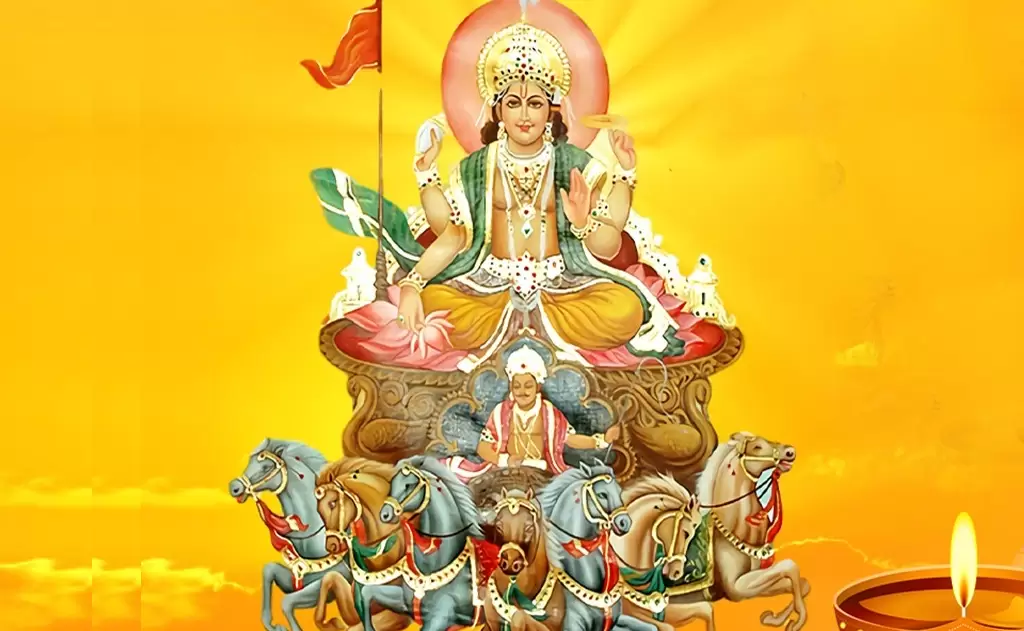
Ratha Saptami honours Surya, the Sun god, son of the sage Kashyapa and Aditi, which is why he is called Aditya. The day is kept as his birthday (Surya Jayanti), and as the day he turns his chariot, drawn by seven horses and driven by the charioteer Aruna, towards the north and the warmer half of the year. The seven horses are often explained as the seven days of the week or the seven colours of light.
Traditions vary. Some calendars call the day Achala Saptami or Arogya Saptami and link it with prayers for health; some tell a story of a king or a devotee healed through Surya's worship; others simply mark it as the true beginning of the Sun's northern journey after Makar Sankranti. These are our own summaries of traditional tellings.
Ratha Saptami puja vidhi: arka leaf bath and Surya arghya
- Wake before dawn. Bathe at Arunodaya, placing seven arka (jilledu, aak) leaves on your head, or on the head and shoulders, as your family does. Some add a little rice, sesame or a pinch of turmeric on the leaves.
- After the bath, face east and offer arghya: pour water from a copper vessel or your joined palms towards the rising Sun, with a few flowers and akshata.
- Draw a rangoli of a chariot with the Sun at the front door or the puja area.
- Worship Surya with a lamp, red flowers and naivedyam. In many Telugu homes paramannam (rice cooked in milk with jaggery) is cooked in the open, sometimes in the sunlight, and offered on broad-bean (chikkudu) leaves.
- Recite the Aditya Hridayam, the twelve names of Surya with Surya Namaskara, or simply "Om Suryaya Namah" 108 times.
- Give food or warm clothes to someone in need; charity is a traditional part of the day.
Health note: the pre-dawn bath is meant to be taken safely. In February it is freezing in much of Canada, the northern USA and the UK: bathe at home in warm water, never in a cold river, lake or the sea in the dark. The milky sap of the arka plant irritates skin and eyes; wash your hands after picking leaves and keep the sap away from children's eyes. Fasting is optional; anyone pregnant, elderly, diabetic, unwell or on regular medication should eat normally or ask a doctor first.
Ratha Saptami at Tirumala, Arasavalli and Konark
- Tirumala: Ratha Saptami is celebrated as a one-day Brahmotsavam, often called Ardha Brahmotsavam. Sri Malayappa Swami is taken out on a series of vahanas through the day, beginning at dawn on the Surya Prabha vahanam and ending at night on the Chandra Prabha vahanam. Check the TTD's official announcements for the 2027 schedule.
- Arasavalli, Srikakulam: the Sri Suryanarayana Swamy temple, one of the best-known Sun temples in India, draws large crowds of devotees on Ratha Saptami.
- Konark, Odisha: the Chandrabhaga Mela is held near the Sun Temple on Magha Shukla Saptami, with a dawn bath at the Chandrabhaga beach.
- Elsewhere: Sun temples and Vishnu temples across South India hold special processions. We do not list timings or sevas; check each temple's official website.
For temple-by-temple planning abroad, see our guides to Surya and Navagraha temples in the USA, the UK and Europe and Australia, New Zealand and the UAE.
A verse from the Aditya Hridayam
The Aditya Hridayam, taught by the sage Agastya to Rama before his battle with Ravana in the Valmiki Ramayana, is the prayer most often recited on Ratha Saptami. Its sixth verse, from the text published by sanskritdocuments.org:
रश्मिमन्तं समुद्यन्तं देवासुरनमस्कृतम् ।
पूजयस्व विवस्वन्तं भास्करं भुवनेश्वरम् ॥ ६॥
raśmimantaṃ samudyantaṃ devāsuranamaskṛtam |
pūjayasva vivasvantaṃ bhāskaraṃ bhuvaneśvaram || 6||
Meaning: Worship Vivasvan, the Sun, who is crowned with rays, who rises each day, who is honoured by gods and asuras alike, the maker of light and the lord of the worlds. Read the complete Aditya Hridayam with all verses and the 12 Surya Namaskar mantras.
Ratha Saptami for NRI families
- Check your day: Saturday 13 February in North and South America, the UK and Europe, the Gulf, South-East Asia, Perth, South Africa and Mauritius; Sunday 14 February in eastern Australia, New Zealand and Fiji.
- Arka leaves abroad: the plant is hard to find in cold countries. Indian grocers sometimes stock leaves in season; otherwise a bath with a prayer to Surya is a complete observance.
- Weekend in 2027: the festival falls on a weekend, so families can plan a relaxed dawn arghya, a temple visit and a shared meal.
- Children: draw the seven-horse chariot together and tell the story of Aditi's son, the Sun.
Festival dates, January to March 2027
| Festival | Date in India (Drik Panchang) |
|---|---|
| Makar Sankranti 2027 | Friday 15 January 2027 |
| Thaipusam 2027 | Friday 22 January 2027 |
| Mauni Amavasya 2027 | Saturday 6 February 2027 |
| Vasant Panchami 2027 | Thursday 11 February 2027 |
| Ratha Saptami (this page) | Saturday 13 February 2027 |
| Maha Shivaratri 2027 | Saturday 6 March 2027 |
Ratha Saptami 2027: frequently asked questions
When is Ratha Saptami 2027?
Ratha Saptami 2027 is on Saturday 13 February 2027 in India, per Drik Panchang. The Magha Shukla Saptami tithi runs from 2:59 AM IST on Saturday 13 February to 2:06 AM IST on Sunday 14 February.
What is the Ratha Saptami snan time in 2027?
The holy bath is taken at Arunodaya, the hour and a half before sunrise. Drik Panchang gives 5:04 AM to 6:44 AM for Hyderabad on 13 February 2027. For other cities, bathe in the roughly 96 minutes before your local sunrise shown in the table on this page.
Is Ratha Saptami on 13 or 14 February in Australia?
In Sydney, Melbourne, Brisbane, Auckland and Suva it is Sunday 14 February, because Saptami is present at sunrise there only on the Sunday. Drik Panchang also lists Ratha Saptami on 14 February for Sydney. Perth keeps Saturday 13 February.
Why are arka (jilledu) leaves used in the Ratha Saptami bath?
The arka plant (Calotropis, jilledu in Telugu, aak in Hindi) is sacred to Surya. Many families place seven arka leaves on the head, sometimes with a little rice or sesame, while bathing. The milky sap of the plant irritates the skin and eyes, so handle the leaves with care and keep the sap away from the eyes, especially for children.
Is Ratha Saptami the same as Surya Jayanti?
Yes. Ratha Saptami is also called Surya Jayanti, the birthday of the Sun god, and Magha Saptami or Achala Saptami. In 2027 it falls on the same day as Kumbha Sankranti, the Sun's entry into Aquarius in the sidereal zodiac.
Do I have to fast on Ratha Saptami?
No. Some devotees eat one simple meal or fast until noon, but it is optional. Anyone pregnant, elderly, diabetic, unwell or on regular medication should eat normally or ask a doctor first.
Editor's note
Editor's note (21 October 2026): We have rewritten this page in place for Ratha Saptami 2027. The date, the Saptami tithi times, the Hyderabad snan muhurat and sunrise come from Drik Panchang's Ratha Saptami page for Hyderabad, and Drik's day panchang lists Ratha Saptami on Sunday 14 February for Sydney. Snan windows for other cities are from our ephemeris calculator (Arunodaya taken as 96 minutes before sunrise), which agrees with Drik to within a few minutes, using the 2027 clock rules for Canada, the USA, the UK and Australia. The Sanskrit verse is reproduced from sanskritdocuments.org. Temple customs are described in general terms only; check official temple websites for schedules. Stories are our own summaries, and customs vary by region and family.
Related guides
Share this with family and friends
Send it on WhatsApp, post it, or copy the link.
More from Culture
- Godavari Pilichindi: Sir Arthur Cotton, the Dowleswaram Anicut and a Telugu Story of Coming Home
- Hindus Worldwide Must Be Safe in Public Places: Temple Security, Festival Safety and Daily Life
- Why We Never See Dead Monkeys: The Belief and the Natural Explanation
- Why Learn Grammar? – A Sanskrit Verse Explaining the Significance of Correct Pronunciation and Its Interpretation
- RCB Wins IPL 2026: Heartiest Congratulations from HinduTone — Jai King Kohli!
You might also like
Importance of Telugu Pronunciation, Grammar & Pedda Bala Siksha – Let Us Preserve Our Mother Tongue
Purusha Suktam: Full Text, Meaning and Significance (Rig Veda 10.90)
Vat Savitri Vrat Story: The Power of a Wife's Devotion That Defeated Death Itself