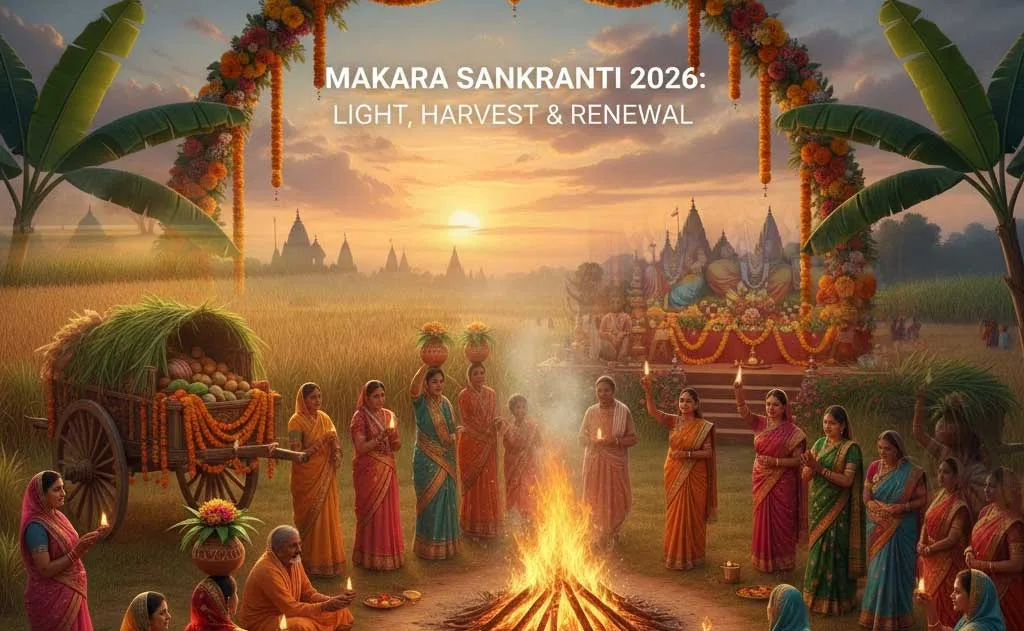
Sankranti muggulu and gobbemmalu: meaning, materials, method
Quick answer: Muggulu are the floor designs Telugu households draw at the doorstep, usually in rice flour or white powder, and drawn largest at Sankranti. Gobbemmalu are small cones of cow dung topped with flowers and set on the muggu.

Quick answer: Muggulu are the floor designs Telugu households draw at the doorstep, usually in rice flour or white powder, and drawn largest at Sankranti. Gobbemmalu are small cones of cow dung topped with flowers and set on the muggu. Girls traditionally sing and dance around them during the month before Sankranti. Below: meaning, materials and a simple method.
| Key fact | Detail |
|---|---|
| Sankranti (Pedda Panduga) 2027 in India | Friday 15 January 2027, per the panchang |
| Bhogi 2027 in India | Thursday 14 January 2027 |
| Season for big muggulu | Dhanurmasam, the solar month that ends at Bhogi, through the festival days |
| Muggu | A pattern drawn on the floor with lines of flour or coloured powder |
| Gobbemma | A small cone or ball of cow dung, decorated and worshipped |
| Tamil equivalent | Kolam, drawn daily in the month of Margazhi |
What are muggulu?
A muggu (plural muggulu) is a pattern drawn on the ground in front of the house. C. P. Brown's Telugu-English Dictionary of 1903 defines it as "a pattern or diagram drawn with lines of flour or coloured powder". Many homes draw a small muggu every morning. In Dhanurmasam, the month before Sankranti, the designs grow, and on the festival days they can be large enough to fill the front yard.
Two styles are common:
- Chukkala muggulu (dot designs): a grid of dots joined or looped around by lines.
- Freehand muggulu: flowing borders, lamps, pots, sugarcane and the Sun.
Older households say rice flour was used so the design would also feed ants and small birds; a temple community page and a Hyderabad news site both record this explanation.
What are gobbemmalu, and what do they mean?
A gobbemma (plural gobbemmalu) is a small cone or ball of fresh cow dung, set on the muggu and decorated with flowers and colour, often turmeric and kumkum (red powder). An account of a Godavari-delta childhood in The South First names pumpkin flowers on top, and a larger sande gobbemma sitting at the centre of the big muggu at the gate.
Brown's dictionary records gobbi as a festival kept by girls in the month of Pushyam, and gobbemma as "a lump of cowdung worshipped as a goddess on this occasion". Explanations of the name and the figure differ, so we give each with its source:
- A Telugu temple community in the USA describes the cow-dung ball as representing Krishna, and gives two explanations of the name: from gobbillu, the small cow-dung spheres, or from gopi, the young cowherd girls devoted to Krishna.
- Brown's dictionary describes it as worshipped as a goddess.
Families follow their own understanding.
The gobbemma songs and dance
In the evenings of Dhanurmasam, girls gather round the gobbemmalu, clap, and dance in a circle while singing. No instruments are used: only the girls' voices and hands. Brown records gobbillu as dancing in honour of a god. The songs are traditional folk songs, many about Krishna and about the season, passed down in families. We do not print them here; ask the women in your family, who often remember them by heart.
Is the ratham muggu a real Sankranti custom?
Yes, though how it is drawn varies by family. The ratham muggu is a chariot design. A Hyderabad-based writer's account in The South First (January 2024) remembers that on Kanuma, the third day of the festival, the muggu was a chariot, with its ropes drawn away from the house to show the deities heading home. A Newsmeter feature (January 2025) notes that it often has the Sun at its centre.
The day and the direction of the ropes can differ between families. Ask your elders how your family draws it. For the Kanuma day itself, see our Kanuma and Mukkanuma guide.
Materials
| Material | Use | Notes |
|---|---|---|
| Rice flour | Traditional white lines | Coarse flour flows more evenly from the fingers |
| White stone powder (muggu pindi) | Bright white lines that last | Sold in markets before Sankranti |
| Chalk or sidewalk chalk | Abroad, on driveways and paths | Washes away with water |
| Rangoli colours | Filling the design | Choose colours labelled non-toxic; avoid unlabelled bright powders |
| Turmeric, kumkum, flower petals | Natural colour for small areas | Petals and turmeric are gentle on hands |
| Fresh cow dung | Gobbemmalu; a thin wash for the floor | Wash hands well afterwards |
| Pumpkin flowers or marigolds | Topping the gobbemmalu | Use what grows locally |
Keep powders away from small children's mouths and eyes, and wash hands after drawing. If anyone has sensitive skin, use gloves or a narrow paper cone to pour the powder.
How to draw a Sankranti muggu: step by step
- Choose and clean the spot. Sweep the doorstep or yard. Many homes sprinkle water first; some use a thin wash of cow dung and water, the older custom.
- Let the surface settle. It should be damp, not wet, so the powder sits cleanly.
- Lay the dots. For a chukkala muggu, place rows of dots in a square or diamond grid. Start small: seven rows of seven dots is plenty for a first design.
- Draw the frame. Pinch the powder between thumb and forefinger and let it fall in a steady line as you move your hand, joining or looping round the dots.
- Add the motifs. A pot of pongal, sugarcane, a kite or a Sun in the centre all suit the festival.
- Fill with colour. Work from the centre outwards so you do not smudge finished parts.
- Finish the border. A double line or a row of small loops frames the design.
- Place the gobbemmalu. Shape small cones of cow dung, press a flower into each top, add a dot of turmeric and kumkum, and set them on the design. Put a larger one at the centre if you like.
- Light a lamp nearby if your family does, keeping it clear of loose clothes and children.
In an apartment or abroad, draw on a board, a tray or a large sheet of paper inside the door, or use chalk on a driveway where local rules allow. Fresh cow dung may not be available; small cones shaped from clay or rice dough, or simply a few flowers, can take the place of gobbemmalu.
Kolam: the Tamil counterpart in Margazhi and Pongal
In Tamil Nadu the same art is kolam. The Tamil Lexicon defines it as "ornamental figures drawn on floor, wall or sacrificial pots with rice-flour, white stone-powder, etc." Asia InCH, the intangible-heritage encyclopaedia of the Craft Revival Trust, notes that kolams are especially elaborate in the month of Margazhi, roughly mid-December to mid-January, and at Pongal. Dot kolams (pulli kolam), line patterns and looped sikku designs are all common. On Thai Pongal many families draw a pongal pot with sugarcane and the Sun. See our Thai Pongal guide and Dhanurmasam and Tiruppavai.
Frequently asked questions
What is the difference between muggulu and rangoli?
They are the same family of floor art under regional names: muggu in Telugu, kolam in Tamil and rangoli in much of western and northern India. Telugu muggulu are often white dot designs, with colour added for the festival.
Why are gobbemmalu made of cow dung?
The cow is honoured throughout the Sankranti season, and cow dung was the everyday material for washing floors and courtyards in villages. Shaped into a cone and decorated, it becomes a small object of worship at the door. Explanations of what it represents differ by family.
Who keeps the gobbemma custom?
Traditionally girls and young women, who gather in the evenings of Dhanurmasam to sing and dance around the gobbemmalu. Brown's 1903 dictionary already describes it as a festival kept by girls.
When is the ratham muggu drawn?
One published account places it on Kanuma, the day after Sankranti, with the chariot's ropes pointing away from the house as the deities return home. Practice varies, so follow your family's custom.
Which colours are safe for muggulu?
Rice flour, white stone powder, chalk, turmeric and flower petals are the gentlest. If you buy rangoli colours, choose ones labelled non-toxic, keep them away from small children, and wash hands afterwards.
Can I draw muggulu abroad or in an apartment?
Yes. Use chalk on a driveway or path where local rules allow, or draw on a board or sheet inside your door. Clay or dough cones with flowers can stand in for gobbemmalu.
Sources
- C. P. Brown, A Telugu-English Dictionary (1903): "muggu" (p. 1003), "gobbi", "gobbemma", "gobbillu" (p. 388), via Digital South Asia Library, https://dsal.uchicago.edu/dictionaries/brown/ (accessed 12 November 2026).
- University of Madras, Tamil Lexicon, "kolam" (p. 1195), via Digital South Asia Library, https://dsal.uchicago.edu/dictionaries/tamil-lex/ (accessed 12 November 2026).
- Asia InCH (Craft Revival Trust), "Rangoli and Kolam: threshold arts of India", https://www.asiainch.org/craft/rangoli-kolam-threshold-arts-of-india/ (accessed 12 November 2026).
- Sai Sannidhi (temple community, USA), "Sankranthi", https://www.saisannidhiusa.org/our-schedule-of-events/festivals/207-sankranthi (accessed 12 November 2026).
- The South First, "Hyderabad-based textile specialist revisits childhood days of Makar Sankranthi celebrations in Amalapuram", 15 January 2024, https://thesouthfirst.com/featured/hyderabad-based-textile-specialist-revisits-childhood-days-of-makar-sankranthi-celebrations-in-amalapuram (accessed 12 November 2026).
- Newsmeter, "Muggulu magic: why Telugu homes adorn rice rangolis during Sankranti", 10 January 2025, https://newsmeter.in/lifestyle/muggulu-magic-why-telugu-homes-adorn-rice-rangolis-during-sankranti-741990 (accessed 12 November 2026).
- Telangana Today, "Cow dung in demand for gobbemmas ahead of Sankranti", 14 January 2023, https://telanganatoday.com/telangana-cow-dung-in-demand-for-gobbemmas-ahead-of-sankranti (accessed 12 November 2026).
- Drik Panchang, Makar Sankranti 2027 (Hyderabad), https://www.drikpanchang.com/sankranti/makar-sankranti-date-time.html?year=2027 (accessed 11 November 2026).
Last reviewed: 12 November 2026.
Related guides
Share this with family and friends
Send it on WhatsApp, post it, or copy the link.
More from Festivals
- Pongal 2027: Dates, the Four Days and How It Is Celebrated
- Kaanum Pongal: The Last Day of Pongal, for Visits and Outings
- Mattu Pongal: The Day for Cattle, and Kanu Pidi
- Thai Pongal: What the Day Means and How Families Keep It
- Bhogi: Meaning, the Bhogi Fire, Bhogi Pallu and Goda Kalyanam
You might also like
Makar Sankranti 2027: Date, Punya Kaal Timings and Festival Guide

Vrishchika Sankranti 2026: Monday 16 November, Sankranti Moment 7:48 PM IST, Punya Kaal by City, Karthigai and Sabarimala Mandala Season
Tula Sankranti 2026 — Date (October 17), Tula Month Calendar to 16 November, Kaveri Sankramana, Thula Snanam, Puja Vidhi & NRI Guide