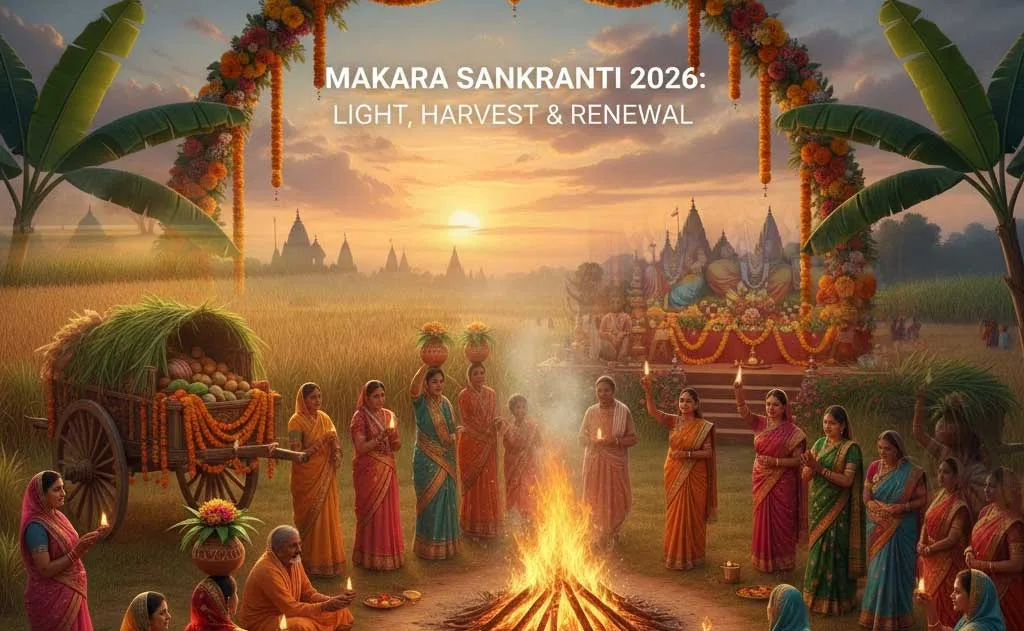
Sankranti in Andhra Pradesh and Telangana: The Four Days, Customs and Foods
Quick answer: In Andhra Pradesh and Telangana, Sankranti is called Pedda Panduga, "the big festival". It runs over four days: Bhogi, Sankranti, Kanuma and Mukkanuma.

Quick answer: In Andhra Pradesh and Telangana, Sankranti is called Pedda Panduga, "the big festival". It runs over four days: Bhogi, Sankranti, Kanuma and Mukkanuma. In 2027 the panchang places Bhogi on Thursday 14 January, Sankranti on Friday 15 January, Kanuma on Saturday 16 January and Mukkanuma on Sunday 17 January.
Sankranti 2027 in Andhra Pradesh and Telangana: key facts
| 2027 (India) | |
|---|---|
| Bhogi (first day) | Thursday 14 January 2027 |
| Sankranti, also called Pedda Panduga (main day) | Friday 15 January 2027 |
| Kanuma (cattle day) | Saturday 16 January 2027 |
| Mukkanuma (fourth day) | Sunday 17 January 2027 |
| Moment the Sun enters Makara | 9:14 PM IST on Thursday 14 January 2027 (Drik Panchang) |
| Punya Kaal, Hyderabad (Drik Panchang) | 6:49 AM to 6:01 PM on Friday 15 January 2027 |
| Maha Punya Kaal, Hyderabad (Drik Panchang) | 6:49 AM to 8:41 AM on Friday 15 January 2027 |
| AP and Telangana holiday lists for 2027 | Not yet published (awaited) |
Makar Sankranti falls on 15 January in India per the panchang; some government lists mark 14 January. Because the Sun enters Makara after sunset on Thursday 14 January, panchangs move the observance to the next morning. Drik Panchang's Hyderabad pages give Kanuma on Saturday 16 January and Mukkanuma on Sunday 17 January 2027. For the full India and world timetable, see our Makar Sankranti 2027 guide. Confirm the exact timings with your local panchang or temple priest.
What do the Telugu names mean?
| Name | Meaning |
|---|---|
| Sankranti (also spelt Sankranthi) | The Sun's passage from one zodiac sign into the next; here, its entry into Makara (Capricorn) |
| Pedda Panduga | "The big festival", the name for the main Sankranti day and often for the whole season |
| Bhogi | The first day, with the early-morning bonfire |
| Bhogi mantalu | "Bhogi flames", the bonfire itself |
| Bhogi pallu | "Bhogi fruits", the shower of small fruits poured over young children |
| Muggulu (singular muggu) | Designs drawn with rice flour or powder at the doorstep |
| Gobbemmalu (also gobbillu) | Small balls of cow dung, decorated with flowers and turmeric, set on the muggulu |
| Bommala Koluvu | A display of dolls arranged on steps or shelves at home |
Why is Sankranti the biggest festival in the Telugu states?
Sankranti marks the Sun's entry into Makara and the start of Uttarayana, the Sun's northward half of the year in the traditional reckoning. In the Telugu countryside it comes after the paddy harvest, so rice sweets, cattle and the family home sit at its centre.
It is a homecoming. Families travel back to their native villages, and married daughters come home with their husbands; a new son-in-law is welcomed with a lavish feast.
The month before it is Dhanurmasam, the solar month that ends on Bhogi. Through Dhanurmasam, women draw muggulu at dawn, and many Vaishnava households recite one verse of Andal's Tiruppavai each morning. The month closes, around Bhogi, with Goda Kalyanam, the wedding of Goda Devi (Andal) to Lord Ranganatha, celebrated in Vaishnava temples. More in our Dhanurmasam guide.
Day 1: Bhogi (Thursday 14 January 2027)
Bhogi is the day of clearing out. Before dawn, households and neighbourhoods light the Bhogi mantalu and put old, worn-out wooden things into the fire as a sign of letting go of the old. The dried gobbemmalu from the month's muggulu are burnt in the same fire.
Explanations of the festival days differ. Some accounts dedicate Bhogi to Indra, the god of rain. Others tie the season to the story of Krishna lifting Govardhana hill to shelter the people of Gokulam from Indra's storm; Drik Panchang gives this as the origin of Kanuma. Families keep their own explanation.
Bhogi pallu for young children
In the evening, many Telugu families hold Bhogi pallu for small children, often between about three and six years old. Dressed in new clothes (girls often in a langa-voni, the half-sari), the child sits while elders pour over their head a mix of regi pallu (Indian jujube fruit), flower petals, small pieces of sugarcane, soaked black chickpeas, jaggery and coins. The custom is traditionally believed to ward off the evil eye and to bless the child with a long, full life. Some families also hold Ariselu adugulu, where a toddler takes steps on ariselu sweets laid on the floor, marking the child's first steps.
Bommala Koluvu
Many families set out a Bommala Koluvu over the festival: rows of dolls showing gods, epics and village life, often with wooden toys from Kondapalli and Etikoppaka. Some sets show the festival itself, with a Haridasu and a Gangireddu.
A safe Bhogi fire
- Burn only dry wood, dried cow-dung cakes and untreated wooden items.
- Never burn plastic, tyres, rubber, foam, painted or varnished wood. The smoke is toxic.
- In cities, heed air-quality advisories and keep the fire small, or join a single community fire instead of many small ones.
- Never light an open flame on an apartment balcony or inside a closed courtyard.
- Keep children and elders upwind, and keep water or sand at hand.
Day 2: Sankranti or Pedda Panduga (Friday 15 January 2027)
This is the main day: new clothes, prayer, a feast, and offerings for the ancestors.
Morning
- An early bath, ideally before sunrise.
- A large muggu at the door, often with a sun, a pot, sugarcane or a chariot drawn in, and gobbemmalu set in the design.
- Prayer to Surya, the Sun, and to the family deity. Our Surya arghya guide explains offering water to the Sun.
- Pongali (rice cooked with milk and jaggery) or another sweet made from the new rice is offered first, then shared.
Pitru tarpanam: remembering the ancestors
Many Telugu families remember their departed ancestors on Sankranti. The practice is called pitru tarpanam (offerings for the forefathers). Depending on the family, it may mean offering water with sesame seeds, laying out the festival food on a banana leaf for the ancestors before the family eats, giving food or new clothes to others in their memory, or a fuller rite with a priest.
Who performs it, and how, differs between families and communities, so follow your family priest or elders. Daan (giving) is part of the day too: rice, sesame, jaggery, clothes or vegetables for those who need them.
Haridasu and Gangireddu
Two figures belong to the Telugu Sankranti season:
- The Haridasu is a Vaishnava singer who walks the streets in the Dhanurmasam weeks, in saffron with garlands and ankle bells, singing devotional songs to the tambura. Households place rice in the vessel he carries on his head. Newspapers report that few families now keep up the tradition.
- The Gangireddu is a bull decorated with silk cloth, garlands, bells and shell ornaments, led from door to door by its keepers. The bull performs tricks, the keepers sing blessings, and households give rice, cloth or money. The bull is honoured as a form of Nandi, Shiva's mount.
Kites
Kite flying runs through the festival in both states. In 2026 the Telangana Government's tourism department held its annual International Kite and Sweet Festival at the Parade Grounds, Secunderabad, from 13 to 15 January, according to All India Radio News. Dates for 2027 had not been announced when we checked on 12 November 2026; watch the Telangana Tourism website.
Fly safely:
- Use cotton thread. Do not use glass-coated, nylon or other synthetic manja. The National Green Tribunal's order of 11 July 2017 directed state governments to prohibit the manufacture, sale, storage, purchase and use of synthetic and nylon manja.
- Sharp synthetic string injures birds, animals and people. Collect cut string and do not leave it in trees.
- Rooftops: only with a parapet, and never let children fly alone on a terrace.
- Keep away from power lines. Never try to free a kite caught on a wire.
Day 3: Kanuma (Saturday 16 January 2027)
Kanuma is the day for cattle. Cows and bullocks are bathed, their horns painted, and they are decorated with turmeric, kumkum, garlands and bells, then fed and honoured. Drik Panchang notes that Kanuma's rituals are close to Mattu Pongal in Tamil Nadu. In Chittoor and Tirupati districts the cattle festival is also called Pasuvula Panduga. Our Kanuma and Mukkanuma guide covers the day in detail.
Handle cattle calmly: approach from the front, keep children back from horns and hooves, and use only safe colours on the animals.
Food on this day varies by family. Some households cook meat dishes on Kanuma or on the following days; many keep the whole festival vegetarian. Follow your family's custom.
Day 4: Mukkanuma (Sunday 17 January 2027)
Mukkanuma closes the festival. It is a quieter day of visiting relatives, outings and the last festival meals before people travel back to work. In some villages, families take pongali out to the fields and offer it to the land.
Muggulu and gobbemmalu
Muggulu are drawn at the threshold every morning through Dhanurmasam, growing larger towards Sankranti. Chukkala muggulu are built on a grid of dots; others are free-hand.
Gobbemmalu are balls of fresh cow dung shaped by girls and young women, topped with turmeric, kumkum and flowers, and set on the muggulu. In some places girls gather round them and sing and dance. After the day, the gobbemmalu are pressed onto walls to dry, and the dried cakes go into the Bhogi fire.
In flats, families draw a smaller muggu at the door and use clay or flower balls instead of cow dung.
Sankranti foods in Andhra Pradesh and Telangana
Rice, jaggery and sesame run through the festival table. Many sweets are made days ahead and shared.
| Dish | What it is | Recipe |
|---|---|---|
| Ariselu | Rice-flour and jaggery discs, fried and pressed, often with sesame | Ariselu recipe |
| Sakinalu | Crisp rings of rice flour and sesame, a Telangana favourite | Recipe to follow |
| Chakkara pongali | Rice and moong dal cooked with milk and jaggery, the main-day sweet | Chakkara pongali recipe |
| Pulihora | Tamarind rice tempered with mustard seeds, peanuts and curry leaves | Pulihora recipe |
| Garelu | Savoury urad dal fritters | Garelu recipe |
| Paramannam | Rice cooked in milk with jaggery, often offered as naivedyam | Paramannam recipe |
Other festival sweets include gavvalu (small shell-shaped sweets), sunnundalu (urad dal and jaggery balls), kajjikayalu (sweet-filled pastries), and sesame and peanut sweets. Sesame, peanuts, cashews, milk and ghee are common allergens; label shared plates. More dishes are in our Pongal and Sankranti recipe collection.
Andhra Pradesh and Telangana: what differs?
- Coastal Andhra is known for bullock-cart races and, in Konaseema, Prabhala Teertham, a procession honouring Shiva.
- Rayalaseema has cattle festivals and races in Chittoor and Tirupati districts, and kite flying in Kadapa and Anantapur.
- Telangana is known for rooftop kite flying in Hyderabad, and for sakinalu and sesame or peanut sweets on the festival table.
Are cockfights at Sankranti legal?
No. Cockfights are illegal in India. The Prevention of Cruelty to Animals Act, 1960 makes it an offence to incite any animal to fight (section 11(1)(m)(ii)) and to organise, keep or manage a place for animal fighting (section 11(1)(n)). Police also treat betting on them as illegal gambling. Even so, newspapers report organised cockfights with heavy betting in parts of coastal Andhra Pradesh every Sankranti, and police in the Godavari districts issue warnings and run drone surveillance against them. Our guide does not list or promote any such event.
Are Sankranti holidays declared in 2027?
The Andhra Pradesh and Telangana government holiday lists for 2027 had not been published when we checked on 12 November 2026. They are awaited from each state's General Administration Department. Do not plan leave on unofficial lists; school vacation dates are announced separately.
How do Telugu families keep Sankranti abroad?
Telugu families in the USA, the UK, Canada and Australia keep the main day at home with a small muggu, an early prayer and chakkara pongali or pulihora, and hold Bhogi pallu for the little ones at the weekend, when Telugu associations and temples usually hold their programmes.
The date can differ: in North America and the UK, the Sun enters Makara during the day on Thursday 14 January 2027, so Sankranti there falls on Thursday 14 January. See the USA guide and our Sankranti dates abroad page. Outdoor fires abroad usually need permission, so most families skip the Bhogi fire or light a diya instead.
How is Telugu Sankranti different from Tamil Pongal?
| Andhra Pradesh and Telangana | Tamil Nadu | |
|---|---|---|
| Name of the main day | Sankranti, Pedda Panduga | Thai Pongal |
| Day 1 | Bhogi, with Bhogi mantalu and Bhogi pallu for children | Bhogi Pandigai, with the bonfire |
| Day 3 | Kanuma | Mattu Pongal |
| Day 4 | Mukkanuma | Kaanum Pongal |
| Threshold art | Muggulu with gobbemmalu | Kolam |
| Signature food | Ariselu, chakkara pongali, pulihora, sakinalu | Sakkarai pongal and ven pongal boiled over in a pot |
| Seasonal figures | Haridasu and Gangireddu | The call "Pongalo Pongal!" when the pot boils over |
| Dolls | Bommala Koluvu at Sankranti | Golu is a Navaratri custom |
The Pongal guide covers the Tamil festival, and our names of the festival across India page compares other states.
Frequently asked questions
When is Sankranti 2027 in Andhra Pradesh and Telangana?
Per the panchang, Bhogi is on Thursday 14 January, Sankranti (Pedda Panduga) on Friday 15 January, Kanuma on Saturday 16 January and Mukkanuma on Sunday 17 January 2027. Some government lists mark Makar Sankranti on 14 January. Confirm with your local panchang or temple priest.
Why is Sankranti called Pedda Panduga?
Pedda Panduga means "the big festival" in Telugu. It is the year's biggest family festival in both states, when people return to their home villages.
What is Bhogi pallu?
Bhogi pallu is a blessing for young children on Bhogi. Elders pour regi pallu (Indian jujube fruit) mixed with flower petals, sugarcane pieces, soaked chickpeas, jaggery and coins over the child's head. It is traditionally believed to protect the child from the evil eye and bring a long life.
What are gobbemmalu?
Gobbemmalu are small balls of cow dung decorated with turmeric, kumkum and flowers, placed on the muggulu during Dhanurmasam. They are later dried and burnt in the Bhogi fire.
Who are the Haridasu and the Gangireddu?
The Haridasu is a Vaishnava singer who goes from door to door in the festival month and receives rice in a vessel carried on his head. The Gangireddu is a decorated bull led by its keepers, who sing blessings as the bull performs. Both are welcomed as auspicious visitors.
Do Telugu families perform tarpanam on Sankranti?
Many do. Families remember their ancestors on the main day with offerings of water and sesame, food laid out for them, or a fuller rite with a priest. Practice differs widely, so follow your family priest or elders.
Are AP and Telangana holidays for Sankranti 2027 announced?
Not yet. Neither state's 2027 holiday list had been published when we checked on 12 November 2026. Check the official notification before you plan.
Is cockfighting allowed at Sankranti?
No. Inciting animals to fight and running a place for animal fights are offences under the Prevention of Cruelty to Animals Act, 1960. Illegal fights still take place in some areas, and police act against them.
Sources
- Drik Panchang, Pedda Panduga 2027, Hyderabad: https://www.drikpanchang.com/festivals/sankranti/pedda-panduga/pedda-panduga-date-time.html?year=2027&geoname-id=1269843 (accessed 12 November 2026)
- Drik Panchang, Bhogi Pandigai 2027 (Bhogi pallu, Bommala Koluvu), Hyderabad: https://www.drikpanchang.com/festivals/pongal/bhogi-pandigai-date-time.html?year=2027&geoname-id=1269843 (accessed 12 November 2026)
- Drik Panchang, Kanuma Panduga 2027, Hyderabad: https://www.drikpanchang.com/festivals/sankranti/kanuma-panduga/kanuma-panduga-date-time.html?year=2027&geoname-id=1269843 (accessed 12 November 2026)
- Drik Panchang, Mukkanuma 2027, Hyderabad: https://www.drikpanchang.com/festivals/sankranti/mukkanuma/mukkanuma-date-time.html?year=2027&geoname-id=1269843 (accessed 12 November 2026)
- HinduTone Makar Sankranti 2027 date data (Drik Panchang ingress and Hyderabad Punya Kaal): Makar Sankranti 2027
- Animal Welfare Board of India, Animal Protection Law summary (text of section 11(1)(m) and (n), Prevention of Cruelty to Animals Act, 1960): https://www.iitk.ac.in/animalwelfare/data/Animal-Protection-Law-Summary-by-AWBI.pdf (accessed 12 November 2026)
- National Green Tribunal, order of 11 July 2017 in O.A. No. 384 of 2016 (Khalid Ashraf v. Union of India), copy published by the Puducherry Pollution Control Committee: https://dste.py.gov.in/ppcc/pdf/Legal/Hon%E2%80%99ble%20NGT%20Orders/384%20of%202016%20dt.%2011.07.2017.pdf (accessed 12 November 2026)
- All India Radio News, "Telangana govt to host mega drone, air balloon shows with International Kite and Sweets festival", 8 January 2026: https://www.newsonair.gov.in/telangana-govt-to-host-mega-drone-air-balloon-shows-with-international-kite-sweets-festival (accessed 12 November 2026)
- Deccan Chronicle, "Dhanurmasam rituals spruce up Sankranthi", 11 January 2026: https://www.deccanchronicle.com/lifestyle/culture-and-society/dhanurmasam-rituals-spruce-up-sankranthi-1929756 (accessed 12 November 2026)
- Deccan Chronicle, "Sankranti celebrations a legacy rooted in AP's traditions", 12 January 2025: https://deccanchronicle.com/southern-states/andhra-pradesh/sankranti-celebrations-a-legacy-rooted-in-aps-traditions-1853617 (accessed 12 November 2026)
- Deccan Chronicle, "Sankranti: a harvest told through food, fire and memory in Telugu states", 8 January 2026: https://www.deccanchronicle.com/southern-states/telangana/sankranti-a-harvest-told-through-food-fire-and-memory-in-telugu-states-1929102 (accessed 12 November 2026)
- Deccan Chronicle, "Andhra Pradesh: drone surveillance, control rooms to curb cockfights during Sankranti": https://www.deccanchronicle.com/southern-states/andhra-pradesh/andhra-pradesh-drone-surveillance-control-rooms-to-curb-cockfights-during-sankranti-1930345 (accessed 12 November 2026)
- Press Trust of India via Siasat, "Andhra Pradesh celebrates Bhogi with traditional fervour", 14 January 2026: https://www.siasat.com/andhra-pradesh-celebrates-bhogi-with-traditional-fervour-3325701/ (accessed 12 November 2026)
- Outlook, "Bommala Koluvu: a treasure trove of Telugu heritage": https://outlookindia.com/culture-society/bommala-koluvu-a-treasure-trove-of-telugu-heritage-weekender_story-261251 (accessed 12 November 2026)
Last reviewed: 12 November 2026.
Related guides
Share this with family and friends
Send it on WhatsApp, post it, or copy the link.
More from Festivals
- Pongal 2027: Dates, the Four Days and How It Is Celebrated
- Kaanum Pongal: The Last Day of Pongal, for Visits and Outings
- Mattu Pongal: The Day for Cattle, and Kanu Pidi
- Thai Pongal: What the Day Means and How Families Keep It
- Makar Sankranti and Pongal in Canada: Times by Province, Tamil Heritage Month and Winter Tips
You might also like
Makar Sankranti 2027: Date, Punya Kaal Timings and Festival Guide
Vrishchika Sankranti 2026: Monday 16 November, Sankranti Moment 7:48 PM IST, Punya Kaal by City, Karthigai and Sabarimala Mandala Season
Tula Sankranti 2026 — Date (October 17), Tula Month Calendar to 16 November, Kaveri Sankramana, Thula Snanam, Puja Vidhi & NRI Guide