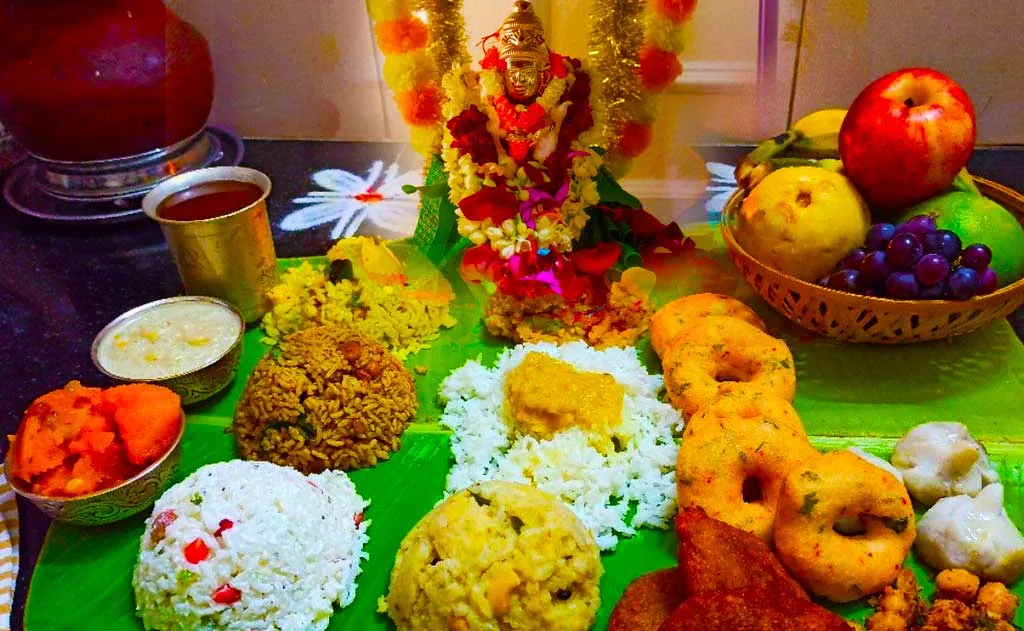
Pulihora Recipe (Andhra Tamarind Rice)
Quick answer: Pulihora is tangy tamarind rice from Andhra Pradesh and Telangana. Cook rice so the grains stay separate, cool it, then mix in a thick tamarind paste cooked with sesame oil, mustard seeds, dals, peanuts, chillies, curry leaves and turmeric. Rest it for at least 30 minutes.

Quick answer: Pulihora is tangy tamarind rice from Andhra Pradesh and Telangana. Cook rice so the grains stay separate, cool it, then mix in a thick tamarind paste cooked with sesame oil, mustard seeds, dals, peanuts, chillies, curry leaves and turmeric. Rest it for at least 30 minutes. Many families offer it as naivedyam on Sankranti day.
| Key facts | Details |
|---|---|
| Other names | Chintapandu pulihora (tamarind pulihora); puliyodharai in Tamil Nadu; puliyogare in Karnataka |
| Festival role | Festive rice and naivedyam for Sankranti day, and for many other Telugu festivals |
| Sankranti 2027 | 15 January in India per the panchang; some government lists mark 14 January |
| Serves | 4 as part of a festival meal |
| Prep and soaking | 20 minutes (tamarind soaks while you prepare) |
| Cook time | About 35 minutes, including the rice |
| Resting time | At least 30 minutes |
| Allergens | Peanuts, sesame (oil and seeds); some asafoetida contains wheat |
Where pulihora fits in Sankranti
Pulihora is the festive rice of Telugu homes. It is not tied to one day of the festival. Bhogi, on Thursday 14 January 2027 in India, is the day of the pre-dawn bonfire. Sankranti itself, the "Pedda Panduga" or big festival, is the main cooking day: many families make pulihora with the sweets, offer it to the household deity, and serve it at lunch. Kanuma, on Saturday 16 January 2027, is the day for cattle and, in many homes, a non-vegetarian feast.
Pulihora is also a common temple prasadam in South India. Our Ugadi recipes page gives a version with a roasted coriander and dal spice powder. This page gives the simpler Andhra-style home version, finished with a little roasted sesame and fenugreek powder. Both are traditional; families differ.
Naivedyam notes
- For an offering, make it without onion or garlic. This recipe has neither.
- Set aside the first portion for the deity before anyone tastes the dish.
- Many families use sesame oil (nuvvula nune, cold-pressed gingelly oil) for the offering.
Ingredients
| Ingredient | Metric | US measure |
|---|---|---|
| Raw rice (sona masuri or another short- or medium-grain rice) | 200 g | 1 cup |
| Water for cooking the rice | about 400 ml | about 1 2/3 cups |
| Tamarind, seedless block | 40 g | a packed 1/4 cup (a lemon-sized ball) |
| Hot water for the tamarind | 250 ml | 1 cup |
| Sesame oil (gingelly oil) | 60 ml | 4 tablespoons |
| Mustard seeds | 5 g | 1 teaspoon |
| Chana dal (split Bengal gram) | 15 g | 1 tablespoon |
| Urad dal (split black gram, skinned) | 15 g | 1 tablespoon |
| Raw peanuts | 35 g | 1/4 cup |
| Dried red chillies, broken | 4 | 4 |
| Green chillies, slit | 2 to 3 | 2 to 3 |
| Fresh curry leaves | 2 sprigs | about 20 leaves |
| Turmeric powder | 2 g | 1/2 teaspoon |
| Asafoetida (hing) | a large pinch | about 1/4 teaspoon |
| Salt | about 8 g | about 1 1/2 teaspoons |
| Jaggery, grated (optional) | 5 g | 1 teaspoon |
| White sesame seeds (for the powder) | 10 g | 1 tablespoon |
| Fenugreek seeds (for the powder) | 2 g | 1/2 teaspoon |
How to make pulihora (stovetop)
- Soak the tamarind in the hot water for 20 minutes. Squeeze it well with your fingers, strain, and squeeze the pulp again with a little more water. You want about 3/4 cup of thick extract.
- Rinse the rice two or three times. Cook it with the water until just tender, with firm, separate grains. Avoid soft, mushy rice.
- Spread the hot rice on a wide plate. Sprinkle over the turmeric and 1 tablespoon of the sesame oil. Mix gently with a fork and let it cool.
- In a small dry pan, roast the sesame seeds and fenugreek seeds on low heat until the sesame turns light golden and smells nutty. Cool and grind to a powder.
- Heat the rest of the oil in a heavy pan on medium heat. Add the mustard seeds. When they crackle, add the chana dal, urad dal and peanuts. Stir until the dals turn golden and the peanuts crunch.
- Add the red chillies, green chillies, curry leaves and asafoetida. Stir for a few seconds.
- Pour in the tamarind extract with the salt and the jaggery, if using. Simmer on low to medium heat for 8 to 10 minutes, stirring often, until it thickens to a glossy paste and the oil starts to separate at the edges. The raw sour smell should be gone.
- Stir in half the sesame and fenugreek powder and switch off the heat.
- Add the paste to the cooled rice a little at a time. Fold it in gently with a wide spoon so the grains do not break. Taste and add salt, paste or the remaining powder as needed.
- Cover and rest for at least 30 minutes so the rice absorbs the flavour. Serve at room temperature.
Pressure cooker and rice cooker
Cook the rice in a pressure cooker or rice cooker with slightly less water than usual, so the grains stay firm, then continue from step 3. Make the paste on the stove, where you can watch it thicken.
Mango and lemon pulihora
In summer many Telugu homes make mamidikaya pulihora with grated raw mango in place of tamarind. Nimmakaya (lemon) pulihora uses lemon juice stirred in off the heat. In January, tamarind is the usual choice because raw mangoes are out of season.
Ingredient substitutions abroad
| Where you live | Tamarind | Rice | Oil and other items |
|---|---|---|---|
| USA, Canada | Tamarind blocks and concentrate at Indian and Latin American grocers | Sona masuri; Calrose works | Gingelly oil, not toasted East Asian sesame oil |
| UK | Tamarind blocks and paste at Indian and South Asian shops and many supermarkets | Sona masuri or ponni | Gingelly oil at Indian shops |
| Australia | Tamarind blocks at Indian and South-East Asian grocers | Sona masuri or medium-grain rice | Gingelly oil at Indian grocers |
| Gulf | Wide choice at Indian supermarkets | Sona masuri easy to find | Gingelly oil widely available |
| South-East Asia | Wet tamarind (asam jawa in Malaysia and Singapore; Thai blocks) works well | Local medium-grain rice, cooked firm | Use gingelly oil from Indian shops |
With tamarind concentrate, start with 2 tablespoons in 1/2 cup of water and add more after tasting; brands differ widely. If you cannot find gingelly oil, use groundnut or a neutral oil.
Common mistakes
- Soft rice. Overcooked rice turns to paste when mixed. Cook it firm and cool it fully.
- Thin tamarind paste. If the paste is watery, the rice turns soggy. Cook it until it is thick and the oil separates.
- Burnt dals. The tempering moves fast. Keep the heat at medium and have everything ready.
- Serving straight away. Pulihora tastes flat at first. Resting lets the sour and spice settle into the rice.
Storage
Refrigerate leftovers within two hours of cooking, covered, and eat them within two days. The cooked tamarind paste keeps in a clean, dry jar in the fridge for about two weeks; use a dry spoon each time.
Allergens and dietary notes
- Peanuts: used in the tempering. Leave them out for a peanut-free version, or use cashews only if nuts are safe for everyone eating.
- Sesame: in the oil and the powder. For a sesame-free version, use groundnut or sunflower oil and skip the sesame powder.
- Wheat: many compounded asafoetida powders contain wheat flour. Check the label, or leave the asafoetida out for a gluten-free meal.
- Vegan: the recipe is vegan as written.
Frequently asked questions
Can I make pulihora with leftover rice?
Yes. Many families prefer day-old rice because the grains are firmer. Bring refrigerated rice back to room temperature and break up any lumps before you fold in the paste.
Why does my pulihora taste bitter?
Usually the fenugreek or the dals were over-roasted, or the tamarind was boiled too hard. Roast on low heat and keep the paste at a gentle simmer.
How much pulihora paste should I add?
Add it a little at a time and taste. Rice should be coated evenly and taste clearly sour, but not sharp. Any spare paste keeps in the fridge for another batch.
Is pulihora the same as puliyodharai?
They are close cousins. Tamil puliyodharai and Karnataka puliyogare usually use a richer roasted spice powder. Andhra pulihora is usually sharper and simpler.
Can I make pulihora a day before Sankranti?
You can make the tamarind paste a day or two ahead and keep it in the fridge. Cook the rice and mix on Sankranti morning, so the dish is fresh for the offering.
Sources
- Telangana Today, "Pulihora: A festival treat" (pulihora as a festival dish and temple prasadam; tamarind, mango and lemon variants): https://telanganatoday.com/pulihora-a-festival-treat (accessed 12 November 2026)
- Deccan Chronicle, "Sankranthi Recipes For Telugus", 7 January 2024 (pulihora among Telugu Sankranti dishes): https://deccanchronicle.com/nation/current-affairs/070124/telugu-pindi-vantalu-for-sankranti.html (accessed 12 November 2026)
- Wikipedia, "Pulihora" (regional names): https://en.wikipedia.org/wiki/Pulihora (accessed 12 November 2026)
- Drik Panchang, Kanuma 2027 date for Hyderabad, as cited on our Makar Sankranti 2027 guide: https://www.drikpanchang.com/festivals/sankranti/kanuma-panduga/kanuma-panduga-date-time.html?geoname-id=1269843&year=2027 (accessed 21 October 2026)
Last reviewed: 12 November 2026.
Related guides
Share this with family and friends
Send it on WhatsApp, post it, or copy the link.
More from Recipes
- Prasadam in an Instant Pot, Pressure Cooker or Rice Cooker
- Coconut Laddu Recipe with Jaggery (Kobbari Laddu, Nariyal Ladoo)
- Besan Laddu Recipe (Gram Flour Laddus for Naivedyam)
- Boondi Laddu Recipe, with a Tirupati-Style Home Version
- Famous Temple Prasadams of India and What They Are Made Of