Collapse of Brahmamgaru's Residence: Potuluri Veerabrahmendra Swami's Historic Home Crumbles Under Montha Cyclone Rains
Kadapa, October 30, 2025 – In Brahmamgarimatham, YSR Kadapa district, the sacred residence where Potuluri Veerabrahmendra Swami (affectionately known as…
Kadapa, October 30, 2025 – In Brahmamgarimatham, YSR Kadapa district, the sacred residence where Potuluri Veerabrahmendra Swami (affectionately known as…
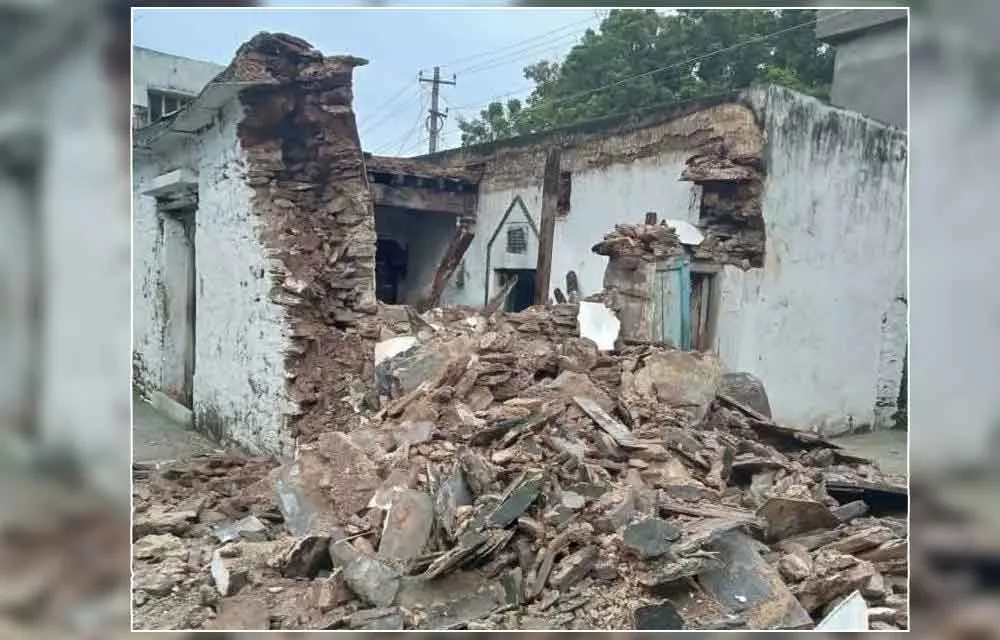
Kadapa, October 30, 2025 – In Brahmamgarimatham, YSR Kadapa district, the sacred residence where Potuluri Veerabrahmendra Swami (affectionately known as Brahmamgaru) once lived—a structure steeped in over 400 years of history—has tragically collapsed under the relentless downpours from the Montha cyclone. This devastating event has ignited waves of grief among devotees worldwide, coupled with fierce anger directed at local authorities and the matham's successors for neglecting the preservation of this irreplaceable historic site.
What Happened? Montha Cyclone Rains Devastate a 16th-Century Legacy
Though the Montha cyclone made landfall along the Andhra Pradesh coast, its fury unleashed unyielding rains across Kadapa district for 2–3 grueling days. On Wednesday night, the ancient residence of Veerabrahmendra Swami in Brahmamgarimatham succumbed entirely, crumbling into ruins. Dating back to the 16th–17th centuries, officials attribute the collapse to the building's severely dilapidated condition and long-overdue lack of maintenance. This home, said to have been personally constructed by the Swami himself, now lies in heaps of debris.
Brahmamgarimatham holds profound spiritual significance as the site of Swami's living samadhi. It is here that he penned his timeless Kaala Gnaana scriptures, drawing pilgrims from every corner of the globe for darshan and solace.
Devotees in Distress: Heartbreak, Rage, and Foreboding Fears
Pilgrims flocking from Telugu states and Karnataka arrived only to be met with a scene of utter devastation, their hearts shattered by the loss.
- Outrage over neglect: Devotees are furious at authorities and matham successors for failing to safeguard this cultural treasure.
- Questions of misplaced priorities: "Crores are poured into matham expansions, yet not a rupee for repairing his house?" – echoes of disbelief and betrayal fill the air.
- Ominous whispers: Some devotees tremble with fear, wondering, "Is this the harbinger of the calamities foretold in Brahmamgaru's Kaala Gnaana?"
- Practical woes: Additional complaints highlight the scant accommodation available for visiting faithful, exacerbating the tragedy.
Authorities Respond: Inspection, Promises, and Steps Forward
In a swift show of accountability:
- Collector Cherukuri Sridhar personally surveyed the wreckage on Wednesday night, vowing, "We will faithfully restore Veerabrahmendra Swami's residence to its former glory."
- Minister Lokesh issued directives for immediate remedial action.
- Ongoing deliberations focus on the mathadhipati appointment, with notable applicants including Venkatadri Swami, Govind Swami, and Bhadrayya Swami.
- A firm commitment rings out: Upholding our cultural heritage remains paramount.
Did You Know? The Enduring Legacy of Potuluri Veerabrahmendra Swami
Sri Madvirat Potuluri Veerabrahmendra Swami (1608–1693), revered as the visionary author of the Kaala Gnaana scripture, continues to inspire awe centuries later.
Hindutone Advice: Dear devotees, in this hour of sorrow, approach Brahmamgaru's feet with devotion and claim his boundless blessings. Together, let us unite in prayer for a swift and reverent reconstruction, ensuring his legacy endures for generations to come
Who Was Potuluri Veerabrahmendra Swami and Why Does His Matham Matter?
Potuluri Veerabrahmendra Swami is widely venerated as a Maha Yogi and prophetic saint of the Virashaiva-Vaishnava tradition, believed to have lived approximately between the 16th and 17th centuries in the Kadapa region of present-day Andhra Pradesh. He is often compared to Nostradamus by his devotees for the uncanny accuracy of his prophetic verses, known as Kaala Gnaana — literally 'Knowledge of Time' — which forecast social upheavals, natural calamities, and the ultimate arrival of Kalki, the tenth avatar of Vishnu.
Brahmamgarimatham, located in Kandimallayapalle village in YSR Kadapa district, is not merely an administrative religious institution — it is the living spiritual epicenter of the Swami's legacy. It is here that Veerabrahmendra Swami is said to have entered Jeeva Samadhi, a conscious self-interment practiced by advanced yogis as a deliberate spiritual transition rather than ordinary death. This practice is attested in several Shaiva and Natha traditions, and the samadhi shrine at Brahmamgarimatham has drawn pilgrims continuously for centuries.
What Are the Kaala Gnaana Scriptures and What Do They Prophesy?
The Kaala Gnaana, literally meaning 'Wisdom of the Age' or 'Knowledge of Time,' is a collection of prophetic verses composed by Veerabrahmendra Swami in Telugu. These writings describe events unfolding across the Kali Yuga — the current cosmic age described in texts such as the Vishnu Purana and the Bhagavata Purana — including wars, famines, the erosion of dharmic values, and ultimately a cosmic reset heralded by Kalki Avatar. Devotees frequently read current events through the lens of these verses, and the collapse of the Swami's own residence has intensified such interpretations.
Among the recurring themes in the Kaala Gnaana is the concept of 'Pralaya,' a period of great destruction that precedes regeneration — a framework deeply rooted in the Puranic cycle of Srishti (creation), Sthiti (sustenance), and Laya (dissolution). The Swami's verses specifically warn of rivers flooding their banks, ancient structures falling, and moral neglect among custodians of sacred spaces. For many devoted readers of these texts, the cyclone-induced collapse carries a symbolism that goes well beyond structural failure.
What Is Jeeva Samadhi and Why Is the Site at Brahmamgarimatham Considered Sacred Ground?
Jeeva Samadhi — sometimes rendered as Sanjeevan Samadhi — refers to the voluntary interment of a yogi who has attained a state of complete absorption in Brahman (the ultimate reality), choosing to leave the body while remaining spiritually present at the site. This practice is documented in the Shaiva Agama tradition and is associated with saints of the Natha Sampradaya as well as the Karnataka-rooted Veerashaiva or Lingayat tradition. Veerabrahmendra Swami's samadhi at Brahmamgarimatham is believed by devotees to be of this category — a place where his divine consciousness continues to reside.
Because of this belief, the physical premises of the matham — including the residence that has now collapsed — are treated not as historical monuments alone but as divya kshetras, or sacred geography charged with spiritual presence. Pilgrims perform pradakshina (circumambulation) of the samadhi shrine, offer pushpa (flowers) and deepa (lamps), and seek what is locally called 'Swami's kataksham,' meaning the grace of the Swami's divine gaze. The destruction of even the peripheral structures of such a site is experienced by devotees as a deeply personal spiritual loss.
How Have Authorities and the Archaeological Survey Failed to Protect This Structure?
Under the Ancient Monuments and Archaeological Sites and Remains Act of India, structures of established historical and cultural significance are eligible for protected status, which mandates periodic structural surveys, conservation funding, and regulated use. However, the 400-year-old residence of Veerabrahmendra Swami appears to have fallen into a grey zone — neither fully under the custody of the Archaeological Survey of India nor maintained adequately by the matham's hereditary trustees, leaving it vulnerable to precisely the kind of neglect that makes old lime-mortar and mud-brick construction fatally susceptible to prolonged rainfall.
Devotees and heritage activists have pointed out that considerable funds flow into the matham annually through hundi collections, donations, and state government grants tied to major festivals. The Endowments Department of Andhra Pradesh, which oversees many religious institutions in the state, has faced repeated criticism for prioritizing new construction and expansion projects over the conservation of original historical structures. The collapse of the Swami's residence is now being cited as the most visible and painful consequence of that institutional failure.
What Steps Are Devotees and Community Leaders Demanding in the Aftermath?
In the immediate aftermath of the collapse, devotee organizations across Telugu states have called for a high-level inquiry into the circumstances of the structural neglect, demanding accountability from both the matham trustees and the Andhra Pradesh Endowments Department. Several groups have urged that the site be accorded the status of a centrally protected monument, which would bring it under the direct conservation framework and funding of the Archaeological Survey of India, ensuring professional structural assessments and climate-resilient restoration.
Community leaders and spiritual organizations have also called for the reconstruction of the residence to be undertaken using traditional Vastu Shastra principles and locally sourced materials consonant with the original construction, rather than through modern materials that would alter the site's historic character. Scholars of Telugu heritage have additionally requested that before any reconstruction begins, a thorough documentation exercise — including photogrammetric surveys of the debris — be conducted to preserve an accurate record of the original structure's dimensions, layout, and architectural details for posterity.
How Does This Loss Fit Within the Broader Pattern of Heritage Site Neglect Across Andhra Pradesh?
The collapse at Brahmamgarimatham is not an isolated incident but part of a troubling pattern visible across Andhra Pradesh and Telangana, where historic temples, matham complexes, and sacred structures built between the 10th and 18th centuries face steady deterioration due to inadequate funding, administrative disputes over custody, and the absence of trained conservation professionals. Sites associated with the Kalamukha, Veerashaiva, and Vaishnava traditions — many of which lack the high-profile patronage enjoyed by larger temple complexes like Tirumala Tirupati or Srisailam — are particularly at risk.
The Montha cyclone has served as a harsh stress test, revealing the structural vulnerability of dozens of heritage structures that had been weakened by decades of deferred maintenance. Heritage conservationists argue that a dedicated state-level corpus fund, modeled on existing endowment surplus accounts, should be established specifically for the emergency repair and long-term preservation of historically significant but administratively overlooked religious sites. The grief and anger of Veerabrahmendra Swami's devotees, expressed powerfully in the wake of this collapse, may yet become the catalyst for that overdue policy change.
Frequently Asked Questions
What is Collapse of Brahmamgaru's Residence?
Kadapa, October 30, 2025 – In Brahmamgarimatham , YSR Kadapa district, the sacred residence where Potuluri Veerabrahmendra Swami (affectionately known as Brahmamgaru) once lived—a structure steeped in over 400 years of history—has tragically collapsed under the relentless downpours from the Montha cyclone . This devastating event has ignited waves of grief a
What are the key points about Collapse of Brahmamgaru's Residence?
Montha Cyclone Rains Devastate a 16th-Century Legacy Though the Montha cyclone made landfall along the Andhra Pradesh coast, its fury unleashed unyielding rains across Kadapa district for 2–3 grueling days. On Wednesday night , the ancient residence of Veerabrahmendra Swami in Brahmamgarimatham succumbed entirely , crumbling into ruins.
Why does Collapse of Brahmamgaru's Residence matter in Hinduism?
It reflects core values of Sanatana Dharma and offers practical and spiritual guidance that remains relevant across generations.
How can devotees apply Collapse of Brahmamgaru's Residence in daily life?
By reflecting on its teaching, incorporating the related practices or observances into daily routine, and approaching it with sincere devotion and understanding.
You might also like
Shani Deva Temples Worldwide & Must-Performed Rituals — Complete Devotee's Guide

Jyeshtha Masam 2026: Dates, Significance, Festivals, Mantras, and Danas – Complete Guide
Purushottam Maas 2026: Lord Vishnu's Sacred Gift of Spiritual Multiplication & Divine Grace