Achyutashtakam (Achyutam Keshavam): Meaning, Names of Vishnu & Benefits
The Achyutashtakam, beginning 'Achyutam Keshavam Rama Narayanam,' is a garland of the Lord's divine names composed by Adi Shankaracharya. Discover its meaning, the names it invokes, how to chant it, and its devotional benefits.

The Achyutashtakam, beginning 'Achyutam Keshavam Rama Narayanam,' is a garland of the Lord's divine names composed by Adi Shankaracharya. Discover its meaning, the names it invokes, how to chant it, and its devotional benefits.
Quick answer: The Achyutashtakam is a devotional hymn of eight verses attributed to Adi Shankaracharya that glorifies Lord Vishnu in His forms as Krishna, Rama, Vamana and others by chanting His many divine names such as Achyuta, Keshava, Narayana, Damodara and Hari. Its famous refrain is 'Achyutam Keshavam Rama Narayanam, Krishna Damodaram Vasudevam Harim.' It is a nama-sankirtana hymn — the spiritual practice of remembering God through repetition of His names — chanted for peace of mind, deepening bhakti and constant remembrance of the Lord.
Among the treasured hymns of Sanatana Dharma, the Achyutashtakam holds a special place in the hearts of devotees. Its opening line — 'Achyutam Keshavam Rama Narayanam' — is so beloved that it is sung in temples, homes and satsangs across India and the world. This eight-versed hymn, attributed to the great Adi Shankaracharya, is a fragrant garland of the divine names of Lord Vishnu, weaving together His many forms and leelas into a single, flowing prayer.
The very word 'Ashtakam' means a composition of eight verses (ashta = eight). 'Achyuta' is one of the most cherished names of the Lord, meaning 'the one who never falls, the infallible, the imperishable.' Together, the Achyutashtakam is an eight-fold hymn of praise to the Achyuta — the eternal, unchanging Supreme Being who protects all who take refuge in Him.
Who Composed the Achyutashtakam?
The Achyutashtakam is traditionally attributed to Adi Shankaracharya (c. 8th century CE), the towering acharya who established the Advaita Vedanta school and revived devotional Hinduism across the subcontinent. Though renowned as a philosopher of non-dualism, Shankaracharya was also a supreme bhakta who composed many stotras of tender devotion, including the Bhaja Govindam and the Achyutashtakam.
This dual gift — the sharpest philosophy alongside the softest devotion — is one of the great treasures of Shankaracharya's legacy. Through hymns like the Achyutashtakam, he taught that the path of chanting the Lord's holy names (nama-sankirtana) is open to every seeker, whether learned or simple, and leads the mind gently toward the Divine.
The Famous Refrain: Achyutam Keshavam
The most well-known portion of the hymn is its recurring refrain, sung as an invocation of the Lord by a cascade of His names:
Achyutam Keshavam Rama Narayanam, Krishna Damodaram Vasudevam Harim; Shridharam Madhavam Gopika-vallabham, Janaki-nayakam Ramachandram bhaje.
Meaning of the Refrain
'I worship (bhaje) the Lord who is Achyuta (the infallible), Keshava, Rama, Narayana, Krishna, Damodara, Vasudeva and Hari; who is Shridhara (holder of Sri/Lakshmi), Madhava, the beloved of the gopis (Gopika-vallabha), the lord of Janaki/Sita (Janaki-nayaka) — I worship Him, Ramachandra.' In a single breath the devotee salutes the Lord across His avatars — as Rama the ideal king, as Krishna the enchanting cowherd, and as Narayana the eternal refuge.
The Theme: A Garland of Divine Names
The Achyutashtakam is not a narrative or a philosophical treatise. It is a nama-mala — a garland of names. Across its eight verses, the poet strings together epithet after epithet of the Lord, each name a jewel that reveals a facet of His infinite glory. To chant it is to walk through the entire universe of the Lord's leelas: His birth as Krishna, His childhood butter-thieving that earned Him the name Damodara, His victory as Rama over Ravana, His cosmic form as Narayana resting on the serpent Shesha.
This structure reflects a profound truth of bhakti: the names of God are not mere labels but are non-different from God Himself. To utter 'Rama' or 'Krishna' with love is to invoke the living presence of the Lord. This is why nama-sankirtana — the chanting of the divine names — is celebrated in the scriptures as the simplest and most powerful spiritual practice of the Kali Yuga.
Key Names in the Achyutashtakam and Their Meanings
The hymn draws upon the vast treasury of Vishnu's names. Here are some of the most prominent, along with their traditional meanings:
| Name (IAST) | Meaning |
|---|---|
| Achyuta | The infallible, imperishable; one who never falls or slips from His nature |
| Keshava | One with beautiful long hair; slayer of the demon Keshi; from whom Brahma and Shiva arise |
| Rama | The delightful one; Vishnu's avatar as the ideal king, son of Dasharatha |
| Narayana | The refuge of all beings; one who resides in the cosmic waters and in every heart |
| Krishna | The all-attractive dark-hued one; the avatar of Vrindavan and the Gita |
| Damodara | One whose waist (udara) was bound by a rope (dama) by Mother Yashoda |
| Vasudeva | Son of Vasudeva; the indwelling Lord who pervades all existence |
| Hari | One who removes sins and sorrows; the remover of all suffering |
| Shridhara | Holder of Sri (Lakshmi) upon His chest; bestower of prosperity |
| Madhava | Lord of Lakshmi; the sweet one, master of knowledge (madhu-vidya) |
| Gopika-vallabha | The beloved of the gopis of Vrindavan |
| Janaki-nayaka | The lord and husband of Janaki (Sita) |
| Ramachandra | Rama, radiant and gentle as the moon (chandra) |
How and When to Chant the Achyutashtakam
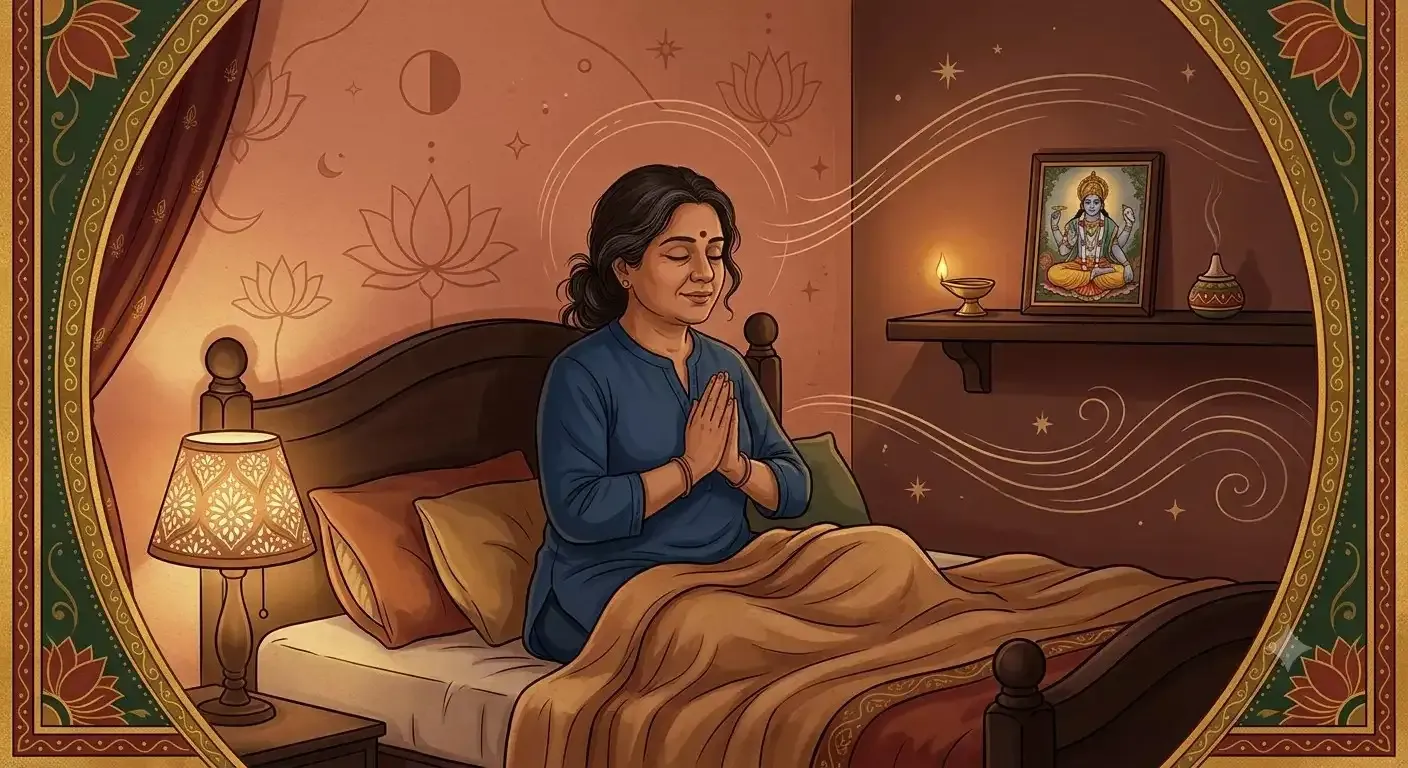
The Achyutashtakam is beautifully suited to daily worship. Devotees traditionally recite it as part of their morning or evening prayers, in front of an image of Vishnu, Krishna or Rama. Its gentle, singable rhythm makes it ideal for group kirtan and satsang, where the refrain 'Achyutam Keshavam' is sung again and again with rising devotion.
- As a daily practice: recite it after your morning bath and puja to begin the day in remembrance of the Lord.
- On Ekadashi: the fortnightly day sacred to Vishnu is an especially auspicious time for chanting the Lord's names.
- During Krishna and Vishnu observances: sing it on Janmashtami, Rama Navami, Vaikuntha Ekadashi and other Vaishnava festivals.
- In kirtan: use the refrain as a call-and-response chant, letting the names carry the whole gathering into bhava.
- In times of distress: repeat 'Achyutam Keshavam' to steady the mind, for Achyuta is the one who never lets His devotee fall.
Benefits of Reciting the Achyutashtakam
Like all nama-sankirtana, the Achyutashtakam works its blessing simply through the loving repetition of the divine names. The scriptures and saints promise rich spiritual fruits to those who chant with faith:
- Peace of mind and inner calm, as the restless thoughts settle upon the sweetness of the Lord's names.
- Deepening of bhakti — devotion grows naturally as the heart lingers on Rama, Krishna and Narayana.
- Constant remembrance (smarana) of the Lord, so that His presence accompanies the devotee through the day.
- Purification of the mind and the washing away of sins, for Hari is the remover of all impurity.
- Protection and refuge, since Achyuta never abandons those who call upon Him.
- Progress toward liberation, for the mind fixed upon the Lord's names is drawn steadily toward Him.
Why the Names Matter So Much
In the Bhagavata tradition it is said that even a single utterance of the Lord's name, spoken knowingly or unknowingly, has the power to redeem. The Achyutashtakam gathers not one but a whole garland of these names, offering the devotee an easy and joyful way to bathe the mind in divine remembrance. Each name is a doorway; to chant the hymn is to pass through them all, drawing ever nearer to the one Lord who wears them all.
This is the genius of Adi Shankaracharya's composition — it asks nothing of the devotee but love. There is no elaborate ritual, no complex procedure, only the sweet act of singing the Lord's names. In an age where minds are scattered and hearts grow weary, the Achyutashtakam offers a simple, radiant refuge.
A Closing Salutation
Let us end where the hymn begins, taking the Lord's names upon our lips and into our hearts. Achyutam Keshavam Rama Narayanam, Krishna Damodaram Vasudevam Harim — I bow to the infallible one, to Keshava, to Rama and Narayana, to Krishna and Damodara, to Vasudeva and Hari.
May the Achyuta who never falls hold us close, and may the constant chanting of His names fill our lives with peace, devotion and light. Jai Shri Hari. Om Namo Narayanaya.
Frequently Asked Questions
What is the Achyutashtakam?
The Achyutashtakam is a devotional hymn of eight verses (ashtakam) attributed to Adi Shankaracharya. It glorifies Lord Vishnu in His forms as Krishna, Rama, Vamana and others by chanting a garland of His divine names such as Achyuta, Keshava, Narayana, Damodara and Hari. It is a nama-sankirtana hymn, meaning it praises God through the repetition of His holy names.
Who composed the Achyutashtakam?
The Achyutashtakam is traditionally attributed to Adi Shankaracharya, the 8th-century acharya who established Advaita Vedanta and composed many devotional stotras, including the Bhaja Govindam. Though a great philosopher, he was also a profound bhakta who taught the path of chanting the Lord's names.
What does 'Achyutam Keshavam' mean?
'Achyutam Keshavam Rama Narayanam, Krishna Damodaram Vasudevam Harim' means 'I worship the Lord who is Achyuta (the infallible), Keshava, Rama, Narayana, Krishna, Damodara, Vasudeva and Hari.' It is the famous refrain of the Achyutashtakam, invoking the Lord by His many names across His avatars.
What does the name 'Achyuta' mean?
Achyuta is one of the most beloved names of Lord Vishnu. It means 'the infallible one,' 'the imperishable,' or 'one who never falls or slips from His true nature.' It expresses the Lord's eternal, unchanging and dependable presence — He never abandons His devotees.
When should the Achyutashtakam be chanted?
The Achyutashtakam can be chanted daily as part of morning or evening prayers. It is especially auspicious on Ekadashi and during Vaishnava festivals such as Janmashtami, Rama Navami and Vaikuntha Ekadashi. Its singable refrain also makes it perfect for group kirtan and satsang.
What are the benefits of reciting the Achyutashtakam?
Reciting the Achyutashtakam brings peace of mind, deepens bhakti (devotion), and fosters constant remembrance of the Lord. As a nama-sankirtana practice it purifies the mind, washes away sins, offers the Lord's protection, and draws the devotee steadily toward liberation.
Is the Achyutashtakam about Vishnu, Krishna or Rama?
It is about all of them, for they are one. The Achyutashtakam glorifies the Supreme Lord Vishnu through all His avatars — invoking Him as Krishna of Vrindavan, as Rama the son of Dasharatha, and as Narayana the cosmic refuge. The hymn celebrates the single Lord who wears all these forms and names.
What is nama-sankirtana?
Nama-sankirtana is the spiritual practice of remembering and worshipping God through the repetition and singing of His holy names. The Achyutashtakam is a perfect example, stringing together the Lord's many names into a garland of praise. The scriptures celebrate this as the simplest and most powerful path of devotion in the Kali Yuga.