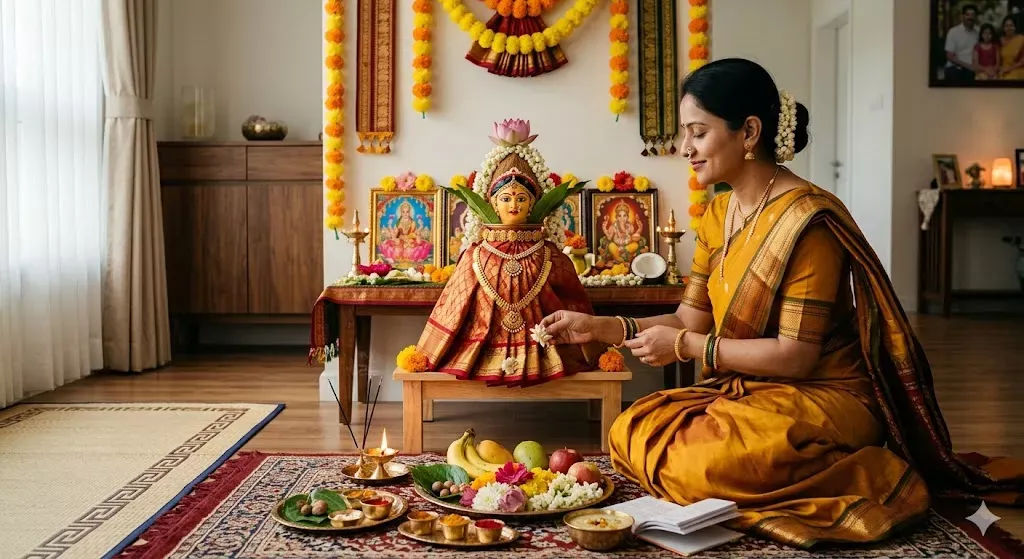
Annapurna Stotram (Annapurna Ashtakam) — Adi Shankaracharya's Hymn to the Goddess of Nourishment
The Annapurna Stotram, composed by Adi Shankaracharya, is an eight-verse hymn to Devi Annapurna — the Mother who is ever-full and nourishes the three worlds. Discover its meaning, the Kashi Vishwanath legend, how to chant it, and the blessings it grants.

The Annapurna Stotram, composed by Adi Shankaracharya, is an eight-verse hymn to Devi Annapurna — the Mother who is ever-full and nourishes the three worlds. Discover its meaning, the Kashi Vishwanath legend, how to chant it, and the blessings it grants.
Quick answer: The Annapurna Stotram, also called the Annapurna Ashtakam, is an eight-verse Sanskrit hymn attributed to Adi Shankaracharya in praise of Goddess Annapurna, the deity of food and nourishment and the presiding goddess of Kashi (Varanasi). Every verse closes with the refrain 'Bhikshaam dehi Kripaavalambanakari Mata Annapurneshwari' — 'O compassionate Mother Annapurneshwari, grant me the alms of Your grace.' Devotees chant it for prosperity, freedom from want, and the deeper 'alms' of wisdom and detachment. It is especially recited before meals and on Fridays.
Among the most beloved hymns of the Hindu devotional tradition is the Annapurna Stotram, also known as the Annapurna Ashtakam — an eight-verse Sanskrit composition attributed to the great teacher Adi Shankaracharya. It is a heartfelt song of surrender to Devi Annapurna, the Divine Mother who feeds and sustains all of creation, from whose hand even Lord Shiva himself is said to have received alms.
The very name Annapurna carries the whole meaning of the hymn: 'anna' means food or nourishment, and 'purna' means full, complete, ever-abundant. She is the Goddess who is eternally full of nourishment — never lacking, never empty — and from whose boundless store the entire universe is fed.
Who Is Goddess Annapurna?
Annapurna is a benevolent form of Goddess Parvati, the consort of Lord Shiva. Where other forms of the Devi may hold weapons to destroy evil, Annapurna is depicted with the gentlest of emblems — a golden ladle (darvi) and a vessel or bowl of sacred food (anna-patra) — for her power is the power to nourish. She is the Mother who ensures that no being goes hungry, that the cycle of life is fed and sustained.
She is honoured as the presiding deity of Kashi (Varanasi), the eternal city of light, where she resides alongside Lord Vishwanath (Shiva). In Kashi, tradition holds that no devotee who takes refuge in Annapurna will ever go without food. She embodies grace (kripa), abundance, and the maternal compassion that asks for nothing in return.
The Kashi Legend: When Shiva Sought Alms from Annapurna
The most treasured story behind the Annapurna Stotram unfolds in Kashi. According to the legend, a discourse arose over whether the material world — including food — was mere illusion (maya) or a real necessity. To teach the truth that nourishment cannot be dismissed, Devi Parvati playfully withdrew from the world, and at once food and abundance vanished; the three worlds were struck by hunger and want.
Seeing the suffering of all beings, the Mother reappeared in Kashi as Annapurna, seated in a kitchen of endless plenty, ready to feed every hungry soul. Lord Shiva himself, taking the form of a mendicant with begging bowl in hand, came before her and asked for alms. In that moment the great truth was revealed: even the Lord of the universe honours the Mother who nourishes, for food and the grace behind it are real and sacred, not to be scorned.
This is why every verse of the Stotram is a plea for 'bhiksha' — alms — placing the devotee in the humble posture of one who receives everything from the Mother's compassionate hand.
The Recurring Refrain: 'Bhikshaam Dehi'
Each of the eight verses of the Annapurna Ashtakam ends with the same beautiful refrain, which becomes a kind of mantra in itself:
Bhikshaam dehi Kripaavalambanakari Mata Annapurneshwari
Meaning: 'Grant me alms, O compassionate Mother Annapurneshwari, whose very nature is to extend the support of grace.' The word 'kripaavalambanakari' — 'she who offers the refuge and support of her compassion' — captures the tenderness at the heart of the hymn. The devotee does not demand; the devotee asks like a child, certain of the Mother's love.
The Famous Closing Verse
The best-loved and most widely recited verse of the entire hymn is its final prayer, chanted daily in countless homes and temples:
Annapurne Sadaapurne Shankara-praana-vallabhe | Jnaana-vairaagya-siddhyartham bhiksham dehi cha Paarvati ||
Meaning: 'O Annapurna, ever-full and complete, beloved of the very life-breath of Shankara (Shiva) — for the attainment of wisdom and detachment, grant me alms, O Parvati.'
This single verse reveals the depth of the Stotram: the devotee asks not merely for physical food, but for the higher nourishment of 'jnana' (spiritual knowledge) and 'vairagya' (dispassion or detachment). The Mother who fills the stomach is also the Mother who fills the soul.
The Meaning and Themes of the Eight Verses
Rather than reciting the verses in isolation, it helps to understand the vision they unfold together. Across the eight stanzas, Adi Shankaracharya paints a majestic portrait of Annapurna as both cosmic sovereign and tender mother:
- She whose glory shines with the splendour of the rising sun, adorned with divine ornaments and radiating grace.
- She who is the very embodiment of the sacred syllable and the source of all learning, arts and scriptures.
- She who is the beloved consort of Shiva, seated with him as the nurturing half of the eternal cosmic couple.
- She who is the Mother of the three worlds — Brahma, Vishnu and Shiva themselves are sustained by her nourishment.
- She who is at once the fierce, world-supporting power and the gentle giver of food to every creature.
- She who grants both the abundance of the world and liberation from bondage to it.
In every verse the majesty rises higher and higher — and then, at the close of each, it gently returns to the same humble plea: 'Mother, grant me alms.' This movement between cosmic grandeur and childlike dependence is the poetic genius of the hymn.
Annapurna, Kashi and Lord Vishwanath
The Stotram cannot be separated from Kashi. There, in the Kashi Vishwanath complex, stands the revered Annapurna temple, one of the holiest shrines to the Goddess of nourishment. Pilgrims believe that darshan of Annapurna alongside Vishwanath completes their journey, for Shiva is the giver of liberation and Annapurna is the giver of sustenance — together they hold both the worldly and the spiritual welfare of the devotee.
It is said that in Kashi, the Mother personally ensures no seeker of her shelter ever suffers hunger. This spirit lives on in the tradition of feeding pilgrims and offering 'annadana' (the gift of food), regarded as one of the highest forms of charity in Hindu practice.
When and How to Chant the Annapurna Stotram
The hymn can be chanted at any time with devotion, but certain occasions are considered especially auspicious:
- Before meals — offering the food mentally to Annapurna, remembering that it is her gift, transforms an ordinary meal into prasadam (sacred offering).
- On Fridays — traditionally sacred to the Goddess, an ideal day for recitation and for offering food to the needy.
- During Annakut and Diwali — festivals of abundance when the Goddess of grain and plenty is especially honoured.
- In the morning after bathing — lighting a lamp before an image of Annapurna and reciting the eight verses to begin the day in gratitude.
- When beginning a new home, kitchen or venture — invoking her blessing so the household never lacks nourishment.
The best method is simple: sit calmly, light a lamp or incense if possible, and recite the verses aloud or silently with attention to their meaning. Sincerity and humility matter far more than perfect pronunciation. Concluding with the famous 'Annapurne Sadaapurne' verse and a bow to the Mother completes the practice.
Benefits of Reciting the Annapurna Stotram
Devotees who chant this hymn regularly and offer food in her name describe both material and inner blessings:
| Blessing | How It Is Experienced |
|---|---|
| Freedom from want | Assurance that the household will never lack food or basic sustenance. |
| Prosperity and abundance | Growth of resources, grain and well-being in the home. |
| Gratitude and contentment | A mind at peace, thankful for what is given rather than anxious about lack. |
| Spirit of charity | Inspiration to feed others through annadana, multiplying the Mother's grace. |
| Wisdom and detachment | The higher 'alms' the hymn itself asks for — jnana and vairagya. |
| Maternal protection | A felt sense of being sheltered in the compassionate care of the Divine Mother. |
Above all, the Stotram cultivates the right inner attitude: that everything we receive is a gift, that the body and the world are to be honoured and cared for, and that the same Mother who feeds the body can, if we ask, feed the soul with wisdom.
A Simple Practice of Gratitude
One need not be a scholar to make the Annapurna Stotram a living part of daily life. Even pausing before a meal to whisper 'Annapurne Sadaapurne' and to remember with gratitude the countless hands and blessings that brought food to the plate is itself the hymn's spirit fulfilled. To eat with reverence, to share with the hungry, and to ask the Mother for wisdom along with our bread — this is the whole teaching of the Ashtakam.
Closing Salutation
May the ever-full Mother, from whose kitchen the three worlds are fed, keep our homes free of hunger, our hearts free of greed, and our minds turned toward the higher nourishment of knowledge and detachment. As Adi Shankaracharya taught us to pray: 'Jnana-vairagya-siddhyartham bhiksham dehi cha Parvati.'
Om Namah Shivaya. Salutations to the compassionate Mother — Annapurneshwari, grant us the alms of Your grace.
Frequently Asked Questions
What is the Annapurna Stotram?
The Annapurna Stotram, also called the Annapurna Ashtakam, is an eight-verse Sanskrit hymn attributed to Adi Shankaracharya in praise of Goddess Annapurna, the deity of food and nourishment and the presiding goddess of Kashi. Each verse ends with the refrain asking the Mother for alms of food and grace.
Who composed the Annapurna Ashtakam?
It is traditionally attributed to Adi Shankaracharya, the eighth-century sage and philosopher who composed many devotional hymns (stotras) alongside his non-dualistic (Advaita) teachings.
Who is Goddess Annapurna?
Annapurna is a gentle, nourishing form of Goddess Parvati, consort of Lord Shiva. Her name means 'she who is full of food'; she is shown holding a ladle and a vessel of food, and she is the presiding deity of Kashi (Varanasi), ensuring no devotee goes hungry.
What is the meaning of the 'Bhikshaam Dehi' refrain?
'Bhikshaam dehi Kripaavalambanakari Mata Annapurneshwari' means 'Grant me alms, O compassionate Mother Annapurneshwari, who offers the support of your grace.' It places the devotee in the humble posture of one who receives everything from the Mother's hand.
What is the famous closing verse of the Annapurna Stotram?
The most recited verse is 'Annapurne Sadaapurne Shankara-praana-vallabhe, Jnaana-vairaagya-siddhyartham bhiksham dehi cha Paarvati' — 'O ever-full Annapurna, beloved of Shiva, for the attainment of wisdom and detachment, grant me alms, O Parvati.'
When should the Annapurna Stotram be chanted?
It can be chanted before meals to sanctify food, in the morning after bathing, on Fridays which are sacred to the Goddess, during festivals of abundance like Annakut and Diwali, and when beginning a new home or kitchen.
What are the benefits of reciting the Annapurna Stotram?
Devotees believe it brings freedom from want, prosperity and abundance, contentment and gratitude, and inspires the charity of feeding others (annadana). On a deeper level, the hymn asks for the higher 'alms' of spiritual wisdom (jnana) and detachment (vairagya).
What is the Kashi legend connected with Annapurna?
According to legend, when a dispute arose over whether food and the world were mere illusion, Parvati withdrew and hunger struck the three worlds. She reappeared in Kashi as Annapurna to feed all beings, and Lord Shiva himself came as a mendicant to receive alms from her, revealing that nourishment and the Mother's grace are truly sacred.
You might also like
Japa Mala — A Complete Guide to the Sacred Rosary
Ganesha Sahasranama — The 1000 Names of Lord Ganesha
Shiva Tandava Stotram — Full Text, Meaning & Benefits