Dakshinamurthy Stotram: Shiva as the Silent Guru of Advaita
The Dakshinamurthy Stotram by Adi Shankaracharya reveres Shiva as the silent supreme guru who teaches through stillness. Explore its Advaita Vedanta meaning, the mirror-city and rope-snake analogies, the chinmudra, and how to chant it for knowledge and inner clarity.
The Dakshinamurthy Stotram by Adi Shankaracharya reveres Shiva as the silent supreme guru who teaches through stillness. Explore its Advaita Vedanta meaning, the mirror-city and rope-snake analogies, the chinmudra, and how to chant it for knowledge and inner clarity.
Quick answer: The Dakshinamurthy Stotram is a devotional-philosophical hymn composed by Adi Shankaracharya in praise of Shiva as Dakshinamurthy — the supreme teacher facing south who imparts the highest knowledge through silence. Its verses expound Advaita Vedanta, revealing that the individual Self (Atman) is one with Brahman and that the visible world is like a reflection in a mirror. Traditionally chanted by students and seekers, especially on Thursdays and Guru Purnima, it is invoked for wisdom, mastery over the mind, and self-realization.
Among the most profound hymns in the Hindu tradition, the Dakshinamurthy Stotram stands apart. It is not a hymn asking for wealth or worldly boons, but a meditation on the nature of reality itself — sung to Shiva in his form as the silent, supreme teacher. Composed by the great Advaita master Adi Shankaracharya, this stotram distills the essence of Vedanta into a garland of luminous verses.
Who Is Dakshinamurthy?
Dakshinamurthy is a form of Lord Shiva as the Adi Guru, the first and foremost teacher of all knowledge. The name is often understood as 'the one facing south' (dakshina meaning south), for he is depicted seated facing southward — the direction associated with change, time, and ultimately transcendence.
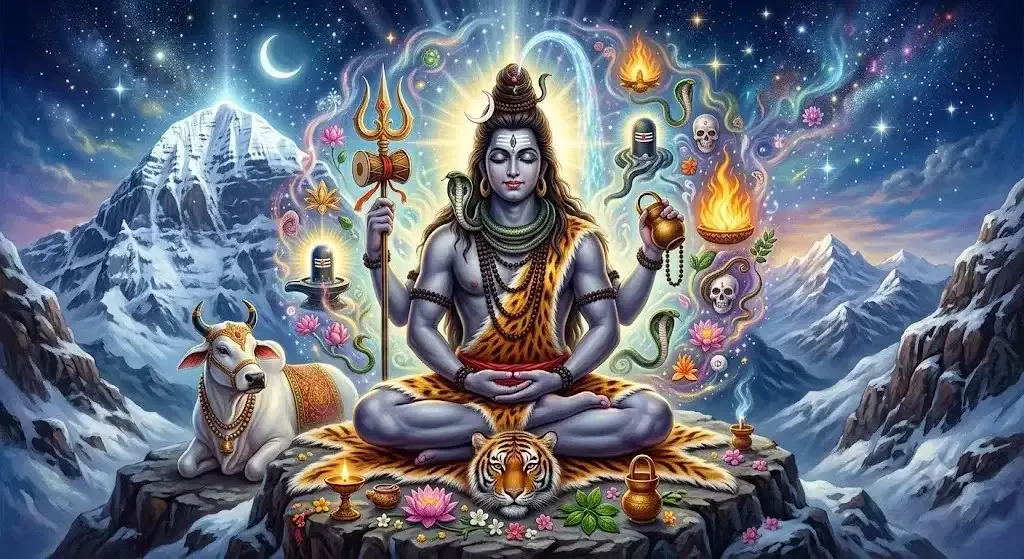
In this form, Shiva appears not as the fierce destroyer nor the cosmic dancer, but as a serene, youthful sage seated beneath a banyan tree. Around him gather aged rishis, seekers far older in years, who receive wisdom from this eternally young master. The image itself carries a teaching: true knowledge is timeless and does not depend on age.
The Iconography of the Silent Teacher
Dakshinamurthy is portrayed with several distinctive features, each rich with symbolic meaning. He is seated in a posture of ease, one foot resting on the demon of ignorance (Apasmara), signifying the subduing of spiritual forgetfulness.
- The right hand held in chinmudra — the gesture of consciousness, transmitting the highest truth in silence.
- A book or scriptures in one hand, representing revealed knowledge (the Vedas).
- A rosary (aksha-mala) in another hand, symbolizing meditation and the cycle of time.
- Fire or a serpent, marking his identity as Shiva the ascetic.
- A serene, meditative expression, embodying stillness and inner peace.
The Chinmudra: Teaching Through Silence
The chinmudra is the heart of Dakshinamurthy's symbolism. In this gesture, the tip of the thumb touches the tip of the index finger to form a circle, while the remaining three fingers extend outward.
The traditional interpretation is deeply philosophical. The index finger represents the individual self (jiva), the ego that habitually points to 'I'. The three extended fingers stand for the body, mind, and the world of names and forms. The thumb represents Brahman, the supreme reality. When the index finger bends away from its usual outward pointing and joins the thumb, it signifies the ego turning away from external identification and merging with the absolute — the recognition that the Self is not separate from Brahman.
This is why Dakshinamurthy teaches in silence. The highest truth — that the Self and Brahman are one — cannot finally be captured in words. It is realized in the stillness where speech and thought dissolve. The stotram famously celebrates this paradox: the guru who is young teaches disciples who are old, and he teaches through silence while their doubts are dispelled.
Adi Shankaracharya and the Composition
The Dakshinamurthy Stotram is attributed to Adi Shankaracharya (traditionally dated to the early 8th century CE), the philosopher-saint who revived and systematized Advaita Vedanta — the doctrine of non-duality. Across his short life he composed extensive commentaries on the Upanishads, the Bhagavad Gita, and the Brahma Sutras, as well as many devotional hymns.
This stotram is unique among his works: it wraps the rigorous metaphysics of Advaita in the warmth of devotion. It is often studied alongside a traditional explanatory commentary (the Manasollasa, attributed to Sureshvara, one of Shankara's direct disciples), which unpacks its dense philosophical imagery.
The Advaita Vedanta Theme
At its core, the stotram teaches the central insight of Advaita: the individual Self (Atman) is identical with the supreme reality (Brahman), and the apparent multiplicity of the world is a superimposition upon that single, non-dual consciousness. Shankaracharya conveys this not through dry argument but through vivid analogies that make the abstract tangible. Two of these are especially celebrated.
The Mirror and the City Within
The opening verse offers the image of the entire universe existing like a city seen reflected within a mirror. Just as a reflected city appears real and detailed yet exists only within the mirror, the whole world of names and forms appears within consciousness. When the seer awakens to his true nature, he realizes that the world he perceives is a projection appearing within the Self — as if in a dream, seen as though external, yet arising from within. The Self alone is the substratum, the ever-present witness in which all experience appears. The world is not denied as an experience, but its independent, separate reality is seen through — much as one sees through a dream on waking.
The Rope and the Snake
A second classic analogy, drawn from Advaita tradition, is that of the rope mistaken for a snake in dim light. The frightened traveler sees a snake and recoils — but there was never a snake, only a rope. When light reveals the rope, the illusory snake vanishes instantly; it was a superimposition (adhyasa) of something unreal upon what is real.
So too, says the teaching, the world of separateness and the sense of an isolated ego are superimposed upon the one Brahman. Knowledge — the light of the guru's grace — does not create anything new; it simply reveals what was always there, and the illusion of duality dissolves.
The Guru-Disciple Transmission
The stotram repeatedly returns to the mystery of transmission through silence. Dakshinamurthy is the archetype of the guru whose very presence awakens understanding — the disciple does not merely acquire information; a recognition dawns from within, catalyzed by the master's grace. This is why the hymn is beloved by teachers and students alike. It honors the sacred relationship of guru and shishya, and reminds the seeker that the ultimate teacher is not external — the inner Self is itself the silent guide that Dakshinamurthy represents.
The Phalashruti: Benefits of Chanting
Like many traditional stotrams, the Dakshinamurthy Stotram concludes with a phalashruti — a statement of the fruits or benefits of its recitation. The rewards it promises are spiritual rather than material, in keeping with its theme.
- Attainment of true knowledge (jnana) and clarity of understanding.
- Mastery and steadiness of the restless mind.
- Removal of ignorance (avidya) that veils the Self.
- Growth in discrimination between the eternal and the fleeting.
- Ultimately, the possibility of self-realization and liberation (moksha).
How and When to Chant
The Dakshinamurthy Stotram is especially favored by students, scholars, teachers, and spiritual seekers who long for wisdom and mental focus. It can be chanted daily, but certain times are considered particularly auspicious.
| Occasion | Significance |
|---|---|
| Thursdays (Guruvaram) | The day of the guru; ideal for honoring the Adi Guru Dakshinamurthy. |
| Guru Purnima | The festival dedicated to gurus; a powerful day for this hymn. |
| Before study or exams | Invoked by students for concentration and knowledge. |
| Early morning (Brahma Muhurta) | The calm pre-dawn hours suited to meditative recitation. |
For chanting, sit quietly facing east or north, calm the breath, and recite with attention to the meaning rather than mere speed. Many begin with a dhyana verse visualizing the youthful sage beneath the banyan tree, hand in chinmudra, before proceeding through the verses. A moment of silence at the close — echoing Dakshinamurthy's own silent teaching — allows the meaning to settle inward.
A Salutation to Dakshinamurthy
To meditate on Dakshinamurthy is to turn toward the light of pure awareness that shines within every heart. He is the guru who asks for nothing, who teaches without words, and who reveals that the seeker and the sought are, in truth, one. May the silent teacher beneath the banyan tree still the wandering mind, dissolve the shadow of ignorance, and awaken the timeless knowledge of the Self. Salutations again and again to Sri Dakshinamurthy, the supreme guru in the form of Shiva.
Frequently Asked Questions
You might also like
Japa Mala — A Complete Guide to the Sacred Rosary
Ganesha Sahasranama — The 1000 Names of Lord Ganesha
Shiva Tandava Stotram — Full Text, Meaning & Benefits