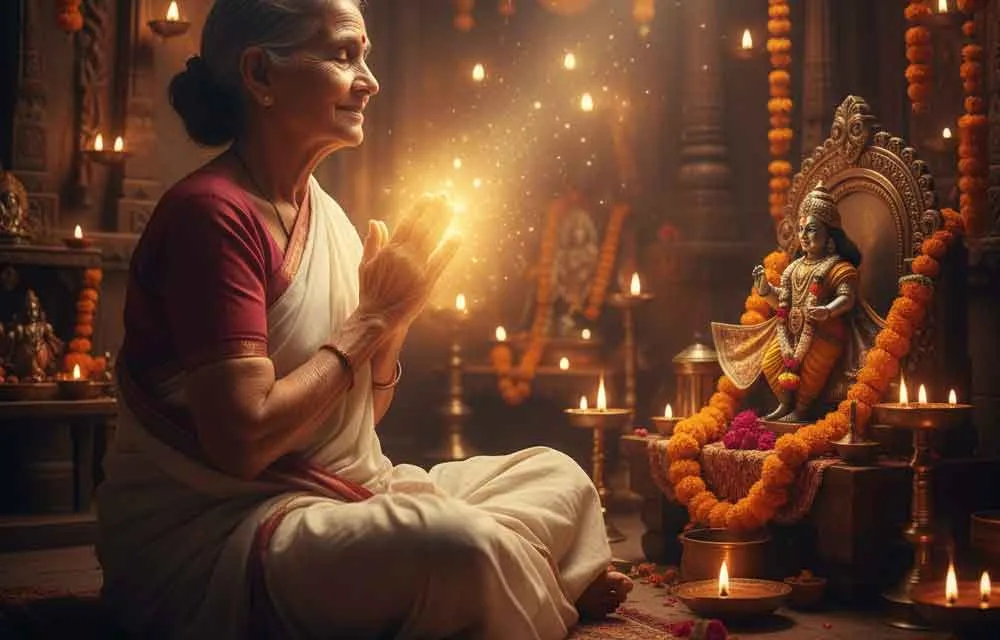
Bhakti Yoga: The Path of Divine Devotion
In the heart of Bhakti Yoga lies the essence of supreme Divinity—God, the ultimate source of love and purity.
In the heart of Bhakti Yoga lies the essence of supreme Divinity—God, the ultimate source of love and purity.
In the heart of Bhakti Yoga lies the essence of supreme Divinity—God, the ultimate source of love and purity. To walk this path, immerse yourself in thoughts of Him, feeling His divine presence envelop you. He is dearer than the dearest, closer than the closest. During meditation, let your heart gravitate toward God, letting worldly attachments fade into the background. As the revered saint Tulsidas beautifully expressed: "Bhaktim prayaccha Raghupungava nirbharam me, kamadi dosha rahitam kuru manasamcha"—a heartfelt prayer to Lord Rama, beseeching the gift of unwavering devotion and a mind purified of desires, lust, and other impurities, filled instead with the nectar of divine love.
This journey of devotion is not a fleeting endeavor but a gradual, transformative process. There are no shortcuts to divine connection; true devotion requires patience and persistence. Concentration, the cornerstone of existence in this world, must be redirected toward a sacred channel. By cultivating a spiritual mood throughout the day, you can nurture this divine connection silently, without outward display. Like water purified through distillation, the mind—though clouded by worldly distractions—can be cleansed and elevated through dedicated sadhana (spiritual practice).
As you deepen your practice of Bhakti Yoga, you will come to realize that the love and strength flowing through you are but a reflection of God’s infinite power and boundless love. This sacred path transforms the individual, aligning the heart and soul with the eternal, divine essence of the Supreme.
Embrace this journey with sincerity, and let devotion illuminate your path to the Divine.
What does the Bhagavad Gita say about the supremacy of Bhakti Yoga?
In the Bhagavad Gita, Lord Krishna dedicates the entirety of Chapter 12 — the Bhakti Yoga Adhyaya — to establishing devotion as the most direct path to the Supreme. When Arjuna asks whether it is better to worship the personal God with form (Saguna Brahman) or the formless Absolute (Nirguna Brahman), Krishna unequivocally honors the devotee of personal love: 'Mayy āveśya mano ye māṁ nityayuktā upāsate — those who fix their minds on Me with constant devotion, I consider most perfectly absorbed in yoga' (Gita 12.2).
Krishna further enumerates the qualities that distinguish a true bhakta — freedom from hatred, equal-minded toward friend and foe, content, free from ego, and unmoved by sorrow or elation (Gita 12.13–19). These are not passive virtues but the fruit of sustained inner transformation that only consistent bhakti sadhana can produce. The Gita thus presents Bhakti Yoga not as mere emotional sentiment but as a rigorous discipline that reshapes every layer of the personality.
What are the Nava Vidha Bhakti — the nine classical forms of devotion?
The Bhagavata Purana (7.5.23) enumerates nine modes of bhakti, collectively called Nava Vidha Bhakti, through the voice of the child-devotee Prahlada. They are: Shravana (hearing the glories of God), Kirtana (singing His names), Smarana (constant remembrance), Pada-sevana (serving His lotus feet), Archana (ritual worship), Vandana (prostration and prayer), Dasya (cultivating the attitude of a servant), Sakhya (treating God as a beloved friend), and Atma-nivedana (complete self-surrender).
Each of these nine limbs addresses a different faculty of the human being. Shravana and Kirtana purify the ears and tongue; Smarana steadies the mind; Archana trains the hands and sense organs in sacred discipline; and Atma-nivedana, the highest rung, dissolves the last remnant of individual ego into the ocean of divine will. The great saint Narada elaborated these paths further in his Narada Bhakti Sutras, affirming that even one limb, practiced with sincerity, is sufficient to carry the seeker to liberation.
Historical exemplars embody each form: the blind poet-saint Surdas exemplified Smarana through his ceaseless inner vision of Krishna's Vrindavana lila; Mirabai expressed Sakhya-bhava and Dasya-bhava in her immortal pada compositions addressed to Giridhara Gopala; and the Alvars of South India — particularly Nammalvar — poured all nine forms into the 4,000 Tamil hymns of the Divya Prabandham, still chanted daily in Vaishnava temples from Srirangam to Tirupati.
How does Nama-Japa serve as the practical heartbeat of Bhakti Yoga?
Across virtually every school of Bhakti, the recitation of the divine Name — Nama-Japa — is treated as the most accessible and potent instrument available to the devotee. The Vishnu Sahasranama declares that chanting the thousand names of Vishnu equals in merit the recitation of the entire Rigveda; yet the same text adds that one name of Rama equals all thousand names of Vishnu, underscoring the extraordinary power concentrated in Taraka Nama. Tulsidas, quoted in the existing article, built his entire Ramcharitmanas around this principle.
The mechanics of japa rest on a simple but profound insight: the Name is not a mere linguistic symbol but is identified with the Named. Adi Shankaracharya, though predominantly associated with Advaita Vedanta, opens his Bhaja Govindam with an urgent call to remember the Name of Govinda, warning that no grammatical learning will save the individual at the final hour. In practice, the devotee chooses an Ishta-Devata (personal deity), receives a mantra from a qualified guru where possible, and repeats it on a mala of 108 beads — 108 being a number sacred in Vedic mathematics as a multiple of the solar and lunar diameters relative to Earth.
What role do temples and sacred pilgrimage play in deepening Bhakti?
For the bhakta, the temple (devalaya or mandira) is not merely an architectural structure but a living axis mundi — a point where the divine descends to meet the human seeker. The Agama Shastras, which govern temple construction and ritual, specify that the consecrated image (murti) in the inner sanctum (garbhagriha) is a vibrant form of the deity, enlivened through the rite of Prana-Pratishtha. Visiting such a temple, especially during Abhisheka or Alankara darshan, is considered an act of Pada-sevana and Archana combined.
Tirtha-yatra (pilgrimage) extends this principle across the sacred geography of Bharatavarsha. The Char Dham — Badrinath in the Himalayas, Dwarka on the Gujarat coast, Puri Jagannath in Odisha, and Rameshwaram at the southern tip — form a ritual circuit that traverses the four cardinal directions, symbolizing the encompassing totality of God's presence. Closer circuits such as the Pancha Bhuta Stalas of Shiva in Tamil Nadu, or the 108 Divya Desams of Vishnu honoured by the Alvars, serve the same purpose at a regional level: to immerse the pilgrim-devotee in an environment saturated with collective bhakti spanning centuries.
How did the Bhakti Movement transform devotional practice across medieval India?
Between roughly the 7th and 17th centuries CE, a remarkable wave of poet-saints swept from Tamil Nadu northward through Karnataka, Maharashtra, Rajasthan, and the Gangetic plains, collectively known as the Bhakti Movement. The Nayanmars (63 Shaiva saints) and Alvars (12 Vaishnava saints) of Tamil Nadu were its earliest luminaries, composing devotional hymns in the vernacular that democratised access to the divine — bypassing elaborate ritual knowledge and insisting that sincere love alone was the qualification for God's grace.
In Maharashtra, Sant Dnyaneshwar composed the Dnyaneshwari, a Marathi commentary on the Bhagavad Gita, at the age of about sixteen, making the Gita's wisdom available to ordinary farmers and weavers. Sant Tukaram's Abhangas addressed Krishna with raw, unfiltered intimacy. In North India, Kabir Das dissolved distinctions between Hindu and non-Hindu seekers with couplets (dohas) pointing to the formless Ram within every heart, while Chaitanya Mahaprabhu of Bengal pioneered congregational Sankirtana — ecstatic communal singing — as a complete sadhana in itself, anticipating the later tradition of the Hare Krishna movement.
The enduring legacy of these saints is that they grounded Bhakti Yoga in the lived, spoken languages of the people. They showed that the path of divine devotion requires no caste certificate, no Vedic scholarship, and no wealth — only an honest, yearning heart. This message resonates as powerfully today as it did seven centuries ago.
Frequently Asked Questions
What does the Bhagavad Gita say about Bhakti Yoga?
Chapter 12 of the Gita, the Bhakti Yoga Adhyaya, presents devotion as the most direct path to the Supreme. Krishna calls those who fix their minds on Him with constant devotion most perfectly absorbed in yoga (Gita 12.2).
What are the nine forms of bhakti (Nava Vidha Bhakti)?
They are Shravana, Kirtana, Smarana, Pada-sevana, Archana, Vandana, Dasya, Sakhya and Atma-nivedana, listed in the Bhagavata Purana (7.5.23) through Prahlada. Even one limb practiced sincerely is said to suffice.
How is Nama-Japa practiced in Bhakti Yoga?
The devotee chooses an Ishta-Devata, receives a mantra from a qualified guru where possible, and repeats it on a mala of 108 beads. The divine Name is treated as identical with the Named.
Do I need Vedic scholarship or wealth to follow Bhakti Yoga?
No. The Bhakti saints showed that the path requires no caste certificate, Vedic scholarship or wealth, only an honest, yearning heart.
Which saints shaped the Bhakti Movement?
The Nayanmars and Alvars of Tamil Nadu came first, followed by Dnyaneshwar, Tukaram, Kabir Das and Chaitanya Mahaprabhu. The movement ran roughly from the 7th to 17th centuries CE.
What role do temples and pilgrimage play in Bhakti?
Visiting a consecrated temple, especially during Abhisheka or Alankara darshan, combines Pada-sevana and Archana. Pilgrimages like the Char Dham and the 108 Divya Desams immerse devotees in centuries of collective bhakti.
You might also like
108 Shakti Peethas: The Divine Geography of the Goddess — Complete Guide
Mandukya Upanishad: The Shortest Path to Liberation (Moksha) in Advaita Vedanta | HinduTone
Purushottam Maas 2026: Lord Vishnu's Sacred Gift of Spiritual Multiplication & Divine Grace