
Amba and Shikhandi in the Mahabharata
Quick answer: Amba is the eldest daughter of the king of Kashi. Bhishma carries her off with her sisters from their svayamvara for his half-brother Vichitravirya. She tells him she had already chosen King Shalva, so Bhishma lets her go, but Shalva refuses her because another man has taken her. Holdi
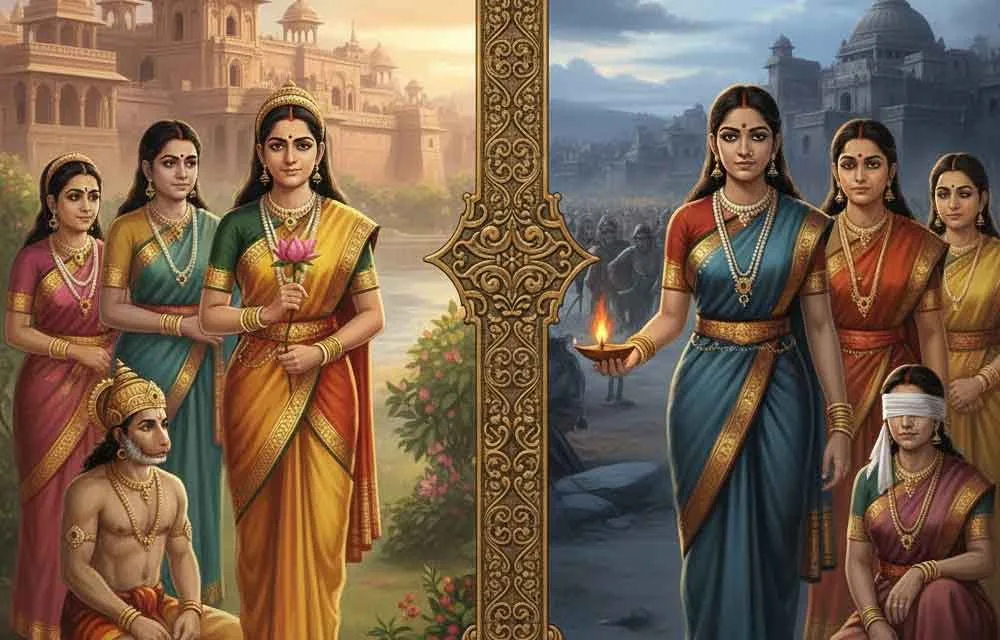
Quick answer: Amba is the eldest daughter of the king of Kashi. Bhishma carries her off with her sisters from their svayamvara for his half-brother Vichitravirya. She tells him she had already chosen King Shalva, so Bhishma lets her go, but Shalva refuses her because another man has taken her. Holding Bhishma responsible, she seeks his death through Parashurama and then through austerities. Shiva promises that in another birth she will kill Bhishma and gain manhood. She is reborn in King Drupada's house as a daughter, raised as a son and named Shikhandin (Shikhandi), and later becomes a man by exchanging sex with a yaksha. At Kurukshetra, Bhishma will not fight Shikhandi, and Arjuna brings him down from behind Shikhandi on the tenth day.
The story is told mostly by Bhishma himself, in the Udyoga Parva. This page follows the Critical Edition of the Mahabharata (Bhandarkar Oriental Research Institute, Pune), with book, chapter and verse numbers, and then sets out how the story has been read. Translations of the Sanskrit are our own.
| At a glance | Where in the Critical Edition |
|---|---|
| Bhishma wins the three Kashi princesses; Amba is let go | Adi Parva 1.96 |
| Duryodhana asks why Bhishma will not kill Shikhandi; Bhishma tells Amba's story | Udyoga Parva 5.170 to 5.193 |
| Shalva refuses Amba | 5.172 |
| Parashurama fights Bhishma for her | 5.176 to 5.186 |
| Amba's austerities, Shiva's boon, her death by fire | 5.187 to 5.188 |
| Shikhandin's birth, marriage and change of sex | 5.189 to 5.193 |
| Bhishma tells the Pandavas to put Shikhandi in front | Bhishma Parva 6.103 |
| Bhishma falls on the tenth day | 6.114 |
| Shikhandi is killed in the night raid | Sauptika Parva 10.8 |
The svayamvara and the abduction
After the death of his half-brother Chitrangada, Bhishma looked for wives for the young king Vichitravirya. At the svayamvara of the three daughters of the king of Kashi, he carried them off by force and defeated the kings who opposed him. Among them was Shalva, lord of Saubha, whom Bhishma beat in battle and let go alive (1.96.39).
At Hastinapura, as the wedding was being arranged, the eldest sister spoke to Bhishma. "In my mind I had chosen the lord of Saubha as my husband," she said, "and he had chosen me. This was also my father's wish" (1.96.48 to 49). Bhishma consulted learned brahmins and allowed Amba, the eldest, to go (1.96.51). Her sisters Ambika and Ambalika were married to Vichitravirya (1.96.52).
Shalva's refusal
Decades later, on the eve of the war, Duryodhana asks Bhishma why he will not kill Shikhandin (5.170.1). Bhishma's answer is the story of Amba, told in the first person.
Amba went to Shalva. He told her to go wherever she wished: he would not take a woman whom another man had carried off (5.172.7). She pleaded that she had not gone with Bhishma willingly but had been taken by force, weeping (5.172.9), that Bhishma did not want her for himself (5.172.12), and that she had thought of no other man (5.172.14). Shalva would not believe her and cast her off "as a snake sheds its old skin" (5.172.17).
Leaving his city, Amba asked herself whom to blame: herself, for not leaving Bhishma's chariot during the fight; Bhishma; her father, who had offered her "like a woman for sale" with valour as the bride-price; Shalva; and fate (5.173.3 to 6). She decided that Bhishma was "the root of this misfortune" and that she must repay him, by austerity or by battle (5.173.7 to 8).
Parashurama and Bhishma
Amba took shelter with ascetics. There she met the royal sage Hotravahana, her mother's father (5.174.24), and through him and the sage Akritavrana she came before Parashurama (Rama Jamadagnya), who had been Bhishma's teacher. She asked him to kill Bhishma (5.176.42).
Parashurama challenged his former pupil. Bhishma tells of a long duel between them (5.177 to 5.186). It ended when the sage Narada and divine beings stopped Bhishma from using the prasvapa weapon (5.186.1 to 6) and Parashurama's own ancestors made him lay down his arms (5.186.30). Parashurama then told Amba in front of everyone that he could not overcome Bhishma, and advised her to go to Bhishma for refuge (5.187.2 to 4).
Amba's austerities and Shiva's boon
Amba refused. She went away to practise severe austerities: fasting, standing in water and on the tip of a toe, for twelve years (5.187.20 to 22). The river goddess Ganga, Bhishma's mother, appeared and warned her that her vow was crooked and could not succeed; if she gave up her body under such a vow she would become a crooked, seasonal river, dangerous to cross (5.187.33 to 35). The text says that by her austerity she was divided: half of her became the river Amba in the land of the Vatsas, and half remained a maiden (5.187.39 to 40).
She told the sages that her vow was for Bhishma's death, not for any heavenly world. Bhishma had left her "neither woman nor man" in this world, cut off from the life of a wife (5.188.4), and she was weary of being a woman and set on becoming a man in order to repay him (5.188.6). Shiva appeared and granted that she would kill Bhishma (5.188.8). When she asked how a woman could win in battle, he promised that she would gain manhood, be born in Drupada's family as a great warrior, and remember everything in her new body (5.188.12 to 14). Amba built a pyre near the Yamuna and entered the fire, saying "for the death of Bhishma" (5.188.17 to 18).
Shikhandini becomes Shikhandin
King Drupada, who wanted a son in order to repay Bhishma, also worshipped Shiva. Shiva told him he would have a child who would be "female and male" (5.189.5), and that the daughter would later become a man (5.189.7). A daughter was born. Drupada's queen announced that a son had been born (5.189.13), and the king had all the birth rites done as for a boy; the child was known as Shikhandin (5.189.14 to 17). Bhishma says he alone knew the truth, through his spies, through Narada and through what he knew of Amba's austerities (5.189.18).
Shikhandin was trained in writing, the arts and archery, as a pupil of Drona (5.190.1). The family arranged a marriage to the daughter of Hiranyavarman, king of the Dasharnas (5.190.8 to 10). The bride discovered that Shikhandin was a woman and told her nurses and friends (5.190.14), and her furious father threatened Drupada with war (5.190.19).
Shikhandin went into the forest and came to the dwelling of a yaksha named Sthunakarna (5.192.20 to 21). The yaksha agreed to exchange sexes with Shikhandin for a time: Sthuna took on Shikhandin's female form, and Shikhandin took on the yaksha's male form, on a promise to exchange back later (5.193.2 to 8). Shikhandin returned home a man. The Dasharna king sent young women to find out the truth; they reported that Shikhandin was a man, and the king went home satisfied (5.193.25 to 28).
Kubera, lord of the yakshas, then visited Sthuna's house. Angry at what Sthuna had done, he decreed that from that day Sthuna would remain a woman and Shikhandin a man (5.193.41 to 43). When the other yakshas pleaded, he set an end to it: when Shikhandin died in battle, Sthuna would regain his own form (5.193.46). When Shikhandin came back at the agreed time to return the yaksha's form, Sthuna told him what had happened and sent him away free (5.193.48 to 52).
Why Bhishma would not fight Shikhandi
Bhishma ends his story by naming Shikhandin as Amba, "the eldest daughter of the king of Kashi", born in Drupada's family (5.193.60). He has a well-known vow, he says: he will not shoot arrows at a woman, at one who was formerly a woman, at one who bears a woman's name or has a woman's form (5.193.62 to 63). So he will not kill Shikhandin, even in battle (5.193.65).
During the war, the Pandavas went to Bhishma at night and asked how he could be defeated. Bhishma repeated that he would not fight a woman or one with a woman's name, among others (6.103.72 to 73), and said that Shikhandin, "who was a woman before and later became a man", was in their army (6.103.75 to 76). Arjuna should put Shikhandin in front of him and strike, he said, and so they would win (6.103.77 to 82).
On the tenth day the Pandavas advanced with Shikhandin in front (6.114.1). As the arrows struck him, Bhishma said again and again: "These are not Shikhandin's arrows", and finally, "These are Arjuna's arrows" (6.114.55 to 60). He fell from his chariot (6.114.84), to lie on the bed of arrows until his death after the war.
Shikhandin survived the war. On the night after the last battle, Ashvatthama attacked the sleeping Pandava camp and cut him in two with his sword (10.8.60 to 61).
How the story has been read
The Mahabharata tells this story to explain one thing: why its greatest warrior would not raise his bow against one man. Modern readers have found much more in it. The main readings are set out below, each with its source. They are not exclusive, and this page does not choose between them.
The text's own frame: Bhishma's vow and Shiva's word
Within the epic, the story belongs to Bhishma. He tells it, it explains his vow, and it makes his death the fulfilment of a boon: Shiva's promise to Amba (5.188.8 to 14) and his word to Drupada (5.189.5 to 8). Bhishma himself chooses the moment, by telling his opponents how he may be brought down (6.103.77 to 82). In this reading the story is about dharma, vows and fate working out across lifetimes.
Amba as a wronged woman
Many modern readers see Amba first of all as a woman wronged by the men around her. The text itself gives her that voice when she blames Bhishma, her father, Shalva and fate in turn (5.173.3 to 6). Roberto Morales Harley, in an article in the Revista de Filología y Lingüística de la Universidad de Costa Rica (2020), describes Amba as a female character who is wronged by Bhishma and later takes revenge "by her own means" as the male character Shikhandin, and studies the Sanskrit words the epic uses for vengeance (pratikara) and womanhood (stritva).
A story of gender change
The story is also one of the oldest Indian narratives of a change of sex, and it is read today in discussions of gender.
- Ruth Vanita and Saleem Kidwai include the episode, as "Sikhandin's Sex Change" from Vyasa's Mahabharata, in the ancient-materials section of their anthology Same-Sex Love in India: Readings from Literature and History (2000).
- Wendy Doniger discusses the Shikhandin story in Splitting the Difference: Gender and Myth in Ancient Greece and India (University of Chicago Press, 1999), a comparative study of myths of gender in Greek and Indian texts.
- Devdutt Pattanaik made Shikhandi the title figure of Shikhandi and Other Tales They Don't Tell You (Zubaan and Penguin, 2014). In a 2020 column he describes Shikhandi as born with a female body but knowing "all her life that she is actually a man", who becomes a man with the help of the yaksha Sthunakarna.
- Rima Ghosh Patranabish, writing for the Heinrich Böll Stiftung's New Delhi office (2022), calls Shikhandi "a trans masculine queer identity that has often been misinterpreted", and notes Pattanaik's criticism that retellings often turn Shikhandi into a eunuch or an intersex person.
Readers who come to the story from tradition, and readers who come to it from gender studies, often draw on the same verses: the Critical Edition calls Shikhandin "formerly a woman" (stripurva, 6.103.78), and the change of sex is made lasting until his death by Kubera's decree (5.193.43 to 46).
Frequently asked questions
Who was Amba in the Mahabharata?
The eldest daughter of the king of Kashi. Bhishma carried her and her sisters off from their svayamvara for Vichitravirya. She had already chosen King Shalva, who then refused her. She vowed to bring about Bhishma's death and was reborn as Shikhandin (Adi Parva 1.96; Udyoga Parva 5.170 to 5.193).
Was Shikhandi Amba reborn?
Yes, according to the epic. Bhishma says that Amba, the eldest daughter of the king of Kashi, was born in Drupada's family as Shikhandin (5.193.60), as Shiva had promised her (5.188.12 to 13).
How did Shikhandi become a man?
The yaksha Sthunakarna exchanged sexes with Shikhandin for a time (5.193.2 to 8). Kubera then decreed that the exchange would last until Shikhandin's death (5.193.41 to 46).
Why did Bhishma not fight Shikhandi?
Because of his vow not to shoot at a woman, at one who was formerly a woman, or at one with a woman's name or form, and because he knew Shikhandin had been born a girl (5.193.62 to 65; 6.103.72 to 78).
Did Shikhandi kill Bhishma?
The arrows that brought Bhishma down were Arjuna's. Arjuna attacked from behind Shikhandin, and Bhishma himself said, "These are Arjuna's arrows, not Shikhandin's" (6.114.55 to 60). Popular speech still often says that Shikhandi caused Bhishma's fall.
How did Shikhandi die?
Ashvatthama killed him with a sword during the night raid on the Pandava camp after the war (Sauptika Parva 10.8.60).
Related reading
- Mahabharata: The Complete Guide
- Bhishma in the Mahabharata
- Udyoga Parva summary
- Bhishma Parva summary
- Sauptika and Stri Parva summary
- The Kurukshetra war day by day
Sources
- Mahabharata, Critical Edition, electronic text (Bhandarkar Oriental Research Institute, Pune, 1999): Adi Parva 1.96; Udyoga Parva 5.170 to 5.193; Bhishma Parva 6.103 and 6.114; Sauptika Parva 10.8. References on this page are book, chapter and verse in this edition. Translations are our own.
- The Mahabharata, translated by Kisari Mohan Ganguli (1883 to 1896), Udyoga Parva (Amba-upakhyana Parva), public domain (online at sacred-texts.com, hin/m05).
- Roberto Morales Harley, "Ambā: la venganza femenina en el Mahābhārata", Revista de Filología y Lingüística de la Universidad de Costa Rica 46 (special issue, 2020), doi 10.15517/rfl.v46iEspecial.41638: Redalyc.
- Ruth Vanita and Saleem Kidwai (eds.), Same-Sex Love in India: Readings from Literature and History (New York: St. Martin's Press, 2000), Part I ("Sikhandin's Sex Change").
- Wendy Doniger, Splitting the Difference: Gender and Myth in Ancient Greece and India (Chicago: University of Chicago Press, 1999).
- Devdutt Pattanaik, Shikhandi and Other Tales They Don't Tell You (New Delhi: Zubaan and Penguin, 2014); and "Gender fluidity in Hinduism", Mumbai Mirror, 2 August 2020: devdutt.com.
- Rima Ghosh Patranabish, "Trans masculinity in Indian mythology: misinterpreted, forgotten?", Heinrich Böll Stiftung, New Delhi, 28 February 2022: in.boell.org.
Last reviewed: 12 November 2026.
Share this with family and friends
Send it on WhatsApp, post it, or copy the link.
More from Stories
- Lava and Kusha: The Twin Sons of Rama and Sita
- Sita's Agni Pariksha: What Valmiki, the Adhyatma Ramayana and Tulsidas Say
- Regional Mahabharatas: Tamil, Kannada, Odia, Bengali and More
- The Ramayana Beyond India: Ramakien, Reamker, Kakawin and More
- Adhyatma Ramayana and Kerala's Ramayana Month