
BAPS Mandir in Abu Dhabi: First Look at the Divine Carving and Construction Journey | A Testament to Faith, Unity, and Timeless Craftsmanship
Published on HinduTone.com | Your Gateway to Hindu Spirituality and Culture Introduction: Where Faith Meets the Desert Sands In the heart of Abu Dhabi, rising…
Published on HinduTone.com | Your Gateway to Hindu Spirituality and Culture Introduction: Where Faith Meets the Desert Sands In the heart of Abu Dhabi, rising…
Published on HinduTone.com | Your Gateway to Hindu Spirituality and Culture
Introduction: Where Faith Meets the Desert Sands
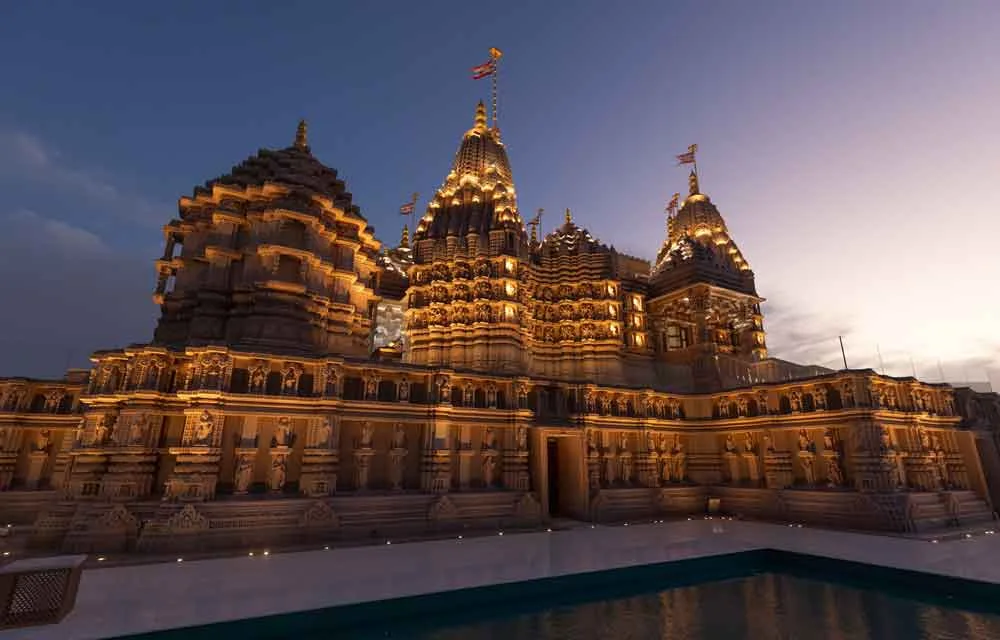
In the heart of Abu Dhabi, rising majestically from the golden Arabian sands, stands a monument that transcends borders and speaks the universal language of devotion—the BAPS Hindu Mandir Abu Dhabi, the first traditional Hindu stone temple in the Middle East. This architectural and spiritual marvel represents not just a place of worship, but a bridge between civilizations, a testament to human craftsmanship, and a beacon of interfaith harmony.
Inspired by Pramukh Swami Maharaj and consecrated by Mahant Swami Maharaj on February 14, 2024, this sacred sanctuary has already welcomed over 2.2 million devotees and visitors in its inaugural year, establishing itself as a spiritual oasis in the heart of the Middle East.
The Vision That Became Reality: A Journey of Faith
The Divine Inspiration
The seeds of this magnificent temple were planted decades ago. On April 5, 1997, His Holiness Pramukh Swami Maharaj visited the Middle East and envisioned a mandir in Abu Dhabi during his visit to a desert in Sharjah, stating that it would bring "countries, cultures, and religions closer together".
What began as a spiritual vision transformed into reality through extraordinary interfaith cooperation. In August 2015, the UAE government announced the decision to provide land for building a Hindu mandir in Abu Dhabi, with Sheikh Mohammed bin Zayed Al Nahyan gifting 27 acres of land for this noble purpose.
A Monument to Unity
This temple tells a remarkable story of human unity. The land was presented by a Muslim Sheikh, the architecture was co-designed by a Christian, and the project was headed by a Sikh—a beautiful tapestry woven by diverse faiths working together toward a common spiritual goal.
Architectural Grandeur: Where Ancient Wisdom Meets Modern Marvel
Sacred Dimensions and Divine Proportions
Built according to the shilpa shastras—the ancient Hindu treatises of temple construction—the BAPS Hindu Mandir stands at 108 feet in height, 262 feet in length, and 180 feet in width. Every measurement carries spiritual significance, with 108 being a sacred number in Hinduism representing the universe itself.
Architectural Features That Inspire Awe
The temple showcases extraordinary architectural elements that blend symbolism with beauty:
- Seven Shikars (Spires): Seven shikars symbolic of the seven Emirates in the UAE, representing unity in diversity
- Two Ghumats (Domes): Including the Dome of Harmony and Dome of Peace
- 12 Samrans: Pyramidal domes adding to the celestial beauty
- 402 Pillars: Each of the 402 white marble pillars is unique, with at least four artisans working for a minimum of a year to complete a single pillar
Materials Chosen by the Divine
Pink sandstone from northern Rajasthan was selected for the exterior due to its ability to withstand scorching summer temperatures of up to 50°C, while Aqua Bianca, a special Italian marble, was used to build the interior, creating a stunning contrast of pink and white that symbolizes purity and strength.
The Artisans: Hands That Carved Divinity
A Labor of Devotion
The creation of this sacred space is a story of extraordinary human dedication. More than 2,000 artisans worked on the intricate carvings in Rajasthan, pouring their hearts and souls into every chisel stroke.
The raw stones were meticulously carved by more than 5,000 skilled artisans in India into more than 30,000 pieces—the smallest weighing just 1 kilogram and the largest over 6 tonnes. Each piece was labeled, carefully packed, and shipped over 2,000 kilometers to Abu Dhabi, where they were assembled like a divine jigsaw puzzle.
The Sacred Art of Stone Carving
The designs would be drawn out on paper, traced onto stone, and then carefully hammered and chiseled by the artisans. This painstaking process preserved techniques passed down through generations, keeping alive the ancient traditions of Hindu temple architecture.
A number of sculptors and artisans were brought from India for the final touches, living in camps at the site and working closely with BAPS volunteers and municipal employees, exemplifying the spirit of seva (selfless service).
Stories Carved in Stone
Within each of the shikars, there are carvings of stories from the Ramayana, Shiva Purana, Bhagavatam, Mahabharata, and carvings that portray the lives of Jagannath, Swaminarayan, Venkateshwara, and Ayyappa. Additionally, the mandir features carvings of creatures native to the UAE, like camels, oryxes, and falcons, beautifully blending Indian spirituality with Arabian heritage.
The Seven Divine Shrines: Where Deities Reside
The heart of the BAPS Mandir houses seven sacred shrines, each dedicated to revered Hindu deities, representing the spiritual diversity within the Hindu faith:
1. Swaminarayan Shrine (Main Sanctum)
The central spire enshrines Lord Swaminarayan, worshipped as an avatar of Krishna, under the magnificent main dome. This is the primary deity of the BAPS Swaminarayan Sanstha.
2. Shiva Shrine
Dedicated to Lord Shiva, the cosmic destroyer and regenerator, with intricate carvings from the Shiva Purana adorning the spire.
3. Ram Shrine
Where Ram and Sita are enshrined, the entire Ramayana is carved in stone, depicting the epic journey of dharma and devotion.
4. Krishna Shrine
Celebrating the divine leelas (pastimes) of Lord Krishna, the eighth avatar of Vishnu, whose life story continues to inspire millions.
5. Tirupati Balaji (Venkateshwara) Shrine
Honoring Lord Venkateshwara, one of the most worshipped forms of Vishnu, especially revered in South India.
6. Puri Jagannath Shrine
Dedicated to Lord Jagannath, the Lord of the Universe, whose form represents the universal aspect of divinity.
7. Sabarimala Ayyappa Shrine
The seventh shrine is dedicated to the deity Ayyappan, whose murti is made from panchaloha (traditional five-metal alloy) and was designed by 15 artisans from Kerala, standing four feet in height and accompanied by a model of the 18 holy steps of the Sabarimala Ayyappa Temple.
Construction Timeline: Building a Legacy
Foundation of Faith (2018-2019)
- February 10, 2018: Memorandum of Understanding signed between India and UAE in the presence of the royal family and over 250 local leaders
- April 20, 2019: Foundation stone-laying ceremony (shilanyas vidhi) was performed with Mahant Swami Maharaj in the presence of guests and officials from India and the UAE
- December 2019: Construction of the mandir began on 27 acres of land at Abu Mureikhah, near Al Rahba off the Dubai-Abu Dhabi Sheikh Zayed Highway
Rising Toward Heaven (2020-2023)
- November 2021: Week-long "Pratham Shila Sthaapan Saptah" ceremony to sanctify the bricks
- May 27, 2022: First carved sandstone placed on the temple's first floor during "Mahapeeth Pujan Vidhi"
- November 2023: Ceremony of showering flower petals over the seven spires, marking near completion
Grand Opening (2024)
- February 14, 2024: Consecration ceremony by Mahant Swami Maharaj on the auspicious occasion of Basant Panchami, with Prime Minister Narendra Modi in attendance
- March 1, 2024: Temple opened to the public
- March 3, 2024: More than 65,000 people visited the mandir
Technical Marvel: Traditional Methods, Timeless Structure
No Iron, No Steel—Pure Ancient Engineering
Following the sacred architectural texts, the stones are assembled using a lock-and-key method, a traditional technique employed in ancient Hindu mandir construction. This means the entire structure stands without any iron reinforcements or concrete, relying solely on precise stone craftsmanship—a technique that ensures the temple will stand for over 1,000 years.
A Foundation Blessed by Nature
Geotechnical surveys at the precise location revealed a substantial layer of sandstone lying just a meter beneath the surface, providing a robust foundation for the temple and ensuring exceptional stability.
Community Contribution
690,000 person-hours were donated to the project by 60,000 people worldwide, exemplifying the spirit of shramdan (voluntary labor) that defines Hindu seva tradition.
Beyond Worship: A Cultural and Community Hub
The BAPS Mandir complex spans 55,000 square meters and includes far more than just the temple structure:
Facilities for Learning and Gathering
- Amphitheater: Inspired by the ghats of Varanasi, offering space for meditation and cultural programs
- Exhibition Hall: Showcasing Hindu philosophy, culture, and the temple's construction journey
- Library: Housing sacred texts and spiritual literature
- Community Halls: Two halls with capacity for 5,000 people for gatherings and celebrations
- Food Court: Serving traditional vegetarian cuisine
- Majlis: A space for interfaith dialogue and community meetings
- Visitor Center: Providing information and guidance to pilgrims
Sacred Water Features
Before entering the temple, visitors tread through a sand dune and then walk along a shallow pool of water brought from the confluence of the Ganga, the Yamuna, and the mythical Saraswati in India, connecting the Arabian soil with India's sacred waters.
Recognition and Accolades
The BAPS Hindu Mandir has received numerous prestigious awards:
- MEED Project Award's 'Best Cultural Project Across MENA 2024' and 'Best Cultural Project in the UAE' for its architecture, cultural importance, and positive impact to society
- MONDO-DR 2025 Award, known as the 'Oscars of the AV World', in the House of Worship category for its innovative immersive show, 'The Fairy Tale'
Visiting the Sacred Space: Practical Information
Location and Accessibility
Address: Abu Mureikhah area, along Al Taf Road (E16), accessible from the Abu Dhabi-Ghuweifat Highway (E11)
Distance:
- 30 minutes from Abu Dhabi city center
- 40 minutes from Jebel Ali, Dubai
- 25 minutes from Abu Dhabi International Airport
Transportation Options
- By Taxi: Most convenient option, readily available from the airport and city
- By Car: Follow 'Cultural District' signs at exit 366 on route E11
- By Bus: Route 203 from Al Nahyan Abu Dhabi Bus Terminal, approximately 90 minutes (around AED 6.5)
Visiting Hours
Open Daily: 9:00 AM to 8:00 PM (Closed Mondays for maintenance)
Entry Requirements
- Pre-registration Required: Book your visit through the official BAPS Hindu Mandir website or app
- Entry Fee: Free of charge
- Groups: Parties of more than 10 must book a group package
Dress Code (Important)
The temple follows a modest dress code respecting the sanctity of the space:
- Cover shoulders, chest, and knees
- Traditional attire (sarees, salwar kameez, full-length trousers) encouraged
- No tight-fitting or revealing clothing
- T-shirts are not permitted
Photography
- Mobile phone photography permitted for personal use
- Commercial or journalistic photography requires pre-approval (contact: press@mandir.ae)
A Message of Harmony for the World
In January 2025, the mandir hosted defence attachés, their families, and dignitaries from 20 nations worldwide for a cultural exchange and open dialogue on peace, diversity, and harmony, demonstrating its role as a bridge between nations and faiths.
Former Undersecretary-General of the United Nations Shashi Tharoor, visiting for Diwali 2025, stated: "Going beyond its extraordinary spiritual content, every inch of this mandir reflects harmony and unity. I spent years at the UN talking about our common humanity. Today, I have seen the embodiment of that humanity in stone, in spirit, and in purpose".
Spiritual Significance: What the Temple Represents
A Bridge Between Civilizations
The BAPS Mandir stands as living proof that in today's world, faith can be a force for unity rather than division. It demonstrates how mutual respect, cultural appreciation, and spiritual values can transcend geographical and religious boundaries.
Preserving Ancient Wisdom
By adhering strictly to the shilpa shastras and traditional construction methods, the temple preserves millennia-old knowledge and craftsmanship, passing these sacred arts to future generations.
A Space for All Humanity
While rooted in Hindu tradition, the temple welcomes people of all faiths, embodying the Hindu principle of Vasudhaiva Kutumbakam—the world is one family. It serves as a reminder that all paths lead to the same divine truth.
The Future: A Legacy for Generations
The BAPS Hindu Mandir is designed to last over 1,000 years, ensuring that future generations can experience the same sense of wonder, peace, and spiritual connection. It stands not just as a monument to the past, but as a beacon for the future—a future where diversity is celebrated, where ancient wisdom guides modern life, and where the human spirit continues to reach toward the divine.
Conclusion: Where Earth Meets Heaven
The BAPS Hindu Mandir in Abu Dhabi is more than architecture; it is a prayer carved in stone, a hymn sung by chisel and hammer, a testament to what humanity can achieve when guided by faith, unity, and devotion. It reminds us that the divine dwells not just in temples, but in the hearts of those who build them, worship in them, and visit them seeking peace.
As you stand before this magnificent structure, with its pink sandstone glowing in the desert sun and its white marble interiors radiating purity, remember that you are witnessing not just a building, but a bridge—a bridge between past and present, between East and West, between human and divine.
Jai Swaminarayan! Har Har Mahadev! Jai Shri Ram!
SEO Meta Information
Primary Keywords: BAPS Mandir Abu Dhabi, Hindu Temple Abu Dhabi, BAPS Hindu Temple UAE, Abu Dhabi Mandir
Secondary Keywords: BAPS Swaminarayan Temple, Hindu temple Middle East, Abu Dhabi religious sites, Indian temple UAE, traditional Hindu architecture
Meta Title: BAPS Mandir Abu Dhabi: Complete Guide to the First Hindu Temple in UAE | HinduTone
Meta Description: Discover the magnificent BAPS Hindu Mandir in Abu Dhabi—the first traditional Hindu stone temple in the Middle East. Explore its divine architecture, 7 sacred shrines, artisan craftsmanship, visiting hours, and spiritual significance. Your complete guide to this architectural marvel.
Image Alt Text Suggestions:
- "BAPS Hindu Mandir Abu Dhabi exterior with pink sandstone carvings"
- "Seven spires of BAPS Temple representing seven emirates of UAE"
- "Intricate marble carvings inside BAPS Mandir Abu Dhabi"
- "Artisans carving stone for Abu Dhabi Hindu temple"
- "Dome of Harmony at BAPS Hindu Mandir"
Focus Keyphrases:
- BAPS Mandir Abu Dhabi visiting guide
- First Hindu temple in Middle East
- Abu Dhabi Hindu temple architecture
- BAPS Swaminarayan Temple UAE
- Hindu temples in Abu Dhabi
Internal Linking Opportunities (for HinduTone.com):
- Link to articles about Hindu architecture
- Link to content about other BAPS temples worldwide
- Link to guides about Hindu pilgrimage sites
- Link to articles about Hindu festivals celebrated at the temple
- Link to content about Hindu deities enshrined in the temple
External Linking Suggestions:
- Official BAPS Mandir Abu Dhabi website
- Hindu philosophy and architecture resources
- UAE tourism and cultural sites
This article is published on www.hindutone.com - Your premier source for Hindu spirituality, culture, temple guides, and devotional content. Stay connected with your roots, explore sacred spaces, and deepen your spiritual journey with HinduTone.
Follow HinduTone for more temple guides, devotional content, and spiritual insights!
Share this article: Help others discover this magnificent temple by sharing this comprehensive guide on social media.
Visit: Plan your spiritual journey to BAPS Hindu Mandir Abu Dhabi and experience divine peace in the heart of the Arabian desert.
Frequently Asked Questions
Where is BAPS Mandir in Abu Dhabi located?
Published on HinduTone.com | Your Gateway to Hindu Spirituality and Culture Introduction: Where Faith Meets the Desert Sands In the heart of Abu Dhabi, rising majestically from the golden Arabian sands, stands a monument that transcends borders and speaks the universal language of devotion—the BAPS Hindu Mandir Abu Dhabi, the first traditional Hindu stone te
Who is the presiding deity of BAPS Mandir in Abu Dhabi?
The temple's presiding deity and its significance are described in the guide above.
What are the timings and how do I reach BAPS Mandir in Abu Dhabi?
Temples typically open early morning and evening; confirm current darshan timings before visiting. The nearest airport, railway station and road routes are covered in the guide above.
What is the best time to visit BAPS Mandir in Abu Dhabi?
Major festival days and the cooler months are popular, though weekday mornings offer a calmer darshan. Plan around the temple's key festivals for the most vibrant experience.
You might also like
Shani Deva Temples Worldwide & Must-Performed Rituals — Complete Devotee's Guide
Top 20 Sivalayam in USA: A Devotee's Guide to America's Most Sacred Shiva Temples (2026)

Sacred Hindu Festivals & Temple News: Divine Week — May 2026