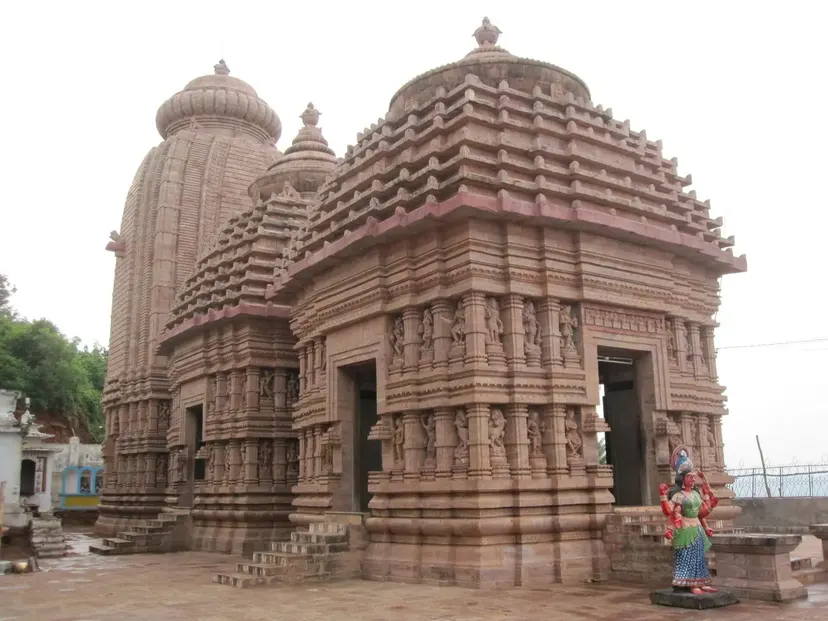
Biranchinarayan Temple, Buguda
Surya (as Biranchi Narayan) temple · Buguda, Ganjam, Odisha, India
The Biranchinarayan Temple stands in Badadanda Sahi, a street of the small town of Buguda in the Ghumusar area of Ganjam district in southern Odisha. It is a living temple of the Sun god, Surya, who is worshipped here as Biranchi Narayan. According to the documentation prepared for the Indira Gandhi National Centre for the Arts (IGNCA), the presiding image is a two-armed Surya standing on a chariot placed on a platform.
The temple is popularly called the 'Wooden Konark' because of the carved timber work in its roof and ceilings, and it is admired as much for its painted walls as for its sculpture. Wikipedia describes it as the second notable Sun temple of Odisha after Konark, and the Orissa Post has called it one of only two wooden temples known in the state. The temple was built under the Bhanja rulers of the former Ghumusar state in the late eighteenth century.
Faith & Tradition
Religious Significance of Biranchinarayan Temple, Buguda
Unlike the Konark Sun Temple, which faces east, the Biranchinarayan Temple faces west. A chief priest of the temple, quoted by the Orissa Post, explained the contrast this way: at Konark the rays of the rising sun fall on Surya, whereas at Buguda the rays of the setting sun fall on the feet of the deity.
The temple is planned in the form of a chariot. Wikipedia describes the iconography as Surya on a chariot drawn by seven horses with Aruna, the charioteer, at the reins, and the Orissa Post likewise says the structure is shaped like a chariot pulled by seven horses. Wikipedia also records the tradition that the presiding image was recovered from ruins at Maltigad; the Orissa Post names the place as the Malatipur hills.
Devotees gather on Sundays and on the Sankranti days, which are traditionally associated with the Sun. The IGNCA record notes that sacred-thread ceremonies are also held at the temple, showing that it continues to serve the local community as a working place of worship and not only as a monument.
Heritage
History of Biranchinarayan Temple, Buguda
Temple records cited in the IGNCA documentation say that Raja Srikara Bhanja of the former Ghumusar state built the temple, and the IGNCA assigns it to the last quarter of the eighteenth century, giving 1790 CE as the date of construction. Wikipedia describes 1790 as the year in which King Srikara Bhanjadeva renovated the temple, while a 2019 Orissa Post report gives 1777 as the year of building; the exact year therefore differs between sources, but all place it in the late eighteenth century under the Bhanja rulers.
According to the IGNCA record, the temple has been a protected monument of the Odisha State Archaeology department, with day-to-day care in the hands of the temple's mahanta. A small Jagannatha temple nearby, documented separately by the IGNCA, is looked after by the Biranchi-Narayana Matha and is dated to the early nineteenth century.
The temple's condition has been a concern. The IGNCA survey noted rainwater seepage that had damaged both the paintings and the wooden members of the eaves, and in 2019 the Orissa Post reported that the temple was in urgent need of repair, quoting local residents and priests who asked the state government to protect the carvings and murals.
Architecture and sacred features
The IGNCA describes a west-facing temple on a chariot-like plan shaped like a Latin cross, built of ashlar masonry in khondalite stone and lime plaster, set in a complex measuring about 43 by 51 metres. The Orissa Post counts forty-six pillars supporting the roof, thirty-two short and fourteen tall, with the ceiling, struts and walls decorated with intricate wood carving; Wikipedia adds that, at the king's wish, the main icon itself was made of wood.
The walls carry paintings that are among the temple's best-known features. The IGNCA lists scenes from the Ramayana, including Sita's marriage, the slaying of Bali, the building of the bridge to Lanka, the killing of the golden deer and the battle between Rama and Ravana, together with scenes of Krishna's life, the incarnations of Vishnu and a painted plan of the Jagannatha temple at Puri. Odisha Tourism describes Buguda as preserving one of the region's rare wooden and mural temples of the early nineteenth century.
Plan Your Visit
Darshan and Visitor Information
This is a living temple with daily worship, so dress modestly, remove footwear before entering and follow the instructions of the priests. The wall paintings and wooden carvings are old and fragile; do not touch them, and ask before taking photographs. Confirm current darshan timings and any photography rules locally with the temple management before visiting.
Timings and arrangements change with seasons and festivals. Confirm current details with Temple mahanta; Odisha State Archaeology (protected monument, per IGNCA) before travelling. Last reviewed 1 November 2026.
Sacred Calendar
Festivals at Biranchinarayan Temple, Buguda
Ratha Saptami (Magha Saptami)
The festival of the Sun's chariot; Wikipedia and the IGNCA record both list it among the temple's observances.
Samba Dashami
A Sun-worship festival linked to the legend of Samba, son of Krishna, who is said to have worshipped Surya; listed for this temple by Wikipedia and the IGNCA.
Makara Sankranti
Recorded by the IGNCA among the festivals observed at the temple; Wikipedia notes that Sankranti days and Sundays draw devotees.
Location
How to Reach Biranchinarayan Temple, Buguda
Buguda is a town in Ganjam district, which Wikipedia places about 70 km from Berhampur (Brahmapur), the main city of southern Odisha. The IGNCA gives the temple's location as Badadanda Sahi, about half a kilometre south-west of Palasara chowk in Buguda town.
Location: Buguda, Ganjam, Odisha, India
More in Hindu temples in Odisha · Surya (as Biranchi Narayan) temples · Temples in Ganjam District
Questions
Biranchinarayan Temple, Buguda: Frequently Asked Questions
Why is the Biranchinarayan Temple called the 'Wooden Konark'?
It is a Sun temple on a chariot plan, like Konark, and its roof, ceilings and struts are richly carved in wood. Wikipedia also records that the main icon was made of wood at the king's wish.
Which way does the temple face?
It faces west, unlike Konark, which faces east. A priest quoted by the Orissa Post said the setting sun's rays fall on the feet of the deity here.
Who built the Biranchinarayan Temple?
Temple records cited by the IGNCA say Raja Srikara Bhanja of the former Ghumusar state built it in the late eighteenth century. Sources give 1790 or 1777 as the year.
What do the wall paintings show?
According to the IGNCA, they show scenes from the Ramayana, the life of Krishna and the incarnations of Vishnu, as well as a plan of the Jagannatha temple at Puri.
Is the temple still in worship?
Yes. The IGNCA describes it as a living temple, and festivals such as Ratha Saptami and Samba Dashami are observed there.
Where is Buguda?
Buguda is a town in Ganjam district of southern Odisha, about 70 km from Berhampur according to Wikipedia. The temple is in Badadanda Sahi, about half a kilometre south-west of Palasara chowk.
Sources and attribution
- Indira Gandhi National Centre for the Arts (Ministry of Culture) — Documentation format for Archaeological/Heritage Sites: Biranchi-Narayana Temple, Buguda Town, Dist. Ganjam (OR/GJM-06)
- Indira Gandhi National Centre for the Arts (Ministry of Culture) — Documentation format: Jagannatha Temple, Buguda Town (OR/GJM-07)
- Orissa Post — Temple cries out for maintenance
- Orissa Post — INTACH discovers wooden temple
- Odisha Tourism — Buguda: Frozen in Time
- Wikipedia — Biranchinarayan Temple, Buguda
- Wikipedia — Buguda
Further reading: Biranchinarayan Temple, Buguda on Wikipedia (CC BY-SA 4.0).
Spotted an error? Write to info@hindutone.com — see our editorial policy.