Why Lord Venkateswara Is Called the Kaliyuga Daivam
Lord Venkateswara, also known as Srinivasa or Tirupati Balaji, holds a unique position among Hindu deities as the Kaliyuga Daivam (God of Kali Yuga).
Lord Venkateswara, also known as Srinivasa or Tirupati Balaji, holds a unique position among Hindu deities as the Kaliyuga Daivam (God of Kali Yuga).
Lord Venkateswara, also known as Srinivasa or Tirupati Balaji, holds a unique position among Hindu deities as the Kaliyuga Daivam (God of Kali Yuga). This divine designation stems from ancient Puranic texts that prophesy His special role in providing salvation and protection to devotees during the most challenging of all yugas.
The Puranic Foundation
According to the Venkatachala Mahatmya and Bhavishyottara Purana, Lord Vishnu chose to manifest permanently on Earth during Kali Yuga to offer direct access to divine grace when humanity would need it most. The texts describe how the Lord descended to the Venkata hills to remain accessible to devotees throughout this dark age.
The Complete Story of Lord Srinivasa's Manifestation
The Divine Prophecy
In the waning moments of Dvapara Yuga, as Lord Krishna prepared to leave his earthly form, the sages and celestials grew concerned about humanity's fate in the approaching Kali Yuga. They approached Lord Brahma, who assured them that Lord Vishnu would take a special form to protect devotees during this difficult period.
Sage Bhrigu's Test and the Divine Curse
The story begins with a momentous event that would change the course of divine history. The great sages once gathered to determine which of the Trinity—Brahma, Vishnu, or Shiva—was supreme and most worthy of worship.
Sage Bhrigu was chosen to test the three deities. He first visited Brahma's court but deliberately showed disrespect. Brahma became angry, but his consort Saraswati calmed him. Next, Bhrigu went to Lord Shiva at Kailash and showed similar disrespect. Shiva rose in fury to destroy the sage, but Parvati intervened and pacified her lord.
Finally, Bhrigu reached Vaikuntha, where he found Lord Vishnu resting with Goddess Lakshmi. The sage, receiving no immediate attention, became enraged and kicked the Lord on His chest—the very place where Goddess Lakshmi resides.
Lord Vishnu, the embodiment of patience and compassion, immediately rose and said, "Oh sage, my chest must have hurt your tender foot. Please forgive me." He then gently massaged Bhrigu's foot. This supreme act of humility convinced Bhrigu that Vishnu was indeed the greatest, as only the truly supreme could remain so humble.
However, Goddess Lakshmi was deeply hurt by this incident. She felt dishonored that her sacred dwelling place—the Lord's chest—had been kicked, and that the Lord had responded with such meekness. In her anguish, she left Vaikuntha without a word and descended to Earth.
The Lord's Search for His Consort
Lord Vishnu, distressed by Lakshmi's departure, searched everywhere for her. He learned that she had taken residence in Karavirapur (modern-day Kolhapur) and was performing penance in a golden lotus pond, refusing to return to Vaikuntha.
The Lord descended to Earth and arrived at the Venkata hills (Seshadri), which were considered the ideal place for penance and meditation. The seven hills of Tirumala, formed by the hood of Adisesha, provided the perfect sanctuary. Here, the Lord took up residence in an anthill (Valmikam), meditating and performing his own penance.
Princess Padmavati's Entry
During this time, King Akasha Raja, a pious ruler of the Chola dynasty, was performing a ritual plowing ceremony (Yajna) in his kingdom. As the ceremonial plow cut through the earth, it struck something unusual. To everyone's amazement, a beautiful baby girl emerged from a golden lotus in the field.
The childless king, recognizing this as divine blessing, adopted the girl and named her Padmavati (born from a lotus). She was actually an incarnation of Goddess Lakshmi herself, though neither she nor the king knew this yet.
Padmavati grew into a young woman of extraordinary beauty and virtue. She would often visit the gardens near the Venkata hills with her companions.
The Divine Encounter
One day, while Padmavati was in the garden, a wild elephant charged toward her and her companions. At that very moment, Lord Srinivasa (Vishnu in human form) appeared as a handsome hunter and drove the elephant away, saving the princess.
The moment their eyes met, divine love blossomed. Both were struck by Cupid's arrows—Srinivasa recognized His eternal consort, and Padmavati, though unaware of His true identity, fell deeply in love with the mysterious stranger.
After this encounter, Padmavati could think of nothing else. She fell ill with love-sickness, and her worried parents summoned their advisor and court priest to help.
The Divine Scheme
Meanwhile, Lord Srinivasa was equally lovesick. He confided in His friend Vakula Devi (also called Vakula Maatha), who was actually Yashoda from Krishna's incarnation, reborn to serve the Lord again. Vakula Devi had been caring for the Lord during His time on the hills.
Srinivasa also sought help from Lord Brahma and Lord Shiva, who agreed to act as intermediaries. They disguised themselves as an elderly Brahmin and his wife and visited King Akasha Raja's court.
The Marriage Proposal
Brahma, in disguise, proposed the marriage between Srinivasa and Padmavati, extolling the virtues and divine nature of the prospective groom. However, the marriage required substantial arrangements befitting a royal wedding.
Lord Srinivasa needed wealth for the wedding expenses. He approached Kubera, the God of wealth, and requested a loan of a vast sum of gold and money. Kubera gladly agreed, and they made a divine pact: the Lord would repay the loan with the offerings made by His devotees.
This is why, even today, devotees believe that their offerings at Tirupati help Lord Venkateswara repay His debt to Kubera—a debt that symbolizes His eternal accessibility to devotees.
The Sacred Wedding
The celestial wedding was arranged with great grandeur. All the gods and sages attended the marriage of Lord Srinivasa and Princess Padmavati. The ceremony took place at the present-day site of the Tiruchanur temple, where Padmavati Devi's shrine still stands.
After the marriage, Lord Srinivasa brought His bride to the Venkata hills, where they established their eternal abode. However, there are various legends about what happened next:
According to one version, Goddess Lakshmi from Vaikuntha (in her original form) came to visit the Lord and found Him with Padmavati. A divine disagreement ensued about who would stand on which side of the Lord. It was resolved that Lakshmi would stand on the Lord's left side (as Sridevi) and Padmavati on His right (as Bhudevi), both being manifestations of the same divine mother.
Establishment at Tirumala
Lord Srinivasa then made a solemn declaration: He would reside permanently on the Venkata hills throughout Kali Yuga to grant salvation to His devotees. He proclaimed that anyone who came to Him with sincere devotion would receive His grace, regardless of their caste, creed, or past sins.
The Lord appeared to Saint Annamacharya in a vision and said, "I have taken this form to be accessible to my devotees in Kali Yuga. Those who worship me here will find liberation."
Quotes from Venkatachala Mahatmya
The Venkatachala Mahatmya, found in the Bhavishyottara Purana, contains several significant verses about Lord Venkateswara's role in Kali Yuga:
"Kalau Sankirtya Kesavam Kritvaa Kesava Darshanam | Venkatadri Samaaropya Vimukto Bhava Bandhanat"
"In Kali Yuga, by chanting the names of Keshava (Vishnu) and having His darshan at Venkatadri, one ascends the holy hill and becomes free from the bondage of worldly existence."
"Kali Dosha Vinashaaya Venkatesa Maheshwara | Kalau Sankirtya Govinda Mucyate Sarva Kilbishaat"
"Lord Venkateswara, the great Lord, destroys the afflictions of Kali Yuga. In this age, by singing the glories of Govinda, one is freed from all sins."
The text also states:
"Atra Devo Vasen Nityam Sannidhyam Kurute Prabhuh | Kalau Koti Gunam Punyam Venkatadri Nivaasinam"
"The Lord eternally resides here and maintains His divine presence. In Kali Yuga, the merit of residing near Venkatadri is amplified a million-fold."
Why Specifically the Kaliyuga Daivam?
1. Permanent Physical Presence
Unlike other avatars that came for specific purposes and durations (Rama, Krishna), Lord Venkateswara promised to remain in a Swayambhu (self-manifested) form throughout Kali Yuga—all 432,000 years of it.
2. Accessibility Without Discrimination
The Venkatachala Mahatmya declares: "Sarva Lokam Sharanyam Yat Venkatadri Shikhare Sthitam" (The refuge for all worlds stands on the Venkata hill). The Lord accepts all devotees regardless of social status, caste, or past sins—a revolutionary concept for Kali Yuga when dharma declines.
3. The Debt to Kubera
The divine debt to Kubera symbolizes the Lord's eternal bond with devotees. By accepting offerings from devotees to repay this loan, He creates a direct relationship with every worshipper. The Sthalapurana mentions: "Kali Yuge Hundi Dhaanam Sarvabista Pradaayakam" (Donations in the hundi during Kali Yuga fulfill all desires).
4. Protection Against Kali's Influence
The Brahmanda Purana states that the very darshan (sight) of Lord Venkateswara neutralizes the negative effects of Kali Yuga. The Lord's presence on the Venkata hills creates a sacred zone where dharma remains strong despite Kali's influence.
5. Fulfillment of Desires
Unlike other forms that primarily offer moksha (liberation), Lord Venkateswara is known as "Abhishta Pradaayaka" (granter of desires). He understands that in Kali Yuga, humans struggle with material concerns and compassionately addresses both spiritual and worldly needs.
The Unique Features of His Form
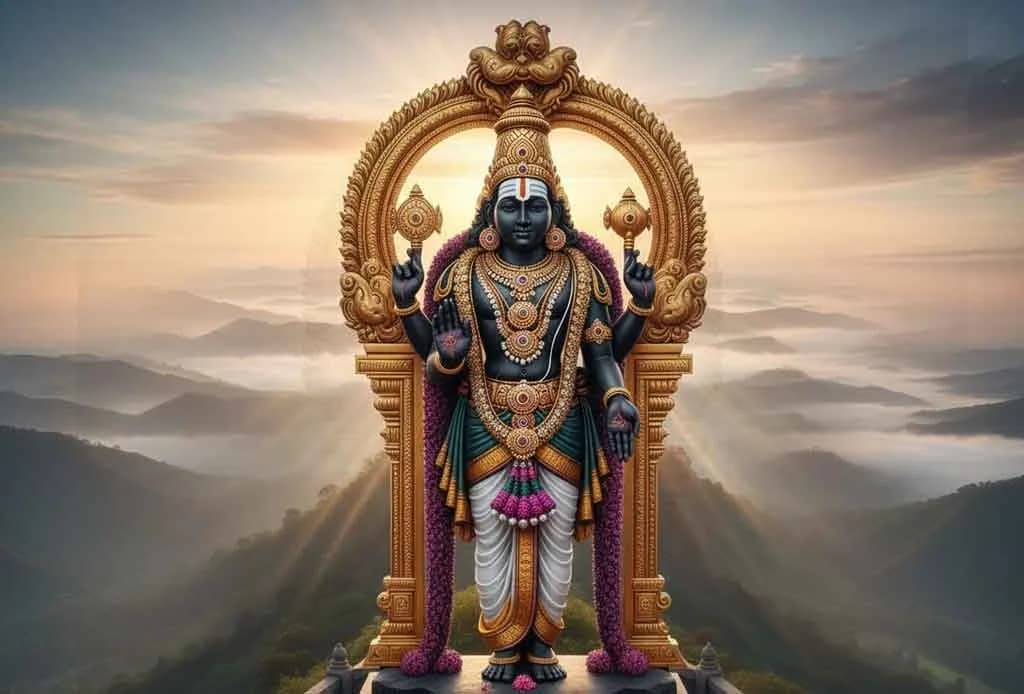
The idol of Lord Venkateswara has several unique features that distinguish Him as the Kaliyuga deity:
- Closed Eyes: His eyes are partially closed in divine contemplation, suggesting He overlooks devotees' faults—crucial for the sin-prone humans of Kali Yuga
- The Chin Mudra: His right hand displays the Chin Mudra, symbolizing the unity of individual and universal consciousness
- The Namam (Sacred Mark): The white sacred mark on His forehead represents the path of devotion open to all
The Science Behind His Magnetism
The Venkatachala Mahatmya describes the idol as having a powerful spiritual magnetism: "Ayaskanta Mayam Vigraha" (a form with the properties of a loadstone). This is interpreted both literally—the idol is said to contain magnetic properties—and metaphorically—the Lord attracts devotees irresistibly toward salvation.
The Kaliyuga Protection Formula
According to the Puranas, Lord Venkateswara established a simple yet powerful formula for Kali Yuga protection:
- Darshan (seeing the Lord) cleanses sins
- Namasmarana (chanting His names) grants protection
- Seva (service) through donations ensures prosperity
- Prasadam (blessed offerings) bestows health and well-being
The Skanda Purana declares: "Venkatadri Samayaatam Paapaatmaanam Apahritam" (One who reaches Venkatadri has their sinful nature removed).
The Eternal Promise
The most compelling reason for His title as Kaliyuga Daivam comes from the Lord's own promise recorded in the Puranas. When asked by the celestials how long He would remain accessible, the Lord replied:
"Yavat Bhugola Dhaaranam Tavat Veṅkaṭa Dhaaranam | Yavat Kali Yugam Taavat Aham Atra Stitha Sadaa"
"As long as the Earth exists, Venkata exists. As long as Kali Yuga lasts, I shall remain here always."
Contemporary Relevance
Today, Lord Venkateswara's temple at Tirumala is the most visited and wealthiest religious site in the world, with over 60-80 million pilgrims annually. This unprecedented devotion—transcending all barriers of religion, region, and social status—validates the Puranic prophecy that He would be the primary deity of Kali Yuga.
The very fact that people from all backgrounds feel an inexplicable pull toward Tirupati, often without knowing these ancient stories, suggests that the divine magnetism described in the Venkatachala Mahatmya continues to operate in our modern age.
Conclusion
Lord Venkateswara's designation as the Kaliyuga Daivam is not merely a title but a divine mission. He descended to Earth, married through human means, took a loan to bear earthly responsibilities, and established Himself in a form that would remain accessible throughout history's most challenging age. His story reminds us that even in Kali Yuga's darkness, divine grace is just a pilgrimage away.
As the ancient verse promises: "Venkata Giri Gatva Yastu Darashanam Karishyati | Sa Sarvam Phalam Aapnoti Kalau Natra Samshayah" (One who goes to Venkata hill and has darshan obtains all fruits; in Kali Yuga, there is no doubt about this).
For millions of devotees, Lord Venkateswara is not just the God of Kali Yuga—He is their eternal refuge, their wish-fulfiller, and their direct connection to the divine in an age when such connections are most needed yet hardest to find.
Govinda Govinda [image: 🙏]
Frequently Asked Questions
What is Why Lord Venkateswara Is Called the Kaliyuga Daivam?
Lord Venkateswara, also known as Srinivasa or Tirupati Balaji, holds a unique position among Hindu deities as the Kaliyuga Daivam (God of Kali Yuga). This divine designation stems from ancient Puranic texts that prophesy His special role in providing salvation and protection to devotees during the most challenging of all yugas.
What are the key points about Why Lord Venkateswara Is Called the Kaliyuga Daivam?
The Puranic Foundation According to the Venkatachala Mahatmya and Bhavishyottara Purana , Lord Vishnu chose to manifest permanently on Earth during Kali Yuga to offer direct access to divine grace when humanity would need it most. The texts describe how the Lord descended to the Venkata hills to remain accessible to devotees throughout th
Why does Why Lord Venkateswara Is Called the Kaliyuga Daivam matter in Hinduism?
It deepens a devotee's connection with Lord Vishnu and with the values of Sanatana Dharma — clarity, devotion and dharmic living.
How can devotees apply Why Lord Venkateswara Is Called the Kaliyuga Daivam in daily life?
By reflecting on its teaching, incorporating the related practices or observances into daily routine, and approaching it with sincere devotion and understanding.
You might also like
Spiritual Science Behind Tirupati's Balaji Idol: Why the Idol Is Always Moist
Janmashtami 2026 in India: Date, Rituals & Top Temples to Visit