Chhatrapati Shivaji Maharaj Jayanti 2026: The dream of independence that a mother sowed in the eyes of her son
19 February 2026 | 396th birth anniversary Jai Bhavani! Jai Shivaji! Today is 19th February.
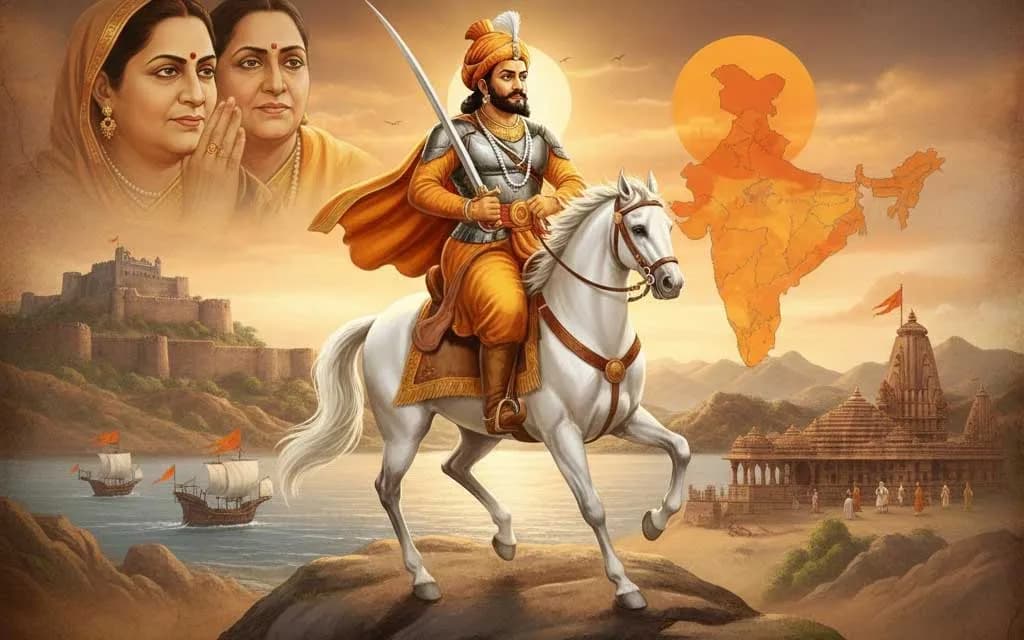
19 February 2026 | 396th birth anniversary Jai Bhavani! Jai Shivaji!
19 February 2026 | 396th birth anniversary Jai Bhavani! Jai Shivaji!
Today is 19th February.
396 years ago, a child was first born to a farmer on the hills of Shivneri Fort. At that time, no one imagined that this child would one day change the fate of all of Hindustan. This child was Shivaji Raje Bhonsle .
Many of us Indians know Shivaji Maharaj. We've studied him in school. We've seen him on TV. Many homes might even have his picture hung during Pooja's birthday. But today—on his 396th birth anniversary —let's delve a little deeper. He's not just a historical figure. He's a life worth living .
First understand the things that the textbooks never told you.
Shivaji Maharaj was not just a warrior. He was a complete system .
At a time when the Mughal Sultanate was expanding across the Deccan, when the Sultans of Bijapur and Golconda were establishing their rule in every village, when temples were being destroyed, and when the Hindu community was just trying to survive – a 19-year-old boy, along with his 12 Mawalas (12 companions of faith like Sadashiv), conquered Torna Fort .
In 1646.
Without any big army. Without any big sequence. With just one vision – Hindu Swarajya .
Jijabai: That mother who herself is a history
If you want to understand Shivaji Maharaj, then first you will have to understand Queen Mother Jijabai .
Jijabai was a woman whose life itself was fraught with hardship. Her husband was away from home, her in-laws' politics, one hardship after another. But she didn't let her own suffering weaken her son. She told him stories of the heroes of the Ramayana and Mahabharata —every day, every night—until he began to feel Dharma even in his dreams.
Jijabai didn't just teach her son how to wield a sword. She taught him the meaning of Dharma .
This is why Shivaji Maharaj was never just a king seeking a victory – he was a dharmik warrior , at every step.
"The son that mother sowed in her eyes, she gave birth to in the sky." — Marathi poetry tradition
Hindavi Swarajya: It all started with a dream
What was Shivaji Maharaj's greatest contribution? Some say it was the Maratha Empire. Some say it was the naval force. Some say it was the protection of temples.
In truth, the biggest contribution was one word – Swarajya .
The term was quite revolutionary then. The concept of Hindus running their own governments didn't even exist in the world of that time. The Mughals, the Bijapur Sultanate, Golconda—all were great rulers. And in their shadows, Hindu society was reduced to subjects—sometimes subject, sometimes prey.
Shivaji Maharaj saw this dream for the first time and also said – "This earth belongs to God and is for the people of God. We will rule our own kingdom."
And in 1674, the coronation ceremony at Raigad Fort wasn't just a coronation. It was a renaissance moment for Hindu civilization . Pandits, saints, and Vedic scholars from across Hindustan came to the ceremony. They installed a Hindu king as the ruler of a Hindu empire using Hindu rituals.
This happened after many years.
Bhavani Mata and Bhavani Talwar: Meeting of Shakti and Shaktidhar
Shivaji Maharaj was a great devotee of Tulja Bhavani . The goddess of Tuljapur (Maharashtra)—a Shakti Peeth—was his family deity.
There is a famous legend that Goddess Bhavani herself appeared to Shivaji Maharaj and presented him with the Bhavani sword . Whether this is fiction or truth, it is certain that Shivaji Maharaj never associated his heroic saga with his personal strength. He always said, "This is the grace of the Goddess."
This was his greatness. Victory did not make him arrogant—his devotion increased further.
"Jai Bhavani! Jai Shivaji!" - the coming together of these two slogans itself shows that for him the sword and penance were one and the same.
Samarth Ramdas: When both the Guru and the disciple are great
Shivaji Maharaj's guru was Samarth Ramdas Swami . Saint, poet, and a pillar of the Maharashtrian Bhakti tradition.
Ramdas Swami wrote Dasbodh —a Marathi treatise that is still read in every household in Maharashtra. And he taught Shivaji Maharaj this:
"Only when there is Dharma in the state will there be a state in Dharma."
There is a famous story: When Ramdas Swami once asked Shivaji Maharaj for alms, the Maharaja placed his entire kingdom at his feet. The Swami returned it and said, "I am not the Swami of this kingdom, but the Dharma is. You are its protector."
This tradition of guru-disciple is the very essence of Hindu civilization. Shivaji Maharaj clearly demonstrated it.
The work that sets them apart—even today
Temples are protected by rules, not by force
Among the regulations written for Shivaji Maharaj's army was one: no temple, mosque, or religious site should be harmed . This wasn't just for Hindu temples. He believed that religious sacrilege was a sin—regardless of who the victim was.
But his policy, especially regarding Hindu temples, was clear: he rebuilt those that had collapsed. He recalled priests who had fled with dignity. He reinstated worship practices that had ceased.
This was not just devotion – it was state policy .
Sea Force: India's First Naval Power
Very few people know that Shivaji Maharaj is called the father of the Indian Navy .
When European powers and Arab traders were trying to capture the Konkan coast, Shivaji Maharaj created a powerful naval fleet— the Maratha Navy . He built forts in the sea. He appointed commanders. He secured routes.
What was its direct benefit? Coastal Hindu pilgrim towns survived. Seaside temples remained secure. Trade routes remained under Hindu control.
Respect for women – Written in the rules of the army
This was the time when women were treated like trophies in war.
Shivaji Maharaj laid down an unbreakable rule for his army – no soldier would touch any woman – even if she belonged to the enemy .
Once, a general presented a beautiful Arab woman to Shivaji Maharaj as a "gift." The Maharaja's reply was—
"I wish my mother was this beautiful. I wish I looked like this today."
And he sent that woman back with dignity.
This is not just a story – it is a test of character .
Gave Marathi and Sanskrit their rights
Persian was the official language in the Mughal and Sultanate courts. Shivaji Maharaj made Marathi the official language in his court.
And not only that—he commissioned a royal conduct dictionary, a government dictionary of Sanskrit and Marathi—so that government work would use its own language, not Persian.
It may seem like a small thing—but it was a major step in cultural decolonization . Shivaji Maharaj did this—ruling his kingdom with his own language.
Those mistakes that we often miss – learn from these too
Shivaji Maharaj was a human being—not a god. And some of his decisions are debatable from today's perspective. But what makes him timeless is that he learned from his mistakes .
The time of meeting Afzal Khan - Mastery of guerrilla tactics - Escape from Agra - Every time life threw him down, Shivaji Maharaj learned, changed, and stood up again.
This is the life science which can be useful for today's Indian youth.
5 principles of Shivaji Maharaj that are still useful today
This is not just for history – it is also for Indian life today:
1. Dharma First, Rajya Later Shivaji Maharaj never used independence for personal glory. The basis of every decision was – "Is this in accordance with Dharma?"
2. His Language, His Identity While everyone else spoke Persian, Maharaja worked in Marathi. Never giving up your language—this is still relevant today.
3. Discipline in the army, justice in governance. His Pradhan Mandal (council of 8 ministers) was like today's Cabinet system. Work was divided and accountability was fixed.
4. Put power to the service of power. Whether it 's naval power or land force—these were not just for expansion. They were for the protection of coastal fishermen, traders, and pilgrims.
5. Don't accept defeat as the final straw: Aurangzeb practically imprisoned him in Agra. But Shivaji Maharaj emerged victorious from there—with creativity and courage. Defeat wasn't even in his words.
Today's Day: What to do on Shivaji Jayanti?
Just saying thank you is not enough. Let's do something meaningful on this anniversary:
- Tell your children a real story about Shivaji Maharaj at home – not the NCERT one, but a real historical one.
- Visit any Maratha fort – Raigad, Shivneri, Sinhagad, Pratapgad – all of them belong to them.
- Read Dasbodh by Samarth Ramdas or any biography of Jijabai.
- Take a rule today – “I will also respect my mother tongue”
- Whatever puja is being performed in the temple, you should participate in it. This is what Shivaji Maharaj wanted.
Ant Mein: Woh Zinda Hain — Har Us Cheez Mein
Chattrapati Shivaji Maharaj is still alive today.
In every fort wall that still stands. In every temple where worship still takes place. In every Marathi mother who calls her son "Shivaji" and hopes for a Bullet. In every Indian who understands that his land, his language, and his religion—these are not mere grants. They have to be protected.
Hail Bhavani! Hail Shivaji! Hail Hind!
This article is dedicated by HinduTone to all those devotees who do not just know the name but also want to know the life.
Published: HinduTone.com | 19 February 2026
Tags: #ShivajiJayanti2026 #ChatrapathiShivajiMaharaj #HindaviSwarajya #JaiBhavani #HinduDharma #MarathaEmpire #Jijabai #SamarthRamdas #HinduTone #HindiArticle
Frequently Asked Questions
When is Chhatrapati Shivaji Maharaj Jayanti 2026?
Chhatrapati Shivaji Maharaj Jayanti 2026 falls on 19 February 2026.
What is the significance of Chhatrapati Shivaji Maharaj Jayanti?
19 February 2026 | 396th birth anniversary Jai Bhavani! 396 years ago, a child was first born to a farmer on the hills of Shivneri Fort.
How is Chhatrapati Shivaji Maharaj Jayanti celebrated?
Devotees observe it with puja, fasting or special offerings, visiting temples, chanting mantras, and gathering with family. Customs vary by region and tradition.
What should devotees do on Chhatrapati Shivaji Maharaj Jayanti?
Worship Lord Shiva, perform the day's puja and offerings, observe the fast where prescribed, and chant the associated mantras with devotion.
You might also like
The Resolve of a Monk – A Divine Incident Showcasing Kanchi Paramacharya’s Compassion
Mantra Recitation in a Diaspora Apartment: A Beginner's Guide for 2026
Lord Shiva: The Three Faces NRI Devotees Should Know in 2026