Bodrai Festival in Telangana: Village Goddess Celebration, Rituals, Folk Art & Complete Cultural Guide
Discover Bodrai — Telangana’s deeply rooted village goddess (Graama Devata) celebration. Complete guide to rituals, Pochamma and Maisamma worship, the women’s sacred pot procession, Oggu Katha storytelling, Dappu drumming, district-wise traditions across Warangal, Karimnagar, Khammam and Adilabad, and how Telugu NRIs in USA, UK, Canada, Australia and GCC participate.
Discover Bodrai — Telangana’s deeply rooted village goddess (Graama Devata) celebration. Complete guide to rituals, Pochamma and Maisamma worship, the women’s sacred pot procession, Oggu Katha storytelling, Dappu drumming, district-wise traditions across Warangal, Karimnagar, Khammam and Adilabad, and how Telugu NRIs in USA, UK, Canada, Australia and GCC participate.
“Janapada Devata Vandanam — Graama Shakti Vandanam” — We bow to the deities of our people; we bow to the power that protects our villages.
Bodrai — the heartbeat of Telangana’s village soul
Deep in the red-earthed villages of Telangana — across Warangal, Karimnagar, Nizamabad, Khammam, Nalgonda, Adilabad, and Mahabubnagar — there exists a celebration so rooted in the land, the soil, and the people that it cannot simply be described as a festival. Bodrai (also rendered Bodra or Bodraiah) is one of Telangana’s most deeply embedded Janapada (folk) celebrations — a community worship tradition centred around Graama Devata (village deity) veneration, primarily honouring forms of the divine mother who protects the village from disease, drought, and disaster.
It is the sound of dhol-tasha drums echoing across paddy fields before dawn. The smell of turmeric paste, fresh neem leaves, and camphor smoke. The sight of women in red and gold sarees carrying earthen pots on their heads to the village goddess’s shrine. Unlike polished urban festivals, Bodrai is raw, authentic, and unmediated — it happens in open fields, at roadside shrines, under ancient banyan trees, at the thresholds of temples built one stone at a time across generations.
Read this together with our companion pieces on Bonalu festival — Telangana’s fierce goddess tribute, Bathukamma — the floral festival of feminine energy, and the Sammakka–Saralamma Jathara of Medaram.
What is Bodrai? Etymology, meaning, and ancient roots
Linguistic origin
In regional Telangana dialect, “Boda” or Boddu refers to the navel or centre — the divine nucleus around whom village life organises itself. “Rai” is a suffix meaning deity or lord (as in Pochamma-rai, Maisamma-rai). Together, Bodrai is understood as the central deity of the community — both a village-wide celebration and a deeply personal Kula Devata (clan deity) worship.
A 2,000-year-old goddess tradition
Archaeological evidence from Kondapur, Phanigiri, and Kolanupaka places goddess worship in the Deccan plateau over 2,000 years ago — pre-Satavahana. Bodrai draws from four ancient streams: Shakta Tantra (worship of cosmic feminine power), Grama Devata (village goddess) tradition unique to South Indian and Deccan communities, Janapada folk art and music preserved orally across generations, and agricultural spirituality — the unbreakable link between the goddess and the fertility of the land.
When is Bodrai celebrated? Seasons and sacred timing
Bodrai is not fixed to a single universal date — it varies by village, community, and traditional calculation. The most common windows are:
Post-harvest (Margashirsha–Pushya, Dec–Jan): thanksgiving for a successful harvest.
Jyeshtha Masam (May–June): pre-monsoon purification; prayers for good rains and protection from epidemic disease.
Shravan Masam (July–August): peak goddess worship season in Telangana — overlaps with Bonalu.
Navaratri (Ashwin, Sep–Oct): aligned with the pan-Hindu nine-night goddess festival.
Village-specific Kula dates: each clan or community follows its own ancestral calendar passed down without written record.
Advertisement
Most Bodrai celebrations cluster in Jyeshtha and Shravan — the months leading into and during the monsoon — when the community’s collective anxiety about rainfall, crop health, and disease is highest, and the goddess’s protection is sought most intensely. For a wider view of this season, see our festivals of Jyeshtha Masam guide.
Sacred geography — where Bodrai thrives in Telangana
District-wise character of Bodrai
Warangal (Hanamkonda): grand community celebration linked to Kakatiya-era goddess temples.
Karimnagar: strong Kula Devata emphasis; elaborate family rituals and ancestor puja.
Nizamabad: agricultural village goddess worship; processions through paddy fields at dawn.
Khammam: tribal and mainstream Hindu fusion; distinct ritual elements from Koya and Gond communities.
Nalgonda: water and rain goddess emphasis; rituals near lakes, tanks, and rivers.
AdvertisementAdilabad: tribal folk emphasis; rich with Gondi and Lambada cultural elements.
Mahabubnagar (Wanaparthy): shepherd and pastoral community celebrations; goat and cattle blessings central.
Medak: large public processions and elaborate folk-art performances.
Hyderabad outskirts: urban–rural fusion; city families return to ancestral villages for Bodrai.
The complete Bodrai ritual sequence — phase by phase
Phase 1 — Panchami preparation (3–7 days before)
Bodrai does not begin on a single morning — it builds. The village headman (Patel/Munsif) and traditional priests (Pujari/Poturaju) issue a Grama Prakatana (formal announcement). Households are scrubbed, floors decorated with rice-flour and kumkum Muggu (Kolam/Rangoli). The shrine is whitewashed and dressed with mango leaf toranams and fresh flowers. Neem branches are tied above every doorway — neem being the goddess’s most sacred plant, believed to carry her protective energy.
Materials gathered communally: fresh turmeric roots, kumkum and sindoor, neem garlands, earthen pots (Bonam), coconuts, bananas, seasonal fruits, new earthen lamps, and vibhuti from the local Shiva temple.
Phase 2 — Avahana Divas (the goddess invocation)
Before dawn (~3:30 AM) the village erupts into sound — the unique Bodrai dhol rhythm passed down without notation, the nadaswaram invocation melody, and the women who will carry sacred pots beginning their own purification. The Pujari (often from the hereditary Poturaju line) performs Mangala Snanam in the sacred pond, applies vibhuti and turmeric, and lights the Mula Jyoti — the first sacred flame.
At sunrise the community gathers for Kalasha Sthapana (a copper pot of water, mango leaves, and coconut), Neem Toran Archana, Turmeric Abhishekam (bathing the murti in fresh turmeric paste), Kumkum Archana with 108 names, and call-and-response chanting in Telugu folk style.
Phase 3 — The women’s pot procession (the heart of Bodrai)
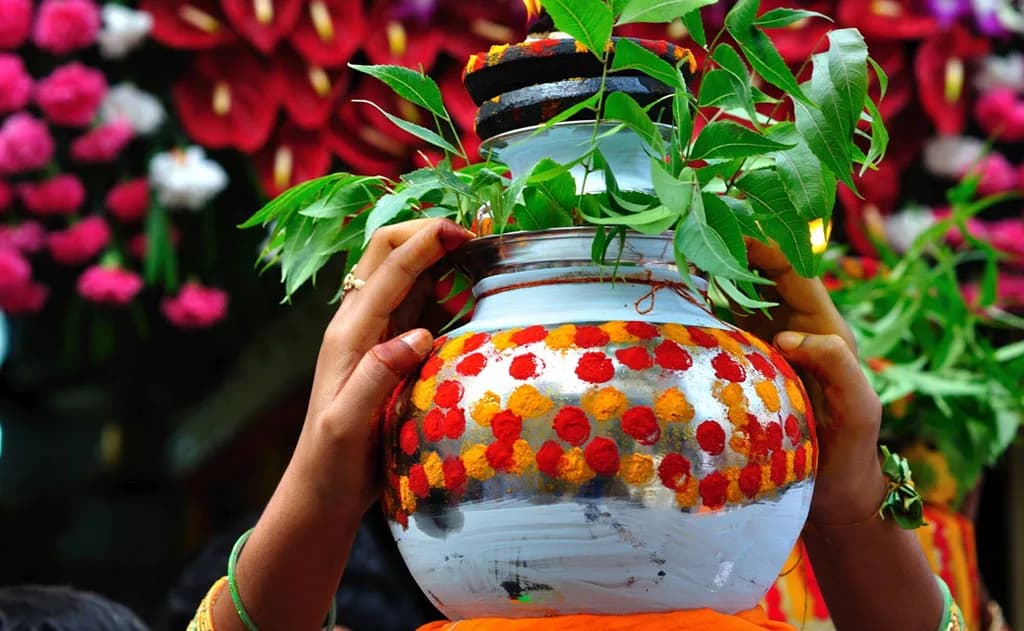
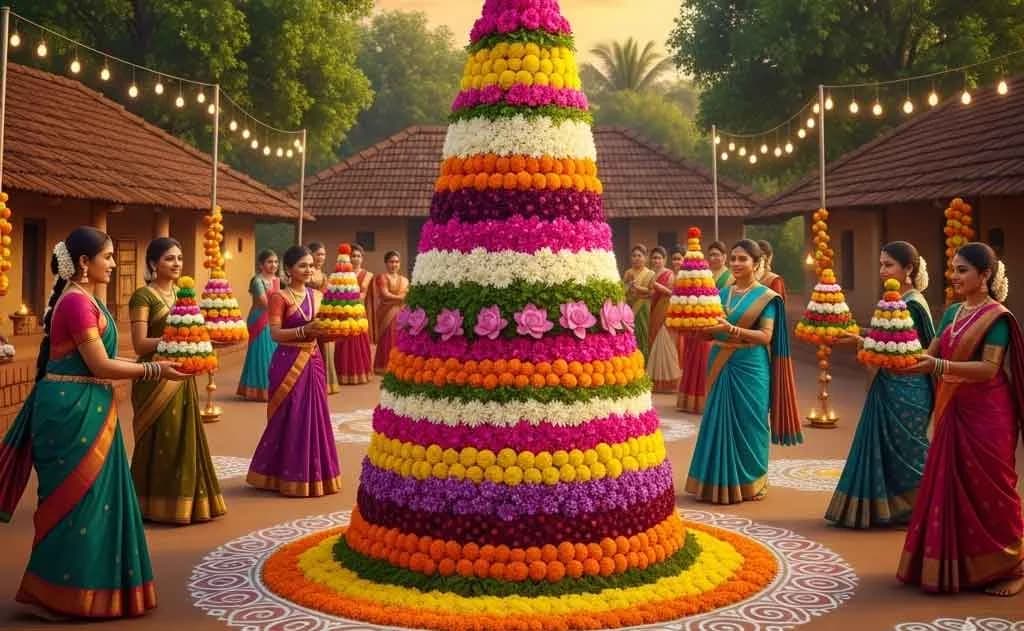
Women in deep red, bright pink, or golden yellow sarees balance large earthen Bonam pots filled with cooked rice or pongal, jaggery, coconut, fresh neem leaves, and a lit diya atop. They walk barefoot in single file from the village edge to the shrine, accompanied by drums, Janapada Geethalu (folk songs), young girls scattering petals, and elder women leading the chants.
What this procession means: the pot is a living symbol of the goddess — the woman carrying it is the goddess for that sacred moment. Many Telangana women describe this as one of the most profound spiritual experiences of their lives — when the goddess is felt not outside them but moving through them. This same pot-carrying tradition is the direct ancestor of Hyderabad’s Bonalu.
Phase 4 — The main puja and offerings
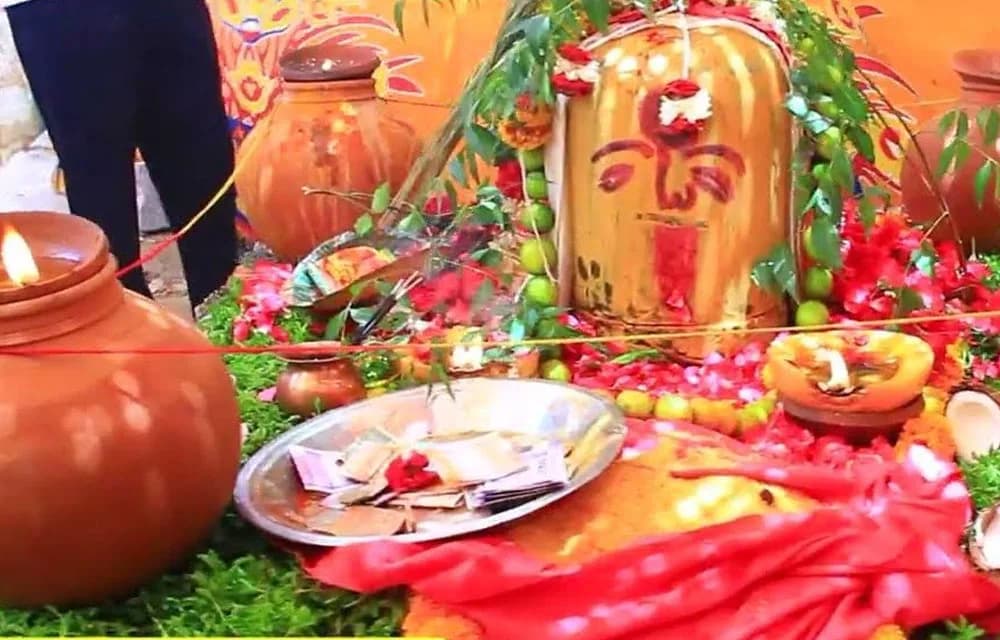
Turmeric Abhishekam to the murti or sacred stone.
Kumkum Archana — each name of the goddess offered with red kumkum.
Neem Archana — the goddess’s own tree, garlanded.
Deepa Aradhana — 9 or 21 lights waved in circular patterns.
AdvertisementNaivedyam — pongal, coconut, jaggery rice, seasonal fruits, marigold/jasmine/hibiscus.
Chakra Puja — a yantra in rice flour and red powder, circumambulated 3, 7, or 21 times.
Phase 5 — Janapada Kala (the folk-art evening)
The village square becomes a living stage. Koya Doli drum performances summon the goddess; Dappu — Telangana’s iconic large frame drum — is played through the night by Madiga community performers; Oggu Katha, the state’s greatest oral storytelling form, sees a single artist accompany himself on the Oggu (bowed string instrument) while narrating the goddess’s mythology in sung verse for 3–6 hours; Veedhi Bhagavatam street theatre, Chindu Bhagavatam devotional dance, and in Adilabad the spectacular peacock-feathered Gusadi Dance of the Gond community all converge during Bodrai.
Phase 6 — All-night Jagaran (the divine vigil)
Sunset–10 PM: community feast — everyone eats together regardless of caste.
10 PM–midnight: inter-village folk-song competitions judged by elders.
Midnight–2 AM: the most intense window — Pujari performs Ardha Ratri Puja and individual devotees approach for Prasna (divine consultation).
2 AM–dawn: continuing folk performances and bhajans until the final dawn puja.
Phase 7 — Visarjan and Grama Pradakshina
At dawn, the formal Visarjan releases the invoked divine presence back to her cosmic realm. The Kalasha is immersed in the nearest water body. The Pujari performs Grama Pradakshina — circumambulating the entire village boundary with sacred fire and neem branches — and finally, every household receives prasadam. No one is left out.
The deities of Bodrai — who is worshipped?
Pochamma (Poleramma): the most universally worshipped village goddess in Telangana — protector from smallpox, cholera, and epidemic disease. Sacred offering: turmeric paste, neem garlands, cooked rice.
Maisamma (Mahishasura Mardini): the demon-slaying form of Goddess Durga — fierce protector of the weak.
Gangamma / Ganga Devi: the water goddess — honoured near rivers and tanks; central in Nalgonda and Khammam.
Yellamma / Renuka Devi: a pan-Deccan goddess — community protection, fertility, social justice.
Katta Maisamma: goddess of boundaries and thresholds — shrines at the village’s four cardinal entry points.
Bodrai foods — the sacred cuisine of community love
Food in Bodrai is a theological statement. Every dish carries ritual meaning, and the cooking itself — in massive earthen pots near the shrine — is a collective act of worship.
Pongal / Annam: first-fruits sacred rice offered before humans eat.
Chakara Pongali: sweet pongal made with new-harvest rice and jaggery.
Pulihora: tamarind rice — community-feast staple cooked in 4–6 ft earthen pots.
Nimmakaya Annam: lemon rice, distributed to children first.
Nuvvula Laddu: jaggery-sesame sweet, offered and shared as prasadam.
Senagala Guggilam: boiled black chickpeas — offered for protection from evil.
Kobbari Annam: coconut rice — white-purity offering.
Mamidikaya Pachadi: raw mango chutney — seasonal offering for the fierce goddess.
Perugu Annam: boiled rice with curd — cooling offering balancing the goddess’s fierce energy.
Bodrai’s social significance — the festival that breaks barriers
A folk tradition made mainstream
Historically, Bodrai belonged to farming, pastoral, and artisan communities — groups who maintained goddess worship while Sanskritic Brahminic traditions dominated elite religious discourse. The formation of Telangana State in 2014 gave new official recognition: the state-funded Janapada Kalajatara, the Telangana State Folklore University, and folk-art inclusion in school curriculums all stem from this revival.
Caste-transcending equality
Bodrai’s most historically significant feature is its radical equality: the feast is shared by all communities; folk performers from communities that faced discrimination hold the central, honoured position; prasadam is distributed without distinction; the all-night vigil has no better seat than another.
Bodrai as agricultural dharma
Bodrai expresses a theological truth that urban Hindu practice sometimes loses: the divine is not separate from the earth. The goddess does not live in a marble temple in a distant city — she lives in the village soil, in the roots of the neem tree, in the water of the village tank, in the bodies of the women who carry the pots. This radical immanence is Bodrai’s greatest philosophical gift to the broader Hindu tradition.
Bodrai in Hyderabad — the urban renaissance
Hyderabad has seen a remarkable revival of Bodrai in Musheerabad, Amberpet, Dilsukhnagar, LB Nagar, Kapra, Uppal, Malkajgiri, Kukatpally, and Secunderabad. Urban Bodrai events feature multi-day puja programmes, professional Oggu Katha performances, Dappu drum performances drawing hundreds, and community feasting arranged by neighbourhood committees. The Telangana government’s annual Janapada Kalajatara (Folk Art Festival) brings the full spectrum of village traditions — including Bodrai rituals, Oggu Katha, Dappu, Chindu Bhagavatam, and Gusadi dance — to urban audiences. For more on Hyderabad’s temple landscape, see our top temples in Telangana guide.
Bodrai vs Bonalu vs Bathukamma — how Telangana’s great festivals relate
Bodrai: the broad, ancient village goddess tradition — variable dates by community, all-night vigil, folk-art-centred. The root from which the others grew.
Bonalu (Shravan, Jul–Aug): Hyderabad-centric urban form — women carry food pots (Bonam) to Mahakali / Pochamma. Direct cousin of Bodrai’s pot procession.
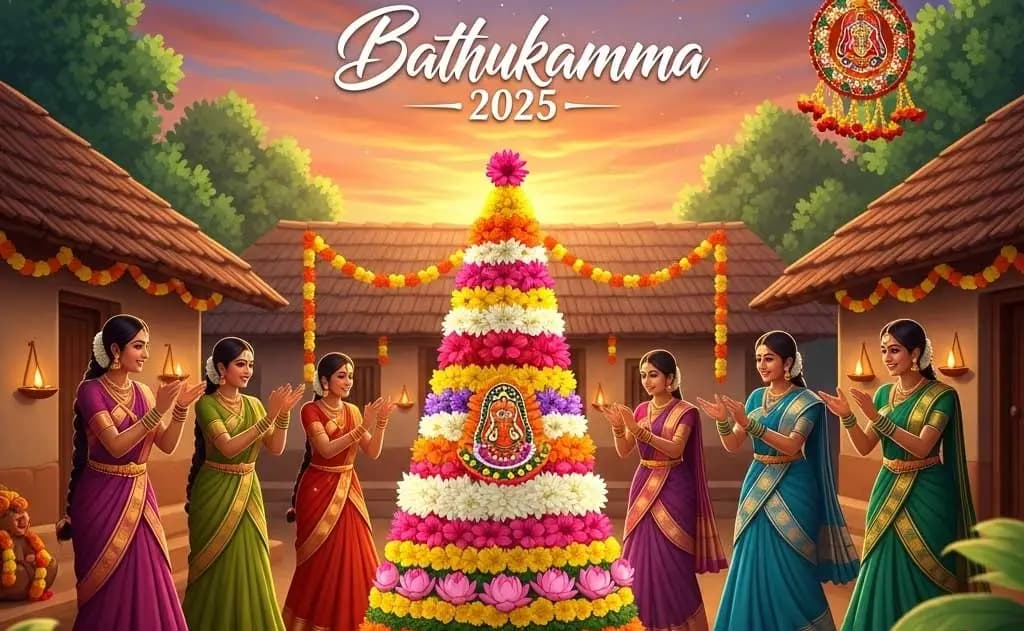
Bathukamma (Shravan–Ashwin): flower-stacking and water immersion — celebrating Goddess Gauri and nature. See our Bathukamma 2025 dates and rituals guide.
Sammakka–Saralamma Jathara (biennial, Magha): the world’s largest tribal pilgrimage — same folk-goddess devotion at massive scale.
Bodrai for the Telugu diaspora — USA, UK, Canada, Australia, GCC
How NRIs stay connected
Virtually: live-stream the village Bodrai via WhatsApp video; financially sponsor village arrangements; archive Oggu Katha performances on YouTube.
Locally: Telugu Associations in Dallas, Chicago, New Jersey, London, Sydney, Dubai, Toronto, and Melbourne organise Bodrai-themed cultural evenings during the season; folk performers from Telangana are increasingly invited.
Spiritually from abroad: on Bodrai day, perform a simple home puja to your Kula Devata — even if you don’t know the specific name, offer flowers, a lit lamp, and a sincere prayer to the divine mother who protects your lineage.
GCC Telugu community observance
The UAE, Qatar, Kuwait, Oman, and Bahrain Telugu communities organise Bodrai gatherings at Indian community centres and cultural halls in Bur Dubai, Sharjah, Abu Dhabi, and Al Ain, often with charity drives (anna daanam) timed to coincide with Bodrai. See also our Bathukamma celebrations around the world for parallel diaspora practices.
Bodrai visitor’s guide — first-time pilgrims
Where to go
Ask family connections in any Telangana village about their Bodrai date — more reliable than any directory.
Warangal, Karimnagar, and Nizamabad districts have the best-preserved Bodrai traditions.
Warangal Heritage Tourism maintains information on upcoming folk celebrations.
What to wear and how to behave
Women: cotton sarees in earth tones (ochre, turmeric yellow, deep red).
Men: dhoti or kurta in natural tones.
Photography: always seek the Pujari’s permission first.
No alcohol inside the celebration space.
Accept prasadam with both hands; remove footwear near the shrine without being asked.
Best times to experience
3:30 AM — the drum awakening; the most spiritually raw moment.
Sunrise — grand invocation and women’s procession.
Evening through midnight — folk performances at peak.
The future of Bodrai — preservation and revival
Challenges: rural outmigration, commercialisation with amplified sound and plastic, and economic pressure on Oggu Katha artists and Dappu players.
Reasons for hope: Telangana state government’s active folk-culture policy, digital documentation by community members on YouTube, second-generation diaspora reconnection, and academic attention from Osmania, Kakatiya University, and international institutions.
Why Bodrai matters to every Hindu
You may not be from Telangana. You may never have heard of Bodrai before today. But what this festival represents speaks to something universal in the Hindu experience: the divine is not only in grand marble temples. She is in the cracked earth of a dry village waiting for rain. She is in the calloused hands of the woman balancing a pot of offering on her head. She is in the all-night drumbeat that keeps the community awake together through darkness. She is in the equal distribution of food to every family, without exception.
Bodrai tells us that Hinduism was never — at its deepest roots — a religion of hierarchy and exclusivity. At its most authentic, it is a tradition of the community gathered around the divine fire, the divine drum, the divine mother — asking for protection, expressing gratitude, celebrating life’s fragile, precious, abundant gift. Remembering Bodrai is not nostalgia. It is the recovery of something essential — something the village has always known.
🌺 Jai Graama Devata · Jai Pochamma · Jai Maisamma · Jai Telangana Janapada Shakti 🙏
Frequently asked questions about Bodrai festival
What is Bodrai festival in Telangana?
Bodrai is a traditional folk celebration in Telangana centred around the worship of village goddess (Graama Devata) or community clan deity (Kula Devata). It involves rituals, women’s sacred pot processions, all-night vigils, folk-art performances including Oggu Katha and Dappu drumming, community feasting, and prayers for the village’s protection, health, and agricultural prosperity.
When is Bodrai celebrated in Telangana?
Bodrai does not have a single fixed date — it is celebrated at different times by different communities, most commonly during Jyeshtha Masam (May–June), Shravan (July–August), and post-harvest in Margashirsha (December). Each village or clan community follows its own ancestral calendar.
Which goddess is worshipped during Bodrai?
The most commonly worshipped deities are Pochamma (Poleramma), Maisamma, Gangamma, Yellamma (Renuka Devi), and Katta Maisamma — all forms of the divine mother goddess who protect the village from disease, drought, and evil.
What is the significance of the women’s pot procession in Bodrai?
Women carry earthen pots filled with sacred food as offerings to the goddess, walking barefoot from their homes to the shrine. The pot symbolises the goddess’s presence — the woman carrying it is considered the goddess’s living embodiment during that sacred journey. It is the most visually spectacular and spiritually powerful part of Bodrai.
How is Bodrai different from Bonalu?
Bonalu (observed in Hyderabad during Shravan) and Bodrai share deep roots — both involve women’s pot processions and goddess worship. Bodrai is considered the broader, older village tradition from which specific urban forms like Bonalu developed. Bodrai varies by village and community; Bonalu has a more standardised urban form.
What is Oggu Katha and its role in Bodrai?
Oggu Katha is a Telangana folk-art form where an artist narrates the goddess’s mythology in sung verse while playing the Oggu (bowed string instrument). It is Bodrai’s theological and storytelling backbone — keeping oral traditions alive across generations through performances lasting 3–6 hours.
How can Telugu diaspora NRIs in USA, UK, Canada, Australia, and GCC participate in Bodrai from abroad?
NRIs can: live-stream their village’s Bodrai via video call, financially support village celebration arrangements, cook traditional Bodrai prasadam dishes at home, connect with Telugu cultural associations in their city for local cultural events, and perform a home puja to their Kula Devata on Bodrai day.
Is Bodrai only for specific castes or communities in Telangana?
No — Bodrai is known for its inclusive, caste-crossing character. The community feast is shared equally by all. Folk performers from communities that faced discrimination hold the most honoured positions. Prasadam is distributed without caste distinction. This radical equality before the goddess is one of Bodrai’s most historically significant features.
Disclaimer: Bodrai celebrations vary significantly by district, village, community, and family tradition. This article presents a comprehensive overview. Specific rituals and dates should be confirmed with local community elders or village priests.
Bookmark this page and explore our wider Telangana festivals and folk traditions library on HinduTone.
You might also like
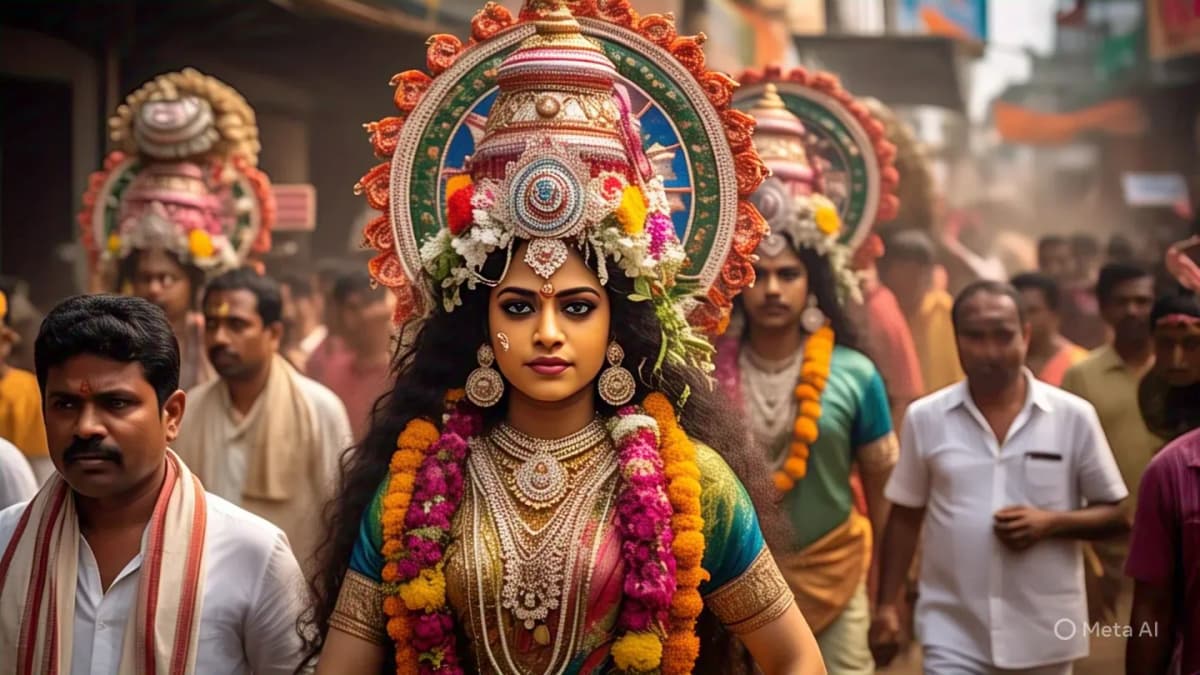
Bonalu Festival: A Sacred Tribute to Telangana's Fierce Goddess
7 Must-Visit Temples for Bonalu: Discover Their Divine Legends
Bathukamma: Telangana's Floral Festival Celebrating Feminine Energy