Wedding Rituals Compared: Hindu Vivah, Nikah, Christian, Buddhist, Jain and Sikh Weddings
What actually makes a couple married in each tradition? A respectful guide to the Hindu vivah with kanyadaan and saptapadi, the Islamic nikah, Christian weddings, Buddhist blessings, Jain ceremonies and the Sikh Anand Karaj, with a comparison table and practical etiquette for guests at an interfaith wedding.
What actually makes a couple married in each tradition? A respectful guide to the Hindu vivah with kanyadaan and saptapadi, the Islamic nikah, Christian weddings, Buddhist blessings, Jain ceremonies and the Sikh Anand Karaj, with a comparison table and practical etiquette for guests at an interfaith wedding.
Quick answer: A Hindu vivah is a sacred samskara centred on the fire, with kanyadaan and the seven steps of saptapadi. An Islamic nikah is a covenant and contract based on consent, mahr and witnesses. A Christian wedding centres on vows before God, and is a sacrament in Catholic and Orthodox churches. Buddhist weddings are largely civil and cultural, often blessed by monks. A Jain wedding resembles a Hindu one with Jain prayers, and the Sikh Anand Karaj is solemnised by four rounds (laavan) around the Guru Granth Sahib.
Why compare weddings?
Weddings are where many NRI families meet other traditions most closely: a college friend's nikah, a colleague's church wedding, a Sikh neighbour's Anand Karaj. Knowing what each ceremony means helps guests take part respectfully. This introductory guide describes each tradition as its own followers and scholars describe it, without ranking. Every tradition has regional, denominational and family variation, so the details below are typical rather than universal.
Hindu vivah: a sacred samskara
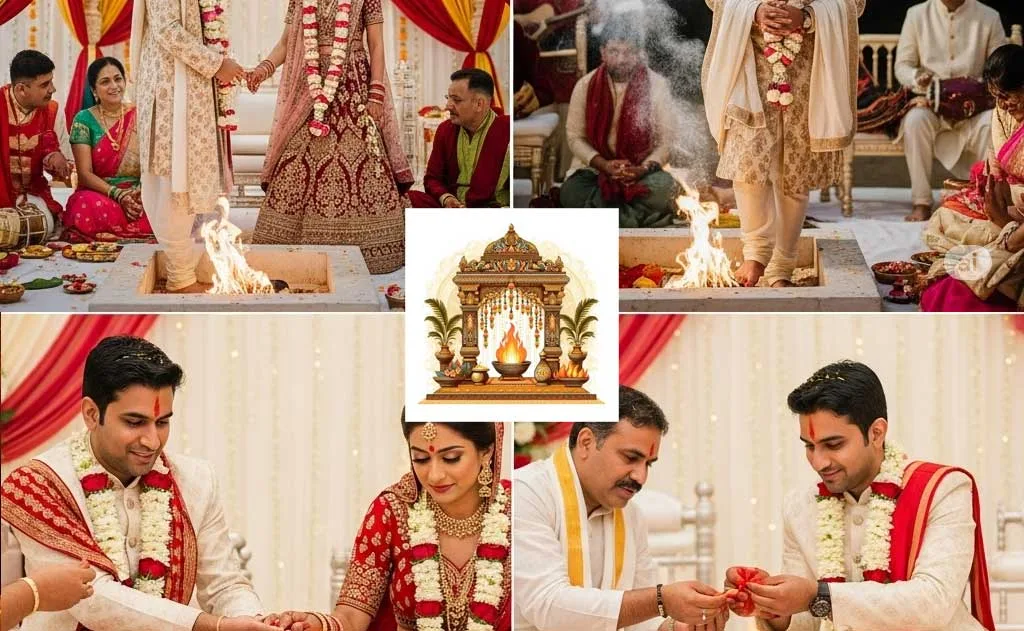
In Hindu tradition, vivaha is one of the principal samskaras (life-cycle sacraments). Marriage is understood as a lifelong partnership in dharma, in which husband and wife perform religious duties together. The rites draw on the Vedic Grihya Sutras, with the sacred fire (Agni) as divine witness. Common elements include:
- Kanyadaan: the bride's parents give their daughter in marriage, considered a deeply meritorious act.
- Panigrahana: the groom takes the bride's hand, accompanied by Vedic mantras.
- Agni and pheras: offerings into the fire, and circling it, often four or seven times depending on community.
- Saptapadi: seven steps taken together, each with a blessing; many traditions regard the marriage as complete with the seventh step.
- Mangalsutra and sindoor: the groom ties the mangalsutra (thali in much of South India) and, especially in North and East India, applies sindoor.
Regional customs are rich and varied: Telugu weddings include jeelakarra-bellam (cumin and jaggery placed on each other's heads) and talambralu (showering rice); Bengali weddings have shubho drishti, the first auspicious glance; Gujarati weddings have the hasta milap; Tamil weddings often include the oonjal (swing) and kashi yatra. The divine marriage of Sita and Rama is a beloved model; see Vivah Panchami and Sita Rama Kalyanam at Bhadrachalam.
Islamic nikah: covenant, consent and mahr
The Quran describes spouses as a source of tranquillity for each other, joined by love and mercy, and as garments for one another. Marriage is strongly encouraged following the example (sunnah) of the Prophet Muhammad. The nikah has a few essential elements:
- Consent: both bride and groom must freely agree; an offer and acceptance (ijab and qabul) are spoken.
- Mahr: a gift from the groom to the bride, which becomes her own property; it may be money, jewellery or something agreed between them.
- Witnesses: Sunni schools require witnesses; Shia jurisprudence recommends but does not strictly require them for the nikah itself.
- Guardian (wali): several schools of law require the bride's guardian to be involved, while the Hanafi school allows an adult woman to contract her own marriage.
- Sermon and celebration: an imam or officiant often gives a short khutbah and recites Quranic verses and prayers; the walima is a celebratory meal hosted afterwards.
Cultural customs around the nikah, such as mehndi or a baraat, vary by country and community. See Hinduism and Islam compared.
Christian weddings: vows before God
Christians often cite Genesis, where a man and woman become one flesh, and the Letter to the Ephesians, which compares marriage to Christ's love for the church. A reading from Paul's description of love in First Corinthians is popular at weddings.
- Catholic: marriage is one of the seven sacraments. In the Latin Church the couple themselves are understood to be the ministers of the sacrament, exchanging consent before a priest or deacon and witnesses, often within a Nuptial Mass.
- Orthodox: the Service of Crowning, in which the priest places crowns on the bride and groom, followed by a common cup and a procession around the table, expresses the couple's shared life in God's kingdom. Rings are blessed in the betrothal service.
- Protestant: marriage is usually understood as a holy covenant rather than a sacrament; services centre on Scripture, the exchange of vows (such as promising to love and cherish for better or worse until parted by death), rings and a blessing.
Indian Christian weddings often include local customs, such as the thali or minnu in Kerala Christian traditions. See Hinduism and Christianity compared.
Buddhist weddings: blessings rather than rites
The Buddhist scriptures contain no wedding ceremony, and monks traditionally do not officiate at marriages. Marriage is generally treated as a civil and family matter, but ethics for married life are taught: the Sigalovada Sutta, for example, describes mutual duties of respect, faithfulness and care between husband and wife. In practice, couples in many countries invite monks to chant protective verses (paritta) and receive offerings, often on a separate occasion. Local customs include the Sri Lankan poruwa ceremony on a decorated platform and the Thai custom of elders pouring blessed water over the couple's hands. Some Mahayana communities in Japan and elsewhere have developed temple wedding services. See Hinduism and Buddhism compared.
Jain weddings: familiar rites, Jain prayers
Jain weddings share much of their structure with Hindu weddings in the same region, including pheras around a fire, but the prayers and focus are Jain. The Navkar Mantra, honouring the five supreme beings, is recited, Tirthankaras are worshipped, and the ceremony is led by a Jain ritualist. Marriage is seen as a householder's commitment to living by the lay vows, including ahimsa and faithfulness. Many Jain families serve food that follows Jain dietary rules. See Hinduism and Jainism compared.
Sikh Anand Karaj: four rounds around the Guru
The Anand Karaj (blissful union) takes place in the presence of the Guru Granth Sahib, usually in a gurdwara and typically in the morning. The bride's father places one end of a scarf (palla) in the groom's hand and the other in the bride's. As each of the four laavan, hymns composed by Guru Ram Das, is read and then sung, the couple walks clockwise around the Guru Granth Sahib. The laavan describe stages of the soul's union with God, mirrored in the couple's union. The ceremony concludes with the Anand Sahib, Ardas and karah prashad.
A line often quoted from the Guru Granth Sahib teaches that true husband and wife are not those who merely live together, but those who are one light in two bodies. The Sikh Rehat Maryada also discourages dowry and the consulting of horoscopes for fixing the date. See Hinduism and Sikhism compared.
Comparison table
| Tradition | Name of rite | Central act | How marriage is understood | Internal diversity |
|---|---|---|---|---|
| Hinduism | Vivah | Saptapadi before Agni; kanyadaan; mangalsutra | Samskara; partnership in dharma | Many regional and community rites |
| Islam | Nikah | Consent (ijab and qabul), mahr, witnesses | Sacred covenant and contract | Sunni and Shia schools differ on details |
| Christianity | Holy Matrimony | Exchange of vows; crowning in Orthodox rite | Sacrament (Catholic, Orthodox) or covenant (most Protestant) | Catholic, Orthodox, Protestant |
| Buddhism | No single rite | Civil marriage, monks' blessings, local customs | Social commitment guided by ethics | Varies by country |
| Jainism | Vivah with Jain prayers | Pheras, Navkar Mantra, Tirthankara worship | Householder commitment to lay vows | Digambara, Svetambara, regional |
| Sikhism | Anand Karaj | Four laavan around the Guru Granth Sahib | Union of two souls with God at the centre | Largely uniform rite |
Common ground and genuine differences
Common ground: almost every tradition treats marriage as a sacred, lifelong commitment, involves families and community, asks for divine blessing, and celebrates with a shared meal. Differences are also clear: the Hindu and Jain fire, the Sikh centring on the Guru Granth Sahib, the contractual clarity of the nikah, the sacramental theology of Catholic and Orthodox churches, and the Buddhist view of marriage as primarily a social matter blessed by the sangha.
For families and friends: interfaith wedding etiquette
- Dress: dress modestly. At a gurdwara, everyone covers their head and removes shoes; carry a scarf or bandana. At a mosque, women may be asked to cover their hair. Bright colours suit most Hindu, Sikh and Jain weddings; check whether to avoid black or white.
- Timing: Hindu ceremonies can be long, and the muhurat may fall early or late; it is fine to step out quietly. Sikh ceremonies usually start on time in the morning.
- Participation: observe quietly unless invited to join; you may be offered prasad or karah prashad, which you can accept with cupped hands.
- Gifts: cash in a card is common at Indian weddings; registries are common at Christian ones. Avoid alcohol as a gift for Muslim, Sikh or Jain couples.
- Food: expect vegetarian food at gurdwaras and Jain weddings, and halal food at Muslim celebrations; no alcohol at many.
Frequently asked questions
What is the most important moment in a Hindu wedding?
In most Vedic-style ceremonies it is the saptapadi, the seven steps the couple take together before the sacred fire, each with a blessing for food, strength, prosperity, happiness, children, long life together and friendship. Many families also regard kanyadaan, the tying of the mangalsutra or the application of sindoor as essential, depending on region and community.
Is a nikah a religious ceremony or a contract?
Both, in a sense. Muslims understand nikah as a sacred covenant before God and also as a contract with clear terms: free consent of both parties, a mahr (marriage gift) to the bride, and witnesses. It is commonly accompanied by a short sermon, recitation from the Quran and prayers, and is often followed by a walima feast.
Why is marriage a sacrament for some Christians but not others?
Catholic and Orthodox churches count marriage among the sacraments, believing that Christ's grace is given through it and that it reflects his love for the church. Most Protestant churches regard marriage as a holy covenant or ordinance instituted by God but not a sacrament in the same technical sense. All treat it as a lifelong, sacred commitment.
Do Buddhists have a religious wedding ceremony?
Buddhism has no single wedding rite in its scriptures, and in many Buddhist countries marriage is treated as a civil and family matter. Couples often invite monks to chant blessings, before or after the ceremony, and follow local customs such as the Sri Lankan poruwa ceremony or Thai water-pouring blessing.
What is the Sikh Anand Karaj?
Anand Karaj, the blissful union, is the Sikh wedding ceremony held in the presence of the Guru Granth Sahib. As the four laavan, hymns composed by Guru Ram Das, are read and sung, the couple walks around the Guru Granth Sahib four times. The ceremony ends with Ardas (prayer) and karah prashad.
What should I give as a gift at an Indian wedding?
Cash in a card is common at Hindu, Sikh and Jain weddings, often in amounts ending in one, such as 101 or 501, which many families consider auspicious. A gift registry is common at Christian weddings. Avoid giving alcohol to Muslim, Sikh or Jain couples, and when unsure, ask a family member.
Editor's note (9 October 2026)
This page is an introductory comparison for general readers. Wedding rites vary enormously within each tradition, by region, denomination, school of law and family custom, and this guide describes typical practice as mainstream followers and scholars describe it, paraphrasing scripture rather than quoting it. For the details of a specific ceremony, please consult the officiating priest, imam, pastor, Buddhist teacher, Jain ritualist or granthi.
Related guides
You might also like

Worship Compared: Hindu Puja, Islamic Salah, Christian Mass, Buddhist, Jain and Sikh Worship
Dietary Practices Compared: Sattvic, Jain, Buddhist, Halal, Christian and Sikh Food Traditions
Monastic Life Compared: Sannyasa, the Buddhist Sangha, Jain Monks and Christian Monasticism