Dietary Practices Compared: Sattvic, Jain, Buddhist, Halal, Christian and Sikh Food Traditions
What do Hindus, Jains, Buddhists, Muslims, Christians and Sikhs eat and avoid, and why? A respectful introduction to sattvic food and vegetarianism, the Jain diet, Buddhist monastic rules, halal and haram, Christian fasting and Sikh langar, with a comparison table and practical tips for hosting interfaith guests.
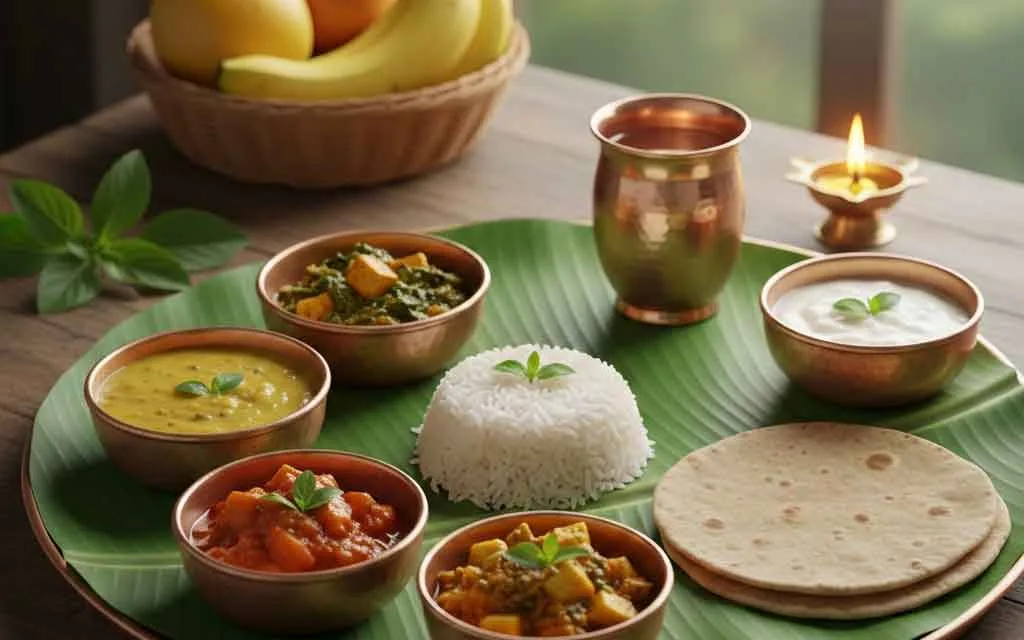
What do Hindus, Jains, Buddhists, Muslims, Christians and Sikhs eat and avoid, and why? A respectful introduction to sattvic food and vegetarianism, the Jain diet, Buddhist monastic rules, halal and haram, Christian fasting and Sikh langar, with a comparison table and practical tips for hosting interfaith guests.
Quick answer: Food is part of spiritual life in almost every faith, but the reasons differ. Hindus often favour sattvic vegetarian food and avoid beef, though many eat meat. Jains keep the strictest vegetarianism, rooted in ahimsa, and many avoid root vegetables and eating after sunset. Buddhist practice ranges from monks eating whatever alms they receive to fully vegetarian Mahayana monasteries. Muslims eat halal food and avoid pork and alcohol. Christians have few permanent food laws but keep fasts such as Lent. Sikh gurdwaras serve vegetarian langar, and the Sikh code of conduct prohibits kutha meat.
Why food matters in religion
For many NRI families, food is where interfaith life becomes practical: a school lunch, an office party, a wedding buffet or a neighbour's dinner invitation. This introductory guide describes each tradition as its mainstream followers and scholars describe it, without ranking any of them. Every tradition has internal diversity, and individual families observe rules more or less strictly, so the best practice is always to ask rather than assume.
Hindu food: sattvic, vegetarian and vrat traditions
The Bhagavad Gita (chapter 17) describes three qualities of food. Sattvic foods are fresh, nourishing and pleasant, and are said to promote clarity, health and calm. Rajasic foods are very spicy, sour or salty and are linked with restlessness, while tamasic foods are stale, spoiled or impure and are linked with dullness. Many Hindus also count onion and garlic as rajasic or tamasic, and some Vaishnava families and temple kitchens avoid them.
Vegetarianism is common and widely admired, rooted in ahimsa and in the practice of offering food to God as naivedya before eating it as prasada. It is not universal: dietary customs have long varied by region, community and family, and fish is a staple for many Hindus in Bengal, Odisha, Kerala, Goa and coastal Karnataka, among others. Beef avoidance is very commonly observed because of the deep reverence for the cow.
Vrat (fasting) foods form a separate category. On Ekadashi, during Navratri or on other vrat days, many people avoid grains and pulses and eat foods such as sabudana, buckwheat (kuttu), water chestnut flour (singhara), potatoes, fruit, milk and rock salt. See our Navratri fasting rules and Karthika Masam food rules for examples.
The Jain diet: non-violence at every meal
Jainism applies ahimsa (non-violence) to food more thoroughly than any other tradition. Jains classify living beings by the number of senses they possess and seek to harm as few as possible. Meat, fish and eggs are excluded, as are alcohol and, for most observant Jains, honey.
- Root vegetables: many observant families avoid potatoes, onions, garlic, carrots and other roots, because roots are understood to harbour countless micro-organisms and uprooting kills the whole plant.
- Eating before sunset: many Jains, especially during festivals such as Paryushana, avoid eating after sunset (a practice often called chauvihar) to avoid harming insects at night.
- Filtered water and fresh food: water is often filtered or boiled, and food that has fermented or been kept too long may be avoided.
- Diversity: Digambara and Svetambara Jains share these principles; strictness varies between families and increases during fasts. Some younger Jains abroad also avoid dairy for ethical reasons.
Monks and nuns take alms only in ways that ensure no food was prepared especially for them. See ahimsa in Hinduism, Jainism and Buddhism and Hinduism and Jainism compared.
Buddhist approaches to food
Buddhism has no single diet. The first precept, to refrain from taking life, and the precept to abstain from intoxicants guide many lay Buddhists.
- Theravada (Sri Lanka, Thailand, Myanmar and nearby countries): monks traditionally receive alms and eat what is offered, usually before midday. The monastic rules (Vinaya) allow meat if the monk has not seen, heard or suspected that the animal was killed for him, and forbid certain kinds of meat. Many lay Buddhists are vegetarian on observance days.
- Mahayana (China, Taiwan, Vietnam, Korea): several Mahayana sutras encourage compassion-based vegetarianism, and Chinese, Vietnamese and Korean monastics are generally vegetarian. Many also avoid pungent vegetables such as onion and garlic.
- Vajrayana (Tibetan and Himalayan Buddhism): meat has historically been eaten where few crops grow, though many teachers encourage vegetarianism.
Islam: halal and haram
In Islam, halal means permitted and haram forbidden. The Quran forbids carrion, blood, pork and meat dedicated to anything other than God, while allowing what is necessary in genuine need, and it prohibits intoxicants. For meat to be halal, the animal is slaughtered with a swift cut while God's name is invoked, a method called zabiha. Muslims see these rules as obedience to God and an expression of gratitude for food.
There is internal diversity. Sunni schools of law and Shia scholars differ on details such as which seafood is permitted and whether meat slaughtered by Christians and Jews (People of the Book) is acceptable. Individual Muslims also differ in how strictly they check certification, ingredients such as gelatine, and shared cooking equipment. A vegetarian meal cooked without alcohol is generally acceptable to Muslim guests.
Christianity: freedom and fasting
The New Testament records Jesus teaching that what goes into the mouth does not make a person unclean, and early church leaders decided that non-Jewish believers need not keep the Jewish dietary laws. So most Christians have few permanent food rules. Food matters through fasting, feasting and the Eucharist.
- Catholic: fasting and abstinence from meat on certain days of Lent; fish is traditionally allowed.
- Eastern Orthodox and Oriental Orthodox: frequent fasts, often on Wednesdays and Fridays and in long seasons, from meat, dairy, eggs and sometimes fish, wine and oil. Ethiopian Orthodox Christians also avoid pork.
- Protestant: practice varies widely; some churches encourage fasting, Seventh-day Adventists often promote vegetarianism, and some churches ask members to avoid alcohol.
See fasting across religions for a fuller comparison of vrat, Ramadan, Lent and Paryushana.
Sikhism: langar and the prohibition of kutha meat
The langar, begun by Guru Nanak and established by his successors, is a free kitchen at every gurdwara where people of all backgrounds sit together and share a vegetarian meal, expressing equality and service (seva). The Sikh Rehat Maryada (code of conduct) prohibits tobacco and intoxicants and forbids eating kutha meat, commonly explained as meat from an animal killed by a ritual method. Sikhs differ on meat otherwise: some eat meat from animals killed with a single blow (jhatka), while many Amritdhari (initiated) Sikhs and several Sikh groups are fully vegetarian. See Hinduism and Sikhism compared.
Comparison table
| Tradition | Main principle | Commonly avoided | Fasting or special practice | Internal diversity |
|---|---|---|---|---|
| Hinduism | Sattvic food, ahimsa, offering food to God | Beef (very common); meat for vegetarian families; onion and garlic for some | Vrat foods on Ekadashi, Navratri and other days | Wide regional and family variation |
| Jainism | Ahimsa to all living beings | Meat, fish, eggs, alcohol, honey; root vegetables for many | No food after sunset for many; Paryushana fasts | Digambara and Svetambara; varying strictness |
| Buddhism | Do not take life; mindfulness | Intoxicants; meat for many Mahayana monastics | Monks often eat before midday | Theravada, Mahayana, Vajrayana differ |
| Islam | Halal and haram as divine command | Pork, blood, carrion, alcohol, non-zabiha meat | Daytime fasting in Ramadan | Sunni and Shia legal details differ |
| Christianity | Food is not unclean in itself | Few permanent rules; meat on certain fast days | Lent; frequent Orthodox fasts | Catholic, Orthodox, Protestant differ |
| Sikhism | Equality and seva at langar | Kutha meat, tobacco, intoxicants | Langar is vegetarian | Views on meat vary |
Common ground and genuine differences
Common ground is substantial: gratitude for food, sharing with the hungry, self-discipline through fasting, and the conviction that eating is a moral and spiritual act. Several traditions also converge on avoiding intoxicants. Differences are real too: Hindu and Jain vegetarianism grows from ahimsa and purity; halal rules are understood as divine command; Christian practice centres on freedom with seasonal fasting; and Sikh langar emphasises equality. Respect means honouring each reason on its own terms.
For families and friends: hosting interfaith guests
- Ask, do not assume. A simple message such as "Do you have any food preferences or restrictions?" is welcome in every tradition.
- Label dishes clearly, especially those containing meat, egg, alcohol, gelatine, onion or garlic, and use separate serving spoons.
- A vegetarian meal without alcohol suits Hindu, Jain, Sikh, many Buddhist and most Muslim guests. For Jain guests, offer a dish without root vegetables and serve before sunset if they prefer.
- When explaining Hindu food to friends, keep it simple: "Many of us are vegetarian out of non-violence, we offer food to God first, and we avoid beef out of respect for the cow."
- When visiting a gurdwara langar, a temple or a mosque iftar, follow the hosts' guidance on head coverings, shoes and seating, and accept food graciously.
Also read: why the cow is sacred.
Frequently asked questions
Are all Hindus vegetarian?
No. Vegetarianism is widespread and highly respected in Hinduism, and many families, temples and Vaishnava communities keep it strictly, but many Hindus eat fish, eggs, chicken or mutton. Customs vary by region, community and family. Avoiding beef is very commonly observed out of reverence for the cow, and many meat-eating Hindus still keep vegetarian days, for example during Navratri, on Ekadashi or in Karthika Masam.
Why do many Jains avoid onions, garlic and potatoes?
Jain teaching holds that root vegetables contain a very large number of tiny living beings and that uprooting a plant destroys the whole plant and the organisms in the soil around it. To minimise harm, many observant Jain families avoid potatoes, onions, garlic, carrots and similar roots. Practice varies, and some Jains are less strict outside festival periods.
What does halal mean?
Halal means permitted. For food, Muslims avoid pork, blood, carrion, meat dedicated to anything other than God, and intoxicants such as alcohol. Meat is considered halal when the animal is slaughtered in the prescribed way (zabiha), with God's name invoked. Schools of Islamic law differ on some details, such as seafood and meat prepared by Christians and Jews.
Do Christians have any food rules?
Most Christians follow very few permanent food laws, since the New Testament teaches that food itself does not make a person clean or unclean. Many Christians fast or abstain at set times: Catholics abstain from meat on certain days of Lent, and Orthodox Christians keep frequent fasts from meat, dairy and other foods. Some churches, such as the Seventh-day Adventists, encourage vegetarian diets.
Is the food at a gurdwara langar vegetarian?
Yes. Langar, the free community kitchen at a gurdwara, serves vegetarian food so that everyone, of any faith or diet, can sit and eat together as equals. Visitors cover their heads, remove shoes and usually sit on the floor in rows.
How should I plan a meal for guests of several faiths?
Ask guests politely in advance, and do not assume. A vegetarian meal without eggs, alcohol or gelatine suits many guests; add clearly labelled halal meat dishes if you wish, keep serving spoons separate, and offer a no-onion, no-garlic or no-root-vegetable option for Jain or strict Vaishnava guests.
Editor's note (9 October 2026)
This page is an introductory comparison for general readers. It summarises food practices briefly, describes each tradition as its mainstream followers and scholars do, and paraphrases scripture rather than quoting it. Observance varies widely within every faith and family. For guidance on your own practice, please consult teachers of each tradition: a priest or acharya, a Jain monk or scholar, a Buddhist teacher, an imam, a pastor or priest, or a granthi.
Related guides
- Fasting across religions: vrat, Ramadan, Lent and Paryushana
- Ahimsa: non-violence in Hinduism, Jainism and Buddhism
- Worship compared: puja, salah, Mass, Buddhist and Jain puja
- Hinduism and Islam: beliefs and practices compared
- Hinduism and Buddhism compared
- Hinduism and Christianity compared
- Monastic life compared: sannyasa, sangha, Jain monks and Christian monasticism
- Wedding rituals compared
You might also like
Non-Veg Allowed in Hinduism? A Comprehensive Analysis of Dietary Practices in Hindu Tradition

AI and the Sanskrit Revival in 2026: Language Models, Manuscript OCR, Translation Tools and What AI Still Gets Wrong

Can a Robot Perform Puja? Robot Aarti, AI in Rituals and What Hindu Tradition Says