Ahimsa (Non-Violence) in Hinduism, Jainism and Buddhism: Meaning, Scriptures and Practice Compared
Ahimsa, non-violence or non-harming, is shared by Hinduism, Jainism and Buddhism, but each tradition places it differently. A respectful guide to the Yoga Sutras' yamas, the Bhagavad Gita and its interpreters, Gandhi, the Jain vows, the Buddhist first precept and karuna, vegetarianism, and ahimsa today.
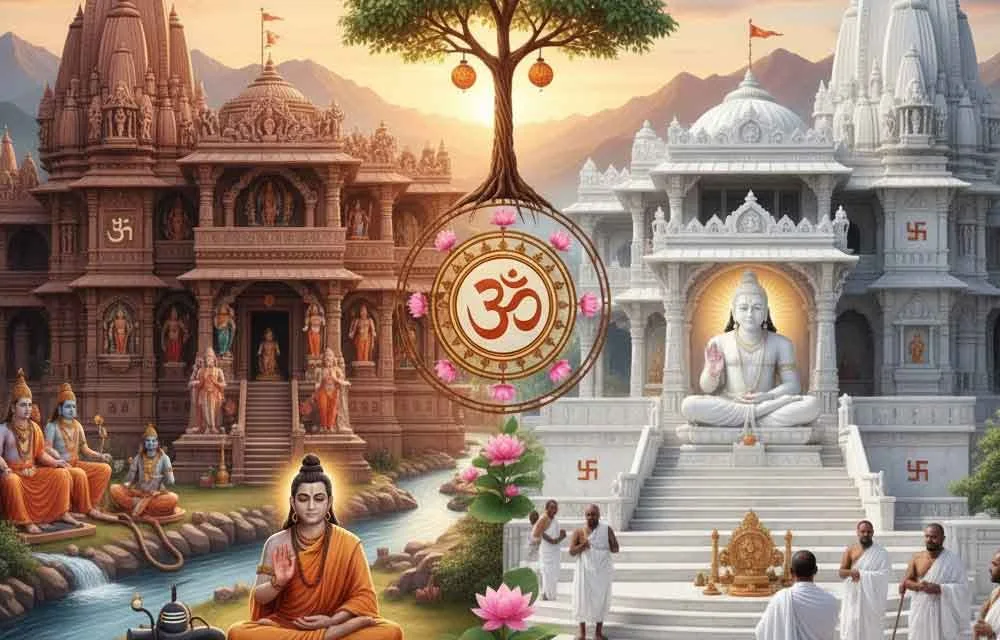
Ahimsa, non-violence or non-harming, is shared by Hinduism, Jainism and Buddhism, but each tradition places it differently. A respectful guide to the Yoga Sutras' yamas, the Bhagavad Gita and its interpreters, Gandhi, the Jain vows, the Buddhist first precept and karuna, vegetarianism, and ahimsa today.
Quick answer: Ahimsa means non-violence or non-harming in thought, word and deed. All three traditions honour it. In Hinduism it is a foundational virtue, the first of the yamas in the Yoga Sutras, held alongside dharma, so Hindu thinkers have long discussed how it relates to duty. In Jainism it is the central vow around which the whole religious life is built, extending to the smallest living beings. In Buddhism it is expressed in the first precept, to refrain from taking life, and in compassion (karuna) and loving-kindness (metta).
This guide describes each tradition as its own teachers and scholars usually do. It does not rank them, and each has real internal variety.
Ahimsa in Hinduism
Early sources
The idea of non-harming appears in the Upanishads; the Chandogya Upanishad, for example, lists non-injury among the virtues that form a person's true offering. The Mahabharata, the great epic, repeatedly praises ahimsa and contains the well-known phrase "ahimsa paramo dharmah", usually translated as "non-violence is the highest dharma", while the same epic also wrestles with war, justice and duty. Scholars note that ancient Vedic ritual included animal sacrifice, and that the growing emphasis on ahimsa over the centuries was shaped by the Upanishads, by bhakti traditions and by dialogue with Jain and Buddhist thought.
The Yoga Sutras: the first yama
In Patanjali's Yoga Sutras, the eight limbs of yoga begin with five yamas (restraints): ahimsa (non-harming), satya (truthfulness), asteya (not stealing), brahmacharya (restraint of the senses) and aparigraha (non-possessiveness). The sutras describe these as a "great vow" when kept universally, regardless of place, time or circumstance. Traditional commentators explain that ahimsa is placed first because the other yamas exist to support it. A later sutra says, in paraphrase, that when a person is firmly established in non-harming, hostility falls away in their presence.
The Bhagavad Gita and the question of duty
The Bhagavad Gita lists ahimsa among the divine qualities, among the marks of true knowledge and as part of the austerity of the body. Yet the Gita is spoken on a battlefield, and Krishna urges a reluctant Arjuna to fight. This has been discussed for centuries:
- Many classical commentators read the Gita as teaching svadharma, one's own duty: a warrior protecting dharma in a just war must act, but without hatred, greed or attachment to results.
- Others, including Gandhi, read the battle as an allegory of the inner struggle against selfishness and anger, and saw the Gita as a teaching of selfless action consistent with non-violence.
- Many Hindus hold both ideas together: ahimsa is the ideal and the default, while protection of the innocent and righteous order may sometimes require force, as a last resort and without malice.
For more on the Gita's teaching, see Gita Jayanti: lessons from the Bhagavad Gita.
Gandhi's interpretation
In modern times, Mahatma Gandhi made ahimsa widely known around the world. He described it not as passivity but as an active force of love and truth, practised through satyagraha (holding firmly to truth). He drew on the Gita, on the Jain ethos of his native Gujarat and his friendship with the Jain thinker Shrimad Rajchandra, and on other sources such as the Sermon on the Mount and Tolstoy.
Diversity in practice
Hindu practice of ahimsa varies across Vaishnava, Shaiva, Shakta and Smarta traditions and across regions. Many Hindus are vegetarian, some also avoid onion and garlic as part of a sattvic diet, and offerings to the deity in many temples are vegetarian. Many other Hindus eat meat or fish. Respect for the cow, care for animals and the idea that the same Self (Atman) dwells in all beings are widely shared themes.
Ahimsa in Jainism
For Jains, ahimsa is the heart of the religion. Jain teaching holds that countless souls (jiva) inhabit not only humans and animals but also insects, plants and, in very subtle forms, earth, water, fire and air. Harming any of them binds karma to the soul, so a Jain life is organised around minimising harm.
Vows: mahavrata and anuvrata
Jainism has five main vows: ahimsa, satya (truth), asteya (not stealing), brahmacharya (chastity) and aparigraha (non-possession). Monks and nuns take them as mahavratas (great vows), kept fully; lay Jains take them as anuvratas (lesser vows), kept as far as household life allows. The Tattvartha Sutra, accepted by both Svetambara and Digambara Jains, defines violence as taking life through careless or passion-driven activity, which is why intention and carefulness matter so much. A phrase from the same text, often translated as "souls render service to one another", is widely used as a Jain motto.
Ahimsa in daily life
- A strictly vegetarian diet, with no meat, fish or eggs; honey and alcohol are traditionally avoided.
- Many Jains avoid root vegetables, eat before sunset and filter or boil water, to reduce harm to small beings.
- Monks and nuns walk barefoot, carry a soft whisk to brush insects gently from their path, and many Svetambara monastics wear a mouth-cloth (muhpatti); Digambara monks carry a whisk of naturally shed peacock feathers.
- Ahimsa of thought is expressed in anekantavada, the teaching of many-sidedness, which encourages humility about one's own viewpoint.
Customs vary between Svetambara and Digambara traditions and among families. See Hinduism vs Jainism.
Ahimsa in Buddhism
In Buddhism, the first of the five precepts taken by lay followers is to refrain from taking life. Buddhists understand the precepts as training rules undertaken voluntarily, not commandments. A well-known verse of the Dhammapada, in its chapter on violence, teaches in paraphrase that all beings fear violence and death, so, seeing others as like oneself, one should neither kill nor cause others to kill.
- Karuna and metta: compassion and loving-kindness are two of the four "sublime states" (brahmaviharas) that Buddhists cultivate in meditation and daily life.
- Right livelihood: part of the Noble Eightfold Path; early texts advise lay followers against trading in weapons, living beings, meat, intoxicants and poisons.
- Intention: Buddhist ethics places strong weight on the intention (cetana) behind an action.
- Diet: Theravada monks traditionally eat what is offered; many Mahayana communities, drawing on sutras that discourage meat-eating, keep vegetarian monasteries; Tibetan practice varies.
See Hinduism vs Buddhism and Hinduism and Buddhism: shared roots.
Comparison table: ahimsa in three traditions
| Aspect | Hinduism | Jainism | Buddhism |
|---|---|---|---|
| Place of ahimsa | A foundational virtue; first yama; balanced with dharma | The central principle of the whole religion | First precept; expressed through compassion |
| Key texts | Upanishads, Mahabharata, Bhagavad Gita, Yoga Sutras | Agamas, Tattvartha Sutra | Tripitaka, Dhammapada, Mahayana sutras |
| Who is protected | All beings, since the Self dwells in all | All jivas, including plants and subtle beings | All sentient beings |
| Vows | Yamas for yoga practitioners; vows vary by tradition | Mahavratas (monastics), anuvratas (lay) | Five precepts (lay); Vinaya rules (monastics) |
| Diet | Varies widely; many vegetarian, many not | Strict vegetarian; many avoid root vegetables and eating after dark | Varies: Theravada eat what is offered; many Mahayana vegetarian |
| Use of force | Debated; just war for dharma vs. allegorical reading | Strongly avoided; intention and carefulness central | Strongly discouraged; emphasis on intention |
Common ground and real differences
All three traditions agree that harm rebounds on the doer through karma, that non-violence includes speech and thought, and that compassion for animals is a spiritual value. All three also gave India a long tradition of vegetarianism, though in different degrees.
The differences are real too. Jainism extends ahimsa furthest, to subtle forms of life, and makes it the organising principle of daily conduct. Hinduism holds ahimsa as a supreme virtue but places it within a wider framework of dharma, so its schools and teachers have debated questions such as the duty of protection. Buddhism emphasises the precept, intention and compassion within the Middle Way. Within each tradition, practice differs among schools and families.
Ahimsa today
- Animals: vegetarian and plant-based eating, animal shelters and gaushalas, and avoiding products made through cruelty.
- Environment: many Hindus, Jains and Buddhists see care for rivers, forests and climate as an extension of non-harming.
- Speech: avoiding harsh words, gossip and online abuse is commonly taught as ahimsa of speech, alongside satya, truthfulness.
- Inner life: yoga and meditation practitioners often start with ahimsa towards oneself, avoiding harshness and self-punishment.
For families and friends
For NRI children, ahimsa is often the easiest Indian idea to explain at school: "We try not to hurt any living being, by our actions, our words or even our thoughts." If a friend asks why your family is vegetarian, or only vegetarian on certain days, a short honest answer works best, and it helps to add that Hindu practice varies.
- When hosting Jain friends, ask in advance about root vegetables, honey and eating before sunset.
- When visiting a Buddhist temple or meditation centre, follow the hosts' lead; many are glad to explain the precepts.
- Avoid generalising about any community's diet or habits; ask individuals what they follow.
For how Sikh and Christian teachings approach related questions, see Hinduism vs Sikhism and Hinduism vs Christianity.
Also read: dietary practices compared and monastic life compared.
Also read: why the cow is sacred.
Frequently asked questions
What does ahimsa mean?
Ahimsa is a Sanskrit word usually translated as non-violence or non-harming. It is formed from a (not) and himsa (harm or injury). In Hinduism, Jainism and Buddhism it covers not only physical violence but also harm through words and, in many teachings, harmful intentions.
Are all Hindus vegetarian?
No. Many Hindus are vegetarian, often for reasons connected with ahimsa, purity or devotion, and some traditions avoid onion and garlic as well. Many other Hindus eat meat or fish. Practice varies by sampradaya, region, community and family, and Hindu scriptures and teachers have taken a range of views on diet.
Why do some Jains avoid root vegetables?
Many Jains avoid potatoes, onions, garlic, carrots and other root vegetables because uprooting a plant ends its life and is understood to harm the many tiny living beings in the soil and in the root itself. How strictly this is followed varies among Jain families and between Svetambara and Digambara communities.
Is Buddhism vegetarian?
Not uniformly. The first precept is to refrain from taking life. In Theravada tradition, monks traditionally eat what is offered, and the texts allow meat if they have not seen, heard or suspected that the animal was killed for them. Many Mahayana communities, especially in China, Vietnam, Korea and Taiwan, encourage or require vegetarianism for monastics, drawing on Mahayana sutras. Tibetan practice varies.
How does the Bhagavad Gita fit with ahimsa if it is set on a battlefield?
This is a long-standing question. The Gita lists ahimsa among the divine qualities, yet Krishna urges Arjuna to perform his duty as a warrior. Some interpreters read this as teaching duty in a righteous war, fought without hatred or selfish motive. Others, including Gandhi, read the battle as an allegory of the inner struggle between right and wrong. Hindu teachers continue to hold different views.
Did Gandhi take his idea of ahimsa from Jainism?
Gandhi drew on several sources. He grew up in Gujarat where Jain influence was strong and was close to the Jain thinker Shrimad Rajchandra, and he also drew on the Bhagavad Gita, the Sermon on the Mount and writers such as Tolstoy. He described ahimsa as an active force of love, not merely the absence of violence.
Editor's note (9 October 2026)
This page is an introductory comparison for general readers. Scriptures are paraphrased rather than quoted, and the descriptions are broad; they cannot capture every school, lineage or community. For deeper study or guidance on practice, please consult the teachers, monks, nuns and scholars of each tradition.
Related guides
You might also like

ISKCON’s Contribution to Vegetarianism and Ahimsa
AI and the Sanskrit Revival in 2026: Language Models, Manuscript OCR, Translation Tools and What AI Still Gets Wrong

Can a Robot Perform Puja? Robot Aarti, AI in Rituals and What Hindu Tradition Says