Moksha, Nirvana, Mukti, Salvation and Jannah: Liberation Compared Across Religions
What is the final goal of spiritual life? Hindus speak of moksha, Buddhists of nirvana, Jains of the liberated siddha, Sikhs of mukti, Christians of salvation and Muslims of Jannah. A respectful introduction to how each tradition understands liberation and how to reach it, with a comparison table.
What is the final goal of spiritual life? Hindus speak of moksha, Buddhists of nirvana, Jains of the liberated siddha, Sikhs of mukti, Christians of salvation and Muslims of Jannah.
Quick answer: Every religion describes a final goal, but they answer different questions. Hindu moksha, Buddhist nirvana, the Jain siddha state and Sikh mukti are forms of freedom from the cycle of rebirth. Christian salvation is reconciliation with God through grace and faith in Jesus Christ, leading to eternal life. Islamic salvation is entry to Jannah (paradise) by God's mercy, on the basis of faith and righteous deeds. Some goals are described mainly as a state, some as a place, and many as a relationship with God.
Different religions, different questions
The religions of Indian origin begin from samsara, the cycle of birth, death and rebirth driven by karma, and ask how to be free of it. Christianity and Islam begin from one earthly life lived before God and ask how a person is made right with God and enters eternal life. Recognising this difference prevents easy equations, such as "nirvana is just heaven", that followers of each faith would not accept. This guide describes each view as its own mainstream followers and scholars describe it, notes internal diversity, and does not rank them. For the mechanics of karma, see karma and rebirth compared.
Hindu moksha
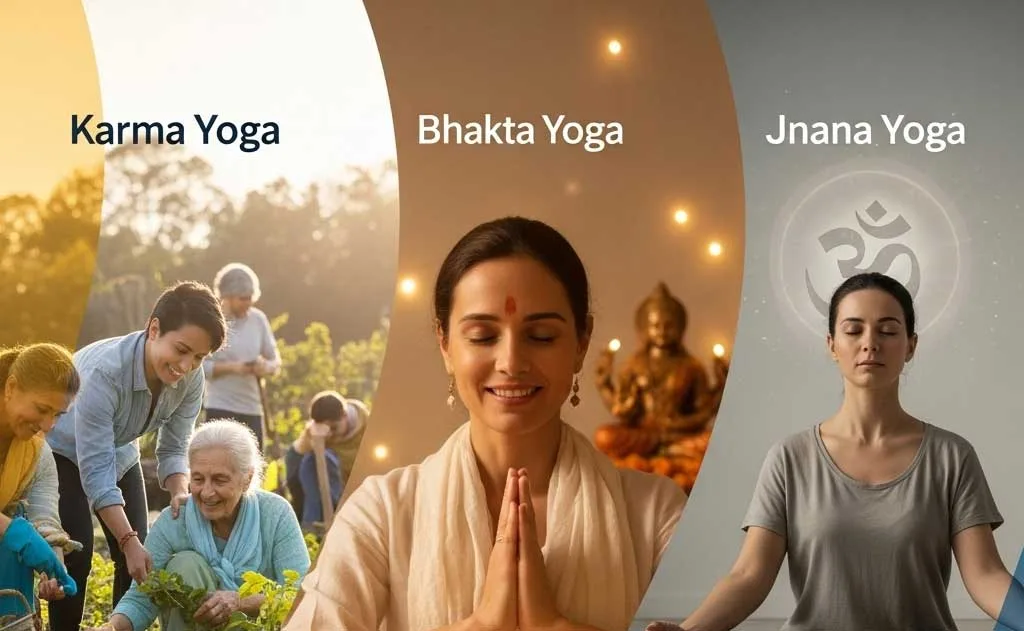
Moksha means release: freedom from samsara and from the ignorance and desire that bind the self (atman). The Bhagavad Gita and later teachers describe four complementary paths:
- Jnana yoga: the path of knowledge, discerning the eternal self from the changing body and mind.
- Bhakti yoga: loving devotion to God; the Gita's closing teaching invites Arjuna to take refuge in Krishna alone and be freed from all sins.
- Karma yoga: selfless action, offered to God without attachment to results.
- Raja yoga: disciplined meditation, systematised in Patanjali's Yoga Sutras, whose goal is called kaivalya, the self's isolation from matter.
What moksha is like depends on the school. In Advaita Vedanta, it is the realisation that the self is Brahman; nothing is gained except the removal of ignorance, and one may be liberated while living (jivanmukti). In Vishishtadvaita and Dvaita, the liberated soul keeps its individuality and lives eternally in loving service of God in Vaikuntha; God's grace is essential. Shaiva Siddhanta teaches that Shiva's grace frees the soul from its bonds so that it shares Shiva's bliss. See the Bhagavad Gita guide.
Buddhist nirvana
Nirvana (Pali nibbana) literally means "blowing out": the extinguishing of the fires of greed, hatred and delusion. It is reached through the Noble Eightfold Path of ethics, meditation and wisdom, and ends rebirth because craving no longer produces new karma. Buddhism teaches it without a permanent self or creator God, and the Buddha often described it by what it is not: unborn, unconditioned, beyond suffering.
Theravada Buddhists distinguish nirvana realised in life by the arahant from final nirvana (parinirvana) at death. Mahayana traditions emphasise the bodhisattva, who vows to help all beings to awakening, and teach that all beings have Buddha-nature; Pure Land Buddhists hope for rebirth in Amitabha Buddha's Pure Land, where awakening is easier. Vajrayana adds tantric practices aimed at awakening in this very life. See Hinduism vs Buddhism.
Jain moksha: kevala jnana and the siddha
For Jains, the soul (jiva) is naturally pure, all-knowing and blissful, but is weighed down by karmic matter. Through the Three Jewels of right faith, right knowledge and right conduct, and through vows, restraint and austerity, the soul stops new karma and sheds the old. When the destructive karmas are gone it attains kevala jnana, omniscience. At death, freed from all karma, the soul rises to Siddhashila at the summit of the universe and dwells forever as a siddha in infinite knowledge, perception, bliss and energy, without a body and without return.
Digambara and Svetambara Jains share this goal while differing on some questions, such as whether a soul in a woman's body can attain liberation in that life (Svetambaras say yes; Digambaras traditionally say a further birth is needed). Liberation is achieved by one's own effort, inspired by the Tirthankaras. See Hinduism vs Jainism.
Sikh mukti
In Sikhism, mukti is liberation from the cycle of rebirth and, more deeply, freedom from haumai (ego) and union with Waheguru, the one God. It comes through God's grace (nadar) and is lived out through Naam simran (remembering the Name), honest work, sharing and selfless service as a householder. Sikh teaching stresses jivan mukti, liberation while alive, and the Guru Granth Sahib often values loving devotion to God above any desire for liberation itself. See Hinduism vs Sikhism.
Christian salvation
Christians teach that all people need salvation from sin, which separates humanity from God, and that God provides it through the life, death and resurrection of Jesus Christ. The Letter to the Ephesians says that believers are saved by grace through faith, as a gift of God and not by their own works. The fulfilment of salvation is eternal life with God, including the resurrection of the body and a renewed creation.
Denominations explain this differently. Catholic teaching emphasises grace received through faith, baptism and the sacraments, with faith working through love; it also teaches purgatory as a final purification. Orthodox Christianity describes salvation as theosis, being transformed by grace to share in the divine life. Many Protestant churches emphasise justification by grace through faith alone. All describe heaven above all as communion with God. See Hinduism and Christianity.
Islamic salvation and Jannah
Muslims believe each person lives one life and will be raised on the Day of Judgement to account for their faith and deeds. Salvation rests on iman (faith in the one God, His angels, books, prophets, the Last Day and divine decree) and righteous deeds, and above all on God's mercy; a well-known hadith teaches that no one enters paradise by deeds alone, but by God's mercy. Jannah is described in the Quran as gardens beneath which rivers flow, a place of peace; many Muslims regard God's good pleasure, and in Sunni teaching the vision of God, as its highest joy. Sunni, Shia and Sufi traditions share this hope while differing on theological details. See Hinduism and Islam compared.
A state, a place or a relationship?
Placed side by side, the goals do not fall neatly into one category:
- Mainly a state: Advaita moksha, Buddhist nirvana, Sikh jivan mukti; liberation as a transformation of awareness, realisable in this life.
- Also a place: Vaikuntha in Vaishnava traditions, Siddhashila for Jains, Jannah in Islam, heaven and the new creation in Christianity.
- Above all a relationship: bhakti traditions, Sikhism, Christianity and Islam all describe the deepest fulfilment as nearness to, love of, or union with God.
Comparison table
| Tradition | Name of the goal | Freed from | How it is reached | Described as |
|---|---|---|---|---|
| Hinduism | Moksha | Samsara, ignorance, karma | Jnana, bhakti, karma and raja yoga; grace | Oneness with Brahman or eternal communion with God |
| Buddhism | Nirvana | Craving, suffering, rebirth | Noble Eightfold Path, wisdom, meditation | Unconditioned peace; no permanent self |
| Jainism | Moksha, siddha state | Karmic matter, rebirth | Three Jewels, vows, austerity | Pure soul at Siddhashila in infinite knowledge and bliss |
| Sikhism | Mukti | Haumai, rebirth | Grace, Naam simran, seva, honest living | Union with Waheguru, possible while alive |
| Christianity | Salvation, eternal life | Sin and death | Grace through faith in Christ; sacraments in many churches | Communion with God, resurrection, heaven |
| Islam | Salvation, Jannah | Punishment in the hereafter | Faith, righteous deeds, God's mercy | Paradise; God's good pleasure |
For families and friends
- If asked "What do Hindus hope for after death?", you might say: "Many Hindus believe we are reborn until we are freed by knowledge and love of God; that freedom is called moksha."
- Listen to how friends describe their own hope; Christians may speak of being saved, Muslims of God's mercy and paradise, Buddhists of awakening.
- At funerals and memorials of other faiths, attend respectfully, follow the family's customs and offer simple condolences rather than theological comments.
- Teach children that different religions ask different questions about life's purpose, and that respectful curiosity is a value every tradition honours.
A respectful conclusion
These traditions ask different questions: how to escape the cycle of rebirth, how to end suffering, how to free the soul from karma, how to overcome ego and merge with God, how to be reconciled to God, and how to stand before God on the Last Day. Their answers are not interchangeable, and honest comparison respects both the common ground (humility, compassion, devotion, ethical living) and the real differences.
Also read: life after death in five religions and monastic life compared.
Frequently asked questions
Are moksha and nirvana the same thing?
They are related but not identical. Both mean freedom from the cycle of rebirth. Hindu moksha is usually described as the self (atman) realising its unity with Brahman or entering eternal communion with God. Buddhist nirvana is the extinguishing of greed, hatred and delusion, taught without an eternal self or creator God. Each tradition explains its goal in its own terms.
What are the four paths to moksha?
Hindu teachers commonly describe four yogas: jnana yoga (the path of knowledge), bhakti yoga (devotion to God), karma yoga (selfless action) and raja yoga (meditation, as systematised in Patanjali's Yoga Sutras). Most practitioners combine them, and different schools emphasise different paths.
Do Christians and Muslims believe in liberation from rebirth?
No. Christianity and Islam teach that each person lives one earthly life, followed by resurrection and judgement. Christians speak of salvation, being reconciled to God through Christ and sharing eternal life with Him. Muslims speak of being admitted to Jannah, paradise, by God's mercy, on the basis of faith and righteous deeds. The question each answers is different from the question of escaping rebirth.
Can a person be liberated while still alive?
Several traditions say yes. Advaita Vedanta speaks of the jivanmukta, liberated while living; Buddhism of the arahant who has realised nirvana in this life; Jainism of the kevalin who has attained omniscience before final liberation at death; and Sikhism of jivan mukti, freedom while living through Naam. Christians and Muslims generally see the fulfilment of salvation in the life to come, though Christians also speak of new life in Christ beginning now.
Is the goal a place or a state?
It depends on the tradition and the school. Advaita describes a realisation rather than a place; Vaishnava schools speak of Vaikuntha, God's eternal abode; Jains of Siddhashila at the summit of the universe; Islam of Jannah as a real abode of reward; Christians of heaven, the beatific vision and a renewed creation. Many traditions add that the deepest reward is nearness to God, or freedom itself.
Editor's note (9 October 2026)
This page is an introductory comparison for general readers. It summarises profound teachings briefly, describes each as its mainstream followers and scholars do, and paraphrases scripture rather than quoting it. Every tradition contains many schools and views. For guidance, please consult qualified teachers of each tradition.
Related guides
- Karma and rebirth in Hinduism, Buddhism, Jainism and Sikhism
- Concept of God in Hinduism, Christianity and Islam compared
- Worship compared: puja, salah, Mass, Buddhist and Jain puja
- Diwali and Jainism: Lord Mahavira's nirvana day
- Gita Jayanti: lessons from the Bhagavad Gita
- Hinduism and Buddhism: shared roots and mutual influences
You might also like
Fasting Across Religions: Hindu Vrat, Ramadan, Lent, Paryushana, Buddhist and Sikh Views Compared

Avatar and Incarnation: Hindu and Christian Views Compared

The Concept of God in Hinduism, Christianity and Islam Compared