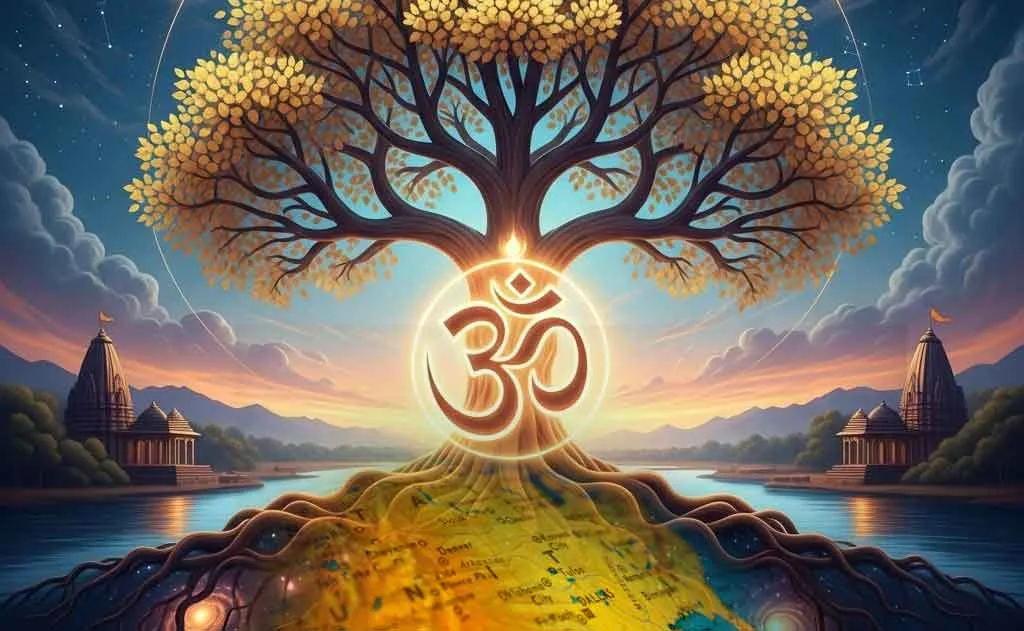
Life After Death in Hinduism, Buddhism, Jainism, Christianity and Islam
What happens after death? A respectful comparison of Hindu, Buddhist, Jain, Christian and Islamic teachings on the soul, rebirth, judgement, heaven and liberation, with funeral customs explained briefly and a gentle note for grieving families in interfaith settings.
What happens after death? A respectful comparison of Hindu, Buddhist, Jain, Christian and Islamic teachings on the soul, rebirth, judgement, heaven and liberation, with funeral customs explained briefly and a gentle note for grieving families in interfaith settings.
Quick answer: Hindus teach that the eternal self (atman) is reborn according to karma until it attains moksha. Buddhists teach rebirth without a permanent self, ending in nirvana. Jains teach that the soul (jiva) moves through four states of existence until, freed of karma, it becomes a siddha. Christians believe in one earthly life followed by judgement and the resurrection of the body, with heaven or hell, and in Catholic teaching purgatory. Muslims believe the soul waits in barzakh until the Day of Judgement, followed by Jannah or Jahannam. All five teach that how we live matters beyond death.
Why compare beliefs about death?
Death is the moment when religious difference is felt most tenderly. NRI families attend funerals of colleagues and neighbours, mixed-faith families make decisions together, and children ask what happened to a grandparent. This introductory guide describes each tradition as its own mainstream followers and scholars describe it, paraphrases scripture, and does not rank or judge. Each is internally diverse: Vaishnava, Shaiva and Shakta Hindus and different Vedanta schools; Theravada, Mahayana and Vajrayana Buddhists; Digambara and Svetambara Jains; Catholic, Orthodox and Protestant Christians; and Sunni and Shia Muslims, along with the Sufi tradition. A brief note on Sikh belief is included because many Indian families encounter it.
Hinduism: atman, rebirth, the ancestors and moksha
Hindu teaching begins with the atman, the self that is not born and does not die. In a much-loved passage of the Bhagavad Gita, Krishna compares death to a person setting aside worn-out clothes and putting on new ones: the self leaves one body and takes another. The kind of birth that follows is shaped by karma, the moral consequences of one's actions and desires. This cycle is called samsara.
The Upanishads speak of two paths after death: a path of the ancestors (pitryana), leading to the world of the forefathers and then back to rebirth, and a path of the gods (devayana), leading towards liberation. Puranic texts describe the soul's journey to the realm of Yama, the lord of death and dharma, and temporary heavens and hells. Some communities read the Garuda Purana during the mourning period. The departed are honoured as pitrs (ancestors) in Pitru loka, and their descendants' offerings are believed to nourish and uplift them.
The final goal is moksha, release from samsara. Advaita Vedanta describes it as realising that the atman is Brahman; Vishishtadvaita and Dvaita describe it as eternal blissful service and communion with God, with the soul remaining distinct. Bhakti traditions emphasise God's grace in granting liberation. See moksha, nirvana and salvation compared and karma and rebirth compared.
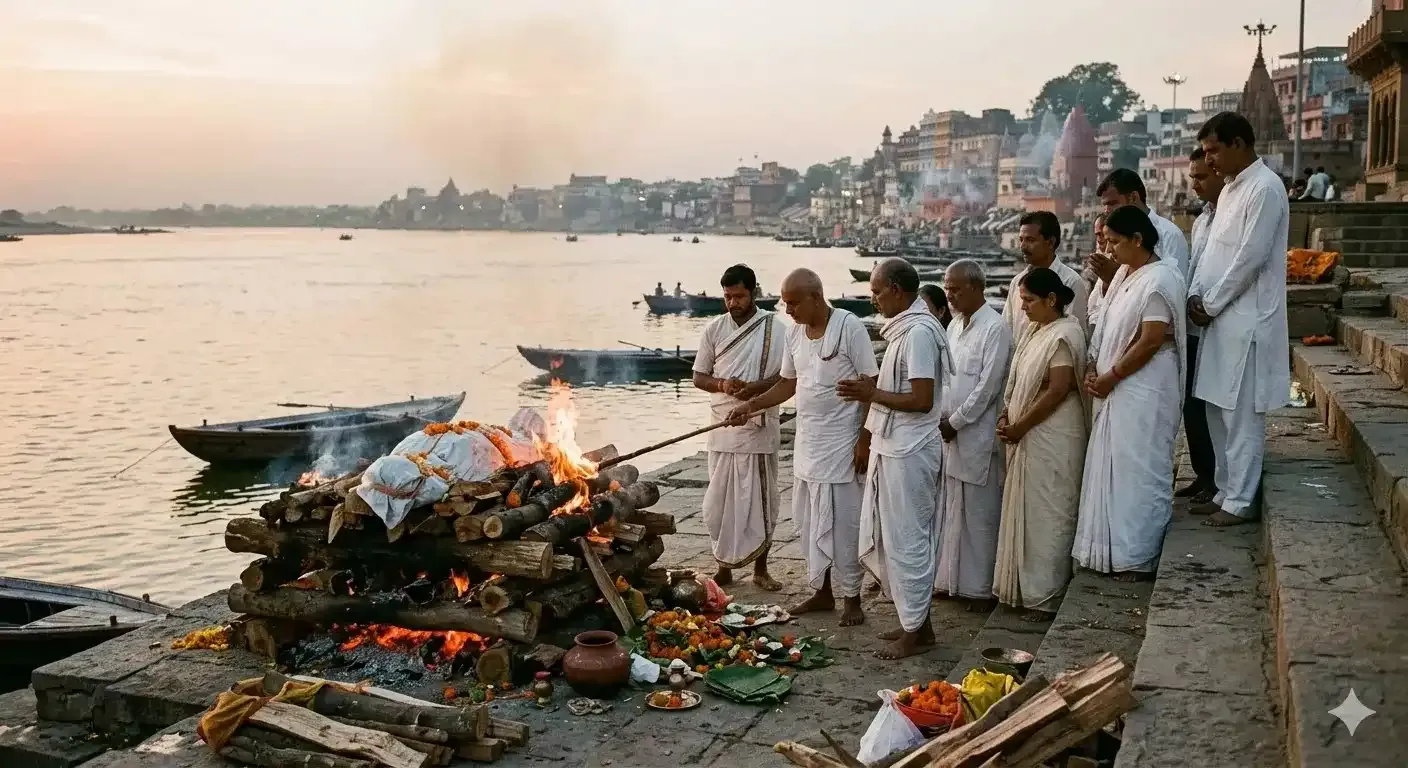
Rites: The funeral rite, antyeshti ("last sacrifice"), is usually cremation, ideally within a day, with a son or close relative lighting the pyre while mantras are recited. Ashes are often immersed in a sacred river such as the Ganga. A mourning period of about ten to thirteen days follows, depending on community, ending with rites that welcome the departed among the ancestors. Annual shraddha and the fortnight of Pitru Paksha honour ancestors with tarpana (water offerings), pinda (rice balls) and feeding of Brahmins and the needy. Some days, such as Karthika Amavasya, are also kept for remembering ancestors. Varanasi, home of Kashi Vishwanath, is traditionally regarded as a place where dying brings liberation.
Buddhism: rebirth without a permanent self
The Buddha taught that there is no permanent, unchanging self (anatta). Yet he also taught rebirth: the stream of consciousness, driven by karma and craving, continues into a new life. The early texts describe rebirth in various realms, including heavenly, human, animal, hungry-ghost and hell realms, none of them permanent. Only nirvana, the extinguishing of greed, hatred and delusion, ends the cycle.
Traditions vary in detail. Many Theravada teachers hold that rebirth follows immediately. Tibetan Buddhism teaches the bardo, an intermediate state between death and rebirth, traditionally up to 49 days, during which texts known in English as the Tibetan Book of the Dead may be read to guide the deceased. In East Asian Pure Land Buddhism, devotees aspire to rebirth in the Pure Land of Amitabha Buddha, a realm especially conducive to reaching enlightenment.
Rites: Cremation is common, following the example of the Buddha's own funeral, though burial is also practised in some countries. Monks chant texts on impermanence, and families make offerings and perform good deeds, dedicating the merit to the deceased, often on the seventh day and at later intervals. See Hinduism and Buddhism compared.
Jainism: the jiva, four gatis and the siddha
Jainism teaches that every living being has an eternal soul (jiva) whose innate qualities of infinite knowledge, perception, bliss and energy are obscured by fine karmic matter attached through passions and actions. At death the jiva moves, according to its karma, into one of four states of existence (gatis): heavenly beings, human beings, animals and plants (tiryancha), or hell beings. Heavens and hells are long but temporary.
A soul that sheds all karma through right faith, right knowledge and right conduct, the three jewels described in the Tattvartha Sutra, becomes a siddha. It rises to the summit of the universe, the siddhashila, and dwells there forever in pure knowledge and bliss, never to be reborn. Jains hold that human birth offers the best opportunity for this liberation. Jains traditionally cremate their dead and emphasise calm, mindful acceptance of death. See Hinduism and Jainism compared.
Christianity: resurrection, judgement, heaven and hell
Christian hope rests on the resurrection of Jesus, which Christians believe defeated death. The Nicene Creed expresses the shared belief in "the resurrection of the dead and the life of the world to come". Christians believe each person lives one earthly life. Catholic and Orthodox teaching describes a particular judgement at death and a final judgement when Christ returns and the dead are raised in transformed bodies.
Heaven is understood as eternal communion with God; hell as separation from God, which churches describe in various ways. Salvation is understood as a gift of God's grace through Christ. In Catholic teaching, purgatory is a purification for those who die in God's friendship but are not yet fully purified. Orthodox Christians pray for the departed without defining purgatory in the same way, and most Protestants do not accept it, holding that believers go to be with Christ.
Rites: Christian funerals include prayers, Bible readings and, for Catholics and Orthodox, often a funeral Mass or service with prayers for the deceased. Burial has been the traditional practice, reflecting belief in bodily resurrection. The Catholic Church has permitted cremation since 1963, while asking that ashes be kept in a sacred place rather than scattered; many Protestant churches permit it, and Orthodox churches generally prefer burial. See Hinduism and Christianity.
Islam: barzakh, the Day of Judgement, Jannah and Jahannam
Belief in the Last Day is one of the articles of faith in Islam. Muslims believe each person lives one life on earth, and that at death the soul is taken by the angel of death. It then enters barzakh, an intermediate state until the Resurrection. Many Muslims believe the deceased is questioned in the grave about their Lord, their religion and their prophet, a teaching drawn from Hadith.
On the Day of Judgement all people are raised and their deeds weighed before God, who is described in the Quran as both perfectly just and most merciful. The righteous enter Jannah (paradise, often described as gardens), and the wicked Jahannam (hell). Scholars discuss whether some punishment is temporary for believers, and Muslim teaching stresses that entry to paradise is ultimately through God's mercy. Sunni and Shia Muslims share these core beliefs, with some differences in detail, and Sufi writers dwell on death as a return to God.
Rites: The body is washed (ghusl), wrapped in a simple white shroud (kafan), and the funeral prayer (salat al-janazah) is offered, usually at a mosque or funeral ground. Burial takes place as soon as possible, with the body laid facing Mecca. Cremation is not permitted. Mourners commonly visit the family, offer prayers for forgiveness for the deceased and bring food. See Hinduism and Islam compared.
A brief note on Sikh belief
Sikhs, like Hindus, Buddhists and Jains, believe in karma and rebirth, and seek mukti, liberation through union with God by remembrance of the divine Name and God's grace. Sikhs usually cremate the dead; the evening prayer Kirtan Sohila is recited, and a complete reading of the Guru Granth Sahib often follows. Sikh teaching discourages loud lamentation, seeing death as part of God's will. See Hinduism and Sikhism.
Comparison table
| Question | Hinduism | Buddhism | Jainism | Christianity | Islam |
|---|---|---|---|---|---|
| What survives death? | The eternal atman | A stream of consciousness; no permanent self | The eternal jiva | The soul, later reunited with a raised body | The soul (ruh), later raised bodily |
| How many lives? | Many (samsara) | Many (samsara) | Many (four gatis) | One | One |
| Between death and what follows | Journey to ancestors or rebirth; heavens and hells temporary | Rebirth; bardo in Tibetan teaching | Rebirth according to karma | Judgement; purgatory in Catholic teaching | Barzakh until Resurrection |
| Final goal | Moksha | Nirvana | Siddha state | Eternal life with God | Jannah, by God's mercy |
| Usual funeral | Cremation; ashes in river | Cremation common | Cremation | Burial traditional; cremation widely permitted | Prompt burial; no cremation |
| Remembering the dead | Shraddha, Pitru Paksha | Merit dedication, chanting | Prayers, charity | Prayers, memorials, anniversaries | Prayers for forgiveness, charity |
Common ground and genuine differences
The common ground is moving. Every tradition here teaches that death is not the end, that moral life has consequences beyond this world, that the dead should be treated with reverence, and that the living can still express love for them through prayer, charity or ritual. Each also turns the fact of death into a call to live wisely now.
The differences are real and should not be blurred. The Indian traditions see many lives and liberation from rebirth; Christianity and Islam teach one life, followed by judgement and resurrection. Hindus and Jains speak of an eternal soul, while Buddhists deny a permanent self. Cremation is customary in the Indian traditions; burial is required in Islam and traditional in Christianity. Respect means honouring both the shared hope and these distinct teachings.
For families and friends: grief in interfaith settings
- When a colleague of another faith loses someone, a simple "I am so sorry for your loss; you and your family are in my thoughts" is welcome in every tradition.
- Ask the family about customs and timing. Muslim burials, for example, usually happen quickly, while Hindu families may hold a prayer meeting after the cremation.
- At a funeral, dress modestly in subdued colours (white is customary for Hindu mourning, dark colours for many Christian funerals), follow guidance on head covering and shoes, and observe quietly.
- In mixed-faith families, it can help to agree early on which rites will be followed and how each side can honour the departed, for example a Christian service followed by a Hindu prayer at home.
- When explaining Hindu rites to friends, you might say: "We believe the soul lives on; the cremation and the prayers on the thirteenth day help it on its journey, and every year we remember our ancestors."
For more comparisons, see the concept of God compared and worship compared.
Frequently asked questions
Do Hindus believe in heaven and hell?
Yes, but usually not as final destinations. Hindu texts describe svarga (heavenly realms) and naraka (hells) where souls experience the results of their karma for a time before being reborn. The final goal is moksha, release from the cycle of birth and death altogether, which different schools of Vedanta describe as oneness with Brahman or as eternal loving communion with God.
How can Buddhists believe in rebirth without a soul?
Buddhism teaches anatta (anatman), that there is no permanent, unchanging self. What continues from life to life is a stream of causes and conditions shaped by karma and craving, not a fixed soul. A classic illustration compares it to a flame lit from another flame: the second is neither exactly the same as the first nor entirely different.
What is purgatory, and do all Christians believe in it?
In Catholic teaching, purgatory is a state of final purification for those who die in God's grace and friendship but are not yet fully purified, before they enter heaven. Orthodox Christians pray for the departed but do not define purgatory in the same way, and most Protestant churches do not accept the doctrine.
What is barzakh in Islam?
Barzakh is the intermediate state or barrier between death and the Day of Resurrection. Islamic tradition teaches that the soul experiences a foretaste of its eventual state during this period, and many Muslims believe the deceased is questioned in the grave by angels. At the Resurrection all people are raised and judged by God.
Why do Hindus cremate while Muslims bury the dead?
Hindu tradition sees the body as a temporary dwelling of the eternal atman; cremation (antyeshti, the last offering into fire) releases the soul and returns the body to the elements. Islam teaches that the body should be treated with dignity and returned to the earth, and does not permit cremation; burial is carried out promptly after washing and prayer. Some Hindu communities and occasions, such as sannyasis and young children, traditionally use burial.
How should I support a grieving friend of another faith?
Offer simple condolences, ask what customs the family is following, attend the funeral or prayer meeting if invited, dress modestly, and bring food or practical help rather than theological opinions. Every tradition values presence and kindness at such times.
Editor's note (9 October 2026)
This page is an introductory comparison for general readers. It summarises deep teachings about death briefly, describes each tradition as its mainstream followers and scholars do, and paraphrases scripture. Funeral customs vary widely by community and country. For guidance at a time of loss, or for deeper understanding, please consult teachers and clergy of each tradition, such as a family purohit, a Buddhist monk or nun, a Jain scholar, a priest or pastor, or an imam.
Related guides
- Sacred texts compared: Vedas, Bible, Quran, Tripitaka and Agamas
- Meditation and prayer compared
- Pilgrimage compared: Kumbh, Char Dham, Hajj, Bodh Gaya and Shikharji
- Karma and rebirth in Hinduism, Buddhism, Jainism and Sikhism
- Moksha, nirvana, salvation: liberation compared
- Ahimsa in Hinduism, Jainism and Buddhism
You might also like

The Concept of God in Hinduism, Christianity and Islam Compared
Karma and Rebirth in Hinduism, Buddhism, Jainism and Sikhism Compared
Ahimsa (Non-Violence) in Hinduism, Jainism and Buddhism: Meaning, Scriptures and Practice Compared