

Mantra Pushpam: The Vedic Floral Offering Chanted at the End of Worship
The Mantra Pushpam is a short but profound Vedic hymn from the Taittiriya Aranyaka of the Krishna Yajur Veda, chanted at the very end of a puja, homa or aarti. Its name means 'the flower of mantras' — a floral offering made not of petals but of sacred words. It contemplates the hidden unity of water, fire, wind, sun, moon, stars, clouds and the year, and promises prosperity to the one who knows their common source.
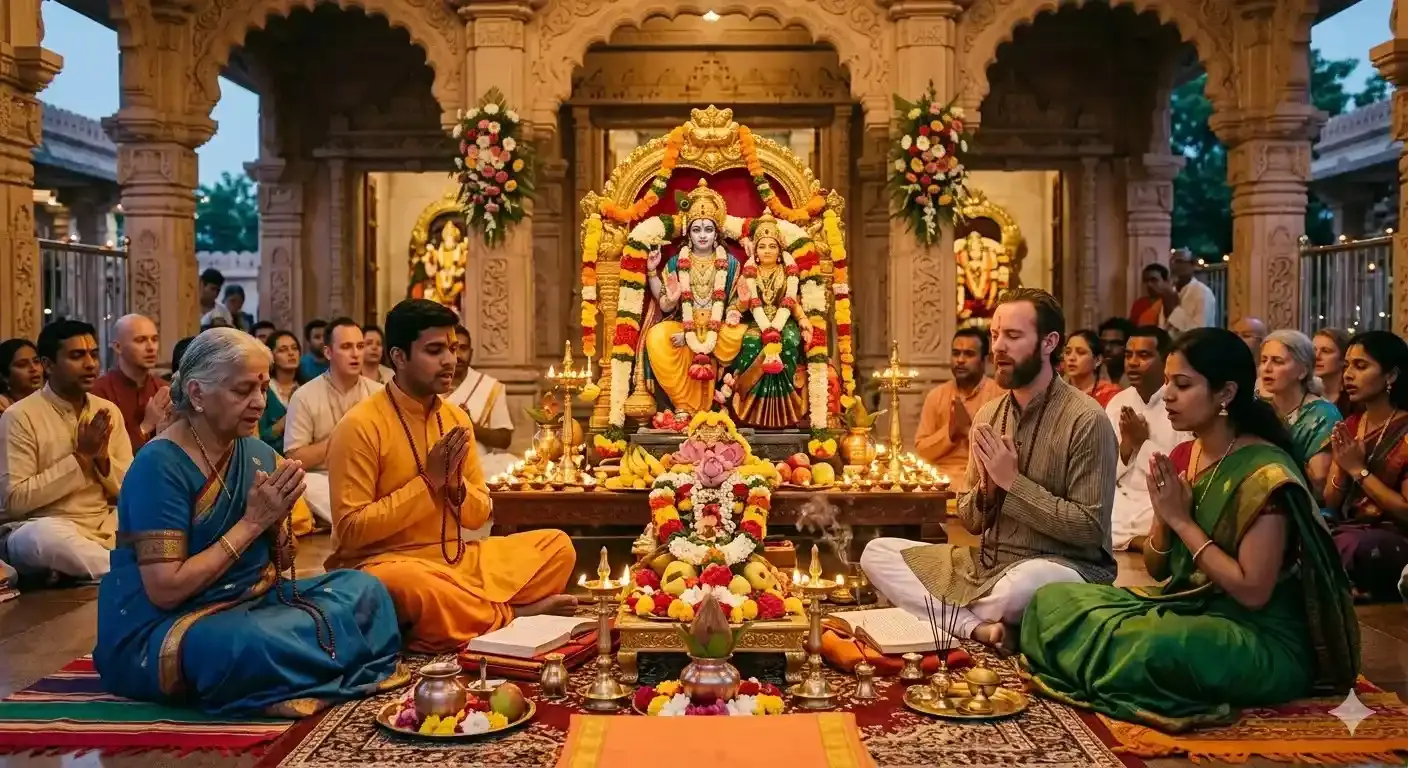
The Mantra Pushpam is a short but profound Vedic hymn from the Taittiriya Aranyaka of the Krishna Yajur Veda, chanted at the very end of a puja, homa or aarti. Its name means 'the flower of mantras' — a floral offering made not of petals but of sacred words.
Quick answer: The Mantra Pushpam is a Vedic hymn from the Taittiriya Aranyaka of the Krishna Yajur Veda, traditionally chanted standing, with folded hands, at the very conclusion of a puja, homa or aarti. Its name means 'the flower (pushpam) of mantras (mantra)' — a symbolic floral offering made of sacred words rather than physical petals. The hymn meditates on the mystical inter-relationship of water (apah), fire (agni), wind (vayu), the moon, the sun, the stars, the clouds and the year, teaching that the one who knows their common hidden source — the 'flower of the waters' (apam pushpam) — attains prosperity, progeny and cattle. Because it distils the essence of worship into a final act of knowledge and surrender, it forms the fitting climax of Hindu ritual.
At the close of almost every traditional Hindu puja, homa or temple aarti, there comes a moment when the priest and the gathered devotees rise to their feet, join their palms, and chant together a rhythmic, rolling hymn that seems to gather the whole ceremony into itself. That hymn is the Mantra Pushpam. Its name means 'the flower of mantras' — a floral offering made not of jasmine or marigold, but of sacred words. This article gently unfolds the Mantra Pushpam: where it comes from, what its verses contemplate, why it is reserved for the very end of worship, and how it is traditionally recited.
What is the Mantra Pushpam?
The Mantra Pushpam is a Vedic hymn whose name joins two words: mantra, a sacred sound or verse, and pushpam, a flower. Together they mean 'the floral offering of mantras.' Where a devotee normally offers real flowers to a deity during worship, here the offering is made of the mantras themselves — words held out to the divine like petals held out on folded palms. It is, in essence, the crowning verbal flower placed at the feet of the Lord as the ceremony ends.
Though short, the hymn is dense with meaning. It does not narrate a story or praise a single deity's exploits. Instead it meditates on the natural elements — water, fire, wind, the luminaries of the sky, the clouds and the year — and reveals that they are secretly bound to one another, arising from a single hidden source. To 'know' that source, the hymn repeats, is to become abundant in life.
Source: The Taittiriya Aranyaka of the Krishna Yajur Veda
The Mantra Pushpam belongs to the Krishna (Black) Yajur Veda and is drawn from the Taittiriya Aranyaka. The Aranyakas are the 'forest' portions of the Vedas — texts meant for reflection and contemplation as much as for ritual — and this contemplative spirit is clearly felt in the Mantra Pushpam, which turns the mind from the physical offerings just completed toward the great mystery of creation.
Because it is a genuine Vedic passage rather than a later devotional composition, the Mantra Pushpam carries the authority and antiquity of shruti, the revealed scripture. Its measured, chant-like structure, with lines that echo and build on one another, is characteristic of the Vedic style and is part of why it is so powerful to hear recited by many voices in unison.
| Detail | Description |
|---|---|
| Name meaning | 'Floral offering of mantras' (mantra = sacred word, pushpam = flower) |
| Veda | Krishna (Black) Yajur Veda |
| Source text | Taittiriya Aranyaka |
| Nature | Shruti — revealed Vedic hymn |
| Central theme | The hidden unity of water, fire, wind and the cosmos |
| Recited | At the conclusion of puja, homa and aarti |
| Posture | Standing, with folded hands (anjali) |
The Opening Line: 'Yo apam pushpam veda'
The hymn's most famous and oft-quoted opening declares the reward of true knowledge. In transliteration it runs:
Yo apam pushpam veda, pushpavan prajavan pashuman bhavati...
Advertisement
This may be rendered: 'One who knows the flower of the waters (apam pushpam) becomes possessed of flowers, of progeny and of cattle.' The 'flower of the waters' is a mystical phrase — it points to the subtle source or essence from which the waters, and through them all life, spring forth. To know this source is not merely to gain information but to align oneself with the very principle of abundance, so that the one who knows it becomes rich in flowers (beauty and offerings), in progeny (continuity) and in cattle (wealth and sustenance). The hymn then repeats this pattern for one element after another, weaving them together so that to know one is to know the next — a chain of contemplation that draws the whole cosmos into a single vision.
The Water, Fire and Cosmos Theme
At the heart of the Mantra Pushpam is a meditation on the interconnection of the great natural forces, moving in a linked sequence in which each element rests upon and flows into another. The recurring lesson is that these are not separate powers but expressions of one underlying reality. The hymn contemplates how the waters (apah) are the foundation and support; how fire (agni) and water are intimately related; how the wind (vayu) carries and stirs the waters; and how the moon, the sun, the stars, the clouds and the year are all bound into the same living web. The clouds gather the waters and release them as rain; the sun and moon govern the rhythms of the sky; the year measures the great cycle in which all of this unfolds. Knowing the common root of these — the 'flower of the waters' — is presented as the supreme knowledge that confers prosperity.
- Apah (water) — the primal support, the source from which the 'flower' arises.
- Agni (fire) — intimately linked to water, the two sustaining one another in the cosmic order.
- Vayu (wind) — the mover that carries and animates the waters.
- Chandrama (moon) — the luminary that governs waters, tides and the rhythms of growth.
- Surya (sun) — the source of light and heat that drives evaporation and life.
- Nakshatras (stars) — the constellations that mark and measure the heavens.
- Parjanya / megha (clouds) — the gatherers of water that pour it back as nourishing rain.
- Samvatsara (the year) — the great cycle within which all these forces turn.
The genius of the hymn is that it does not simply list these forces. It links them in a chain of 'the one who knows this, knows that,' so that the contemplative mind is led step by step from the visible waters up to the turning of the year and the unity behind them all. In this it captures something the entire ritual has been pointing toward: that the offerings of flower, water and fire made during the puja are, at their root, offerings to a single divine source.
Why It Is Chanted at the End of Worship
The placement of the Mantra Pushpam at the very conclusion of a ceremony is deliberate and meaningful. A puja or homa is a gradual movement — from invocation, through offerings of water, flowers, incense and food, to the waving of lamps in aarti. Having offered every physical flower and substance, the worshipper then offers the highest flower of all: the mantra itself, a flower of pure sound and knowledge. It is the final, most refined offering, given when nothing material remains to give.
There is also a spirit of surrender and completion in it. After honouring the deity with all the elements — the very water and fire the hymn contemplates — the devotee steps back and acknowledges the vast, unified reality that underlies those elements. The Mantra Pushpam thus lifts the ceremony from ritual action into contemplative knowledge, sealing the worship with an affirmation of divine unity and a prayer for prosperity. For this reason the hymn is chanted standing, with palms joined in anjali, by everyone present; rising to one's feet is itself a mark of reverence and readiness, as the congregation stands together to make this collective floral offering of words while the lamps are shown and the puja draws to its close.
The Concluding Verses: 'Raja adhirajaya prasahya sahine...'
In many traditions the Mantra Pushpam is followed, at the very end while everyone is still standing, by a set of resonant lines that begin:
Raja adhirajaya prasahya sahine... namo vayam vaishravanaya kurmahe...
These verses offer salutations to the Lord as the supreme sovereign — the king of kings, the all-conquering, ever-victorious ruler — and pray that the worshipper's wishes be fulfilled, that prosperity and well-being be granted. Coming right after the cosmic meditation of the Mantra Pushpam, they turn that vision of unity into a heartfelt, standing prayer for grace, welfare and fulfilment before the assembly disperses.
When and How the Mantra Pushpam Is Recited
The Mantra Pushpam appears at the conclusion of a wide range of Hindu observances, both in temples and in homes. Wherever a formal puja or fire ritual is performed with due care, it is very commonly the note on which the worship ends.
- At the end of temple aarti, when the camphor lamp is shown to the deity and the assembly stands together.
- As the closing hymn of the Satyanarayana Puja and other household vratas.
- At the conclusion of homas and havans, sealing the fire offering with the floral offering of words.
- During major pujas at festivals, weddings and housewarming (griha pravesh) ceremonies.
- At the end of Vedic parayana and group chanting, as a fitting culmination.
The manner of recitation is as important as the words. Devotees stand up — a shift from the seated posture of the puja — and bring their palms together in anjali mudra. The hymn is then chanted aloud, ideally in unison, its rolling cadences filling the space: standing signifies alertness and respect, the folded hands signify surrender, and the collective voice turns the offering into a shared act of devotion. Being a Vedic hymn, it is best learned from a qualified teacher or an authentic recording so that its pronunciation, pauses and intonation are preserved; when chanted correctly, its measured sound carries a dignity that beautifully completes any act of worship.
The Inner Meaning: Knowledge as the Highest Flower
Beneath its ritual role, the Mantra Pushpam carries a quiet spiritual teaching. It suggests that the finest offering a devotee can make is not a material flower but knowledge — specifically, the knowledge of the one source behind the many forms of nature. Water, fire, wind, sun, moon, stars, clouds and the year appear as separate powers, yet the hymn reveals them as branches of a single reality. To perceive that unity is itself an act of worship.
In this light the Mantra Pushpam becomes a small map of the spiritual journey. Worship begins with visible offerings to a form of God; it matures into the recognition that all forms and all elements arise from one divine ground. The 'flower of the waters' is, in the end, a symbol of that hidden source — and the one who truly knows it is said to flourish in every way. That is why, having given everything else, the devotee ends the puja by offering this: the flower of mantras, the flower of understanding, laid at the feet of the Lord.
Frequently Asked Questions
What is the Mantra Pushpam?
The Mantra Pushpam is a Vedic hymn from the Taittiriya Aranyaka of the Krishna Yajur Veda whose name means 'the floral offering of mantras' (mantra = sacred word, pushpam = flower). It is chanted at the very end of a puja, homa or aarti as a symbolic offering of sacred words in place of physical flowers, and it meditates on the hidden unity of water, fire, wind and the cosmos.
What does 'Mantra Pushpam' mean?
The name combines mantra, meaning a sacred sound or verse, and pushpam, meaning a flower. Together they mean 'the flower of mantras' — a floral offering made of holy words rather than petals. Just as a devotee offers real flowers during worship, at the close of the ceremony they offer the mantras themselves as the finest and most refined flower.
Why is the Mantra Pushpam chanted at the end of a puja?
Having offered water, flowers, incense, food and the waving of lamps during the puja, the worshipper offers the Mantra Pushpam last as the highest flower of all — a flower of pure sound and knowledge. It lifts the worship from physical offering into contemplation of divine unity and acts as a prayer for prosperity, sealing and completing the ceremony.
What is the theme of the Mantra Pushpam?
The hymn contemplates the mystical inter-relationship of the natural forces — water (apah), fire (agni), wind (vayu), the moon, the sun, the stars, the clouds and the year — and reveals that they share a single hidden source. It teaches that the one who knows this source, the 'flower of the waters' (apam pushpam), becomes rich in flowers, progeny and cattle, that is, in every kind of prosperity.
Why is the Mantra Pushpam recited standing with folded hands?
Standing marks a shift from the seated posture of the puja into an attitude of alertness and reverence, while joining the palms in anjali mudra expresses surrender. The whole assembly rises together to make this collective floral offering of words as the aarti lamps are shown, turning the closing hymn into a shared act of devotion.
In which ceremonies is the Mantra Pushpam used?
It is chanted at the conclusion of temple aarti, the Satyanarayana Puja and other household vratas, homas and havans, and major pujas performed at festivals, weddings and housewarming ceremonies. It also serves as the culmination of Vedic parayana and group chanting, wherever a formal puja or fire ritual is brought to a close.
What is the meaning of the opening line 'Yo apam pushpam veda'?
The line 'Yo apam pushpam veda, pushpavan prajavan pashuman bhavati' means 'one who knows the flower of the waters becomes possessed of flowers, of progeny and of cattle.' The 'flower of the waters' points to the subtle source from which the waters and all life spring, and to know this source is to align oneself with the very principle of abundance and so to flourish.
What are the concluding 'Raja adhirajaya' verses that follow it?
In many traditions the Mantra Pushpam is followed, while everyone still stands, by verses beginning 'Raja adhirajaya prasahya sahine.' These offer salutations to the Lord as the supreme sovereign — the king of kings, all-conquering and ever-victorious — and pray for prosperity, welfare and the fulfilment of the worshippers' wishes before the puja concludes.
You might also like
Kashi Vishwanath Ashtakam: Meaning, Verses & Benefits (Ganga Taranga Ramaniya)

Saraswati Vandana — Ya Kundendu Tushara Hara Dhavala: Meaning, Lyrics & When to Recite
Narmadashtakam by Adi Shankaracharya: Meaning, Verses & the Sacred River Narmada