
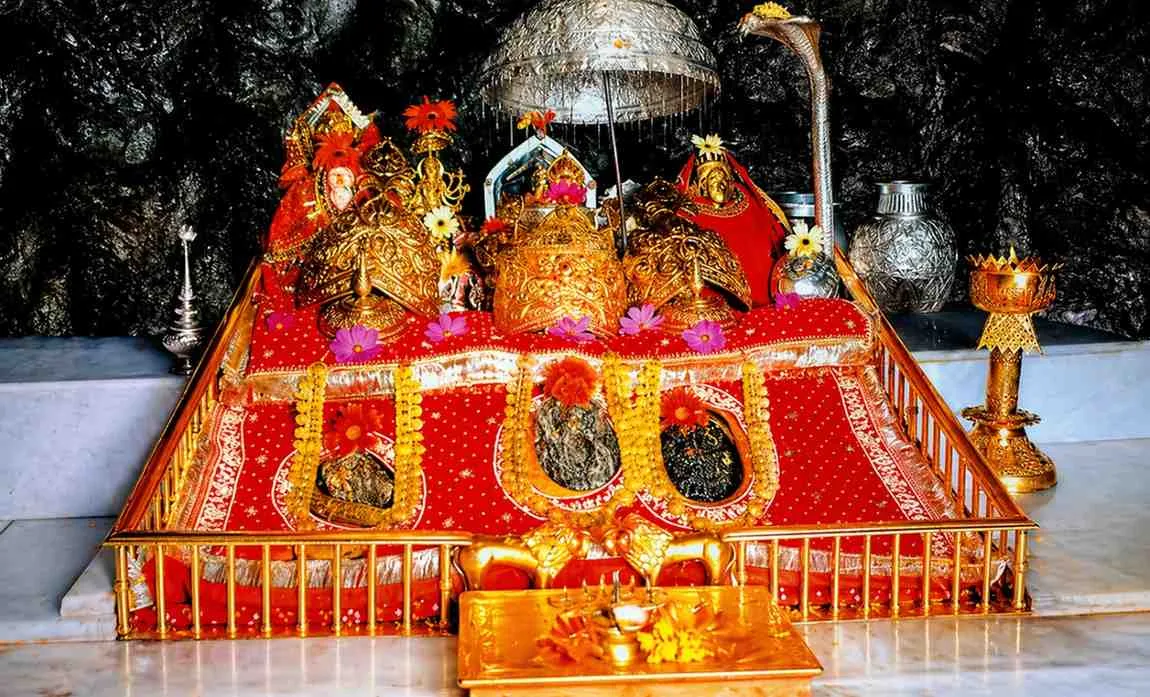
Vaishno Devi Mandir
Devi temple · Katra (base town); shrine in the Trikuta hills, Reasi, Jammu & Kashmir, India
Shri Mata Vaishno Devi is a cave shrine of the Mother Goddess in the three-peaked Trikuta mountain above Katra, in the Reasi district of Jammu and Kashmir. There is no carved idol here. Inside the Holy Cave the Goddess is worshipped as three natural rock formations, the Pindis, which represent Maha Kali, Maha Lakshmi and Maha Saraswati.
The cave sits at about 5,200 feet, and pilgrims reach it on a hill trek from the base town of Katra. The Shri Mata Vaishno Devi Shrine Board, which manages the pilgrimage, says the shrine now receives more than one crore (ten million) yatris a year. That makes it one of the most visited pilgrimage sites in north India.
Faith & Tradition
Religious Significance of Vaishno Devi Mandir
Devotees regard Mata Vaishno Devi as a mother who grants the wishes of those who come to her. At the shrine, darshan is of the three Pindis rather than a sculpted image, and each Pindi stands for one aspect of Shakti. For many families in north India the trek is a vow taken for a wish, or an act of thanks once it is fulfilled. Some people make it every year.
Some traditions count the shrine among the Shakti Peethas, the places where parts of the goddess Sati's body are said to have fallen. The Shrine Board's own history page records this, but it also notes that the traditions disagree about which part fell here. Vaishno Devi does not appear in every standard list of Shakti Peethas, so the label varies by tradition.
According to tradition, the pilgrimage is only complete once the devotee also visits the Bhairon temple on a nearby spur of the mountain. The story behind this is told in the History section below.
Heritage
History of Vaishno Devi Mandir
The best-known story comes from tradition. In it the Goddess, as the maiden Vaishnavi, was performing penance in the Trikuta hills when the tantric Bhairon Nath pursued her. She stopped at several points along the way, and these are now halts on the yatra route. At the Holy Cave she took her divine form and beheaded him. The Shrine Board's account says his head fell on another spur about one and a half kilometres away, where the Bhairon temple now stands. The legend continues that Bhairon repented, the Goddess forgave him, and she then took the form of the three Pindis.
The Shrine Board also tells how the cave was found. According to this account, about 700 years ago a devotee named Pandit Shridhar saw the Goddess in a vision and was guided to the cave, where he found the rock form with three heads. The Board itself notes that several versions of the origin and legend exist. These stories belong to devotional tradition and are not dated historical records.
Other traditions link the shrine to the Pandavas. The Shrine Board mentions a belief that they built the first temples at Kol Kandoli and at the Bhawan, but gives no date. The Board describes the earliest known visit by a historical figure as that of Guru Gobind Singh, who is said to have come by way of Purmandal, on the old foot track to the cave.
The administrative history is better documented. In August 1986 the Jammu and Kashmir government set up the Shri Mata Vaishno Devi Shrine Board, and its role was put into law by the Jammu and Kashmir Shri Mata Vaishno Devi Shrine Act, 1988. Since then the Board has managed the yatra, the shrine's funds and pilgrim facilities. One of its projects is an alternative track from near Adhkuwari to the Bhawan, which opened in 1999.
Architecture and sacred features
The shrine is a natural cave rather than a built temple. The Bhawan complex around it holds the sanctum, the Holy Cave with the three Pindis, along with pilgrim facilities. Most pilgrims now reach the sanctum through man-made tunnels built to handle large crowds. In the leaner winter weeks the Shrine Board has at times opened the original natural cave for darshan, depending on how many pilgrims are present.
Plan Your Visit
Darshan and Visitor Information
As listed by the Shri Mata Vaishno Devi Shrine Board (checked October 2026), every pilgrim must get an RFID Yatra Access Card, and registration is free. Within a set time of the card being issued, the pilgrim must cross the first check post at Banganga. Anyone without a card is turned back. Registration counters are in Katra, and during busy periods the Board has opened extra counters, including one at Katra railway station.
The Board advises footwear with good grip, rain and weather protection, and only essential items: water, light snacks, medicines, a valid identity proof and the yatra slip. Flammable and sharp items are not allowed. The aarti is performed twice a day, just before sunrise and just after sunset, and darshan is paused for about two hours while it takes place. Confirm current arrangements with the Shri Mata Vaishno Devi Shrine Board before travelling.
Timings and arrangements change with seasons and festivals. Confirm current details with Shri Mata Vaishno Devi Shrine Board (official website) before travelling. Last reviewed 5 October 2026.
Sacred Calendar
Festivals at Vaishno Devi Mandir
Navaratri (Chaitra and Sharad)
Navaratri brings some of the shrine's heaviest crowds of the year. For Sharad Navaratri the Shrine Board decorates the Bhawan, Adhkuwari, the Bhairon temple and the track with flowers and lights, and opens extra registration counters.
Location
How to Reach Vaishno Devi Mandir
Katra is the base town. The Shrine Board puts it about 50 km by road from Jammu, and buses and taxis run between them. Shri Mata Vaishno Devi Katra railway station is in Katra itself, on the line through Udhampur. The nearest airport is Jammu Airport. Since June 2025 Katra has also had direct Vande Bharat trains to Srinagar.
From Katra the walk to the Bhawan is roughly 12 to 13 km. The Shrine Board's introduction says nearly 12 km, while its distance table gives 13 km. The route passes Banganga, Charan Paduka, Adhkuwari and either Himkoti or Sanjichhat. The alternative track from near Adhkuwari is wider and less steep, ponies are not allowed on it, and battery vehicles run there for infirm, sick and disabled pilgrims. The Board also lists ponies, palkis, porters and a helicopter service as options. Heavy rain and landslides can suspend the yatra, as happened for several weeks in August and September 2025, so check the Shrine Board's updates before travelling.
Location: Katra (base town); shrine in the Trikuta hills, Reasi, Jammu & Kashmir, India
Nearest airport: Jammu Airport
Nearest railway station: Shri Mata Vaishno Devi Katra (SVDK)
More in Hindu temples in Jammu & Kashmir · Devi temples
Photographs
Vaishno Devi Mandir Photos
Questions
Vaishno Devi Mandir: Frequently Asked Questions
What is worshipped inside the Vaishno Devi cave?
There is no carved idol. The Goddess is worshipped as three natural rock formations, the Holy Pindis, which represent Maha Kali, Maha Lakshmi and Maha Saraswati.
How long is the trek from Katra to the Bhawan?
Roughly 12 to 13 km. The Shrine Board's introduction says nearly 12 km, and its distance table gives 13 km to the Bhawan, with the Bhairon temple about 1.5 km further on.
Is registration needed for the Vaishno Devi yatra?
Yes. Every pilgrim needs an RFID Yatra Access Card, issued free in Katra, and must cross the Banganga check post within the time limit the Shrine Board sets. Confirm current rules with the Board.
Why do pilgrims go on to the Bhairon temple?
According to tradition, the Goddess forgave Bhairon Nath after slaying him and promised that a pilgrimage to her shrine would be complete only after a visit to his temple on the nearby spur.
Is Vaishno Devi a Shakti Peetha?
Some traditions count it as one, and the Shrine Board notes this belief. It is not included in every standard list of Shakti Peethas, and accounts differ on which part of Sati's body is linked to the site.
Who discovered the Vaishno Devi cave?
According to the Shrine Board's account of tradition, the devotee Pandit Shridhar found the cave about 700 years ago after the Goddess appeared to him in a vision. The Board notes that several versions of the legend exist.
Which railway station is closest to Vaishno Devi?
Shri Mata Vaishno Devi Katra (SVDK) station in Katra, the base town for the trek.
Sources and attribution
- Shri Mata Vaishno Devi Shrine Board — Introduction
- Shri Mata Vaishno Devi Shrine Board — Distance / Altitude / Temperature
- Shri Mata Vaishno Devi Shrine Board — History of the Holy Shrine
- Shri Mata Vaishno Devi Shrine Board — Discovery of the Shrine
- Shri Mata Vaishno Devi Shrine Board — Bhawan
- Shri Mata Vaishno Devi Shrine Board — Yatra Registration; Do's & Don'ts; Aarti; Alternative Track; How to Reach Katra
- Incredible India, Ministry of Tourism — Vaishno Devi (Jammu spiritual destinations)
- All India Radio News — Shardiya Navratri begins in J&K as over 45,000 pilgrims visit Shri Mata Vaishno Devi
- Kashmir Life — Natural cave of Vaishno Devi shrine opened for devotees (Jan 2025)
- Kashmir Life — Katra–Srinagar Vande Bharat services begin (June 2025)
Spotted an error? Write to info@hindutone.com — see our editorial policy.