Amarnath Cave Temple
अमरनाथ
Shiva (Holy Ice Lingam) temple · Anantnag district, Jammu & Kashmir, India
Photo: Gktambe at English Wikipedia · Public domain · via Wikimedia Commons
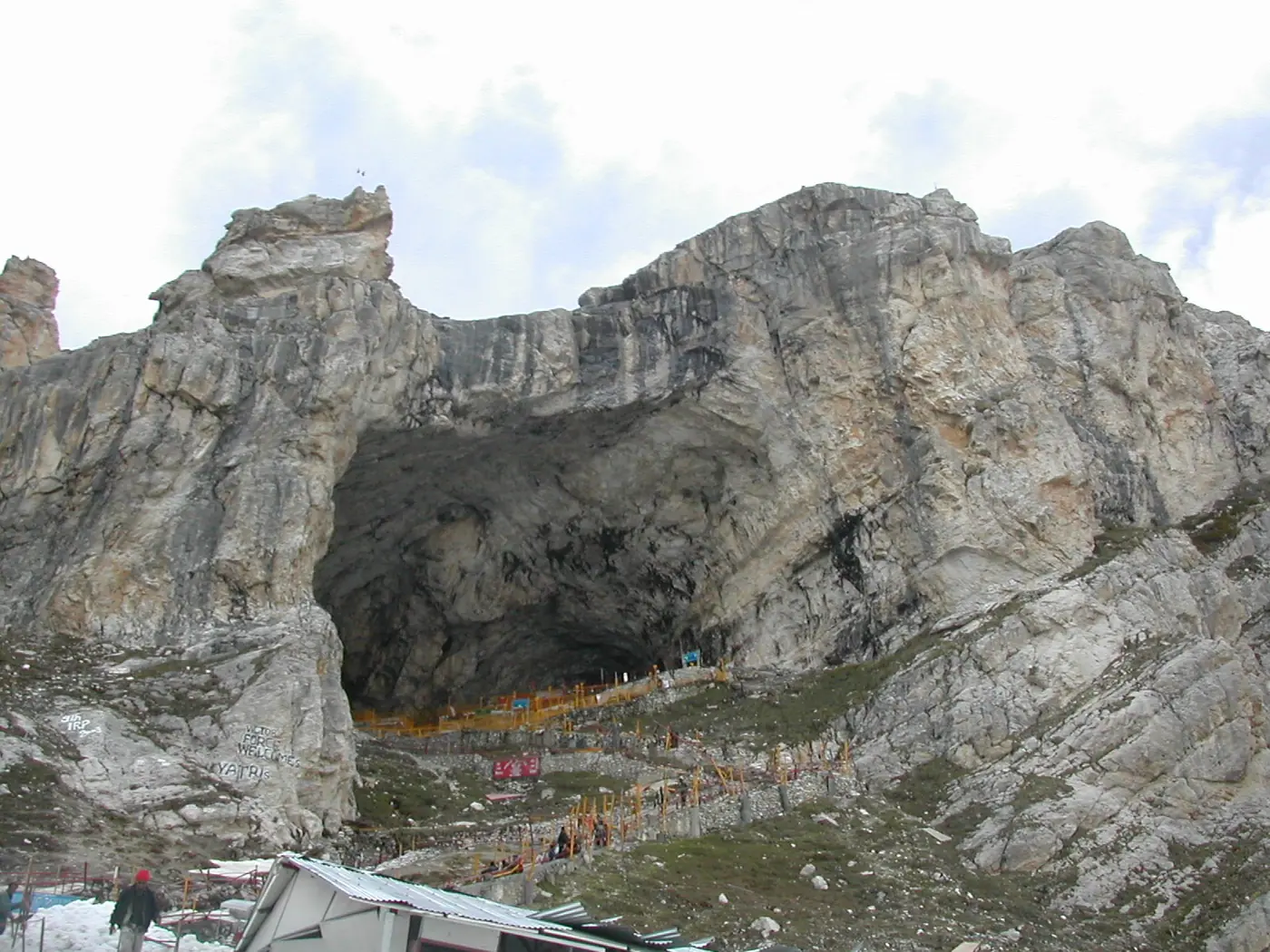
The Amarnath Cave Temple, which the Shri Amarnathji Shrine Board calls the Holy Cave Shrine, is a cave sacred to Shiva in the Kashmir Himalayas of Jammu and Kashmir. Inside the cave, an ice stalagmite forms naturally into a lingam, and devotees worship it as Shiva. Every summer they make the hard trek to the cave to see it.
The cave can only be visited during a short pilgrimage season each summer, called the Shri Amarnathji Yatra. The Shri Amarnathji Shrine Board (SASB) runs the yatra and manages the shrine.
Faith & Tradition
Religious Significance of Amarnath Cave Temple
The Ganderbal district administration and J&K Tourism both describe the lingam as forming naturally from ice, and say it waxes and wanes with the moon. J&K Tourism adds that two smaller ice formations beside it are worshipped as Parvati and as their son Ganesha.
According to tradition, the cave is where Shiva told Parvati the secret of creation. Devotees believe a pair of pigeons overheard the story and has lived in the cave ever since, and many pilgrims say they have seen the birds. Two other stories are told about how the cave was found. In one, a Muslim shepherd named Buta Malik was given a sack by a sadhu that turned to gold, and when he went back to thank him he found the cave. In the other, a sage J&K Tourism calls Bregish Reshi came across the cave and the lingam while travelling in the Himalayas. These are pilgrim traditions, not recorded history.
In 2009 the Indian Express reported concerns that the ice lingam was melting early. The Shrine Board planned to move a helipad away from the cave on the advice of environmental experts. Glaciologist Prof. M. N. Koul told the paper that the lingam's size depends mainly on the phases of the moon and the temperature inside the cave.
Heritage
History of Amarnath Cave Temple
The shrine is managed by the Shri Amarnathji Shrine Board, set up by an Act of the Jammu and Kashmir State Legislature in 2000. The Board states that the Lieutenant Governor of the Union Territory of Jammu and Kashmir is its chairman, and that it is responsible for running the yatra and improving facilities for pilgrims.
The Ganderbal district administration says the Board sets the yatra schedule each year on the advice of a sub-committee. The sub-committee looks at the Hindu calendar, the weather and the clearing of snow from the tracks. The yatra usually begins on Skanda Shashti and ends on Shravan Purnima (Raksha Bandhan).
Architecture and sacred features
The shrine is a natural cave, not a built temple. J&K Tourism describes it as standing in a narrow gorge at the far end of the Lidder valley, at about 3,888 m. The Shrine Board puts the cave at around 12,800 feet.
Plan Your Visit
Darshan and Visitor Information
As listed by the Shri Amarnathji Shrine Board (checked October 2026 via an archived copy of its website), every pilgrim must register in advance. To register you need a Compulsory Health Certificate from a doctor the Board has authorised. Registration is done online or through designated bank branches. Each registered pilgrim must collect an RFID card after biometric authentication and wear it at all times; no one may cross the access control gate without one. The Board's information page says it does not allow people over 70, children under 13 or women more than six weeks pregnant to make the pilgrimage. Confirm current arrangements with the Shri Amarnathji Shrine Board before travelling.
The Board advises pilgrims to bring woollen clothing because temperatures can suddenly drop below 5°C. It also asks pilgrims to carry rain gear, wear laced trekking shoes rather than slippers, keep to the marked track and avoid shortcuts, avoid alcohol, caffeine and smoking, and not ignore symptoms of altitude sickness. It advises against staying overnight at the cave. Plastics are banned, and pilgrims are asked not to throw coins, notes or cloth at the lingam.
Timings and arrangements change with seasons and festivals. Confirm current details with Shri Amarnathji Shrine Board (constituted 2000) (official website) before travelling. Last reviewed 5 October 2026.
Sacred Calendar
Festivals at Amarnath Cave Temple
Shri Amarnathji Yatra
This is the annual pilgrimage season, the only time the cave can be visited. The Shrine Board announces its exact dates every year.
Shravan Purnima (Raksha Bandhan)
The Ganderbal district administration says the yatra ends on this full-moon day each year.
Skanda Shashti
The district administration says the yatra usually begins on this day, although the Board fixes the start date every year.
Location
How to Reach Amarnath Cave Temple
The Shrine Board lists two yatra routes. The first runs from Jammu to Pahalgam, then via Chandanwari, Pissu Top, Sheshnag and Panchtarni to the Holy Cave. The second runs from Jammu to Baltal, then via Domail and Barari to the cave. J&K Tourism puts the cave about 45 km from Pahalgam and 141 km from Srinagar, and Pahalgam about 96 km from Srinagar. It notes that most pilgrims start from Pahalgam and take four or five days for the round trip on that route.
The Board also runs helicopter services for the yatra, which the Ganderbal district administration says fly to Panjtarni on both routes. Bookings open only when the Board announces them. Confirm current routes and services with the Shri Amarnathji Shrine Board before travelling.
Location: Anantnag district, Jammu & Kashmir, India
More in Hindu temples in Jammu & Kashmir · Shiva (Holy Ice Lingam) temples
Questions
Amarnath Cave Temple: Frequently Asked Questions
What is worshipped at the Amarnath cave?
Devotees worship an ice stalagmite that forms naturally into a lingam of Shiva. J&K Tourism notes two smaller ice formations beside it, which are worshipped as Parvati and Ganesha.
Who manages the Amarnath shrine and yatra?
The Shri Amarnathji Shrine Board, set up by an Act of the Jammu and Kashmir State Legislature in 2000. The Lieutenant Governor of the Union Territory chairs it.
When is the Amarnath Yatra held?
Every summer, around the month of Shravan (July–August). The Shrine Board announces the exact dates each year. The yatra usually ends on Shravan Purnima (Raksha Bandhan), so check the Board's website for the next season.
What are the routes to the Amarnath cave?
The Shrine Board lists two. One goes from Pahalgam via Chandanwari, Pissu Top, Sheshnag and Panchtarni. The other goes from Baltal via Domail and Barari.
Is registration compulsory for the Amarnath Yatra?
Yes. The Board requires advance registration, a Compulsory Health Certificate from an authorised doctor, and an RFID card that pilgrims wear throughout the yatra.
How high is the Amarnath cave?
J&K Tourism gives the height as about 3,888 m, and the Shrine Board says around 12,800 feet. The Board warns pilgrims to take precautions against altitude sickness.
Does the ice lingam change in size?
Yes. Official sources say it waxes and wanes with the moon. A glaciologist quoted by the Indian Express in 2009 said its size depends mainly on the phases of the moon and the temperature inside the cave.
Sources and attribution
- © OpenStreetMap contributors — location data © OpenStreetMap contributors (ODbL)
- Wikidata Q455167 — structured data (CC0)
- Wikipedia — Amarnath Temple — text facts from Wikipedia, licensed CC BY-SA 4.0
- Shri Amarnathji Shrine Board (archived 5 May 2026; live site unreachable October 2026) — Shri Amarnathji Shrine Board – home page (Yatra 2026 notices, About the Board, Do's and Don'ts)
- Shri Amarnathji Shrine Board (read via archived copy) — Shri Amarnath Yatra – route map
- Shri Amarnathji Shrine Board (read via archived copy) — Useful Information and Tips
- District Administration Ganderbal, Government of Jammu and Kashmir — Shri Amarnathji Cave
- District Administration Ganderbal, Government of Jammu and Kashmir — Shri Amarnath Ji Yatra
- J&K Tourism (archived 2006) — Amarnathji Yatra – a journey into faith
- The Indian Express (4 June 2009) — Helicopter sorties changed to prevent melting of Amarnath ice lingam
Further reading: Amarnath Cave Temple on Wikipedia (CC BY-SA 4.0).
Spotted an error? Write to info@hindutone.com — see our editorial policy.