Chausath Yogini Temple, Khajuraho
Devi with the sixty-four Yoginis (main cell probably for Durga) temple · Khajuraho, Chhatarpur, Madhya Pradesh, India
The Chausath Yogini Temple is a ruined, open-air shrine on the western side of Khajuraho in Chhatarpur district, Madhya Pradesh. Its name means 'sixty-four Yoginis', the goddesses for whom its ring of small cells was built. Wikipedia describes it as the oldest surviving temple at Khajuraho, dated to the late 9th century.
The temple is part of the Khajuraho Group of Monuments, inscribed as a UNESCO World Heritage Site in 1986, and it is one of the centrally protected monuments listed by the ASI. Unlike the sandstone temples Khajuraho is famous for, it is built of rough granite blocks and has no surviving images in its cells.
Faith & Tradition
Religious Significance of Chausath Yogini Temple, Khajuraho
Yogini temples are shrines to groups of female deities, usually sixty-four, associated with tantric forms of goddess worship. Wikipedia, drawing on published scholarship, links the Yogini temples to the Kapalika and Kaula traditions. Ruins of other Yogini temples have been found across the former Chandela territory, at places such as Badoh, Bhedaghat, Dudahi, Mitaoli and Rikhiyan, which suggests that the worship of the Yoginis was well established in the region.
The Khajuraho temple is unusual among Yogini temples. Most of the others, such as those at Hirapur and Mitaoli, are circular, but this one is rectangular. Wikipedia notes that the Yogini temples at Rikhiyan and Badoh are also rectangular, pointing to a local tradition of building them in this shape. Like all Yogini temples, it is hypaethral: the courtyard and its shrines were left open to the sky.
The largest cell, at the centre of the back wall and facing the entrance, is thought to have been the shrine of the principal goddess, probably Durga. The sixty-four smaller cells around the courtyard presumably held images of the Yoginis, though none remain in place.
Heritage
History of Chausath Yogini Temple, Khajuraho
Wikipedia dates construction to around 885 CE, and the Khajuraho Group of Monuments article lists it as the earliest of the surviving temples, before the great sandstone temples raised by the Chandela kings between the 10th and 12th centuries. Incredible India likewise counts it among the oldest temples at Khajuraho.
Three large images of mother goddesses (Matrikas) found among the ruins are now in the archaeological museum at Khajuraho. Wikipedia identifies them as Brahmani, shown with three faces and a swan; Maheshvari, with a trident and a bull; and Mahishamardini, the goddess standing over the defeated buffalo demon. They are counted among the oldest sculptures at Khajuraho.
The temple was inscribed on the UNESCO World Heritage List in 1986 as part of the Khajuraho Group of Monuments. The ASI's Temple Survey Project lists it among the centrally protected temples of the Bhopal region, in Rajnagar tehsil of Chhatarpur district.
Architecture and sacred features
According to Wikipedia, the temple stands on a platform about 5.4 m high and measures about 31.4 m by 18.3 m. It is built of large, coarse granite blocks around an open central courtyard. The courtyard was originally lined by 65 cells: 10 on the front (north) wall, 11 on the back wall and 22 on each side. Only 35 survive.
Each surviving cell is about a metre high and deep, with a small doorway made of two squared granite pillars and a lintel, topped by a small curved tower; the best preserved have a triangular pediment above the lintel. Incredible India notes that, unlike other Yogini temples, there is no trace of a central shrine to Shiva in the courtyard.
Plan Your Visit
Darshan and Visitor Information
The Chausath Yogini Temple is an ASI-protected heritage monument in ruins, with no images in its cells; the sources consulted do not describe any regular worship here today. Visitors should not climb on or disturb the fragile granite cells, and should follow the ASI's rules for protected monuments. Confirm current opening hours, ticketing and access with the Archaeological Survey of India or the site office at Khajuraho before visiting.
Timings and arrangements change with seasons and festivals. Confirm current details with Archaeological Survey of India before travelling. Last reviewed 1 November 2026.
Location
How to Reach Chausath Yogini Temple, Khajuraho
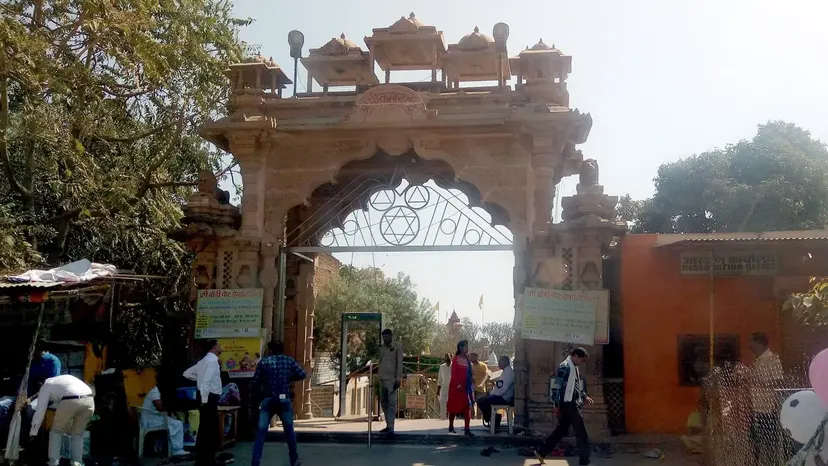
The temple is close to the Western Group of Temples at Khajuraho. Incredible India describes it as reached through a separate gate off the road leading from the Airport Road towards the Western Group, past a pond, with a few steps leading up to the complex.
Wikipedia notes that Khajuraho has its own airport (Khajuraho, HJR) and that the railway station is about six kilometres from the entrance to the monuments. Chhatarpur, the district headquarters, is about 46 km away by road.
Location: Khajuraho, Chhatarpur, Madhya Pradesh, India
Nearest airport: Khajuraho Airport (HJR)
Nearest railway station: Khajuraho (about 6 km from the monuments, per Wikipedia)
More in Hindu temples in Madhya Pradesh · Devi with the sixty-four Yoginis (main cell probably for Durga) temples · Temples in Khajuraho · Temples in Rajnagar Tehsil · Temples in Chhatarpur District
Questions
Chausath Yogini Temple, Khajuraho: Frequently Asked Questions
How old is the Chausath Yogini Temple at Khajuraho?
It is dated to the late 9th century, around 885 CE according to Wikipedia, and is regarded as the oldest surviving temple at Khajuraho.
What does 'Chausath Yogini' mean?
'Chausath' means sixty-four. The temple was built with cells for sixty-four Yoginis, female deities worshipped in tantric goddess traditions, plus one larger cell probably for Durga.
Why is the Khajuraho Yogini temple different from others?
Most Yogini temples, such as Hirapur and Mitaoli, are circular. The Khajuraho temple is rectangular, a shape also found at Rikhiyan and Badoh, and it is built of granite rather than sandstone.
Are there any idols in the Chausath Yogini Temple?
No. The cells are empty. Three large Matrika images found in the ruins, Brahmani, Maheshvari and Mahishamardini, are in the archaeological museum at Khajuraho.
How many shrine cells survive?
The courtyard originally had 65 cells; 35 survive today.
Is the Chausath Yogini Temple part of the UNESCO site?
Yes. It belongs to the Khajuraho Group of Monuments, inscribed on the UNESCO World Heritage List in 1986, and is protected by the ASI.
Sources and attribution
- Wikipedia — Chausath Yogini Temple, Khajuraho
- Wikipedia — Khajuraho Group of Monuments
- Archaeological Survey of India, Temple Survey Project (Northern Region), Bhopal — About The Temple: list of centrally protected temples
- Incredible India (Ministry of Tourism, Government of India) — Chausath Yogini Temple, Khajuraho, Madhya Pradesh
Further reading: Chausath Yogini Temple, Khajuraho on Wikipedia (CC BY-SA 4.0).
Spotted an error? Write to info@hindutone.com — see our editorial policy.