Radha Madan Mohan Temple, Vrindavan
Krishna as Madan Mohan, with Radha and Lalita temple · Vrindavan, Mathura, Uttar Pradesh, India
The Radha Madan Mohan Temple stands on a high bank above Kaliya Ghat at the upper end of Vrindavan, in Mathura district, Uttar Pradesh. It is among the earliest surviving temples of the town and is closely associated with Sanatana Goswami, one of the Goswamis whose work in the 16th century shaped the Krishna worship of Vrindavan. The Mathura district administration lists it first among the Sapt Devalaya, the seven principal temples of the Gaudiya tradition in Vrindavan.
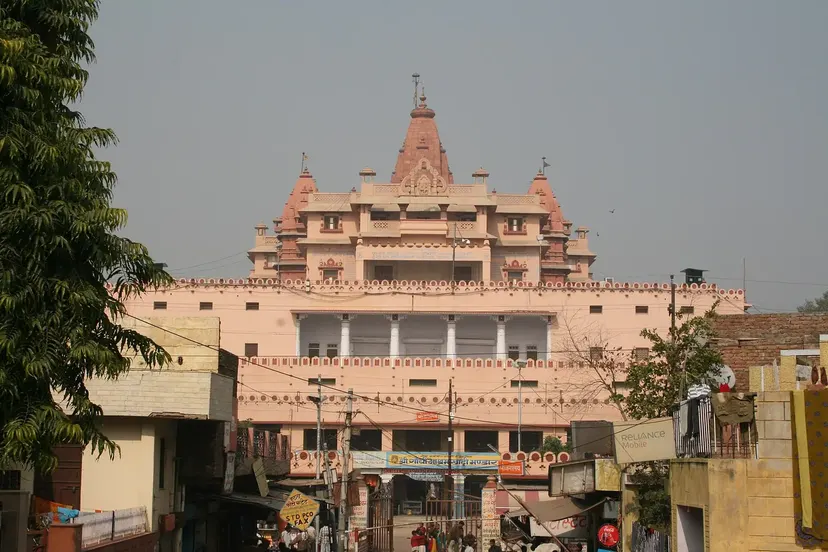
The presiding deity is Madan Mohan, a name of Krishna, worshipped with Radha and the gopi Lalita on either side, according to the district administration. The tall red sandstone tower of the old temple is a landmark of the riverside, and the Archaeological Survey of India (ASI) has recently carried out conservation work on it.
Faith & Tradition
Religious Significance of Radha Madan Mohan Temple, Vrindavan
The temple's foundation story is recorded by F. S. Growse in his Mathura: A District Memoir (third edition, 1883), from the Bhakt Sindhu, a version of the Bhaktamal. In this account, while Sanatana was living as a mendicant in the then-forested Vrindavan, a man in Mathura gave him an image of Madan Mohan, which he set up near the Kali-dah Ghat, building a small hut for himself beside it. A merchant from Multan named Ram Das, known as Kapuri, whose boat bound for Agra had run aground on a sandbank below the ghat, climbed the hill, met Sanatana and prayed to Madan Mohan; the story says his boat floated free at once. After selling his goods in Agra, he gave the proceeds to Sanatana, who asked him to build the temple, and he built both the temple and the ghat in red stone.
Wikipedia records a further tradition that the image had once been worshipped by Vajranabha, Krishna's great-grandson, and was rediscovered at the foot of a banyan tree by Advaita Acharya, who entrusted it to his disciple Purushottama Chaube, from whom it passed to Sanatana. These accounts are devotional traditions rather than documented history.
Kaliya Ghat, beside the temple, is the place where, according to Krishna legend, he subdued the serpent Kaliya, as Growse notes.
Heritage
History of Radha Madan Mohan Temple, Vrindavan
Growse writes that after the Mughal emperor Akbar visited the Goswamis of Vrindavan in 1573, his support encouraged the building of four great temples: Gobind Deva, Gopinath, Jugal Kishor and Madan Mohan. Wikipedia dates the building of the Madan Mohan temple by Ram Das Kapur, under Sanatana's guidance, to about 1580.
The original image of Madan Mohan is no longer in Vrindavan. Growse records that it is at Karauli in Rajasthan, where Raja Gopal Singh (who reigned from 1725 to 1757) built a new temple for it after obtaining it from his brother-in-law, the Raja of Jaipur. Wikipedia says the image was first taken to Jaipur around the time of Aurangzeb's attacks on the temples of Braj in 1670, that a replica was installed at Vrindavan in 1748, and that a new temple was built in 1819 by Nanda Kumar Basu, a zamindar from Baharu.
By the 1870s, Growse found the old temple largely ruined: its vaulted roof had gone, and daily worship was held in a newer building across the street, below the older shrine. Growse records that in 1875 he had the ground round the temple lowered, later buildings cleared from inside the nave and a new flight of steps built up from the east. In 2026 Amar Ujala reported that the ASI's science branch had completed the first phase of chemical cleaning of the temple's outer walls, removing moss and pollution stains from the red stone, and that the ASI planned to protect the northern wall.
Architecture and sacred features
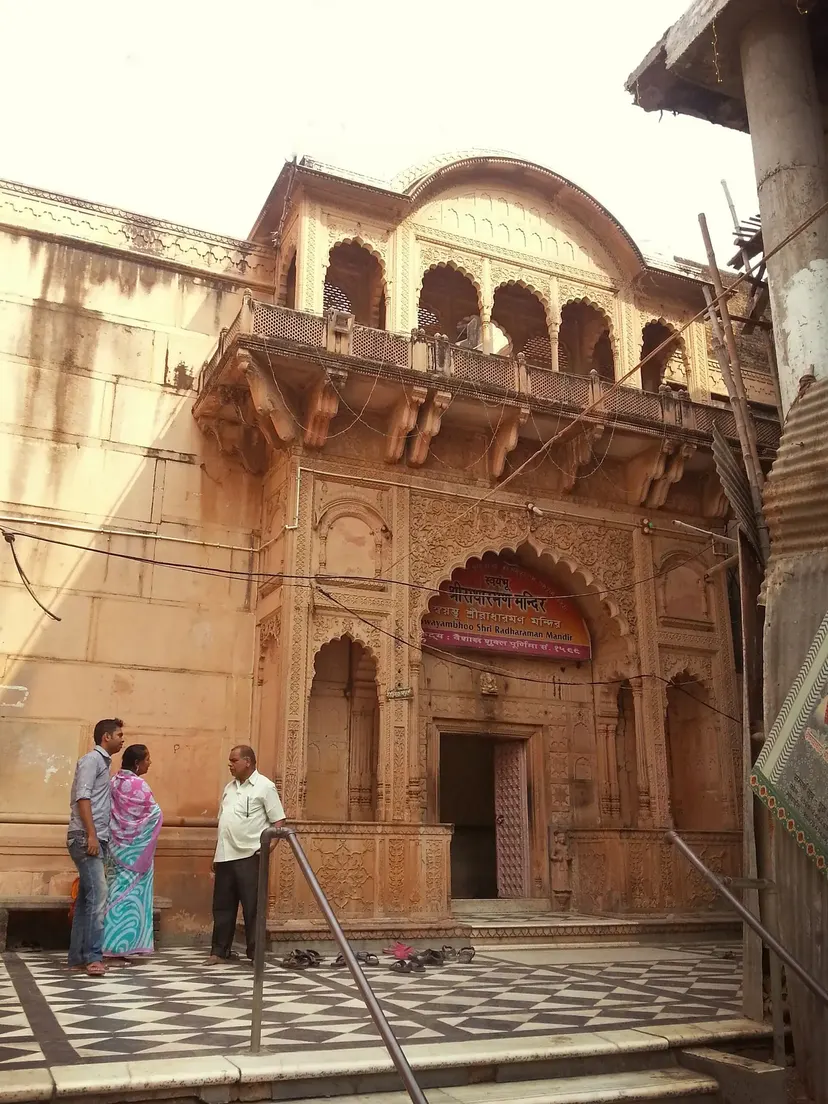
Growse describes the old temple as a long hall (nave) about 57 feet in length, followed by a choir about 20 feet square and a sanctum of the same size. The tower over the sanctum is a plain octagonal spire with a curving outline, tapering towards the top, in the northern Nagara manner. On its south side stands a smaller chapel with its own tower, covered with sculptured panels, whose doorway carries a Sanskrit inscription in Bengali and Nagari scripts recording its dedication to Krishna by one Gunanand. The courtyard is entered up a flight of steps through a massive square gateway with a pyramidal roof.
The district administration gives the height of the temple as about 50 feet.
Plan Your Visit
Darshan and Visitor Information
Worship is held in the newer temple beside the old tower, which is under conservation by the ASI. Vrindavan's temples are crowded on festival days, and timings differ between summer and winter, so confirm current darshan times locally before visiting.
Timings and arrangements change with seasons and festivals. Confirm current details with the temple administration before travelling. Last reviewed 1 November 2026.
Location
How to Reach Radha Madan Mohan Temple, Vrindavan
The temple is near Kaliya Ghat on the Parikrama Marg, the pilgrim circuit road around Vrindavan, at the upstream end of the town. Vrindavan is in Mathura district, and visitors usually travel via Mathura; check current local transport before travelling.
Location: Vrindavan, Mathura, Uttar Pradesh, India
More in Hindu temples in Uttar Pradesh · Krishna as Madan Mohan, with Radha and Lalita temples · Temples in Mathura Tehsil · Temples in Mathura District
Questions
Radha Madan Mohan Temple, Vrindavan: Frequently Asked Questions
Who founded the Madan Mohan Temple in Vrindavan?
Tradition credits Sanatana Goswami, who installed the image of Madan Mohan near Kaliya Ghat. Growse records that a merchant from Multan, Ram Das Kapuri, built the temple and ghat at his request; Wikipedia dates this to about 1580.
Is the original image of Madan Mohan still in Vrindavan?
No. According to Growse, the original image is at Karauli in Rajasthan, where Raja Gopal Singh built a temple for it. Vrindavan worships a later image, which Wikipedia says was installed in 1748.
What are the Sapt Devalaya of Vrindavan?
The Mathura district administration lists seven principal temples of the Gaudiya tradition in Vrindavan, beginning with Madan Mohan and including Radha Raman, Radha Shyamsundar, Gopinath, Radha Damodar, Govind Dev and Radha Gokulananda.
Who looks after the old temple building?
The Archaeological Survey of India has carried out conservation work on the old temple's walls, Amar Ujala reported in 2026.
Where is the temple?
On a high bank near Kaliya Ghat at the upper end of Vrindavan, on the Parikrama Marg.
Sources and attribution
- F. S. Growse, Mathura: A District Memoir, 3rd edition (1883), chapter IX, pp. 250–252 (Internet Archive scan) — Brindaban and its temples: Foundation of the temple of Madan Mohan
- District Administration, Mathura (Government of Uttar Pradesh) — Madan Mohan Mandir
- District Administration, Mathura (Government of Uttar Pradesh) — Sapt Devalay (Gaudiya Sampradaya)
- Amar Ujala — मदन मोहन मंदिर फिर चमका: एएसआई ने दीवारों से हटाई काई और कालिख (5 May 2026)
- Wikipedia — Radha Madan Mohan Temple, Vrindavan
Further reading: Radha Madan Mohan Temple, Vrindavan on Wikipedia (CC BY-SA 4.0).
Spotted an error? Write to info@hindutone.com — see our editorial policy.