Kedarnath Kapat Closing 2026: Portals Close on Bhai Dooj, 11 November, as Baba Kedar Enters Samadhi
High in the Garhwal Himalayas, where the Mandakini River flows like liquid silver through a landscape of stone and sky, the ancient temple of Kedarnath Dham stands today in a final, radiant offering of beauty. Thick strands of marigold, rose and other vibrant flowers cascade over its weathered grey
High in the Garhwal Himalayas, where the Mandakini River flows like liquid silver through a landscape of stone and sky, the ancient temple of Kedarnath Dham stands today in a final, radiant offering of beauty. Thick strands of marigold, rose and other vibrant flowers cascade over its weathered grey stone walls, framing the entrance and the surrounding courtyards in a blaze of colour against the stark autumn light. Devotees crowd the pathways, many with phones raised to capture the moment, their voices rising in waves of "Har Har Mahadev". A richly decorated silver palanquin, the Panchmukhi Utsav Doli, moves through the throng, its canopy and sides heavy with garlands of purple, pink, white and gold. The closure rituals have begun. Tomorrow, on the sacred day of Bhai Dooj, 11 November 2026, at 8:30 in the morning, the portals of Kedarnath will close for the long Himalayan winter.
This is not merely the end of a pilgrimage season. It is a profound turning in the eternal cycle of presence and withdrawal, of outer darshan and inner stillness: the moment when the Lord of the Mountains prepares to enter deep samadhi, and the mountains themselves reclaim their solitude under snow.
Kedarnath closing 2026 at a glance
- Portals close: Wednesday 11 November 2026 (Bhai Dooj) at 8:30 AM IST
- Utsav Doli departs: 11 November 2026, after the Samadhi Puja
- Usual halts: Rampur on the first night, then the Vishwanath Temple in Guptkashi
- Winter seat: Omkareshwar Temple, Ukhimath (Rudraprayag district), where the doli is due on 13 November 2026
- Winter darshan: daily worship, aarti and darshan of Baba Kedar continue at Ukhimath until the portals reopen next spring
The Living Legend of the Hump of Shiva
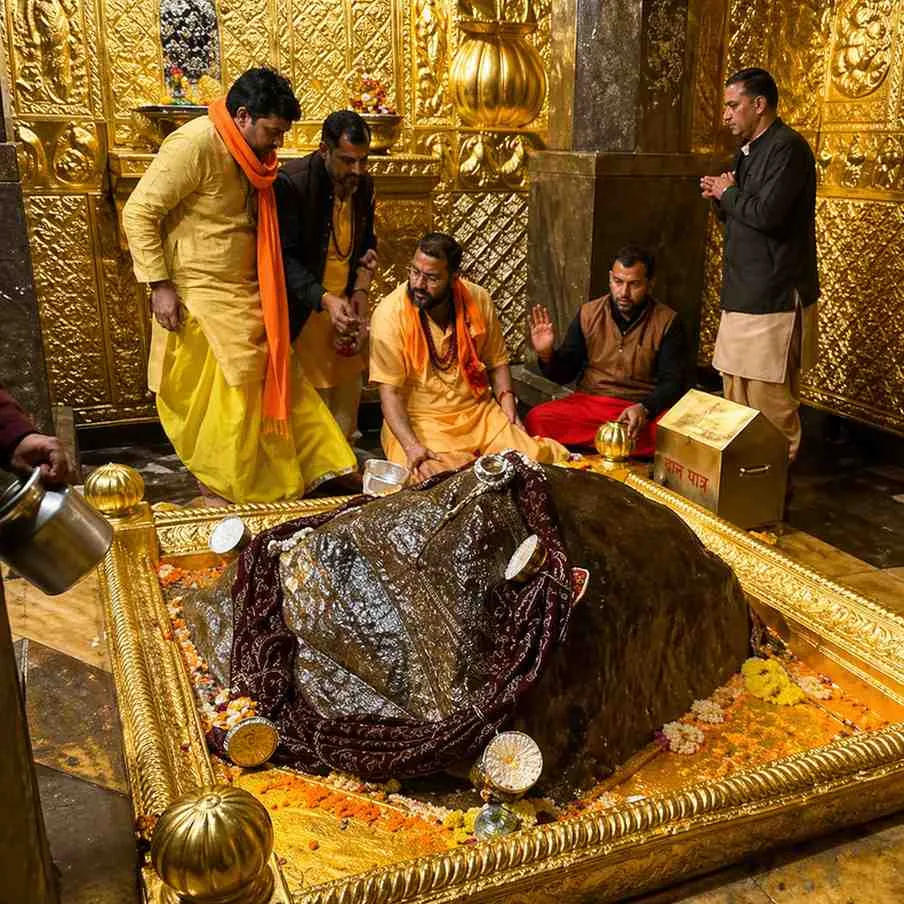
To understand the weight of this closing, one must first feel the weight of the story that has drawn pilgrims here for centuries. After the great war of Kurukshetra, the five Pandava brothers, victorious yet broken by the blood of their own kin, sought the forgiveness of Lord Shiva. Shiva, unwilling to grant them easy absolution, took the form of a bull and hid among the herds near Guptkashi. When the powerful Bhima recognised Him and seized the tail, the divine bull began to sink into the earth. The hind portion, the hump, remained above ground at the spot now known as Kedarnath. The other parts of the body manifested at the four other Panch Kedar shrines: Tungnath, Rudranath, Madhyamaheshwar and Kalpeshwar. The rough, conical, self-manifested (svayambhu) rock that is worshipped in the sanctum of Kedarnath is that very hump, the portion of the Lord that stayed behind so that devotees might always find Him.
Tradition further holds that the temple was later restored and elevated in the eighth century by Adi Shankaracharya, the great philosopher-saint who unified the streams of Sanatana Dharma. Behind the main shrine stands the memorial marking the place where, according to local belief, the Acharya attained mahasamadhi. Thus the site carries both the mythic power of the Mahabharata and the living presence of one of Hinduism's greatest teachers. It is simultaneously one of the twelve Jyotirlingas, the foremost of the Panch Kedar, and a central pillar of the Char Dham Yatra of Uttarakhand.
The Confidential Ritual of Samadhi Puja
As the final hours of the open season approach, the most sacred and secret of the closing rites begins: the Samadhi Puja. This ceremony is performed in the early morning hours, away from the public gaze, by the temple priests under the guidance of the Rawal. The self-manifested Shivalinga is bathed, anointed and then covered with layers of sacred materials: grains of various kinds, fruits, flowers, holy ash (bhasma) and other pure substances. It is as though the priests are preparing the Lord for a long winter's meditation, offering Him every comfort against the coming cold. An Akhand Jyoti, the uninterrupted lamp, is lit within the sanctum. This flame will burn steadily through the six months of snow and silence, a quiet witness that the divine presence never departs.
The belief surrounding this rite is profound. Once the human portals are sealed, the gods themselves are said to descend from their celestial realms to offer worship to Baba Kedar. For six months the temple becomes a place of divine rather than human service. The Lord enters a state of samadhi and tapasya, renunciation and deep absorption, symbolising the truth that lies beyond the changing seasons of the outer world. The closing is therefore not an absence but a different mode of presence: the Lord withdrawing into Himself so that His grace may continue to flow pure and uninterrupted.
The Journey of the Panchmukhi Doli
After the Samadhi Puja and the formal sealing of the garbhagriha, the ceremonial Panchmukhi Utsav Doli is prepared. This five-faced form of the festival idol represents the five aspects of Shiva: Sadyojata, Vamadeva, Aghora, Tatpurusha and Ishana. Adorned with flowers and silver, it is lifted onto the shoulders of designated bearers and begins its slow, sacred descent from the high valley. The procession is accompanied by the deep beat of drums, the call of conches and continuous chanting. Crowds of devotees walk alongside for as long as they can, offering flowers, touching the doli with reverence and receiving the blessing of proximity to the moving form of the Lord.
The journey takes several days. On the first day the doli typically reaches Rampur. The next day it moves through Phata and Narayankoti toward the Vishwanath Temple in Guptkashi, where it rests and allows local devotees darshan. Finally, around 13 November, it arrives at its winter abode, the Omkareshwar Temple in Ukhimath. There, at a gentler altitude, the daily cycle of worship, aarti and offerings continues without interruption. The Lord has not left His devotees; He has simply come closer to them for the season when the high peaks become inaccessible to human feet. (Read more about Baba Kedar's winter seat at Ukhimath.)
The Landscape of Farewell
In these final days the valley itself seems to participate in the farewell. The air is sharp and clear. The surrounding peaks of Kedarnath and the Chorabari glacier already carry heavier snow. The flower decorations on the temple glow against the grey stone and the darkening skies. Priests in traditional attire move with quiet purpose. Local people, many of whose families have served the shrine for generations, speak of both joy and a gentle melancholy: the joy of having completed another season of service, the melancholy of the coming silence. The scenes shared from the site capture this atmosphere: the decorated doli swaying above the heads of the crowd, the temple entrance framed in cascading marigolds, priests describing the rituals, and the constant undercurrent of devotion that turns every practical arrangement into an act of love.
What the Closing Teaches the Devotee
For the millions who could not reach Kedarnath this season, and for those who made the arduous trek or helicopter journey during the record Char Dham season, the closing carries a deep personal message. The outer temple may close, but the inner temple never does. The same Lord who accepts the touch of a devotee's hand on the rough stone lingam in summer remains available in the quiet of the heart, in the remembrance of His name, and in the continued worship at Ukhimath. The cycle of opening and closing mirrors the rhythm of spiritual life itself: periods of intense outer seeking followed by periods of quiet assimilation; seasons of visible grace followed by seasons of faith tested in silence.
The tradition also reminds us of the intimate relationship between nature and the divine. The Himalayas do not close the temple out of hostility; they close it out of necessity and protection. In that enforced withdrawal, the devotee is invited to discover that the true pilgrimage is not only the outer journey up the mountain path but the inner journey into the presence that the mountain both reveals and conceals.
A Prayer for the Season of Silence
As the final aarti is performed and the heavy wooden portals swing shut tomorrow morning, the valley will grow quiet. Snow will begin its slow descent. The Akhand Jyoti will continue its solitary vigil inside the sealed sanctum. And somewhere on the path descending toward Ukhimath, the Panchmukhi Doli will move forward, carried by human hands yet guided by a power far greater.
In that moment, the hearts of devotees across the world may join in a single prayer:
Baba Kedar, Lord of the high mountains and the deep silence, whether Your portals stand open to the summer sun or closed against the winter snow, remain forever established in the temple of our hearts.
In the season of Your visible presence, grant us the joy of darshan. In the season of Your hidden presence, grant us the strength of unwavering faith.
May the Akhand Jyoti that burns in Your sanctum also burn without interruption in our lives. Har Har Mahadev. Jai Baba Kedarnath.
The portals will close. The snow will fall. And the eternal Lord of Kedarnath will continue, as He has for ages beyond counting, to bless, to protect and to draw every sincere seeker closer to the unchanging truth that lies beyond all seasons.
May this sacred transition deepen the devotion of all who read these words, and may the grace of Baba Kedar remain their constant companion through the coming months of quiet and light.
Related reading
- Kedarnath Temple opening date 2026: complete planning guide
- Panch Kedar Yatra 2026: the five sacred Himalayan shrines
- Bhai Dooj 2026: date, tilak muhurat and rituals
The closing date and time (11 November 2026, 8:30 AM) and the doli's arrival at Ukhimath on 13 November are as announced by the temple committee. Timings can change with weather; check the Badrinath-Kedarnath Temple Committee before travelling.
Share this with family and friends
Send it on WhatsApp, post it, or copy the link.
More from Temples
- Varanasi Kartik Maas 2026: Kashi Vishwanath Darshan, Ganga Aarti, Dev Deepawali Dates and Pilgrimage Guide
- Hindu Temples in Florida – Complete City-Wise Directory
- Hindu Temples in California – Complete City-Wise Directory
- Hindu Temples in New York City – Complete Borough-Wise Directory
- Hindu Temples in Texas – Complete City-Wise Directory
You might also like
Kedarnath Helicopter Service 2026 — Booking Guide, Operators, Safety Updates & Complete NRI Pilgrim Manual

Kedarnath Temple Opening Date 2026: Complete Guide to Planning Your Char Dham Pilgrimage

Uttarakhand: Kedarnath Dham Witnesses Second Snowfall of Winter 2026