The Complete Story of Satyabhama: Birth, Divine Love, and Victory Over Narakasura
Introduction Satyabhama stands as one of the most prominent queens of Lord Krishna and holds a special place in Hindu mythology.
Introduction Satyabhama stands as one of the most prominent queens of Lord Krishna and holds a special place in Hindu mythology.
Introduction
Satyabhama stands as one of the most prominent queens of Lord Krishna and holds a special place in Hindu mythology. Known for her beauty, courage, and unwavering devotion, her story intertwines divine love with heroic valor. She is considered an incarnation of Bhudevi (Mother Earth) and played a crucial role in the destruction of the demon Narakasura.
The Birth of Satyabhama
Divine Origins
Satyabhama was born as the daughter of Satrajit, a wealthy Yadava king who was a devotee of Surya (the Sun God). Her birth itself was marked by divine significance, as she was destined to be the earthly manifestation of Bhudevi.
The Syamantaka Jewel
The story of Satyabhama's connection to Krishna begins with the legendary Syamantaka jewel. Satrajit possessed this precious gem, which had the miraculous power to produce eight measures of gold daily and protect its keeper from calamities. The jewel was so brilliant that it illuminated darkness and brought prosperity wherever it went.
The Jewel's Disappearance
One day, Satrajit's brother Prasena took the Syamantaka jewel and went hunting. During the hunt, a lion killed Prasena and took the jewel. Subsequently, Jambavan, the bear king who had served Lord Rama in the Ramayana, killed the lion and took the jewel to his cave for his son to play with.
When Prasena did not return, Satrajit accused Krishna of murdering his brother for the jewel. To clear his name, Krishna tracked the jewel's trail through the forest, discovering Prasena's body and then following the lion's tracks to Jambavan's cave.
Krishna and Jambavan's Battle
A fierce battle ensued between Krishna and Jambavan that lasted for 28 days. Finally, Jambavan recognized Krishna as Lord Rama himself and surrendered. As a gesture of devotion and reconciliation, Jambavan offered his daughter Jambavati in marriage to Krishna and returned the Syamantaka jewel.
Marriage to Lord Krishna
Satrajit's Realization
When Krishna returned the Syamantaka jewel to Satrajit, the king was overwhelmed with shame and guilt for having falsely accused Krishna. To atone for his mistake and to honor Krishna, Satrajit offered his beloved daughter Satyabhama's hand in marriage to Krishna, along with the Syamantaka jewel as dowry.
The Divine Union
Satyabhama's marriage to Krishna was celebrated with great splendor in Dwarka. Among Krishna's eight principal wives (Ashtabharya), Satyabhama held a special position. She was known for her strong personality, fierce independence, and deep love for Krishna.
Satyabhama's Character
Unlike Rukmini, who embodied devotion and gentleness, Satyabhama was spirited, bold, and sometimes possessive of Krishna's affection. She was skilled in archery and warfare, characteristics that would later prove crucial in the battle against Narakasura. Her relationship with Krishna was marked by both passionate devotion and playful jealousy, making their bond deeply human and relatable.
The Story of Narakasura
The Demon King's Origins
Narakasura was born to Bhudevi (Mother Earth) and was originally blessed by Lord Vishnu. He started as a righteous king of Pragjyotishapura (present-day Assam), but gradually became drunk with power and turned into a tyrannical demon.
His Reign of Terror
Narakasura's atrocities grew increasingly severe. He conquered heaven and earth, defeating even Indra, the king of gods, and stealing his mother Aditi's earrings. Most heinously, he kidnapped 16,100 princesses from various kingdoms and imprisoned them in his palace, bringing immense suffering to countless realms.
He also stole the divine umbrella of Varuna, the celestial parijata tree, and parts of Mount Mandara. His arrogance knew no bounds, and he even attempted to assault women of noble families, causing widespread distress.
The Divine Intervention Needed
The gods, unable to defeat Narakasura, approached Lord Krishna for help. Narakasura had received a boon that he could only be killed by his mother. Since Satyabhama was an incarnation of Bhudevi, only she could fulfill this destiny.
The Battle Against Narakasura
Journey to Pragjyotishapura
Krishna, accompanied by Satyabhama, mounted Garuda (the divine eagle) and flew to Pragjyotishapura. The demon's capital was protected by formidable defenses, including mountains on all sides, a moat of water, and barriers of fire and wind created through black magic.
Breaking the Defenses
Using the Sudarshana Chakra, Krishna systematically destroyed each layer of protection. The mountains crumbled, the waters parted, and the mystical barriers dissolved before the divine power of the Lord.
The Demon's Army
Narakasura's commander Mura, along with the demon's powerful army, came out to face Krishna. A fierce battle ensued, with Krishna destroying thousands of demons. Mura attacked Krishna with various mystical weapons, but Krishna defeated him, earning the title "Murari" (enemy of Mura).
The Final Confrontation
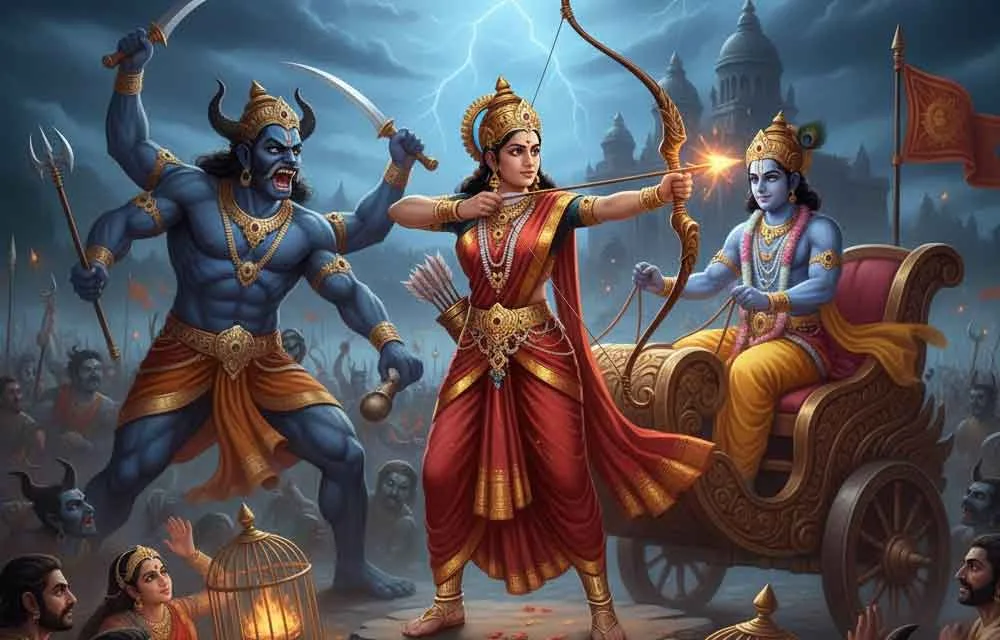
Finally, Narakasura himself entered the battlefield, riding his elephant and wielding powerful weapons. The battle between Krishna and Narakasura shook the three worlds. Narakasura unleashed countless divine weapons, but Krishna countered each one effortlessly.
Satyabhama's Crucial Role
During the intense battle, Narakasura managed to wound Krishna slightly (some versions say Krishna feigned being hurt to give Satyabhama her destined role). Seeing her beloved husband injured, Satyabhama's fury knew no bounds.
Taking up the bow herself, Satyabhama shot arrows with deadly precision. As the incarnation of Bhudevi, she was the only one who could kill her son Narakasura. Her arrows found their mark, and Narakasura fell mortally wounded.
Narakasura's Redemption
As Narakasura lay dying, he attained clarity and recognized Krishna as the Supreme Lord. With his last breath, he repented his sins and requested that his death anniversary be celebrated not with mourning but with joy and lights, symbolizing the victory of good over evil. This day is celebrated as Naraka Chaturdashi, the day before Diwali.
After the Victory
Liberation of the Princesses
After Narakasura's death, Krishna freed the 16,100 imprisoned princesses. These women, though innocent, had been dishonored by society simply for being in a demon's captivity. Understanding their plight and to restore their honor, Krishna married all of them, giving them the dignity and protection of being queens of Dwarka.
Return of Divine Objects
Krishna returned all the stolen items to their rightful owners: Aditi's earrings to the mother of gods, Varuna's umbrella, and other celestial treasures to the devas. The heavens rejoiced, and Indra himself came to honor Krishna and Satyabhama.
Satyabhama's Glory
Satyabhama returned to Dwarka as a celebrated warrior queen. Her courage and skill in battle became legendary, and she was honored not just as Krishna's wife but as a heroine in her own right.
Satyabhama in Other Stories
The Parijata Tree Incident
One of the most famous stories involving Satyabhama is the incident of the Parijata tree. When Krishna brought a single Parijata flower for Rukmini from heaven, Satyabhama, feeling jealous, demanded that Krishna get her the entire celestial tree.
To please her, Krishna went to Indraloka and brought back the Parijata tree. When Indra objected, a battle ensued, which Krishna won. However, when Satyabhama wanted to plant the tree, Krishna cleverly planted it on the border between Rukmini's garden and hers, so that while the tree stood in Satyabhama's garden, the flowers would fall in Rukmini's garden, teaching both wives a lesson about ego and sharing.
The Tulabharam Episode
In another significant story, the sage Narada once created a situation to teach Satyabhama a lesson about true devotion. He told Satyabhama that Krishna could be donated and recovered only if she could equal his weight with her wealth.
Satyabhama, proud of her riches, agreed and placed all her jewelry, gold, and precious possessions on one side of the scale, with Krishna on the other. But the scale did not balance. Even after adding all her wealth, Krishna's side remained heavier.
Humbled and distressed, Satyabhama sought Rukmini's help. Rukmini simply placed a single tulsi leaf on the scale with complete devotion and faith, and immediately the scale balanced. This incident taught Satyabhama that true devotion and love weigh more than material wealth.
Spiritual Significance
Symbol of Bhudevi
Satyabhama's incarnation as Bhudevi represents Mother Earth's relationship with the divine. Her role in slaying Narakasura symbolizes the earth reclaiming justice and destroying the forces that oppress it.
The Warrior Goddess Aspect
Satyabhama represents the fierce, protective aspect of the divine feminine. She embodies the principle that devotion doesn't mean weakness, and that women can be both loving wives and powerful warriors.
Balance in Relationships
Satyabhama's relationship with Krishna teaches important lessons about love, ego, devotion, and personal growth. Her journey from possessiveness to mature love mirrors the spiritual journey many devotees undertake.
Naraka Chaturdashi
The celebration of Naraka Chaturdashi, falling on the second day of Diwali, commemorates Satyabhama's victory over Narakasura. People wake up early, apply oil on their bodies, and bathe before sunrise, symbolizing the cleansing of sins and the triumph of light over darkness.
Legacy and Worship
In Dwarka
Satyabhama is worshipped alongside Krishna in many temples in Dwarka and Gujarat. She is particularly venerated during Naraka Chaturdashi.
Cultural Impact
Satyabhama's character has been portrayed in numerous classical dance forms, particularly Kuchipudi, where the dance-drama "Bhama Kalapam" showcases her devotion and longing for Krishna.
Lessons from Her Life
Satyabhama's story teaches us that:
- Courage and strength are divine qualities in women
- True devotion transcends material possessions
- Pride and ego can be transformed through divine love
- Justice prevails when the righteous take action
- Love can exist in many forms, each valuable and meaningful
Conclusion
Satyabhama's story is one of transformation, from a proud princess to a humble devotee, from a loving wife to a fearless warrior. Her slaying of Narakasura represents the eternal truth that evil, no matter how powerful, must fall before righteousness. Her relationship with Krishna reminds us that divine love embraces all aspects of human emotion—passion, jealousy, pride, and ultimately, selfless devotion.
As we celebrate Naraka Chaturdashi each year, we honor not just the defeat of a demon, but the triumph of courage, the power of the divine feminine, and the eternal dance of love between the human and the divine. Satyabhama's legacy continues to inspire devotees to embrace both strength and surrender on the spiritual path.
May the story of Satyabhama inspire us to cultivate both courage and devotion in our own lives, and may we always remember that true love transforms us from within.
Frequently Asked Questions
When is The Complete Story of Satyabhama?
The Complete Story of Satyabhama is observed on its traditional tithi in the Hindu lunar calendar; refer to the year's panchang for the exact date in your region.
What is the significance of The Complete Story of Satyabhama?
Introduction Satyabhama stands as one of the most prominent queens of Lord Krishna and holds a special place in Hindu mythology. Known for her beauty, courage, and unwavering devotion, her story intertwines divine love with heroic valor.
How is The Complete Story of Satyabhama celebrated?
Devotees observe it with puja, fasting or special offerings, visiting temples, chanting mantras, and gathering with family. Customs vary by region and tradition.
What should devotees do on The Complete Story of Satyabhama?
Take a sacred bath, perform the day's puja and charity (dana), observe any prescribed fast, and chant mantras with sincere devotion.
You might also like
Gita Jayanti 2026 Prasad Recipes — Tulsi-Honoring Sweets, Krishna's Favourites & December 10 Bhog Plate
Shani Deva Temples Worldwide & Must-Performed Rituals — Complete Devotee's Guide
Maha Shivratri 2026 Vrat Recipes — Sabudana Khichdi, Singhada Halwa, Phalahara Foods Complete Fasting Guide