
Diwali 2026 in Saudi Arabia: Lakshmi Puja Muhurat for Riyadh, Jeddah, Dammam and Al Khobar
Lakshmi Puja falls on the evening of Sunday 8 November 2026 across Saudi Arabia, the first day of the Saudi working week. Local muhurat for Riyadh, Jeddah, Dammam and Al Khobar, and how families mark Diwali privately at home.
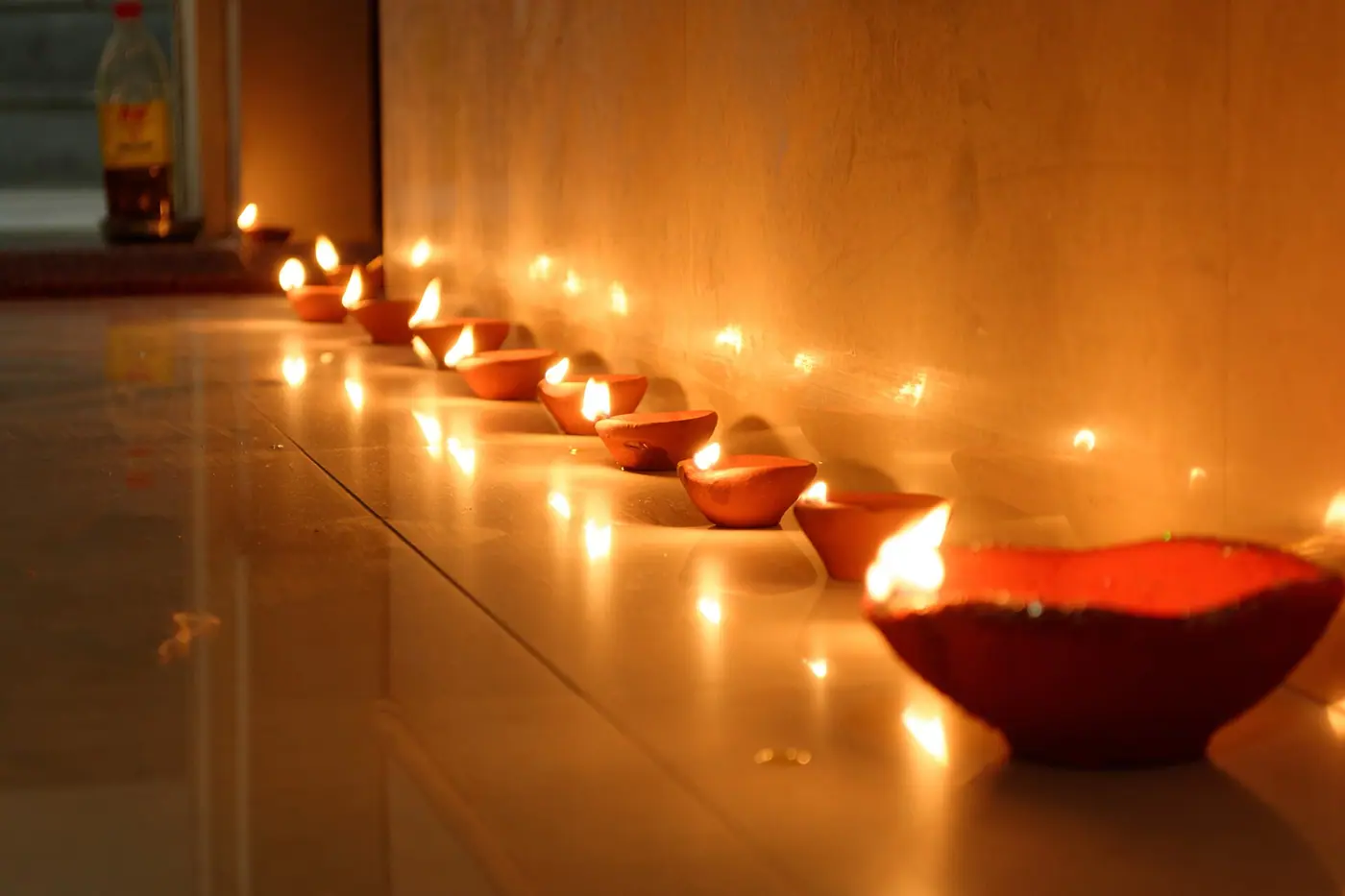
Lakshmi Puja falls on the evening of Sunday 8 November 2026 across Saudi Arabia, the first day of the Saudi working week. Local muhurat for Riyadh, Jeddah, Dammam and Al Khobar, and how families mark Diwali privately at home.
Quick answer: Diwali (Lakshmi Puja) 2026 in Saudi Arabia is on Sunday 8 November 2026. In Riyadh the Lakshmi Puja muhurat is 5:34 PM – 7:31 PM (Arabia Standard Time). Dhanteras is Friday 6 November 2026. Because the Saudi weekend is Friday and Saturday, Diwali evening falls on a normal working day, and celebrations are private and at home.
Editor's note: this page was updated on 10 October 2026. The local muhurat times were calculated by HinduTone using the Drik Panchang method (Pradosh Kaal with the Vrishabha lagna) for each Saudi city, and checked against Drik Panchang for major world cities to within one to two minutes. They are not India's times converted. We do not list public events, because there are none to list in the Kingdom; any community or embassy programme mentioned would come only from the organiser's own announcement. Please confirm the timing with your family priest, or with the temple you follow in India, before you sit for puja.
Diwali in Saudi Arabia is different from almost anywhere else in this series. There are no mandirs to visit, no Diwali melas in the park and no public holiday. What there is, in Riyadh flats, Jeddah villas and Eastern Province company compounds, is a very large Indian community keeping the festival quietly and faithfully at home: a lamp in front of a small Lakshmi-Ganesh altar, a phone propped up for a video call with parents in Kerala or Gujarat, and a box of sweets passed to the family next door. This guide is written for that kind of Diwali.
Diwali 2026 in Saudi Arabia: the five days
| Day | Date | What is observed |
|---|---|---|
| Dhanteras (Yama Deepam) | Friday 6 November | Dhanvantari and Lakshmi puja in the evening, a lamp for Yama facing south, buying a small metal item |
| Kali Chaudas (Gujarati tradition) | Saturday 7 November | Protective prayers to Hanuman or Mahakali among Gujarati families |
| Diwali / Lakshmi Puja | Sunday 8 November | Lakshmi-Ganesh puja at dusk, diyas, Narak Chaturdashi and the Tamil Deepavali oil bath in the morning, Kali Puja for Bengali families, Chopda / Sharda Puja for Gujarati traders |
| Govardhan Puja / Annakut, Bali Pratipada, Gujarati New Year | Tuesday 10 November (in India) | Food offerings to Krishna, Bali Pratipada, Bestu Varas greetings |
| Bhai Dooj / Yama Dwitiya | Wednesday 11 November (in India) | Sisters apply tilak to brothers and pray for their long life |
The five days retell several stories at once. Dhanteras honours Dhanvantari, who rose from the churning of the ocean carrying the pot of amrit. Narak Chaturdashi remembers Krishna's victory over Narakasura. Diwali night welcomes Lakshmi into a clean, lit home and celebrates Rama's return to Ayodhya. Govardhan Puja recalls Krishna lifting the hill to shelter the people of Braj, while Bali Pratipada remembers the generous king Bali, sent to the netherworld by Vamana and allowed to return once a year. Bhai Dooj closes the festival with the bond between brothers and sisters.
In 2026 India has a gap day on Monday 9 November, which is why Govardhan Puja and Bhai Dooj move to the 10th and 11th. The dates given above for those two days are India's; your family's priest or the temple you follow may announce its own day. For Jains, Diwali marks Mahavira's nirvana, and Sikh families observe Bandi Chhor Divas on the same evening.
Lakshmi Puja muhurat 2026, city by city
All times are Arabia Standard Time (UTC+3). Saudi Arabia does not use daylight saving. These local times were calculated by HinduTone using the Drik Panchang method (Pradosh Kaal with the Vrishabha lagna); checked against Drik Panchang for major world cities to within one to two minutes; confirm with your temple.
| City | Region | Lakshmi Puja (Sun 8 Nov) | Pradosh Kaal | Dhanteras puja (Fri 6 Nov) |
|---|---|---|---|---|
| Riyadh | Riyadh | 5:34 PM – 7:31 PM | 5:09 PM – 7:44 PM | 5:41 PM – 7:39 PM |
| Jeddah | Makkah Province | 6:08 PM – 8:07 PM | 5:43 PM – 8:17 PM | 6:16 PM – 8:15 PM |
| Dammam | Eastern Province | 5:17 PM – 7:14 PM | 4:53 PM – 7:29 PM | 5:25 PM – 7:21 PM |
| Al Khobar | Eastern Province | 5:17 PM – 7:14 PM | 4:53 PM – 7:29 PM | 5:25 PM – 7:22 PM |
Sunset and Pradosh Kaal for both evenings:
| City | Sunset, Fri 6 Nov | Pradosh Kaal, Fri 6 Nov | Sunset, Sun 8 Nov |
|---|---|---|---|
| Riyadh | 5:10 PM | 5:10 PM – 7:45 PM | 5:09 PM |
| Jeddah | 5:44 PM | 5:44 PM – 8:17 PM | 5:43 PM |
| Dammam | 4:54 PM | 4:54 PM – 7:30 PM | 4:53 PM |
| Al Khobar | 4:54 PM | 4:54 PM – 7:29 PM | 4:53 PM |
What Pradosh Kaal means: Pradosh is the period that starts at sunset and lasts about two and a half hours. The scriptures recommend worshipping Lakshmi in this twilight, when the day hands over to the night of Amavasya. On 8 November the Amavasya tithi is already running in every Saudi city by sunset, so the whole Pradosh Kaal is suitable.
What Vrishabha lagna means: the lagna is the zodiac sign rising on the eastern horizon. Vrishabha (Taurus) is a 'fixed' sign, and tradition holds that Lakshmi worshipped while a fixed sign is rising stays in the home. Where the Vrishabha lagna overlaps Pradosh Kaal, that overlap is the ideal muhurat, and that is the window in the first column of the table.
Why the cities differ: one clock covers a country that is wide from east to west. Dammam and Al Khobar on the Gulf have the earliest sunset and the earliest muhurat, Riyadh is in the middle, and Jeddah on the Red Sea is latest, close to an hour behind the Eastern Province. If you live in a city not listed, use the nearest listed city of the same longitude and allow a little margin. Never convert India's muhurat into Saudi time; it is calculated for India's sunset.
The Hindu community in Saudi Arabia
India's Ministry of External Affairs puts the number of overseas Indians in Saudi Arabia at 2,750,551 as of January 2026, almost all of them non-resident Indians on work visas (MEA, Population of Overseas Indians). The Embassy of India in Riyadh describes the community as numbering approximately 2.74 million. Neither figure is broken down by religion, so we do not give a number for Hindus.
The community is drawn from across India, and Diwali in Saudi homes reflects that range. North Indian and Gujarati households keep Lakshmi-Ganesh puja on Diwali evening, Gujarati traders may also do Chopda Puja for their account books, Tamil families begin the day with the Deepavali oil bath, Bengali families worship Kali on the same night, and Maharashtrian, Telugu, Kannada and Malayali households each bring their own customs. Many workers live in the Kingdom on their own while their families stay in India, which shapes how Diwali is kept: for many Hindu residents the festival is a video call, a lamp in a shared room and a meal with colleagues.
The three regions in this guide have different rhythms. Riyadh is the capital and seat of the Embassy of India. Jeddah is the old trading port on the Red Sea. Dammam and Al Khobar sit beside the oil and petrochemical industry of the Eastern Province, where many expatriates live in company compounds with their own house rules. India's own bilateral brief on Saudi Arabia (April 2025) notes Embassy-led cultural programmes such as Pravasi Parichay, whose 2024 edition brought artists from 14 Indian states to the Kingdom.
Where to celebrate: at home, privately and online
There are no public Hindu temples in Saudi Arabia, and we do not list places of worship or public Hindu gatherings. The US State Department's report on religious freedom in Saudi Arabia states that the government prohibits the public practice of any non-Islamic religion and that non-Muslims practise their religion in private (US State Department, 2023 Report on International Religious Freedom: Saudi Arabia). For Hindu families, that means Diwali is a home festival here, which is also how much of the festival has always been kept: Lakshmi is welcomed into the house, not the street.
Riyadh
Riyadh's Lakshmi Puja window is 5:34 PM – 7:31 PM. Most families in the capital set up a small altar in the living room, invite one or two close friends or relatives, and keep the evening simple: puja, aarti, a family meal and calls home. Because 8 November is a working Sunday, aim to have the altar and prasad ready the night before. The Embassy of India in Riyadh is the right contact for consular matters, not for religious events.
Jeddah
Jeddah has the latest muhurat in the Kingdom, 6:08 PM – 8:07 PM, which gives working parents a little more time to get home through evening traffic. Jeddah families often have relatives elsewhere in the Gulf and in India, so a shared video aarti across two or three households is common.
Dammam and Al Khobar
The twin cities of the Eastern Province share the earliest window, 5:17 PM – 7:14 PM, with sunset at 4:53 PM. Families on company compounds should check their compound's own rules on candles and lamps before Diwali; many households here use LED diyas and keep one real oil lamp on the altar only for the puja itself.
Online darshan
Many temples in India live-stream their evening aarti. India is two and a half hours ahead, so that aarti happens before your local muhurat: do your own Lakshmi Puja at your city's time and watch the stream as darshan, before or after.
Celebrating at home in Saudi Arabia
A short Lakshmi Puja vidhi. Clean the house in the days before, as Lakshmi is said to enter only a clean, bright home. On the evening of 8 November, bathe and wear fresh clothes. Place a clean cloth on a low table, with a picture or murti of Lakshmi and Ganesha, a kalash of water with mango or betel leaves, and a few coins or a small piece of jewellery. Within your city's muhurat, light a ghee diya, pray first to Ganesha, then invoke Lakshmi with flowers, kumkum, haldi, akshat (rice) and incense. Offer sweets, fruit and puffed rice or batasha, chant 'Om Shreem Mahalakshmyai Namah' or read the Shri Suktam, and finish with aarti. Share the prasad. For the full step-by-step method see our Lakshmi Puja 2026 vidhi.
Diyas and electric lights in flats. Keep real flames to the altar, on a metal plate, away from curtains, and never leave them burning unattended. Use LED diyas or warm-white string lights for the rest of the home. Keep decorations inside your own home, and keep any displays modest and indoors.
Smoke alarms. Ghee lamps, camphor and incense can set off smoke detectors in modern flats and compounds. Use a single small camphor tablet for aarti, open a window, and do not disable or cover the alarm.
Tenancy and compound rules. Many leases and company compounds forbid open flames, loud music or outdoor decorations. Read your tenancy agreement or compound handbook, and ask the landlord or facilities office if you are unsure.
Weather. Early November is the start of the pleasant season. Evenings in Riyadh are dry and noticeably cooler than the day, Jeddah stays warm and humid, and the Eastern Province is warm with humid nights near the coast. Air-conditioning is still usually on, so keep diyas away from vents and fans.
Food and decorations you can find locally
Indian grocers and South Asian sections of large supermarkets are part of everyday life in Riyadh, Jeddah, Dammam and Al Khobar, and they stock ghee, besan, dried fruit, rice flour for rangoli and kolam, and many of the sweets and snacks you need for Diwali. Indian sweet shops and restaurants usually see a rush of orders for mithai boxes in the week before Diwali, so order early.
Families usually bring murtis, pictures, kumkum and puja books from India for personal use, and buy flowers, fruit, lamps and coloured rice locally. Rangoli can be made just inside the front door or on a tray.
Diwali with children and second-generation families
Saudi Arabia's official weekend has been Friday and Saturday since 2013 (Arab News), so for children at Indian-curriculum and international schools alike, Sunday 8 November is a full school day. Plan the evening backwards: homework and dinner prepared in advance, rangoli or diya decorating on Friday or Saturday, and the puja at your city's muhurat on Sunday.
Diwali is a natural time to keep heritage languages alive. Let grandparents in India teach the aarti or a short shloka over video call in Malayalam, Tamil, Hindi, Gujarati, Marathi or Bengali; have children say the Lakshmi mantra themselves; and tell the stories of Rama, Narakasura and Bali in your own family's language. For children who have only ever celebrated Diwali indoors, explain how the festival looks in India, and why at home in Saudi Arabia the lamps glow inside the family rather than out on the street.
For working parents, Dhanteras on Friday 6 November is the relaxed evening of the week: use it for the family's main celebration meal, buying something small of metal, and lighting the Yama Deepam.
Fireworks, safety and local rules
Do not plan fireworks, sparklers, sky lanterns or outdoor celebrations for Diwali in Saudi Arabia. Rules on fireworks, open flames and public gatherings are set by the national and local authorities, and the practice of non-Islamic religions is limited to private settings (see the State Department report linked above). Check the official guidance of the Saudi authorities and your building or compound management, and keep your Diwali indoors and within the family.
At home, keep a fire blanket in the kitchen, keep matches away from children, and blow out every flame before bed.
Celebrating far from family
For many Hindus in Saudi Arabia, Diwali is spent away from parents, spouses or children. A few ideas that families in the Kingdom find meaningful:
- Video-call puja: light your lamp at your own city's muhurat, then join your family's puja in India by video for aarti; India's evening is before yours, so agree in advance whether you watch theirs live or they watch yours.
- Online darshan: follow a live-stream from your family temple in India during the day or after your puja.
- Seva and daan: make a donation to a temple, gaushala, school or charity in your home town, or support a colleague's family; giving is part of Lakshmi worship.
- Share sweets: a box of mithai for neighbours and colleagues of every background is a warm and widely appreciated way to share the occasion.
If you need consular help in an emergency, contact the Embassy of India in Riyadh.
Diwali checklist for Saudi Arabia
- Note your city's Lakshmi Puja window for Sunday 8 November from the table above
- Plan your working Sunday so you are home before the muhurat starts
- Use Friday 6 November, the weekend, for Dhanteras puja and a family meal
- Clean the house and set up the altar on Saturday
- Bring murtis, pictures and puja books from India for personal use
- Buy flowers, fruit, ghee and sweets locally a few days early
- Read your tenancy or compound rules on open flames
- Use LED diyas for decoration and one real lamp only on the altar
- Test your smoke alarm and keep a fire blanket nearby
- Agree the time of the video-call aarti with family in India
- Keep the celebration private, indoors and within the family
Frequently asked questions
When is Diwali 2026 in Saudi Arabia?
Lakshmi Puja is on the evening of Sunday 8 November 2026 in Riyadh, Jeddah, Dammam and Al Khobar. Dhanteras is Friday 6 November. In India the Amavasya tithi runs from 11:27 AM IST on 8 November to 12:31 PM IST on 9 November, and in every Saudi city it covers the whole Pradosh Kaal on the evening of the 8th.
What is the Lakshmi Puja time in Riyadh, Jeddah, Dammam and Al Khobar?
On Sunday 8 November 2026, Arabia Standard Time: Riyadh 5:34 PM – 7:31 PM, Jeddah 6:08 PM – 8:07 PM, and Dammam and Al Khobar 5:17 PM – 7:14 PM. These were calculated by HinduTone using the Drik Panchang method (Pradosh Kaal with the Vrishabha lagna) and checked against Drik Panchang for major world cities to within one to two minutes; confirm with your family priest or temple back home.
Diwali is on a Sunday. Do I have the day off in Saudi Arabia?
No. Saudi Arabia's official weekend is Friday and Saturday, so Sunday 8 November is the first day of the working and school week. There is no Diwali public holiday. The puja window falls after sunset, so most families can finish work, get home and still do Lakshmi Puja within the muhurat. Dhanteras on Friday 6 November falls on the weekend.
Are there Hindu temples in Saudi Arabia where I can do Diwali puja?
No. There are no public Hindu temples in the Kingdom. The US State Department's report on religious freedom in Saudi Arabia says public non-Islamic worship is prohibited and that non-Muslims practise their religion in private. Hindu families therefore mark Diwali at home, with their own family, and many join a live-streamed aarti from a temple in India.
Can I light diyas, fireworks or sparklers for Diwali in Saudi Arabia?
A diya or two inside your own home, as part of a private puja, is how most families observe the day. Do not plan fireworks, sparklers, outdoor lights displays or gatherings; follow your building's rules and the official guidance of the Saudi authorities, and choose electric or LED lights where your compound or landlord requires them.
Why is Jeddah's Lakshmi Puja muhurat later than Riyadh's?
The whole country uses one clock (UTC+3), but the sun sets later the further west you are. Jeddah, on the Red Sea, sees sunset at 5:43 PM on 8 November, while Dammam and Al Khobar on the Gulf see it at 4:53 PM. Pradosh Kaal starts at sunset, so the muhurat shifts with it. Use your own city's row, never India's time converted.
Related guides
- Diwali / Deepavali 2026: complete 5-day guide
- The 5 days of Diwali 2026 explained
- Lakshmi Puja 2026: date, muhurat and step-by-step vidhi
- Diwali 2026 in Qatar: Lakshmi Puja muhurat city by city
- Diwali 2026 in Bahrain: Lakshmi Puja muhurat city by city
- November 2026 Hindu festivals in the UAE
- Dussehra 2026 in Saudi Arabia, city by city
Sources
- Ministry of External Affairs, India: Population of Overseas Indians (January 2026)
- Embassy of India, Riyadh: India-Saudi Bilateral Relations
- Ministry of External Affairs, India: India-Saudi Arabia Bilateral Brief (April 2025)
- US Department of State: 2023 Report on International Religious Freedom, Saudi Arabia (ecoi.net copy)
- Arab News: It's a Friday-Saturday weekend
- Muhurat: HinduTone calculation (Drik Panchang method)
You might also like
Diwali 2026 in Austria: Lakshmi Puja Muhurat City by City, Dhanteras and Temples
Diwali 2026 in Switzerland: Lakshmi Puja Muhurat City by City, Dhanteras and Temples
Diwali 2026 in the Netherlands: Lakshmi Puja Muhurat City by City and Mandirs