
Diwali 2026 in Finland: Lakshmi Puja Muhurat City by City, Dhanteras Times and Temples
Diwali falls on Sunday 8 November 2026 across Finland, and with the dark season closing in, Lakshmi Puja begins around four in the afternoon. Local muhurat for Helsinki, Espoo, Tampere, Turku and Oulu, verified temples and groups, and Finnish rules on fireworks.
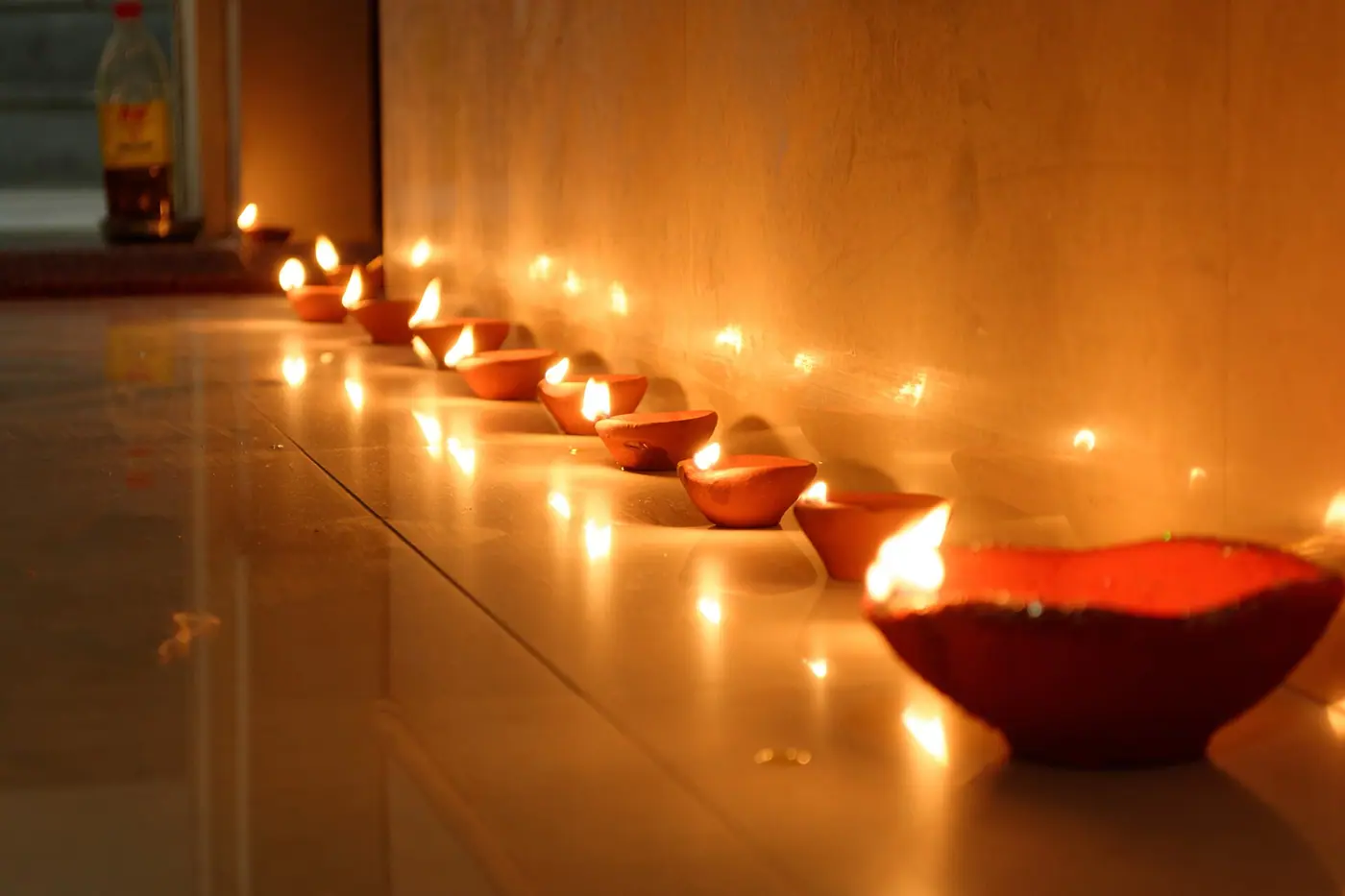
Diwali falls on Sunday 8 November 2026 across Finland, and with the dark season closing in, Lakshmi Puja begins around four in the afternoon. Local muhurat for Helsinki, Espoo, Tampere, Turku and Oulu, verified temples and groups, and Finnish rules on fireworks.
Quick answer: Diwali (Lakshmi Puja) 2026 in Finland is on Sunday 8 November. In Helsinki the Lakshmi Puja muhurat is 4:10 PM – 5:29 PM, in the late afternoon because the sun sets at 4:06 PM. Dhanteras is on Friday 6 November.
Editor's note: this page was last checked on 10 October 2026. The local times were calculated by HinduTone using the Drik Panchang method (Pradosh Kaal with the Vrishabha lagna); checked against Drik Panchang for major world cities to within one to two minutes; confirm with your temple. All times are Finnish standard time (EET, UTC+2), because summer time ended on Sunday 25 October. Details of temples, groups and events come only from organisers' own websites, official listings and established news reports, and nothing here replaces your temple's own announcement.
Diwali in Finland arrives on the edge of kaamos, the dark season. By 8 November Helsinki loses the sun soon after four in the afternoon, and in Oulu it is gone by half past three. For a festival about lighting lamps against the darkness, the meaning could not be plainer. The puja is an afternoon affair here, and in the north the best window is just 39 minutes long.
Diwali 2026 in Finland: the five days
| Day | Date | What is observed |
|---|---|---|
| Dhanteras (Yama Deepam) | Fri 6 Nov | Buying a new utensil or a little gold or silver, Dhanvantari puja, and a lamp for Yama at the doorway in the evening |
| Kali Chaudas | Sat 7 Nov | Gujarati tradition of protection rituals and Hanuman or Kali worship |
| Diwali / Lakshmi Puja | Sun 8 Nov | Lakshmi and Ganesha puja in the evening window; also Narak Chaturdashi and the Tamil Deepavali morning oil bath, Kali Puja for Bengali families, and Chopda / Sharda Puja for business families |
| Govardhan Puja / Annakut | Tue 10 Nov (in India) | Annakut offering of food to Krishna, Bali Pratipada and the Gujarati New Year |
| Bhai Dooj / Yama Dwitiya | Wed 11 Nov (in India) | Sisters apply tilak to brothers and pray for their long life |
The dates follow Drik Panchang for India. The Amavasya tithi runs from 11:27 AM IST on Sunday 8 November to 12:31 PM IST on Monday 9 November, so Lakshmi Puja falls on the evening of Sunday 8 November in every Finnish city. Diwali marks Rama's return to Ayodhya and Krishna's victory over Narakasura; for Bengali families it is Kali Puja night, for Jains the Nirvana of Mahavira and for Sikhs Bandi Chhor Divas. Govardhan Puja and Bhai Dooj fall on Tuesday 10 and Wednesday 11 November in India, but local temples may announce their own day. For the stories behind each day, see our five days of Diwali 2026 explained.
Lakshmi Puja muhurat 2026, city by city
| City | Region | Lakshmi Puja (Sun 8 Nov) | Pradosh Kaal | Dhanteras puja (Fri 6 Nov) |
|---|---|---|---|---|
| Helsinki | Uusimaa | 4:10 PM – 5:29 PM | 4:06 PM – 7:17 PM | 4:18 PM – 5:37 PM |
| Espoo | Uusimaa | 4:11 PM – 5:29 PM | 4:07 PM – 7:18 PM | 4:19 PM – 5:37 PM |
| Tampere | Pirkanmaa | 4:06 PM – 5:19 PM | 4:04 PM – 7:18 PM | 4:14 PM – 5:26 PM |
| Turku | Southwest Finland | 4:19 PM – 5:36 PM | 4:15 PM – 7:27 PM | 4:27 PM – 5:44 PM |
| Oulu | North Ostrobothnia | 3:33 PM – 4:12 PM | 3:33 PM – 6:57 PM | 3:39 PM – 4:19 PM |
Times calculated by HinduTone using the Drik Panchang method (Pradosh Kaal with the Vrishabha lagna); checked against Drik Panchang for major world cities to within one to two minutes; confirm with your temple. Sunset on 8 November is 4:06 PM in Helsinki, 4:07 PM in Espoo, 4:04 PM in Tampere, 4:15 PM in Turku and 3:33 PM in Oulu. On Dhanteras, two days earlier, it is 4:11 PM in Helsinki, 4:12 PM in Espoo, 4:09 PM in Tampere, 4:20 PM in Turku and 3:39 PM in Oulu. If you are used to the 24-hour clock, Helsinki's Lakshmi Puja window is 16.10–17.29.
Pradosh Kaal in plain words: Pradosh is the period that begins at sunset and lasts for about three hours. It is the traditional time for evening worship of Lakshmi and for lighting the lamps of Diwali. In Helsinki on 8 November it runs from 4:06 PM to 7:17 PM.
Vrishabha lagna in plain words: the lagna is the zodiac sign rising on the eastern horizon at a given moment. Vrishabha (Taurus) is a "fixed" sign, and worshipping Lakshmi while a fixed sign is rising is believed to help her blessings stay in the home. The best muhurat is the overlap of Vrishabha and Pradosh, which is the window shown in the table.
Why Finland's times look so unusual: the whole country shares one time zone, but the cities are spread far north and south. Turku, in the south-west, has the latest window; Helsinki, Espoo and Tampere are a few minutes earlier. Oulu, near the top of the Gulf of Bothnia, is the outlier: the sun sets so early that Vrishabha is already rising at sunset. The window therefore starts at the very moment of sunset, 3:33 PM, and ends when Vrishabha sets at 4:12 PM. Families in Oulu should have the puja thali, lamps and murtis ready before sunset. For other European cities, see our Lakshmi Puja muhurat 2026 for Europe, city-wise.
The Hindu community in Finland
Finland's Indian community is young and growing fast. According to Statistics Finland, as published in Finland in Figures 2025, there were 15,115 citizens of India living in Finland at the end of 2024, up from 8,245 at the end of 2021 and 15.7% more than a year earlier. That counts Indian passport holders only, not Finnish citizens of Indian origin or Hindus from Nepal, Sri Lanka or Bangladesh, and it says nothing about religion: there is no official count of Hindus in Finland.
Most families arrived in the last two decades, many for technology, engineering, research or university study, and live mainly in Helsinki, Espoo and Vantaa, with smaller communities in Tampere, Turku and Oulu. They speak Hindi, Telugu, Tamil, Kannada, Malayalam, Marathi, Bengali, Gujarati and Punjabi, and keep Diwali in each of those regional styles.
Bengali families have a long organised festival tradition here. Finland's Living Heritage wiki records that Durga Puja has been held in the Helsinki region since 1999, now run by the Bengali Association of Finland ry, and that Oulu has started its own smaller celebration. A University of Helsinki researcher counted three Durga Pujas in the capital region in 2023, in Helsinki, Espoo and Vantaa. Many of the same families keep Kali Puja on Diwali night.
There is a Sri Lankan Tamil thread too. Yle has reported on a Shiva temple in Paippinen, Sipoo, founded by a Sri Lankan-born resident of Vantaa, with altars to Ganesha and Kartikeya. Indian associations also work together in public: Helsinki Times reported that India Day 2023 in Kaisaniemi Park was organised by the Embassy of India with Friends of India and Finland, a platform of 16 Indian associations.
Where to celebrate: temples and community organisations
We list only temples and groups whose existence we confirmed on their own website or an official or established listing, with name and area only. Check their pages for opening hours and Diwali plans. Temples and community associations usually announce Diwali programmes from mid-October — check their websites and social pages.
Helsinki and Vantaa
- ISKCON Finland, Malmi Manor — Malmi, Helsinki. Finland's Hare Krishna temple, with a weekly Sunday feast and an adjoining Govinda's restaurant (ISKCON listing). ISKCON Finland was registered as a religious community in 1984 (ISKCON News).
- Sharodiya Durga Puja Mohamaya — Kivikko, Helsinki. A Bengali Durga Puja group (University of Helsinki).
- Sri Sri Sarbojanin Durga Puja Pujari Association — Vantaa. A Bengali Durga Puja group active since 2010 (University of Helsinki).
At Diwali, Hare Krishna temples usually hold kirtan, aarti and a feast, and mark Govardhan Puja with an Annakut. Bengali groups may also hold Kali Puja; check each group's own announcement.
Espoo
- Suomi-Intia-Seura (Finnish-Indian Society) — Espoo and the capital region. Co-organiser, with the City of Espoo, of a big free public Diwali festival. TheCity of Espoo says the 2025 festival was the society's 25th Diwali festival, and up to 15,000 people came in 2024.
- Bengali Association of Finland ry (BAF) — capital region, with recent events in Espoo and Helsinki. Organiser of Helsinki Durga Puja (BAF).
2026 event: the City of Espoo lists Diwali – Festival of Lights on Saturday 31 October 2026, from 1 PM to 8 PM, at Espoo Cultural Centre and Kulttuuriaukio in Tapiola, with free entry, music and dance by more than 250 performers, Indian food stalls, games and workshops. It is announced by the City of Espoo and Suomi-Intia-Seura; check before you go. It falls a week before Diwali itself, so families can enjoy the festival and still keep the puja at home on 8 November.
Tampere and Turku
We could not confirm a Hindu temple or an Indian association with its own website in Tampere or Turku, so we do not list any here. Diwali there is usually a home puja plus a community evening in a hired hall; ask colleagues and university international offices, and watch community social pages from mid-October. The capital region's festival and temple are within a day trip.
Oulu
- O-India Oulu — Oulu. A community organisation for Indian families that lists Deepavali, Holi, Janmashtami and cultural programmes (O-India). Its 2026 Deepavali date was not yet listed when we checked.
Oulu's Bengali families have also started their own Durga Puja (Living Heritage wiki). Remember the very short muhurat here: any community Lakshmi Puja on 8 November has to start right at sunset.
Celebrating at home in Finland
For most families in Finland, the heart of Diwali is the home puja. Here is a short version you can do within your city's window:
- Clean the home and the puja corner in the days before; many families do a full clean before Dhanteras.
- Draw a rangoli inside your door, or use stickers or coloured rice if you live in a flat with a shared stairwell.
- Place Lakshmi and Ganesha on a red or yellow cloth, with a kalash of water, rice, coins, flowers and sweets.
- Light the main diya, pray to Ganesha first, then offer Lakshmi kumkum, flowers, rice, sweets and a coin.
- Chant a Lakshmi mantra or the Lakshmi stotram, do aarti together and share prasad.
- Light diyas around the home after the puja, and keep one lamp burning through the evening only if someone is watching it.
For the full step-by-step vidhi and mantras, see our Lakshmi Puja 2026 date, muhurat and vidhi guide.
Diyas and electric lights in apartments: most families in Finnish cities live in flats in a taloyhtiö (housing company) or a rented apartment. Put clay diyas on a metal tray, away from curtains, and never leave a flame alone when you go out or go to bed. Finns light candles all through the dark months, and the same care applies to diyas. Electric diyas and LED string lights are the safer choice for windows, balconies and children's rooms.
Smoke alarms: never take down or cover your smoke alarm (palovaroitin) for the puja. Ghee lamps, camphor and incense can set it off, so open a window briefly instead. Test the alarm in the week before Diwali.
Tenancy and housing rules: read your housing company's house rules (järjestyssäännöt) and your lease about open flames on balconies and in shared spaces. Keep stairwells clear of diyas, rangoli materials and decorations. If you rent, ask before fixing lights to walls or window frames.
Weather in early November: expect short, grey days, temperatures around freezing and often wet snow or sleet, colder and darker in Oulu than on the south coast. Diyas on an outdoor step will blow out or freeze, so use glass lanterns outside and keep real flames indoors.
Food and decorations you can find locally
Indian and South Asian grocers are easy to find in Helsinki, Espoo and Vantaa, and there are smaller shops in Tampere, Turku and Oulu. Besides atta, ghee, dals and spices, many stock mithai, diyas, garlands and puja items before Diwali, so shop early in the week. In smaller towns, order murtis, kumkum and wicks online in good time.
Finnish shops help too: cardamom is a staple of Finnish baking, and supermarkets fill with candles and LED lights as the dark season begins.
Diwali with children and second-generation families
Because 8 November 2026 is a Sunday, children can join the whole puja without missing school, and in most cities it finishes before an early dinner. Friday 6 November (Dhanteras) and Monday 9 November onwards are normal school and working days, so keep Dhanteras simple: a lamp at the door and a small purchase. 8 November is also Isänpäivä, Finnish Father's Day, which MTV Uutiset notes is held on the second Sunday of November. Families with a Finnish parent or grandparent may have two celebrations in one afternoon.
Keeping heritage languages alive is a real challenge in Finland, where children quickly switch to Finnish, Swedish or English. Many municipalities offer mother-tongue lessons (oman äidinkielen opetus) for some languages, so ask your school. At home, tell the story of Rama's return or of Krishna and Narakasura in Hindi, Telugu, Tamil, Bengali or your own language while the lamps are lit. Teach one aarti line by line and give children real jobs: filling diyas, drawing the rangoli, ringing the bell. For ideas, see our Diwali activities for kids.
Fireworks, safety and local rules
Fireworks are not part of Finnish Diwali the way they are in India, and the rules are tight. In a 2026 notice, Ostrobothnia's rescue services explained that private fireworks use as a rule requires advance notice to the rescue authority. Use without notice is allowed only at times or in areas the authority sets, such as New Year. The Pirkanmaa Rescue Department reminds the public that handing fireworks to anyone under 18, or to someone who is intoxicated, is prohibited. Check your own regional pelastuslaitos, and in practice plan Diwali without rockets.
Sky lanterns and outdoor flames: these rules are set nationally and by regional rescue authorities, so check your pelastuslaitos's official guidance before releasing any lantern. Supervised diyas indoors are the safest way to keep the tradition.
Celebrating far from family
Diwali is when many families in Finland miss home most. The early muhurat helps: when aarti ends in Helsinki it is still evening in India, so you can video-call parents and grandparents straight afterwards.
Many large temples in India stream aarti and darshan online on Diwali night. Seva is another way to take part: help at your community's Diwali evening, give to a local food bank, or donate to a temple or charity back home.
Diwali checklist for Finland
- Note your city's Lakshmi Puja window: it starts around four in the afternoon, and at 3:33 PM in Oulu.
- In Oulu, have everything ready before sunset, as the best window lasts only 39 minutes.
- Put the Espoo Diwali festival on Saturday 31 October in your calendar, and check the city's page before you go.
- Check your temple's or group's own dates for Govardhan Puja and Bhai Dooj.
- Buy diyas, wicks, ghee, flowers and sweets early in the week from an Indian grocer.
- Plan Dhanteras around a normal Friday workday.
- Test the smoke alarm and choose a safe spot for diyas, away from curtains.
- Read your housing company's rules on balconies and stairwells.
- Use LED lights in windows and on balconies; keep real flames indoors and supervised.
- Skip rockets: private fireworks need notice to the rescue authority outside exemption periods.
- Book a video call with family in India for right after aarti.
Frequently asked questions
What time is Lakshmi Puja in Helsinki on Diwali 2026?
On Sunday 8 November 2026 the Lakshmi Puja muhurat in Helsinki is 4:10 PM – 5:29 PM, inside a Pradosh Kaal of 4:06 PM – 7:17 PM. Espoo is almost identical at 4:11 PM – 5:29 PM. The window is in the afternoon because the sun sets at 4:06 PM in Helsinki on that day. All times are Finnish standard time (EET), as summer time ended on 25 October.
Why is the Oulu muhurat so short?
Oulu lies much further north, so the sun sets at 3:33 PM on 8 November and Vrishabha (Taurus) is already rising at that moment. The best window therefore starts right at sunset and lasts only until Vrishabha sets: 3:33 PM – 4:12 PM. Have everything ready before sunset. Pradosh Kaal continues until 6:57 PM, so families who miss the Vrishabha window can still do the puja within Pradosh.
Is Diwali a public holiday in Finland?
No. Diwali is not a public holiday in Finland, but in 2026 it falls on a Sunday, 8 November, so most families can do the puja at home or at the temple. Friday 6 November (Dhanteras) and the rest of the following week are normal working and school days. 8 November is also Isänpäivä, Finnish Father's Day, an official flag day but not a day off.
Is there a big public Diwali event in Finland in 2026?
Yes. The City of Espoo lists Diwali – Festival of Lights on Saturday 31 October 2026, from 1 PM to 8 PM, at Espoo Cultural Centre and Kulttuuriaukio in Tapiola, with free entry. It is organised by Espoo's Cultural Venues and Services with Suomi-Intia-Seura (the Finnish-Indian Society). This is announced by the City of Espoo; check before you go.
Can I light fireworks for Diwali in Finland?
Not freely. Finnish rescue services say that private fireworks use as a rule requires advance notice to the rescue authority, apart from exemption periods such as New Year. Handing fireworks to anyone under 18 is prohibited. Plan Diwali with diyas and electric lights, and check your regional rescue department (pelastuslaitos) for its current guidance.
When are Govardhan Puja and Bhai Dooj in Finland in 2026?
In India, Govardhan Puja and Annakut are on Tuesday 10 November and Bhai Dooj on Wednesday 11 November 2026. Local temples and groups in Finland may announce their own day, so follow ISKCON Helsinki or your own community's calendar.
Related guides
- Diwali / Deepavali 2026: complete 5-day guide
- The 5 days of Diwali 2026 explained
- Lakshmi Puja 2026: date, muhurat and step-by-step vidhi
- Lakshmi Puja muhurat 2026 Europe, city-wise
- Diwali 2026 in Sweden: Lakshmi Puja muhurat city by city
- Diwali 2026 in Norway: Lakshmi Puja muhurat city by city
- Dussehra 2026 in Finland, city by city
Sources
- Statistics Finland (via Finland in Figures 2025): Finland in Figures 2025: population by citizenship, 2021–2024
- City of Espoo: Diwali – Festival of Lights
- City of Espoo: Diwali festival in Espoo expands (2025)
- ISKCON Centres: ISKCON Finland Malmi Manor
- ISKCON News: Hundreds gathered in Helsinki to celebrate ISKCON Finland's 40th anniversary
- Wiki-Inventory for Living Heritage (Finland): Indian Durga Puja in Finland
- University of Helsinki, Asian Studies blog: Durga Puja in the Helsinki region (Xenia Zeiler, 2023)
- Bengali Association of Finland ry: Durga Puja
- O-India Oulu: O-India – Indian community in Oulu
- Helsinki Times: India Day 2023: bridging cultures, celebrating friendship
- Yle News: Neighbours say Hindu temple in Sipoo too noisy
- Pirkanmaan pelastuslaitos (Pirkanmaa Rescue Department): Ilotulitteiden käyttö Pirkanmaalla venetsialaisten aikaan (25 Aug 2026)
- Pohjanmaan hyvinvointialue (Ostrobothnia rescue services): Tämä vuosi ratkaisee, pitääkö ilotulitteiden käytöstä ilmoittaa jatkossa (26 Aug 2026)
- MTV Uutiset: Liput liehuvat tänään isille
Muhurat: HinduTone calculation (Drik Panchang method)
You might also like
Diwali 2026 in Tanzania: Lakshmi Puja Muhurat City by City, Dhanteras Times and Temples
Diwali 2026 in Bahrain: Lakshmi Puja Muhurat City by City, Dhanteras Times and Temples
Diwali 2026 in Poland: Lakshmi Puja Muhurat City by City, Dhanteras Times and Temples