
Diwali 2026 in Poland: Lakshmi Puja Muhurat City by City, Dhanteras Times and Temples
Diwali falls on Sunday 8 November 2026 across Poland, a week after the candles of All Saints' Day and three days before Independence Day. Local Lakshmi Puja and Dhanteras times for Warsaw, Kraków, Wrocław, Gdańsk and Poznań, verified temples and practical tips.
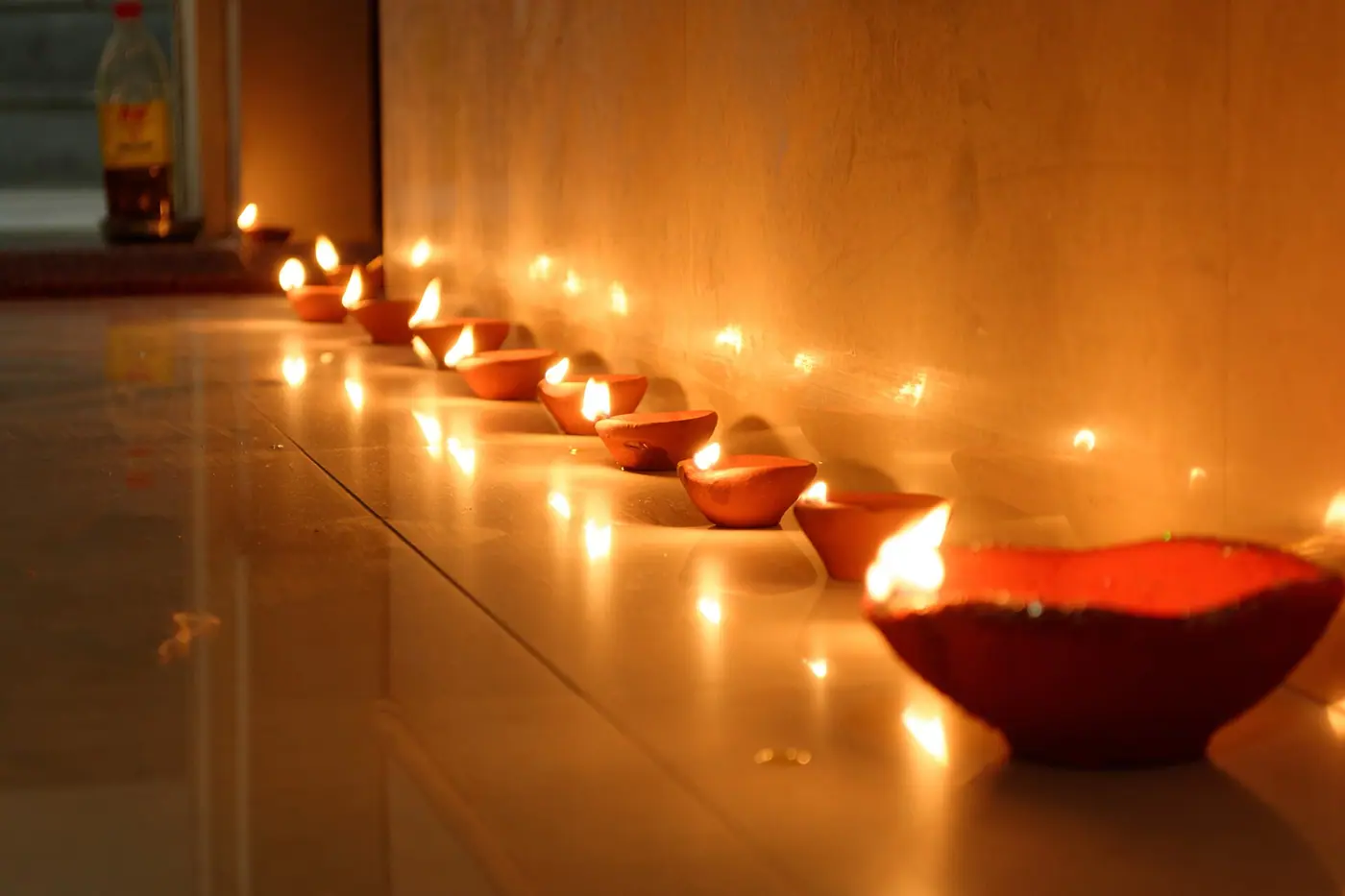
Diwali falls on Sunday 8 November 2026 across Poland, a week after the candles of All Saints' Day and three days before Independence Day. Local Lakshmi Puja and Dhanteras times for Warsaw, Kraków, Wrocław, Gdańsk and Poznań, verified temples and practical tips.
Quick answer: Diwali (Lakshmi Puja) 2026 in Poland is on Sunday 8 November. In Warsaw the Lakshmi Puja muhurat is 4:08 PM – 5:44 PM, in the late afternoon because of the early November sunset. Dhanteras is on Friday 6 November.
Editor's note: this page was last checked on 10 October 2026. The local times were calculated by HinduTone using the Drik Panchang method (Pradosh Kaal with the Vrishabha lagna); checked against Drik Panchang for major world cities to within one to two minutes; confirm with your temple. All times are Polish standard time (CET, UTC+1), because summer time ended on Sunday 25 October. Details of temples, organisations and events come only from organisers' own websites, official listings and established news reports, and nothing here replaces your temple's own announcement.
Diwali in Poland arrives in a season that is already full of light. On 1 November, All Saints' Day, Polish families fill cemeteries with candles in glass lanterns (znicze), and for days afterwards whole hillsides glow after dark. A week later, Hindu families light their own diyas for Lakshmi. Three days after that comes 11 November, National Independence Day, a public holiday that this year coincides with Bhai Dooj in India. For Indian families in Warsaw, Kraków or Wrocław, early November 2026 is a fortnight of lamps, family visits and a welcome midweek day off.
Diwali 2026 in Poland: the five days
| Day | Date | What is observed |
|---|---|---|
| Dhanteras (Yama Deepam) | Fri 6 Nov | Buying a new utensil or a little gold or silver, Dhanvantari puja, and a lamp for Yama at the doorway in the evening |
| Kali Chaudas | Sat 7 Nov | Gujarati tradition of protection rituals and Hanuman or Kali worship |
| Diwali / Lakshmi Puja | Sun 8 Nov | Lakshmi and Ganesha puja in the evening window; also Narak Chaturdashi and the Tamil Deepavali morning oil bath, Kali Puja for Bengali families, and Chopda / Sharda Puja for business families |
| Govardhan Puja / Annakut | Tue 10 Nov (in India) | Annakut, Bali Pratipada and Gujarati New Year |
| Bhai Dooj / Yama Dwitiya | Wed 11 Nov (in India) | Sisters apply tilak to brothers and pray for their long life |
The dates follow Drik Panchang for India. The Amavasya tithi runs from 11:27 AM IST on Sunday 8 November to 12:31 PM IST on Monday 9 November, which is why Diwali, Narak Chaturdashi, the Tamil oil bath and Bengali Kali Puja all fall on Sunday 8 November this year. Diwali night celebrates Rama's return to Ayodhya and welcomes Lakshmi; Jain families mark Mahavira's Nirvana, and Sikh families celebrate Bandi Chhor Divas.
In India, Govardhan Puja is on Tuesday 10 November and Bhai Dooj on Wednesday 11 November. Local temples may announce their own day, and calendars calculated for European cities can differ: our Bhai Dooj 2026 guide for Germany and Europe explains why. Either way, Wednesday 11 November is a public holiday in Poland, which makes a family Bhai Dooj unusually easy this year. For the stories behind each day, see our five days of Diwali 2026 explained.
Lakshmi Puja muhurat 2026, city by city
| City | Region | Lakshmi Puja (Sun 8 Nov) | Pradosh Kaal | Dhanteras puja (Fri 6 Nov) |
|---|---|---|---|---|
| Warsaw | Masovia | 4:08 PM – 5:44 PM | 3:55 PM – 6:53 PM | 4:15 PM – 5:52 PM |
| Kraków | Lesser Poland | 4:20 PM – 6:00 PM | 4:06 PM – 7:01 PM | 4:28 PM – 6:08 PM |
| Wrocław | Lower Silesia | 4:28 PM – 6:06 PM | 4:14 PM – 7:11 PM | 4:35 PM – 6:13 PM |
| Gdańsk | Pomerania | 4:08 PM – 5:41 PM | 3:57 PM – 6:58 PM | 4:16 PM – 5:49 PM |
| Poznań | Greater Poland | 4:24 PM – 6:00 PM | 4:11 PM – 7:09 PM | 4:31 PM – 6:07 PM |
Times calculated by HinduTone using the Drik Panchang method (Pradosh Kaal with the Vrishabha lagna); checked against Drik Panchang for major world cities to within one to two minutes; confirm with your temple. Sunset on Sunday 8 November is 3:55 PM in Warsaw, 3:57 PM in Gdańsk, 4:06 PM in Kraków, 4:11 PM in Poznań and 4:14 PM in Wrocław. On Dhanteras, two days earlier, it is 3:58 PM in Warsaw, 4:01 PM in Gdańsk, 4:09 PM in Kraków, 4:14 PM in Poznań and 4:17 PM in Wrocław.
Pradosh Kaal in plain words: Pradosh is the period that begins at sunset and lasts for roughly three hours. It is the traditional time for the evening worship of Lakshmi and for lighting the lamps of Diwali. In Warsaw on 8 November it runs from 3:55 PM to 6:53 PM.
Vrishabha lagna in plain words: the lagna is the zodiac sign rising on the eastern horizon at a given moment. Vrishabha (Taurus) is a "fixed" sign, and worshipping Lakshmi while a fixed sign is rising is believed to help her blessings stay in the home. The preferred muhurat is the stretch where Vrishabha rises inside Pradosh, and that overlap is the window shown in the table.
Why the east starts first: the whole of Poland keeps one clock, but the sun sets about twenty minutes earlier in Warsaw than in Wrocław. So the capital and Gdańsk share the earliest window, starting at 4:08 PM, while Wrocław, furthest west, starts at 4:28 PM. If you live in a smaller town, use the nearest city in the table, and never convert India's muhurat into Polish time. For other European cities, see our Lakshmi Puja muhurat 2026 for Europe, city-wise.
The Hindu community in Poland
Poland's Hindu community has two quite different roots. The older one is Polish: devotees of the Hare Krishna movement and other Indian traditions who built temples here from 1980 onwards, when ISKCON's New Santipura temple was founded at Czarnów in Lower Silesia. Notes from Poland, reporting in 2022, counted at least eight Hindu temples in Poland. The newer root is the Indian community that has grown fast since Poland joined the EU, built around IT, engineering, business services, medicine and study.
Official numbers are partial. The same Notes from Poland report noted that the 2011 census recorded only 866 Hindus, and that Statistics Poland (GUS) estimated 33,107 Indians living in Poland at the end of 2019. Not all of them are Hindu, and both figures are now out of date. On the student side, the Polish government says that in 2024 the number of Indian students in Poland exceeded 3,700, making Indians the third-largest group of foreign students. The same page lists Indian IT firms such as TCS, Infosys, HCL and Wipro among the main Indian employers in Poland.
In everyday life this means a community of many languages. Bengali families are well organised in Warsaw, and Tamil, Telugu, Kannada, Malayalam, Marathi, Gujarati, Hindi and Punjabi speakers are spread across the big IT and university cities. Many are young professionals or students who have arrived in the last decade, so a typical Diwali in Poland is often a first or second Diwali away from home, celebrated with flatmates, colleagues and new friends rather than an extended family.
Where to celebrate: temples and community organisations
We list only temples and organisations whose existence we confirmed on their own website, an official listing or an established news report, with name and area only. Check their pages for timings and Diwali plans. Temples and community associations usually announce Diwali programmes from mid-October — check their websites and social pages.
Warsaw
- Hindu Bhavan Mandir — Kolonia Warszawska, just south-west of Warsaw. Built as a project of the Indian Association of Poland and opened in 2010 (Hinduism Today, 2010); its own website shows festivals from Shivratri and Holi to Ram Navami. Notes from Poland called it the largest Hindu temple in Poland.
- ISKCON Warsaw – New Ramana Reti — Mysiadło, Piaseczno, south of Warsaw (temple contact page).
- Warsaw Bengali Association of Poland (WBAP) — Warsaw. Its website lists Durga Puja and Lakshmi Puja for October 2026; Bengali associations often also gather for Kali Puja on Diwali night.
At Diwali, temples near Warsaw typically hold Lakshmi-Ganesha puja, aarti and bhajans, and the Hare Krishna temple usually marks Govardhan Puja with an Annakut, a large offering of vegetarian dishes.
Kraków
- Radha Govind Bhakti Yog Mandir — Brzegi, between Kraków and Wieliczka. Opened in 2022 by the Radha Govind Society of Poland, part of Jagadguru Kripalu Parishat, and described as the first Hindu temple in the Kraków region (Notes from Poland).
Kraków's large business-services sector and universities bring many young Indian professionals and students, so Diwali here is often a mix of a temple visit to Brzegi and a shared evening organised by colleagues or student groups.
Wrocław and Lower Silesia
- ISKCON New Santipura — Czarnów, in the Lower Silesian countryside. Founded in 1980, with daily aratis and a regular Sunday feast (ISKCON listing).
Wrocław has many Indian IT and engineering staff, but we could not confirm a temple inside the city on an official site, so we do not list one. Most families do Lakshmi Puja at home and look out for community gatherings announced by colleagues and Indian student groups.
Gdańsk and Poznań
We could not confirm a Hindu temple in the Tricity (Gdańsk, Sopot and Gdynia) or in Poznań through reliable listings. Families usually celebrate at home and with friends, and some travel to Warsaw or Lower Silesia for a temple Diwali. Universities are a good place to watch: in Łódź, for example, Indian and Malaysian students of the Medical University ran Diwali workshops with rangoli and clay diyas in October 2025 at the city's archaeology and ethnography museum. Look for similar announcements from universities and student societies in your own city.
Celebrating at home in Poland
For most families in Poland, Diwali is a home festival. A short Lakshmi Puja you can do inside your city's window:
- Clean the home and the puja corner before Dhanteras, and wash the doorstep or entrance mat.
- Draw a small rangoli at the door; in a block of flats, keep it inside your own door or use rangoli stickers.
- Place Lakshmi and Ganesha on a red or yellow cloth with a kalash of water, rice, coins, flowers and sweets.
- Light the main diya, pray to Ganesha first, then offer Lakshmi kumkum, flowers, rice, sweets and a coin.
- Chant a Lakshmi mantra or read the Lakshmi stotram, do aarti together and share prasad.
- Light the remaining diyas around the home after the puja, and keep watch over every flame.
For the full step-by-step vidhi and mantras, see our Lakshmi Puja 2026 date, muhurat and vidhi guide.
Diyas and electric lights in flats: most Indian families in Poland live in apartment blocks. Stand clay diyas on a metal tray away from curtains and radiator covers, and never leave a flame alone. Polish homes are used to candles in November, and the same care applies to diyas. Electric diyas and LED strings are the safer choice for windows, balconies and children's rooms.
Smoke alarms: if your flat has a smoke alarm, do not cover or disconnect it for the puja. Ghee lamps, camphor and incense can set it off, so open a window for a few minutes instead.
Tenancy and building rules: read your rental contract and the house rules of your housing cooperative (spółdzielnia) or residents' association (wspólnota). They often restrict open flames on balconies and anything left in stairwells and corridors, which must stay clear.
Weather in early November: Poland is cold, damp and often foggy by now, with frost possible at night, and it is fully dark soon after the muhurat. Diyas on a balcony or doorstep will not last long in the wind; use glass lanterns outdoors and keep the real flames inside.
Sunday shopping: Poland restricts Sunday trading, and most supermarkets are closed on Sunday 8 November. Buy flowers, fruit, milk and sweets on Friday or Saturday.
Food and decorations you can find locally
Warsaw, Kraków and Wrocław all have Indian grocers, and Indian restaurants are common in the bigger cities. Before Diwali, grocers usually stock ghee, atta, dals, spices, mithai and some puja items. Murtis, puja thalis and diyas are easier to order online well before the festival.
Polish shops help too. In late October, supermarkets and florists are full of candles, glass lanterns and chrysanthemums for All Saints' Day, so tea lights and glass holders for safe outdoor lights are easy to find.
Diwali with children and second-generation families
Because 8 November 2026 is a Sunday, children can join the whole puja without missing school. Friday 6 November (Dhanteras) and Monday 9 and Tuesday 10 November are normal working and school days, so keep Dhanteras simple on Friday evening. Wednesday 11 November is National Independence Day, a statutory day off under Poland's act on days off work, so schools and most offices are closed. That gives families a natural Bhai Dooj or Diwali-milan day midweek.
Polish schools rarely know about Diwali, so a short note to the teacher or a class talk with diyas and rangoli can help. The Hindu Bhavan was planned partly so that second-generation children could connect with their heritage, and Diwali is a good time to do just that at home. Tell the story of Rama's return or of Krishna and Narakasura in Tamil, Telugu, Bengali, Hindi, Marathi or Malayalam while the lamps are lit, teach one aarti line by line, and let children fill the diyas and ring the bell. For ideas, see our Diwali 2026 complete 5-day guide.
Fireworks, safety and local rules
Fireworks are part of New Year's Eve in Poland, not of everyday life, and many families in Polish flats keep Diwali to lamps. The State Fire Service (Państwowa Straż Pożarna) advises that fireworks are for people over 18 only, should be used only in open spaces, never from balconies, terraces or windows, and never near houses, trees or sites such as airports. It also notes that voivodes or local authorities can ban or restrict their use in public places. Check your city's own rules before buying anything, and in practice plan Diwali without rockets.
Sky lanterns: we did not find an official national page setting out a specific rule for floating lanterns, so we do not state one. Rules can be set nationally or locally; check with your municipality and the fire service before releasing any, and do not release them near an airport.
Celebrating far from family
Many Indians in Poland are celebrating far from parents and grandparents. Polish time is four and a half hours behind India in November, so by the time your Lakshmi Puja ends, it is already late night at home. A good plan is a video call during the day on Sunday, or a call during aarti so grandparents can join from bed.
Many big temples in India stream aarti and darshan online on Diwali night. Seva is another way to take part: help in your temple's prasad kitchen, give to a local food bank, or donate to a temple or charity back home.
Diwali checklist for Poland
- Note your city's Lakshmi Puja window: it starts in the late afternoon.
- Shop on Friday or Saturday, as most supermarkets are closed on Sunday 8 November.
- Keep Dhanteras simple on a working Friday; buy your utensil or coin after work.
- Check your temple's dates for Govardhan Puja and Bhai Dooj.
- Plan a family day for Wednesday 11 November, Independence Day.
- Buy diyas, wicks, ghee and puja items early, or order online.
- Pick up glass lanterns and tea lights in the All Saints' Day aisle for safe outdoor lights.
- Check your housing association's rules on balconies and stairwells.
- Keep real flames indoors and supervised; use LED lights in windows.
- Skip fireworks unless your local rules allow them.
- Book a video call with family in India.
- Watch temple and association pages from mid-October.
Frequently asked questions
What time is Lakshmi Puja in Warsaw on Diwali 2026?
On Sunday 8 November 2026 the Lakshmi Puja muhurat in Warsaw is 4:08 PM – 5:44 PM, Polish standard time (CET). Sunset is at 3:55 PM and Pradosh Kaal runs 3:55 PM – 6:53 PM. Gdańsk has almost the same window, 4:08 PM – 5:41 PM. In Kraków it is 4:20 PM – 6:00 PM, in Poznań 4:24 PM – 6:00 PM and in Wrocław 4:28 PM – 6:06 PM.
Is Diwali a public holiday in Poland?
No. Poland's act on days off work does not list any Hindu festival. Diwali falls on Sunday 8 November, so most families are free anyway, but Friday 6 November (Dhanteras) and Monday 9 and Tuesday 10 November are normal working and school days. Wednesday 11 November is National Independence Day, a statutory day off for everyone.
Can I use Bhai Dooj on 11 November as a family day in Poland?
In India, Bhai Dooj is on Wednesday 11 November 2026, which happens to be Poland's Independence Day, a public holiday. That makes it easy for brothers and sisters living in different Polish cities to meet. Calendars calculated for Europe may place Bhai Dooj on Tuesday 10 November, and local temples may announce their own day, so check with yours.
Is there a Hindu temple near Kraków?
Yes. The Radha Govind Bhakti Yog Mandir opened in 2022 in Brzegi, between Kraków and Wieliczka. It is run by the Radha Govind Society of Poland, part of Jagadguru Kripalu Parishat, and Notes from Poland reported that it is open to visitors as well as devotees. Check the temple's own channels for any Diwali programme.
Where can I celebrate Diwali in Gdańsk or Poznań?
We could not confirm a Hindu temple in the Tricity or in Poznań. Families there usually do Lakshmi Puja at home and join friends, student societies or community groups for a shared evening. Some travel to the temples near Warsaw, or to ISKCON's New Santipura temple at Czarnów in Lower Silesia, for a larger celebration.
Can I light fireworks for Diwali in Poland?
Check before you do. The State Fire Service says fireworks are for over-18s only, must never be launched from balconies, terraces or windows, and must be kept away from houses, trees and airports. Voivodes and local authorities can ban or restrict them in public places. In practice, most families in Polish flats keep Diwali to diyas and electric lights.
Related guides
- Diwali / Deepavali 2026: complete 5-day guide
- The 5 days of Diwali 2026 explained
- Lakshmi Puja 2026: date, muhurat and step-by-step vidhi
- Lakshmi Puja muhurat 2026 Europe, city-wise
- Diwali 2026 in Austria: Lakshmi Puja muhurat city by city
- Diwali celebrations in Germany 2026
- Dussehra 2026 in Poland, city by city
Sources
- Notes from Poland: First Hindu temple opens near Kraków in Poland
- Republic of Poland (gov.pl), Poland in India: Bilateral relations
- Hindu Bhavan Mandir (Związek Wyznaniowy Hindu Bhavan RP): Hindu Bhavan Mandir
- Hinduism Today: Poland to get a Hindu temple by August (2010)
- Hare Kryszna Warszawa (ISKCON): Kontakt
- ISKCON Centres: ISKCON New Santipura Poland
- Warsaw Bengali Association of Poland: WBAP
- Internet System of Legal Acts (eli.gov.pl): Ustawa o dniach wolnych od pracy (consolidated text, Dz.U. 2020 poz. 1920)
- Internet System of Legal Acts (eli.gov.pl): Obwieszczenie: jednolity tekst ustawy o dniach wolnych od pracy (Dz.U. 2025 poz. 296)
- State Fire Service, Brzeg district command (gov.pl): Fajerwerki
- Medical University of Łódź: Promoting cultural diversity through Diwali celebrations in Łódź
Muhurat: HinduTone calculation (Drik Panchang method)
You might also like
Diwali 2026 in Tanzania: Lakshmi Puja Muhurat City by City, Dhanteras Times and Temples
Diwali 2026 in Bahrain: Lakshmi Puja Muhurat City by City, Dhanteras Times and Temples
Diwali 2026 in Finland: Lakshmi Puja Muhurat City by City, Dhanteras Times and Temples