
Hanuman Jayanti 2026 April 2: NRI Puja Guide & Blessings
www.hindutone.com • The Voice of Hindus Worldwide: Unity in Diversity ॥ श्री राम जय राम जय जय राम ॥ ॥ जय बजरंग बली ॥ Chaitra Purnima 2026: Hanuman Jayanti…
www.hindutone.com • The Voice of Hindus Worldwide: Unity in Diversity ॥ श्री राम जय राम जय जय राम ॥ ॥ जय बजरंग बली ॥ Chaitra Purnima 2026: Hanuman Jayanti…
www.hindutone.com • The Voice of Hindus Worldwide: Unity in Diversity
॥ श्री राम जय राम जय जय राम ॥ ॥ जय बजरंग बली ॥
Chaitra Purnima 2026: Hanuman Jayanti Blessings in Parabhava Year
How NRIs Across the USA, UK, Canada, Australia, UAE & the World Can Celebrate Hanuman Jayanti 2026 on April 2 with Full Devotion
SEO Keywords: Hanuman Jayanti 2026 April 2 | Chaitra Purnima Vrat | NRI Hanuman Puja Abroad | Parabhava Year Remedies | Hanuman Chalisa for NRIs
Introduction: Jai Hanuman — Wherever You Are in the World
Dear Hindu devotees of Hindutone.com, wherever the journey of life has taken you — whether you are raising your family in the suburbs of New Jersey, working in the towers of Dubai, studying in the foggy lanes of London, or building your dreams in Melbourne's sunshine — on April 2, 2026, the birthday of Lord Hanuman calls you home. Not home to a physical place, but home to the deepest truth of your identity: you are a child of Sanatana Dharma, and Pawanputra Hanuman is your eternal guardian.
Chaitra Purnima 2026 falls on Thursday, April 2 — the full moon of the first lunar month of the Hindu year, and the day on which Lord Hanuman, the son of the Wind God and the devoted bhakt of Lord Rama, was born. Across India, this day will see millions pouring into Hanuman temples before sunrise, offering sindoor, chanting the Hanuman Chalisa, and immersing themselves in bhakti. But you, as an NRI — a Non-Resident Indian, a Hindu living in foreign lands — need not feel that your distance from India reduces the power of your worship. Hanuman is chiranjeevi, immortal, and omnipresent. He is with you in your apartment in Toronto just as surely as he is in the ancient temples of Varanasi and Tirupati.
The year 2026 corresponds to Parabhava Samvatsara — the year of defeat and challenge in the sixty-year Hindu calendar cycle. NRIs often experience the pressures of Parabhava acutely: career uncertainties in foreign economies, the longing for family in India, the difficulty of raising Hindu children in non-Hindu environments, visa anxieties, and the constant effort to remain connected to dharma while navigating a secular world. It is precisely for these struggles that Lord Hanuman's grace on Chaitra Purnima 2026 is most needed.
This complete NRI guide from Hindutone.com — your spiritual companion for everything Sanatana Dharma — covers: the significance of Hanuman Jayanti 2026, the full Puja Vidhi adapted for NRI homes and diaspora temples, country-specific guidance for devotees in the USA, UK, Canada, Australia, the UAE, and Southeast Asia, inspiring stories from the Ramayana, the blessings of Tuesday and Saturday worship, and practical tools for staying connected to Hanuman through digital platforms and community resources.
✦ ✦ ✦
The Sacred Significance of Hanuman Jayanti on Chaitra Purnima
According to the Valmiki Ramayana, the Sundara Kanda, and the Puranic traditions, Lord Hanuman was born on the full moon (Purnima) day of Chaitra month, under the Chitra Nakshatra, at sunrise. His mother Anjana Devi, a celestial apsara born as a Vanara due to a sage's curse, performed severe austerities to beget a divine son. The Wind God Vayu, carrying the divine spark of Lord Shiva, blessed her with Hanuman — who is thus called Anjaneya (son of Anjana), Pawanputra (son of Wind), and Mahaveer (the Great Hero).
Chaitra Purnima is itself one of the most auspicious full moon days of the year. It marks the full blossoming of the first lunar month — the month of new beginnings that opens the Hindu New Year. Purnima (full moon) energy is universally recognized in Vedic tradition as a time when the spiritual 'ocean' of the universe is at high tide, when prayers penetrate easily into the divine field, and when blessings flow with extraordinary abundance. When Hanuman's birthday coincides with this full moon — as it does in 2026 on April 2 — the combined energy is almost beyond description.
Ancient jyotishis describe this day as 'Mahasiddhi Yoga' — a day on which any sincere sadhana (spiritual practice) achieves results that would ordinarily require months or years of effort. For NRIs who cannot always maintain regular temple routines due to work schedules and distance from India, Hanuman Jayanti on Chaitra Purnima is the one day of the year to invest maximum devotion.
Parabhava Samvatsara 2026: The NRI's Spiritual Shield
Parabhava means 'humiliation' or 'defeat.' In the cycle of sixty Hindu Samvatsaras, this year governs collective karma that tends to bring setbacks, reversals, and testing circumstances. For NRIs in 2026, Parabhava's influence may manifest as immigration delays, unexpected job changes, housing difficulties, family separations, or the emotional toll of living between two worlds.
But here is the great secret that Hindutone.com shares with you today: Parabhava year does not defeat those who carry the protection of Hanuman. The Chalisa itself declares — 'Aapan tej samharo aapai, Teenhon lok haank te kanpai' — Your own radiance, when you reclaim it, makes all three worlds tremble. Hanuman teaches NRIs that being abroad is not defeat — it is a sacred posting. You are the torchbearers of dharma in the diaspora, the builders of temples in foreign lands, the parents who teach Ramayana to children born in other countries. This is your seva. Hanuman himself was on a 'foreign mission' in Lanka — and he completed it with glory.
✦ ✦ ✦
Complete Puja Vidhi for Hanuman Jayanti 2026 — April 2
Whether you live near a Hanuman temple or in a city where the nearest Hindu mandir is an hour's drive, the rituals below can be observed with full potency. Hanuman does not need marble temples — he needs sincere bhakti.
Preparation the Night Before — April 1, 2026
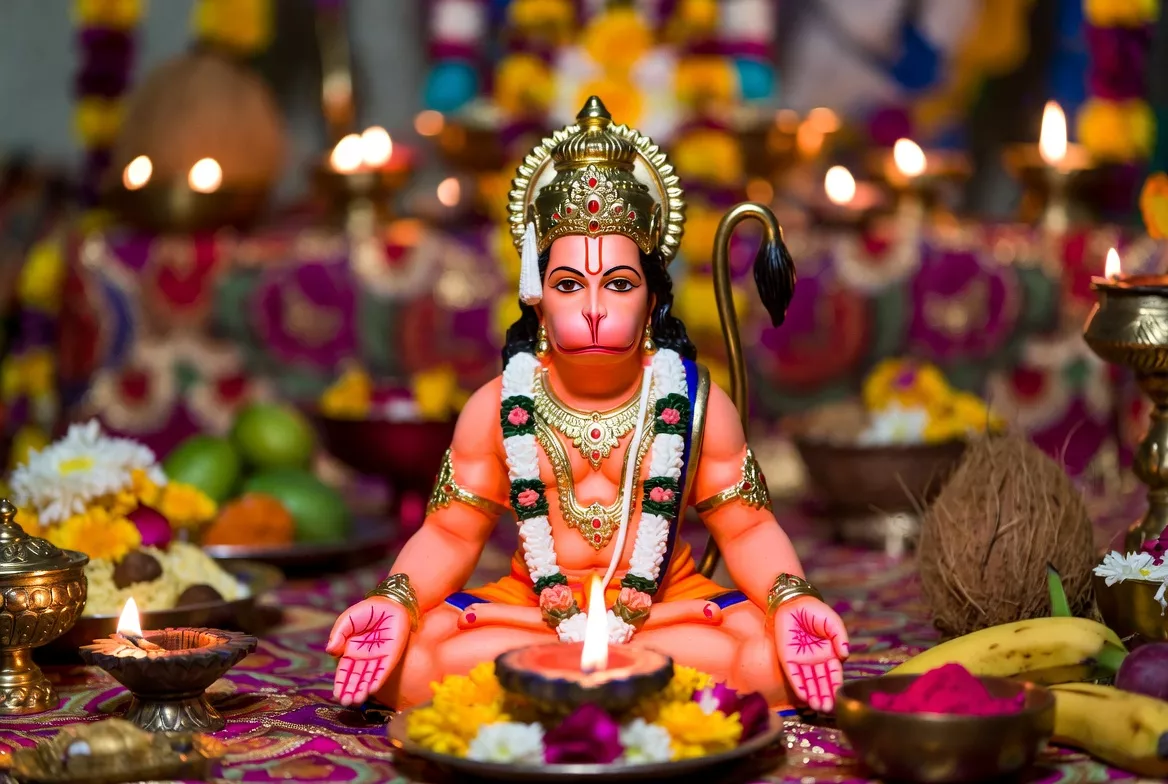
Clean your home and puja space on the evening of April 1. Set up your altar with an image or idol of Lord Hanuman — if you don't have one, a printed image from the internet is fully acceptable. Light a ghee diya or sesame oil lamp. If you have any image of Lord Rama alongside Hanuman, place it to the right (east-facing if possible). Offer fresh flowers — marigold, rose, or any available flower. Place a small bowl of prasad (fruits, jaggery, or modak) before the deity.
Before sleeping, chant this shloka seven times while facing the Hanuman image:
"Manojavam Maruta Tulya Vegam, Jitendriyam Buddhimatam Varishtham, Vatmajam Vanarayuthamukhyam, Shri Ramdutam Sharnam Prapadye"
Devotees observing the Chaitra Purnima vrat should avoid non-vegetarian food, alcohol, onion, and garlic from April 1 evening onward.
Brahma Muhurta Rising — Sunrise Darshan on April 2
Rise between 4:00 and 5:00 AM local time on April 2. Bathe with clean water. If possible, add a pinch of sesame seeds (til) to the bathing water — a powerful purifying practice on Purnima days. Wear clean, preferably orange or saffron-colored clothes. Light your lamp, offer incense (agarbatti — jasmine or rose are Hanuman's favorites), and begin your Hanuman Jayanti worship at sunrise.
Check your local sunrise time for April 2, 2026 — the exact moment of sunrise is when you should be in your puja, eyes closed, visualizing the radiant form of Hanuman at the moment of his divine birth. This is your 'sunrise darshan' even at home. For those near a Hanuman temple, arrive at least 30 minutes before sunrise for the morning abhishek and darshan.
Sindoor Offering — The Red Blessing
The offering of sindoor (vermilion) to Hanuman is one of the most distinctive and beloved rituals of Hanuman worship. The story behind it comes from the Ramayana: Hanuman saw Sita Mata applying sindoor to her hair and asked why. She explained that it was for Lord Rama's long life. In his limitless love for Rama, Hanuman covered his entire body in sindoor — reasoning that if a little ensured Rama's well-being, covering himself entirely would multiply the blessing.
Lord Rama was so moved by this that he declared: 'Whoever offers sindoor to Hanuman and applies it to their forehead will receive my special grace.' On Hanuman Jayanti 2026, mix a small amount of sindoor powder with sesame oil or mustard oil to form a paste and offer it to your Hanuman idol. Then apply a small amount to your own forehead as tilak. This is one of the most powerful things you can do on this day.
Hanuman Chalisa Path — The Heart of Jayanti Worship
The Hanuman Chalisa, composed by Goswami Tulsidas, is the supreme prayer of Hanuman devotion. Its 40 verses encompass his entire glory. On Hanuman Jayanti 2026, commit to reciting the Chalisa at minimum 7 times. The ideal practice is:
• Morning (sunrise): 1 Chalisa path with sindoor offering and lamp
• Mid-morning: 1 Chalisa path for family protection
• Noon: 1 Chalisa path for career and prosperity
• Afternoon: 1 Chalisa path for children's well-being
• Sunset: 1 Chalisa path as the day's offering closes
• Evening aarti time: 2 Chalisa paths as final offering before moonrise
Devotees with greater time and bhakti may do 11, 21, or 108 Chalisa paths. The number 108 is the highest practice, yielding the merit described in the Chalisa itself: 'Jo sat baar paath kar koi, Chhutahi bandi maha sukh hoi' — whosoever completes one hundred recitations is freed from all bondage.
Fasting — The Chaitra Purnima Vrat
Observing the Chaitra Purnima vrat on April 2, 2026 is a powerful act of devotion. Choose the level that suits your health and circumstances:
Nirjala Vrat (waterless fast): The strictest form — observed by very senior devotees from sunrise to moonrise. Not recommended without prior practice or if you have health conditions.
Phalahar Vrat (fruit fast): Fruits, milk, coconut water, nuts, rock salt, sabudana khichdi, and sweet potatoes are permitted. Grains and regular salt are avoided. This is the most widely practiced form and is perfectly suitable for working NRIs.
Sattvic Vrat: Simple vegetarian food without onion or garlic. This is the accessible form for those who cannot fast strictly due to work demands.
Take the sankalpa (vow) at sunrise: Face east, hold water in your right palm, and state your name, your intention to observe the Chaitra Purnima vrat for Hanuman Jayanti, and your prayer. Pour the water over a plant or into a bowl as an offering. The fast is broken after moonrise on the night of April 2, following the full moon darshan and a small prayer of gratitude.
Evening Aarti and Full Moon Night Practice
The night of Chaitra Purnima is one of the most beautiful nights of the Hindu year — the full moon of spring, when the sky is a luminous silver and the air carries the fragrance of the season. For NRIs, stepping outside on the night of April 2 to look at the full moon and chant Hanuman's name is a deeply moving act of spiritual homecoming. You may be in Chicago or in Cape Town, in Singapore or in Stockholm — but the same moon shines above you that shines above the temples of India.
Perform the final aarti with multiple wicks at moonrise. Light camphor (kapoor) aarti, wave it in a circular motion before Hanuman's image, and sing 'Aarti Kije Hanuman Lala Ki.' Break your fast with fruits and sweets offered first to Hanuman as prasad. If your family is with you, make this an event — light diyas together, sing the Chalisa together, and let your children watch and absorb the meaning of this devotion. The memory of parents praying together on Hanuman Jayanti will stay with your children for life.
✦ ✦ ✦
NRI Country-Wise Guidance: Celebrating Hanuman Jayanti 2026 Abroad
[image: 🇺🇸] United States of America
April 2, 2026 falls on a Thursday, which is a working day for most US-based NRIs. However, the beauty of Hanuman worship is that it asks only for sincerity, not hours. Rise at 4:30–5:00 AM before work. Perform your sunrise puja, do at least 3 Chalisa paths, offer sindoor, and take your sankalpa. Many major US cities — Houston, New Jersey, Chicago, Los Angeles, San Jose, Atlanta, Dallas — have established Hanuman temples that will hold special Jayanti celebrations. The BAPS Swaminarayan temples, Chinmaya Mission chapters, Hindu Temples of Texas and Georgia, and local Hanuman Mandir associations typically organize all-day events.
For those in smaller cities without easy temple access, connect with your local Hindu community organization for a virtual or home-based group Chalisa path. Organizations like the Hindu Swayamsevak Sangh (HSS) and VHP of America often coordinate Hanuman Jayanti programs. After work on April 2, gather your family for an evening aarti and moonrise fast-breaking.
[image: 🇬🇧] United Kingdom
The UK's large Hindu Gujarati, Tamil, and Telugu communities mean that Hanuman Jayanti is celebrated with genuine enthusiasm in Leicester, Wembley, Southall, Birmingham, and Manchester. The Shree Swaminarayan Temple in Golders Green, the BAPS Neasden Temple (Europe's largest Hindu temple), and dozens of community temples in the Midlands will hold special programmes. Thursday April 2 is a school and work day — plan your sunrise puja at home and temple visit in the evening.
UK-based NRIs from Andhra Pradesh and Telangana communities typically organize large Hanuman Jayanti melas with cultural programs, prasad distribution, and Chalisa marathons. Check with your local Telugu Cultural Association or Gujarati Hindu Society. The strong UK Sikh-Hindu interfaith tradition in cities like Birmingham means temple doors are often open to all.
[image: 🇨🇦] Canada
Canada's Hindu communities in the Greater Toronto Area, Vancouver, Calgary, and Edmonton are vibrant and well-organized. The BAPS Shri Swaminarayan Mandir in Toronto, the Vishnu Mandir in Richmond Hill, and numerous community temples will organize Hanuman Jayanti events. April 2 is spring in Canada — the weather may still be cool but the devotion is warm. Toronto sunrise is around 7:00 AM EDT on April 2.
The large South Indian Tamil and Telugu communities in the GTA, as well as the Gujarati and North Indian communities, each have their own Hanuman Jayanti traditions. Second-generation Canadian-born Hindus often benefit from the structured, English-language Chalisa sessions organized by organizations like the Hindu Heritage Youth Camp and HSS Canada chapters, which help younger devotees connect with their heritage.
[image: 🇦🇺] Australia
For Australian NRIs in Sydney, Melbourne, Brisbane, Perth, and Adelaide, Hanuman Jayanti 2026 on April 2 falls at a time when the Southern Hemisphere is entering autumn — the perfect season for spiritual reflection and inner turning. Sydney sunrise will be approximately 7:10 AM AEDT. The Sri Venkateswara Temple in Helensburgh, the BAPS Mandir in Campbelltown, and numerous community mandirs across Melbourne will host celebrations.
Australia's Hindu council coordinates temple events, and WhatsApp groups run by Indian community associations in each state share Jayanti puja schedules. Many Australian NRIs combine Hanuman Jayanti with weekend family puja programs, especially as April 2 falls on a Thursday — the extended weekend can be used for a deeper retreat-style observance from Thursday evening through Saturday.
[image: 🇦🇪] United Arab Emirates & Gulf Countries
The UAE — particularly Dubai, Abu Dhabi, and Sharjah — has one of the largest Hindu NRI communities outside India. While public Hindu temples are limited in the Gulf, the Hindu Temples in Dubai (Bur Dubai Mandir) and Abu Dhabi host significant Hanuman Jayanti observances. Many NRIs in Saudi Arabia, Oman, Bahrain, Kuwait, and Qatar celebrate within their private residential communities.
For Gulf-based NRIs, April 2 morning in UAE time (GST, UTC+4) means that Brahma Muhurta falls around 5:00–5:30 AM. This early morning puja can be completed before the working day. The large Malayali, Tamil, Telugu, Gujarati, and North Indian communities in the UAE each maintain their own Hanuman devotion groups, with many Chalisa path WhatsApp communities that do collective virtual recitations every Tuesday, Saturday, and on major festival days.
[image: 🌏] Southeast Asia — Singapore, Malaysia, & Beyond
Singapore and Malaysia have deep Hindu Tamil roots, and Hanuman is widely worshipped in both countries through the Murugan-Hanuman tradition. The Sri Srinivasa Perumal Temple in Singapore and the Arulmigu Sri Rajakaliamman Temple in Johor Bahru are known for their Hanuman Jayanti observances. The Tamil and Telugu NRI communities in Singapore's Little India organize processions, Chalisa marathons, and prasad distribution.
Malaysia's rich Hindu cultural heritage — particularly in Tamil Nadu-origin communities in Penang and Kuala Lumpur — means Hanuman Jayanti is a community celebration with processions, temple events, and home pujas. Devotees in Bangkok, Hong Kong, Tokyo, and other Asian cities can connect with local Hindu temples or the Indian diaspora organizations that typically organize festival observances.
✦ ✦ ✦
From the Ramayana: Stories That Speak to Every NRI Heart
Hanuman in a Foreign Land — Lanka as a Mirror of the NRI Experience
There is a dimension of the Ramayana that NRIs sometimes discover with a deep pang of recognition: Hanuman's mission in Lanka was essentially the journey of a dharmic soul into a foreign land. Lanka was prosperous, powerful, technologically advanced (Pushpaka Vimana, golden palaces), and culturally completely different from Kishkindha. Hanuman entered it alone, without support systems, without maps, using only his intelligence, his divine power, and his unwavering connection to Lord Rama.
He did not lose himself in Lanka's splendor. He did not forget why he had come. He observed, adapted, and remained profoundly himself — a servant of Rama in a land that did not know Rama. This is the NRI's spiritual calling in its truest form. You are Hanuman in Lanka. The foreign land may offer its glitter, its opportunities, its challenges — but your dharma, your connection to your Lord, your mission of raising children who love Sanatana Dharma — this remains your north star, just as Rama's name was Hanuman's north star in Lanka.
When the demons tried to extinguish Hanuman's flame by setting his tail on fire, they only succeeded in giving him a greater weapon. When the world tries to extinguish your dharmic fire through cultural pressure, secular modernity, or the isolation of diaspora life — let Hanuman's example be your answer. His burning tail became the torch that lit Lanka. Your dharma, kept alive in foreign lands, becomes a beacon for future generations.
The Sanjeevani: When Time Runs Out, Surrender Completely
In the darkest moment of the Lanka battle, Lakshmana lay dying. The physician Sushena named the Sanjeevani herb as the only cure, but it had to be found on a Himalayan mountain range and brought back before sunrise. Hanuman leaped northward across the entire subcontinent.
When he reached the Dronagiri mountain and could not identify the specific herb among thousands of glowing plants, Hanuman did not freeze in indecision. He did not return empty-handed. He did not give up. He uprooted the entire mountain and carried it back. Every herb was present. Lakshmana was saved.
For NRIs facing impossible situations — visa rejections, career setbacks, health crises, family separations — Hanuman's Sanjeevani moment is the ultimate teaching: when you cannot find the precise solution, make a total offering. Bring the whole mountain. Pray with your whole heart. Do the maximum you can and let divine grace handle the rest. Hanuman Jayanti 2026 on April 2 is your opportunity to bring your whole mountain — every worry, every challenge, every hope — and lay it at Pawanputra's feet.
Hanuman and Ram: The Original Long-Distance Devotion
After the war in Lanka, when Ram and Sita returned to Ayodhya and Ram Rajya was established, Hanuman did not retire to a life of comfort. He remained in continuous service — but more beautifully, he remained in continuous devotion across distance. Ram was in Ayodhya; Hanuman was wherever he was needed. Their devotion transcended physical proximity.
This is the deepest comfort for NRIs who feel spiritually 'far' from India's temples and sacred geography. Hanuman and Rama were not always in the same physical location — and yet their bond was unbreakable, their love was complete. Your relationship with your deity, with your dharma, with your divine mother India — it is not diminished by ocean or distance. It is a matter of the heart. And the heart has no time zone.
✦ ✦ ✦
Tuesday & Saturday Hanuman Worship: Your Weekly Armor in Parabhava Year
Mangalvar (Tuesday) — The NRI's Weekly Reset
Every Tuesday is a mini Hanuman Jayanti. In Vedic tradition, Tuesday is ruled by Mangala (Mars), whose fierce energy can create conflicts, accidents, Mangal Dosha, and impulsive decisions if unmanaged. Lord Hanuman is the supreme controller of Mars energy. Tuesday worship transforms Mars' aggression into courage, its conflict into bold positive action.
For NRIs, the Tuesday Hanuman ritual is the weekly spiritual reset. In the middle of a demanding work week, in a secular environment that offers no religious scaffolding, this ritual says: I remember who I am. I am not merely an employee, a visa holder, a mortgage payer. I am a child of Sanatana Dharma, and Hanuman walks before me.
Tuesday practice: Light a red or orange lamp with sesame oil after sunset. Offer a red flower garland. Recite the Chalisa once. Apply sindoor tilak. Many NRIs also observe a no-salt or fruit-only fast on Tuesdays, eating a simple sattvic dinner. Do this every Tuesday through the Parabhava year 2026, and observe the transformation in your inner life and outer circumstances.
Shanivar (Saturday) — The Saturn Pacifier
Saturday is Shani's day — the day of Saturn, karmic account-settling, delays, and tests. In 2026's Parabhava year, Shani's influence is particularly strong. The single most powerful remedy for Saturn's challenges is Saturday Hanuman worship, because of a beautiful episode from the Ramayana.
When Hanuman searched Lanka's dungeons for Sita, he found Shani Dev himself imprisoned by Ravana in a dark cell. Ravana had captured Saturn to prevent the planet's malefic influence from afflicting his kingdom. Hanuman freed Shani, and in gratitude, Shani Dev promised eternal protection to all who worship Hanuman on Saturdays. No Sade Sati (the feared 7.5 year Saturn transit), no Shani Dhaiya (2.5 year transit), and no Saturn-related suffering can fully afflict those who offer Saturday worship to Hanuman.
Saturday NRI practice: Light a sesame oil lamp in the morning. Offer black sesame seeds (til) if available — or any dark seeds. Recite the Bajrang Baan (the fierce protective prayer to Hanuman) for maximum Shani pacification. Alternatively, read the Sundara Kanda of the Ramayana, which is specifically recommended for Saturdays and is available in English translation. Donate a small amount to a charity or temple on Saturdays — even $5 or £5 online — as an act of Saturn-pacifying selfless service (seva).
✦ ✦ ✦
Staying Connected: Digital Devotion for the Global Hindu Community
One of the most significant developments for NRIs in the digital age is the ability to participate in temple ceremonies, Chalisa marathons, and devotional programs in real time from anywhere in the world. Hindutone.com is your central hub for this connection — but here is a broader resource map for Hanuman Jayanti 2026.
Live Temple Streams on Hanuman Jayanti April 2:
The Sankat Mochan Hanuman Temple in Varanasi, the Salasar Balaji Temple in Rajasthan, the Jakhu Temple in Shimla, and the Mahavir Mandir in Patna all live-stream their Hanuman Jayanti programs on YouTube. Search for ' live' on YouTube on April 2, 2026. Watching the sunrise abhishek of Hanuman live from Varanasi while sitting in your living room in California is a spiritually powerful act of participation.
Hanuman Chalisa Apps & Resources:
Hanuman Chalisa apps with audio, transliteration, and meaning are available on iOS and Android. 'Hanuman Chalisa' by Shemaroo, 'Bhakti Songs' by Times Music, and various Sanskrit learning apps provide full support for NRIs and second-generation devotees. YouTube channels like T-Series Bhakti Sagar, Shemaroo Bhakti, and Rajshri Soul offer full Chalisa path sessions with synchronized text.
Virtual Puja Communities:
WhatsApp groups and Telegram channels organized by regional Indian associations in the USA, UK, Canada, and Australia often run Hanuman Jayanti group Chalisa paths. Contact your local Indian Association, Telugu Association, Gujarati Samaj, or Tamil Sangam to find or organize a group virtual puja. Zoom-based group recitations have become an extremely popular NRI devotional format since 2020, and Hanuman Jayanti is one of the most widely observed.
Hindutone.com Daily Devotional Content:
Subscribe to Hindutone.com for daily devotional articles, puja guides, mantra explanations, temple guides, and NRI-specific spiritual guidance. Our articles on Monday (Shiva), Tuesday (Hanuman), Wednesday (Ganesha), and all major festivals are crafted with the global Hindu community in mind. Share this article with your NRI friends and Hindu community groups as a Hanuman Jayanti gift of knowledge.
✦ ✦ ✦
The Blessings of Hanuman Jayanti: What NRIs Receive
Visa, Immigration & Legal Protection
Among the most commonly cited blessings that NRIs experience through Hanuman worship is the resolution of immigration and visa difficulties. The Chalisa verse 'Sankat kate mite sab peera, Jo sumirai Hanumat Balbira' — all crises are averted and all pain removed for those who remember mighty Hanuman — is particularly invoked in immigration matters. Many NRI families report that visa issues resolved, immigration backlogs cleared, or seemingly impossible paperwork situations untangled in the months following sincere Hanuman Jayanti worship.
Career Success and Professional Protection
Hanuman is the deity of strength, intelligence, and the successful completion of difficult missions. These are precisely the qualities demanded of NRI professionals navigating competitive foreign workplaces. Regular Hanuman worship, anchored by the full-day observance of Hanuman Jayanti, creates a field of protective energy around career and professional endeavors. The removal of workplace conflicts, the opening of promotion pathways, and the wisdom to navigate professional challenges are all within Hanuman's domain.
Children's Cultural Rootedness
One of the deepest anxieties of NRI parents is whether their children — born in foreign lands, educated in secular systems, surrounded by non-Hindu peers — will retain any connection to their Hindu heritage. Hanuman is the perfect deity for NRI children to connect with: he is heroic, strong, loyal, intelligent, and his stories are exciting and vivid. The practice of reading the Ramayana together, reciting the Chalisa as a family, and celebrating Hanuman Jayanti with special rituals creates cultural and spiritual roots that no amount of Western cultural pressure can fully displace.
Mental Peace and Anxiety Relief
The Parabhava year's collective anxiety, the pressures of immigrant life, the loneliness of being far from extended family — these are real mental health challenges for NRIs. Hanuman's name is the supreme antidepressant of Sanatana Dharma. The neuroscience of mantra chanting confirms what saints have known for millennia: rhythmic, focused chanting reduces cortisol, activates the parasympathetic nervous system, and creates genuine states of calm and clarity. Chanting the Chalisa daily — just 10 minutes — is one of the most effective mental health practices available to the global Hindu community.
✦ ✦ ✦
Conclusion: Jai Hanuman — Your Eternal Companion Across the Globe
Dear Hindutone family — NRIs in every corner of the world — as Chaitra Purnima 2026 approaches on April 2, let us make a collective sankalpa together. Let every Hindu home across the globe — from Houston to Hounslow, from Toronto to Tokyo, from Melbourne to Munich — light a lamp for Hanuman on his birthday. Let every Hindu parent recite the Chalisa with their children on the morning of April 2. Let every NRI who has faced the challenges of Parabhava year 2026 come before Hanuman and say: 'I came to you with my whole mountain, as you came to Rama with yours. I surrender my difficulties and trust your grace.'
Hanuman is not geographically restricted. He is Chiranjeevi — eternally alive and present. He is with the devotee in the Himalayan cave and in the New York apartment. He is with the mother praying for her child's visa in Dubai and with the student preparing for competitive exams in London. He is with the NRI elder who lights a lone diya on a Tuesday evening in a foreign city, with no temple nearby, and chants his name with tears of bhakti.
This is the unbreakable contract of Hanuman with his devotees: 'Tumhare bhajan Ram ko pave, Janam janam ke dukh bisrave' — Through your devotion, you attain Ram himself, and the sorrows of countless births are erased. No Parabhava year, no foreign land, no ocean of distance can break this contract. It is written in the Chalisa. It is written in every stone of every Hanuman temple the world over. And it is written, dear reader, in your own heart — which recognized something true and deep in these words because Hanuman is already there.
"Jai Hanuman Gyan Gun Sagar, Jai Kapis Tihu Lok Ujagar" — Victory to Hanuman, the ocean of wisdom and virtue, Victory to the monkey lord who illuminates all three worlds.
Jai Shri Ram. Jai Bajrang Bali. Happy Hanuman Jayanti 2026.
— From all of us at Hindutone.com, your spiritual home, wherever in the world you are. [image: 🙏]
✦ ✦ ✦
Published by Hindutone.com | The Voice of Hindus Worldwide: Unity in Diversity
Nilagiri Block, 513, 5th Floor, Beside Ameerpet Metro Station, Hyderabad – 500016
SEO Tags: Hanuman Jayanti 2026 April 2 | Chaitra Purnima Vrat | NRI Hanuman Puja | Parabhava Year Remedy | Hanuman Chalisa NRI | Hindu Festivals Abroad | Tuesday Hanuman Worship | Saturday Shani Hanuman
॥ श्री हनुमान की जय ॥ • www.hindutone.com
Frequently Asked Questions
When is Hanuman Jayanti in 2026?
Hanuman Jayanti 2026 falls on Thursday, April 2, which is Chaitra Purnima, the full moon of the first lunar month. Devotees prepare the puja space on the evening of April 1.
How can NRIs celebrate Hanuman Jayanti without a nearby temple?
Set up an image or idol of Hanuman at home, light a ghee or sesame oil lamp, offer flowers and prasad, and worship at local sunrise. A printed image is fully acceptable, since Hanuman needs sincere bhakti rather than marble temples.
Why is sindoor offered to Hanuman?
As commonly told, Hanuman saw Sita apply sindoor for Lord Rama's long life and covered his whole body in it. Rama was moved and promised special grace to those who offer sindoor to Hanuman, mixed with sesame or mustard oil.
How many times should the Hanuman Chalisa be recited on Hanuman Jayanti?
The guidance is to recite it at least 7 times through the day, from sunrise to the evening aarti before moonrise. Devotees with more time may do 11, 21 or 108 paths.
What should devotees avoid during the Chaitra Purnima vrat?
Those observing the vrat avoid non-vegetarian food, alcohol, onion and garlic from the evening of April 1 onward.
What time should I start the puja if I live abroad?
Rise between 4:00 and 5:00 AM local time on April 2, bathe, wear orange or saffron clothes, and begin worship at your local sunrise. Check the local sunrise time for April 2, 2026.
You might also like
Tuesday Rituals in Hinduism: Must-Perform Mangalvar Puja, Vrats & Temples for NRIs Worldwide
Hanuman Chalisa: Complete Meaning, Scientific & Spiritual Benefits, and a 30-Day Daily Practice for NRIs
Hanuman Worship on Saturday: Powerful Rituals & Remedies for Shani Dosha