
Makar Sankranti and Pongal in the UK: Date, Time and How Families Keep It
Quick answer: In 2027 the Sun enters Makara (sidereal Capricorn) at 3:44 PM GMT on Thursday 14 January, so families in London, Leicester, Birmingham and Manchester keep Makar Sankranti and Thai Pongal on Thursday 14 January. India keeps it a day later.
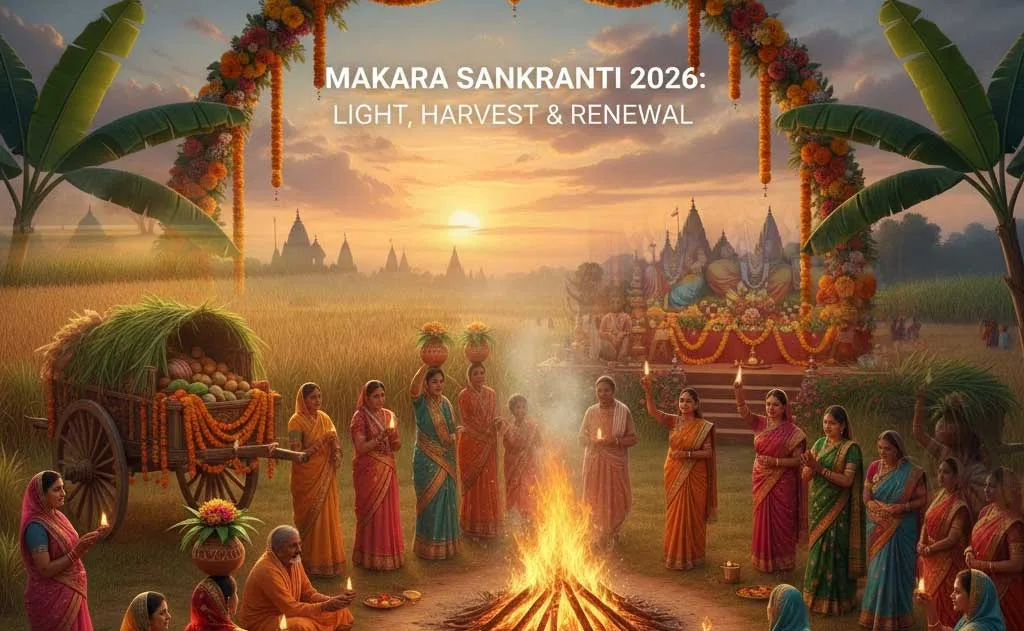
Quick answer: In 2027 the Sun enters Makara (sidereal Capricorn) at 3:44 PM GMT on Thursday 14 January, so families in London, Leicester, Birmingham and Manchester keep Makar Sankranti and Thai Pongal on Thursday 14 January. India keeps it a day later. Drik Panchang gives London only a 35-minute Punya Kaal, from 3:44 PM to 4:19 PM, because sunset follows so soon.
Key facts for 2027
| Detail | United Kingdom |
|---|---|
| Sun enters Makara | 3:44 PM GMT, Thursday 14 January 2027 (15:44 UTC) |
| Makar Sankranti and Thai Pongal in the UK | Thursday 14 January 2027 |
| Punya Kaal, London (Drik Panchang) | 3:44 PM to 4:19 PM, Thursday 14 January |
| Maha Punya Kaal, London (Drik Panchang) | 3:44 PM to 4:19 PM, the same window |
| Same moment in India | 9:14 PM IST on Thursday 14 January |
| Sankranti in India | 15 January in India per the panchang; some government lists mark 14 January |
| Bhogi and Lohri | The day and evening before your local Sankranti |
| Mattu Pongal and Kaanum Pongal | The two days after your local Thai Pongal |
| Community celebrations | Often on the nearest weekend; follow your temple's notice |
Leicester, Birmingham and Manchester share the same clock time, 3:44 PM, because the whole of Great Britain is on GMT in January. Sunset there falls within a few minutes of London's, so the window is just as short. Confirm with your local panchang or temple priest.
Why is the UK Punya Kaal only 35 minutes long?
Makar Sankranti is the instant the Sun enters the sidereal sign Makara. The panchang rule used by Drik Panchang is simple: if that instant falls before local sunset, the festival belongs to that civil day, and the Punya Kaal (the auspicious period for bathing, prayer and giving) runs from the instant until sunset. If it falls after sunset, the festival moves to the next day, and the Punya Kaal starts at the next sunrise.
In 2027 the instant is 15:44 UTC. In India that is 9:14 PM, well after dark, so India's Punya Kaal fills the whole of Friday 15 January. In London it is 3:44 PM on a short January afternoon, and Drik Panchang gives sunset as 4:19 PM. That leaves only 35 minutes. The festival is still on Thursday in the UK; it is simply a short window.
This also means the UK and India keep the main day on different dates. It is one moment in the sky, read on two clocks. Some UK families choose to do their main Sankranti puja on Friday morning alongside relatives in India. That is a family choice rather than the panchang date for Britain, so ask your priest what your tradition prefers.
How do you fit Surya puja into a short January day?
Sunrise in London is around 8:00 AM in mid-January and the Sun stays low all day. A working Thursday makes a 3:44 PM window hard for many people. Practical options families use:
- Morning offering. Offer water to the Sun (Surya arghya) after your bath at sunrise, before leaving for work or school. Our guide to Surya arghya explains the steps.
- The Sankranti window itself. If you can work from home or take the afternoon off, keep a short prayer, a lamp and the giving of food or money (daan) between 3:44 PM and 4:19 PM.
- Cloud and rain. British January skies are often overcast. Many families still face the Sun's direction, low in the south-west by mid-afternoon, and make the offering. Ask your priest what your family custom allows.
- Weekend gathering. Cook the full Pongal with the wider family on the weekend if Thursday is impossible, but keep at least a lamp and a prayer on the day itself.
For the Aditya Hridayam, a hymn to the Sun in the Yuddha Kanda of the Valmiki Ramayana, see our Aditya Hridayam page linked below, and use your family prayer book or ask your priest for the text.
Where do Tamil and South Indian families gather in the UK?
Tamil families in Britain, from Sri Lanka, India and elsewhere, keep Pongal at home and at temples, some of which trace their trusts back to the 1970s. These are a few temples whose own websites we checked on 12 November 2026. None had posted a 2027 Thai Pongal programme on that date, so check their website for this year's programme before you travel:
- London Sri Murugan Temple, Manor Park, east London. A registered charity; its website gives the address as 78–90 Church Road, London E12. londonsrimurugan.org.uk
- Highgate Hill Murugan Temple, north London. Its website says the trust bought the Archway Road site in 1977 and the main temple was consecrated in 1986, and that hours are extended on festival days. highgatehillmurugan.org
- Shri Venkateswara (Balaji) Temple, Tividale, West Midlands. Serves South Indian families across the Birmingham area; its website lists upcoming festivals. venkateswara.org.uk
For Leicester and Manchester, ask your local mandir or Tamil school; we have not listed temples there that we could not check on their own websites.
Is Pongal recognised by councils in the UK?
Yes, in parts of London. On 2 December 2021 the London Assembly unanimously agreed a motion calling on the Mayor and the London boroughs to mark Tamil Heritage Month in January and Pongal, the harvest festival. Some boroughs do so: Sutton Council, for example, announced that it celebrates January as Tamil Heritage Month, with Pongal named in its notice. Prime Ministers have also issued Thai Pongal messages through GOV.UK, for example in January 2016 and January 2018. Council and civic events change from year to year, so check your borough's website in January.
Bhogi in a British home: fires, smoke alarms and the law
In Tamil Nadu and the Telugu states, Bhogi morning begins with a fire of old, worn-out things, a sign of clearing out the old before the new season. In a UK home, keep the meaning and change the method.
Can you light a Bhogi fire in the garden?
GOV.UK says there are no general laws against garden bonfires, but there are laws about the nuisance they cause. Your council can serve an abatement notice if smoke becomes a statutory nuisance, and you can be fined if smoke drifts across a road and endangers traffic. Household waste must not be burned in a way that causes pollution or harms health. So:
- Never burn plastic, rubber, foam, painted wood or old clothes with synthetic fibres.
- Keep any fire small, away from fences, sheds and cars, and never leave it unattended.
- In a flat, never light an open flame on a balcony. Do Bhogi as a deep clean instead, and donate or recycle the old things.
Many UK families keep Bhogi as a clean-out day: wash the house, give away old clothes and household items, and light a single oil lamp.
Smoke alarms and the boiling-over pot
The government's home fire safety guidance asks you to fit at least one smoke alarm on every level of your home and to test it at least monthly. It also asks you to stay with pans on the hob, keep candles in proper holders away from curtains, and never leave children alone with a lit flame. In Scotland, the law has required interlinked smoke alarms and a heat alarm in the kitchen in every home since February 2022.
Pongal is meant to boil over, so plan for it:
- Use a wide pan or put a tray under the pot so milk does not run into the burner.
- On a gas hob, spilled milk can put out the flame; watch the pot and turn the heat down as soon as it rises.
- A clay pot will not work on an induction hob, and many clay pots are not made for a high direct flame. Follow the maker's instructions, or use a heavy steel or brass pot.
- Open a window or use the extractor fan rather than taking the battery out of a smoke alarm.
Ingredients: what can you find in Britain?
Most of what you need is sold by South Asian and Sri Lankan grocers in London, Leicester, Birmingham and Manchester, and some supermarkets stock the basics in their world-food aisles.
| Item | Where it usually comes from in the UK | If you cannot find it |
|---|---|---|
| Raw short-grain rice (for example ponni or sona masoori) | South Asian grocers | Any raw white rice; avoid parboiled rice for sweet Pongal |
| Split moong dal | Grocers and many supermarkets | No real substitute; keep a packet from December |
| Jaggery (vellam) | South Asian grocers | Dark soft brown sugar |
| Sugarcane | Some grocers stock it in January | A piece of sugarcane is customary but not required |
| Fresh turmeric plant | Rare in the UK | A fresh turmeric root tied to the pot with thread |
| Banana leaves | Frozen sections at grocers | Steel plates |
Remember allergens when cooking for guests: sweet Pongal usually contains cashews and ghee (dairy), and Sankranti sweets often contain sesame and peanuts. See our sakkarai Pongal recipe.
How can children take part?
- Draw a kolam (a rice-flour pattern on the doorstep) with them. On a wet British morning, draw it inside on a tray or with chalk on the path.
- Let them shout the festive call "Pongalo Pongal!" when the pot boils over.
- Give them a role in Bhogi: choosing toys and clothes to donate.
- If their school marks Tamil Heritage Month in January, a kolam picture or a short talk about Pongal is an easy way for them to share the festival.
- On Kaanum Pongal, the day of visits and outings, take them to see grandparents or older relatives.
Lohri in the UK's Punjabi community
Lohri is the Punjabi winter bonfire festival on the evening before Makar Sankranti. It is kept by Hindu and Sikh Punjabi families alike, and the next day is Maghi. For Sikhs, Maghi also recalls the Forty Liberated Ones (Chali Mukte) commemorated at Sri Muktsar Sahib.
Because the UK's Sankranti day is Thursday 14 January, the Lohri evening for the UK falls on the evening before it. Many gurdwaras, mandirs and community halls hold their Lohri gathering on the nearest weekend instead. The same garden-fire rules apply. Families in flats often gather around a small, safe fire at a community venue, or simply share rewri, gajak, peanuts and popcorn around a lamp. Read more in our Lohri bonfire guide.
Frequently asked questions
Is Pongal on 14 or 15 January in the UK in 2027?
Thai Pongal and Makar Sankranti fall on Thursday 14 January 2027 in the UK. The Sun enters Makara at 3:44 PM GMT, before sunset, so the panchang places the festival on that day. India keeps it on Friday 15 January because the same moment is 9:14 PM there.
What is the Punya Kaal in London?
Drik Panchang gives the Punya Kaal for London as 3:44 PM to 4:19 PM on Thursday 14 January 2027, and the Maha Punya Kaal as the same window. It is short because sunset comes 35 minutes after the Sankranti moment. Confirm with your local panchang or temple priest.
Is the time the same in Leicester, Birmingham and Manchester?
Yes. The Sankranti moment is 3:44 PM across Great Britain because the country is on one time zone. Sunset differs by only a few minutes between these cities, so the window is about as short as London's.
Can I do my Sankranti puja on Friday with my family in India?
Some UK families do, especially when Thursday is a working day. The panchang date for the UK is Thursday 14 January, so you may wish to keep at least a lamp and a short prayer on Thursday too. Ask your priest what your family tradition prefers.
Is it legal to light a Bhogi bonfire in my garden?
GOV.UK says there is no general law against garden bonfires, but councils can act if smoke becomes a nuisance, and smoke across a road can lead to a fine. Never burn plastic or household waste. In a flat, do not light any open flame on a balcony.
When do UK temples celebrate Thai Pongal?
Temples set their own programmes, and many hold the main community celebration on the nearest weekend. Check your temple's website in early January. We list only temples whose own sites we checked.
When is Lohri in the UK in 2027?
Lohri is the evening before the local Makar Sankranti, so in the UK it falls on the evening before Thursday 14 January. Many Punjabi community gatherings move to the weekend for convenience.
Sources
- Drik Panchang, Makar Sankranti 2027 for London (Punya Kaal and Maha Punya Kaal): https://www.drikpanchang.com/sankranti/makar-sankranti-date-time.html?geoname-id=2643743&year=2027 (accessed 11 November 2026)
- GOV.UK, Garden bonfires: the rules: https://www.gov.uk/garden-bonfires-rules (accessed 12 November 2026)
- GOV.UK, Fire safety in the home (accessible version): https://www.gov.uk/government/publications/make-your-home-safe-from-fire/fire-safety-in-the-home-accessible-version (accessed 12 November 2026)
- Scottish Government, Fire and smoke alarms: the law: https://www.gov.scot/publications/fire-and-smoke-alarms-in-scottish-homes/ (accessed 12 November 2026)
- London Assembly, press release "Assembly supports Tamil Heritage Month", 2 December 2021: https://www.london.gov.uk/press-releases/assembly/assembly-supports-tamil-heritage-month-0 (accessed 12 November 2026)
- London Borough of Sutton, Celebrating Tamil Heritage Month, 6 January 2023: https://www.sutton.gov.uk/w/celebrating-tamil-heritage-month (accessed 12 November 2026)
- Prime Minister's Office, Thai Pongal: Prime Minister's message (2016): https://www.gov.uk/government/news/thai-pongal-prime-ministers-message (accessed 12 November 2026)
- Prime Minister's Office, Prime Minister Theresa May's Thai Pongal message, 14 January 2018: https://www.gov.uk/government/news/prime-minister-theresa-mays-thai-pongal-message (accessed 12 November 2026)
- London Sri Murugan Temple: https://www.londonsrimurugan.org.uk/ (accessed 12 November 2026)
- Highgate Hill Murugan Temple: https://highgatehillmurugan.org/ (accessed 12 November 2026)
- Shri Venkateswara (Balaji) Temple of UK: https://www.venkateswara.org.uk/ (accessed 12 November 2026)
Last reviewed: 12 November 2026.
Related guides
- Makar Sankranti 2027: date and Punya Kaal timings
- Makar Sankranti and Pongal abroad: dates and times by city
- Hindu life in the United Kingdom
- Surya puja at home for families abroad
- Our Aditya Hridayam page
- Pongal across India: one festival, many names
- Pongal 2027: the four days and how it is celebrated
- Thai Pongal puja at home, including in a flat
- Pongal and Sankranti in the USA
- Pongal and Sankranti in Canada
Share this with family and friends
Send it on WhatsApp, post it, or copy the link.
More from Festivals
- Pongal 2027: Dates, the Four Days and How It Is Celebrated
- Kaanum Pongal: The Last Day of Pongal, for Visits and Outings
- Mattu Pongal: The Day for Cattle, and Kanu Pidi
- Thai Pongal: What the Day Means and How Families Keep It
- Bhogi: Meaning, the Bhogi Fire, Bhogi Pallu and Goda Kalyanam
You might also like
Hindus in the UK: Temples, Festivals, Community and City Guide
Makar Sankranti, Pongal and Lohri in the USA
Makar Sankranti and Pongal in Australia: A Midsummer Festival Guide