Dussehra 2026 in Austria, City by City: Date, Vijay Muhurat and Hindu Temples
Vijayadashami falls on Tuesday 20 October 2026 across Austria. Local Vijay Muhurat, Aparahna and Dashami times for Vienna, Graz, Linz, Salzburg and Innsbruck, the Hindu mandirs and Krishna centres in Vienna, Traiskirchen and Salzburg, and how to mark the day at home.
Vijayadashami falls on Tuesday 20 October 2026 across Austria. Local Vijay Muhurat, Aparahna and Dashami times for Vienna, Graz, Linz, Salzburg and Innsbruck, the Hindu mandirs and Krishna centres in Vienna, Traiskirchen and Salzburg, and how to mark the day at home.
Quick answer: Dussehra (Vijayadashami) 2026 in Austria is on Tuesday 20 October 2026 in every city. The Vijay Muhurat, calculated by the Drik Panchang method, is 2:25 PM – 3:07 PM in Vienna, 2:29 PM – 3:12 PM in Graz, 2:33 PM – 3:15 PM in Linz, 2:38 PM – 3:21 PM in Salzburg and 2:45 PM – 3:28 PM in Innsbruck (Central European Summer Time, UTC+2). Navratri runs from Sunday 11 to Monday 19 October 2026.
Editor's note (5 October 2026): The local times on this page were calculated for each city from the Drik Panchang tithi (Dashami from 12:50 PM IST on 20 October to 2:11 PM IST on 21 October 2026), shown in Austrian time. Austria is still on summer time (CEST, UTC+2) on 20 October; clocks go back on Sunday 25 October. The Vijay Muhurat is the 11th of the 15 daytime muhurtas, calculated by the Drik Panchang method. We do not list 2026 event schedules, because temples and associations announce their own programmes; please check with them directly.
Austria's Hindu community is small but long established. The first Hindu religious group in the country was founded in Vienna in 1980 by Dr Bimal Kundu, an engineer from Bengal, and grew into the Hindu Mandir Gesellschaft. Since 1998 Hindus have had legal status as a state-registered religious confessional community, represented by the Hinduistische Religionsgesellschaft in Österreich (HRÖ). Hindus make up well under one per cent of the population, but the community is diverse: Indian professionals, students and their families, many working for the international organisations and companies based in Vienna; Hindus from Nepal and Bangladesh; Tamil Hindus from Sri Lanka and South India; and Austrian devotees of Krishna. Vienna is the clear centre of temple life, with smaller groups in Salzburg, Graz and the other regional capitals.
Dussehra 2026 in Austria: dates and Vijay Muhurat by city
The whole of Austria uses one time zone, Europe/Vienna, which is UTC+0200 on 20 October. The Dashami tithi therefore begins and ends at the same clock time everywhere, but the sun-based windows shift by about 20 minutes from Vienna in the east to Innsbruck in the west.
| Region (Bundesland) | City | Dussehra date | Vijay Muhurat (Drik Panchang method) | Dashami begins → ends |
|---|---|---|---|---|
| Vienna | Vienna | Tue 20 Oct | 2:25 PM – 3:07 PM | Tue 20 Oct, 9:20 AM → Wed 21 Oct, 10:41 AM |
| Styria | Graz | Tue 20 Oct | 2:29 PM – 3:12 PM | Tue 20 Oct, 9:20 AM → Wed 21 Oct, 10:41 AM |
| Upper Austria | Linz | Tue 20 Oct | 2:33 PM – 3:15 PM | Tue 20 Oct, 9:20 AM → Wed 21 Oct, 10:41 AM |
| Salzburg | Salzburg | Tue 20 Oct | 2:38 PM – 3:21 PM | Tue 20 Oct, 9:20 AM → Wed 21 Oct, 10:41 AM |
| Tyrol | Innsbruck | Tue 20 Oct | 2:45 PM – 3:28 PM | Tue 20 Oct, 9:20 AM → Wed 21 Oct, 10:41 AM |
The Aparahna (afternoon period) is the traditional window for Aparajita and Shami puja, and sunset marks the time for any evening aarti or symbolic Ravan Dahan:
| City | Aparahna, 20 Oct | Sunset, 20 Oct |
|---|---|---|
| Vienna | 1:42 PM – 3:49 PM | 5:57 PM |
| Graz | 1:46 PM – 3:54 PM | 6:02 PM |
| Linz | 1:50 PM – 3:58 PM | 6:05 PM |
| Salzburg | 1:56 PM – 4:03 PM | 6:11 PM |
| Innsbruck | 2:02 PM – 4:10 PM | 6:18 PM |
Key Navratri and Dussehra dates 2026
| Observance | Date (2026) |
|---|---|
| Navratri begins (Ghatasthapana) | Sunday 11 October |
| Durga Ashtami and Maha Navami | Monday 19 October |
| Dussehra / Vijayadashami in Austria | Tuesday 20 October |
| Dashami tithi, Austrian time | Tue 20 Oct, 9:20 AM → Wed 21 Oct, 10:41 AM |
| Vijay Muhurat (Vienna) | 2:25 PM – 3:07 PM |
| Aparahna (Vienna) | 1:42 PM – 3:49 PM |
| Sunset (Vienna) | 5:57 PM |
| Bijoya Dashami / Sindoor Khela (India, Bengal tradition) | Wednesday 21 October |
Ashtami and Navami share Monday 19 October in India's calendar this year, so families who do Kanya pujan on either day will hold it then. In every Austrian city the Dashami tithi has already begun by mid-morning on 20 October and overlaps the Aparahna by more than two hours, so there is no doubt about the date: Vijayadashami is Tuesday 20 October.
Hindu temples in Austria for Navratri & Dussehra
These temples and organisations have been confirmed to exist in each area. We list name and area only; check their own websites or social pages for opening hours and festival plans. Temples and community groups usually announce Navratri garba, Durga Puja, Ramlila and Ravan Dahan programmes a few weeks ahead — check their websites/social pages.
Vienna and Lower Austria: Vienna
Vienna's Vijay Muhurat is 2:25 PM – 3:07 PM, with the Aparahna from 1:42 PM – 3:49 PM and sunset at 5:57 PM. The capital is home to most of Austria's Hindus and to almost all of its established temples and associations, and families from the surrounding state of Lower Austria usually worship here or in Traiskirchen.
- Hindu Mandir Gesellschaft — Josefstadt (8th district). A long-established Hindu association that has held its pujas in a converted basement mandir and is building a larger purpose-built temple in Floridsdorf (21st district). Check its announcements for where festival pujas are held this year.
- Hinduistische Religionsgesellschaft in Österreich (HRÖ) — Josefstadt. The officially registered body representing Hindus in Austria, and a useful first contact for finding pujas and community groups.
- Vedisches Zentrum (ISKCON Vienna) — Mariahilf (6th district). The Hare Krishna centre, known for its Sunday feast with kirtan, arati and prasadam.
- Sri Sri Radha Govinda Gaudiya Math — Traiskirchen, Lower Austria, south of Vienna. A Krishna temple in the Gaudiya Vaishnava tradition, which celebrates festivals such as Ram Navami.
At Navratri, Vienna's mandirs typically hold Devi pujas, aarti, bhajans and Kanya pujan, while Krishna centres mark the season with kirtan and readings. Indian, Nepali and Bengali associations in Vienna may organise garba and dandiya nights, Durga Puja or Dashain gatherings in rented halls, usually on the weekends around Navratri.
Styria: Graz
Graz's Vijay Muhurat is 2:29 PM – 3:12 PM (Aparahna 1:46 PM – 3:54 PM, sunset 6:02 PM). Austria's second city has a sizeable community of Indian students and researchers at its universities and engineers in the region's automotive and technology industries.
- Brahma Kumaris — Graz. One of the movement's three centres in Austria, offering Raja Yoga meditation; it is a spiritual centre rather than a traditional mandir.
We could not confirm a Hindu temple in Graz through reliable listings. Families usually celebrate at home or with informal student and community groups, and some travel to Vienna, about two and a half hours away by train, for temple pujas.
Upper Austria: Linz
Linz's Vijay Muhurat is 2:33 PM – 3:15 PM (Aparahna 1:50 PM – 3:58 PM, sunset 6:05 PM). The Linz area has a growing number of Indian professionals in its industrial and IT firms and students at the Johannes Kepler University. We could not confirm a Hindu temple in Linz through reliable listings, so families usually mark Navratri at home or in small community gatherings, and Vienna and Salzburg are each little more than an hour away by train.
Salzburg: Salzburg
Salzburg's Vijay Muhurat is 2:38 PM – 3:21 PM (Aparahna 1:56 PM – 4:03 PM, sunset 6:11 PM).
- Hindu Mandir Salzburg — Lehen. A mandir set up by mostly Indian-origin Hindus in an adapted basement space in a residential and commercial building; the City of Salzburg notes that around 150 families gather there for major festivals.
At Navratri, the Salzburg mandir typically holds Devi puja, aarti and bhajans, and it is a natural place to visit on Vijayadashami evening after work. Families from Upper Austria and Tyrol sometimes travel here for the bigger festivals.
Tyrol: Innsbruck
Innsbruck's Vijay Muhurat is 2:45 PM – 3:28 PM (Aparahna 2:02 PM – 4:10 PM, sunset 6:18 PM), the latest in Austria because the city lies furthest west. Innsbruck has Indian students and researchers at its university and medical school, and many visitors in the tourism season. We could not confirm a Hindu temple in Innsbruck through reliable listings, so most families celebrate at home or with friends, and travel to Salzburg or Munich for temple worship.
How Austria celebrates Navratri and Dussehra
Because Navratri falls mostly on ordinary working days, much of the community celebration moves to the weekends of 10–11 and 17–18 October and to the evenings. Gujarati families and Indian associations hold garba and dandiya nights in community halls, with chaniya choli and kediyu, a central Mataji image and aarti at the start. Bengali families gather for Durga Puja with pushpanjali, bhog and cultural evenings, ending with Bijoya greetings and sweets. Nepali families observe Dashain, receiving tika and jamara from elders on Vijaya Dashami. Tamil and other South Indian families set up Golu (Bommai Kolu) displays of dolls at home and visit each other's homes, while Ayudha Puja honours tools, vehicles and workplaces. Malayali families observe Pooja Veppu and Vidyarambham, and Telugu families may celebrate Bathukamma with flower stacks and circle songs. Krishna devotees mark the season with kirtan and readings from the Ramayana.
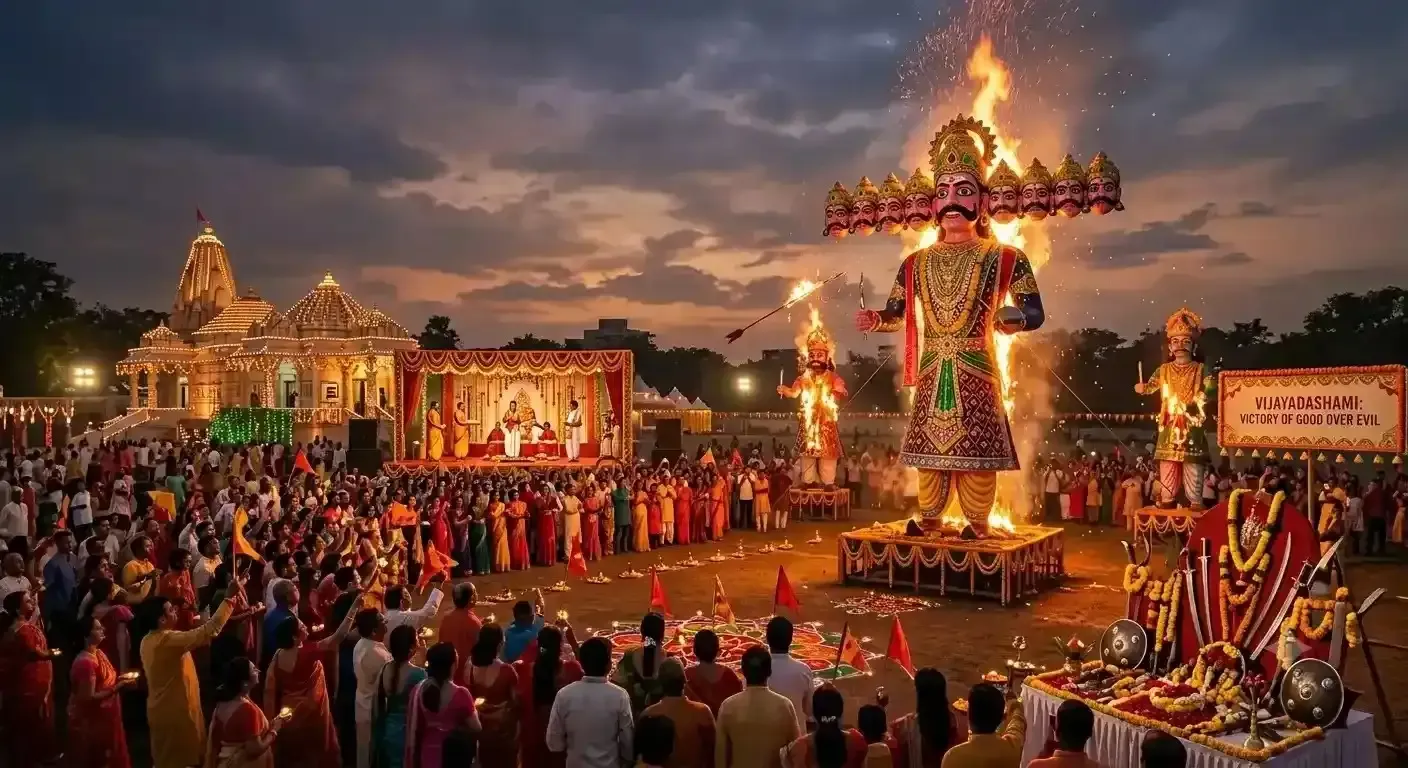
Large open-air Ramlila and Ravan Dahan as seen in North India are rare in Austria. Open fires, effigy burning and fireworks are regulated by Austrian law and by local authorities, so where groups mark Ravan Dahan it is usually as a stage play of the Ramayana, a small symbolic effigy or a story session for children. Many North Indian families watch a Ramlila online and tell children the story of Rama's victory over Ravana.
Dussehra puja at home
If you cannot reach a temple on a Tuesday, a short puja at home is entirely traditional. Ideally do it during your city's Vijay Muhurat, or at least within the Aparahna, which in Austria falls in the early to mid afternoon:
- Aparajita puja: draw an eight-petalled lotus with kumkum or rice flour, place a lamp, and worship Devi Aparajita, the goddess of victory, with flowers, akshat and a simple prayer for success over obstacles.
- Shami puja: Shami trees do not grow in Austria, so offer a few Shami leaves if you have dried ones, or simply pray facing north-east and offer akshat. Maharashtrian and Kannada families exchange apta leaves, or a substitute, as "gold".
- Ayudha Puja / Shastra puja: clean and decorate tools, books, laptops, bicycles and the car, apply kumkum and offer flowers, thanking them for their service.
- Vidyarambham: Vijayadashami is the traditional day for small children to begin learning, writing "Om" or the first letters of the alphabet in rice.
- Seemollanghan and new beginnings: a short walk beyond your street, starting a course or signing a new venture are traditional symbols of victory on this day.
A simple order: bathe, light a lamp, pray to Ganesha, do the Aparajita and Shami puja, then Ayudha puja, offer naivedya (sweets, fruit), do aarti and share prasad. For full step-by-step vidhi and the stories behind the festival, see our Dussehra / Vijayadashami 2026 pillar guide.
Practical tips for Dussehra in Austria
- Working day: Tuesday 20 October is a normal working and school day in Austria. The Vijay Muhurat falls in the mid-afternoon, so a short break may be possible; otherwise do the puja later within the Aparahna, or keep it simple and pray in the evening.
- Fire and fireworks: the use of fireworks and open fires is regulated by Austrian law and by your municipality, and is generally restricted in built-up areas. Do not burn effigies or set off fireworks without checking the rules, and follow the organisers' instructions at any event.
- Candles and diyas: many apartment buildings have house rules on open flames and smoke alarms. Keep diyas on a safe surface, never leave them unattended, and consider LED lamps for balconies.
- Getting to temples: Vienna's mandirs and centres are easiest to reach by U-Bahn, tram or bus, as parking is limited in the inner districts. Traiskirchen is reachable by regional train and bus from Vienna, and ÖBB trains link Graz, Linz, Salzburg and Innsbruck with the capital.
- Weather: late October in Austria is cool, and evenings in Salzburg and Innsbruck can be cold. Bring a warm layer for evening aarti and outdoor gatherings.
- Puja items: Indian and Asian grocers in Vienna and the larger cities stock kumkum, incense, ghee and sweets, but flowers and special items run short before Navratri weekends, so buy a few days early.
- Muhurat: use your own city's times from the table above; never convert India's times into Austrian time.
Frequently asked questions
When is Dussehra 2026 in Austria?
Tuesday 20 October 2026 in every Austrian city. The Dashami tithi begins at 9:20 AM Austrian time on 20 October and ends at 10:41 AM on Wednesday 21 October, so it covers the whole afternoon of the 20th.
What is the Vijay Muhurat in Vienna on Dussehra 2026?
Calculated by the Drik Panchang method: 2:25 PM – 3:07 PM in Vienna on Tuesday 20 October 2026 (Central European Summer Time, UTC+2). Graz is 2:29 PM – 3:12 PM, Linz 2:33 PM – 3:15 PM, Salzburg 2:38 PM – 3:21 PM and Innsbruck 2:45 PM – 3:28 PM.
Can I convert India's Dussehra muhurat into Austrian time?
No. The Vijay Muhurat depends on local sunrise and sunset, so it has to be calculated for your own city. Use the Austrian times on this page or your temple's calendar, not India's times shifted by three and a half hours.
When is Bijoya Dashami and Sindoor Khela for Bengali families in Austria?
In India, Bengal-tradition Bijoya Dashami and Sindoor Khela fall on Wednesday 21 October 2026 (Drik Panchang, Kolkata). Durga Pujas organised in Austria follow their own committee's schedule, which is often moved to a weekend, so check with the organisers.
Where will garba and Ravan Dahan take place in Austria?
Temples and community groups usually announce Navratri garba, Durga Puja, Ramlila and Ravan Dahan programmes a few weeks ahead — check their websites/social pages. Open fires, effigy burning and fireworks are regulated by Austrian law and local authorities, so Ravan Dahan is usually marked symbolically, if at all.
Is Dussehra a holiday in Austria?
No. Tuesday 20 and Wednesday 21 October 2026 are normal working and school days in Austria. Many families do a short puja at home, ideally in the afternoon, and join temple or community celebrations in the evening or on the following weekend.
Related guides
- Dussehra / Vijayadashami 2026: complete guide
- Dussehra 2026 in Europe, country by country
- Navratri 2026: complete guide for NRI families
- Dussehra 2026 in Germany, city by city
- Dussehra 2026 in Switzerland, city by city
- Dussehra 2026 in Italy, city by city
- Dashain 2026 in Nepal: Vijaya Dashami date and rituals
- Durga Puja and Bijoya Dashami 2026 in West Bengal
- October 2026 Hindu festival calendar
You might also like
Dussehra 2026 in Finland, City by City: Date, Vijay Muhurat and Hindu Temples
Dussehra 2026 in Poland, City by City: Date, Vijay Muhurat and Hindu Temples
Dussehra 2026 in Saudi Arabia, City by City: Date, Vijay Muhurat and How to Observe at Home