Ramayana FAQ: Kandas, Verses, Characters and Versions
Quick answer: The Ramayana is the Sanskrit epic of Rama ascribed to the sage Valmiki. It has seven kandas (books) and is traditionally said to have 24,000 verses. Rama's exile lasted fourteen years. Many well-known episodes, such as the Lakshmana Rekha, come from later Ramayanas rather than Valmiki'
Quick answer: The Ramayana is the Sanskrit epic of Rama ascribed to the sage Valmiki. It has seven kandas (books) and is traditionally said to have 24,000 verses. Rama's exile lasted fourteen years. Many well-known episodes, such as the Lakshmana Rekha, come from later Ramayanas rather than Valmiki's. The answers below give a reference for each point and link to the page that covers it fully.
Unless stated otherwise, sarga numbers refer to the edition of Valmiki's Ramayana on IIT Kanpur's site (heritage.iitk.ac.in/VRAM). Other editions number the sargas differently.
About the text
Who wrote the Ramayana?
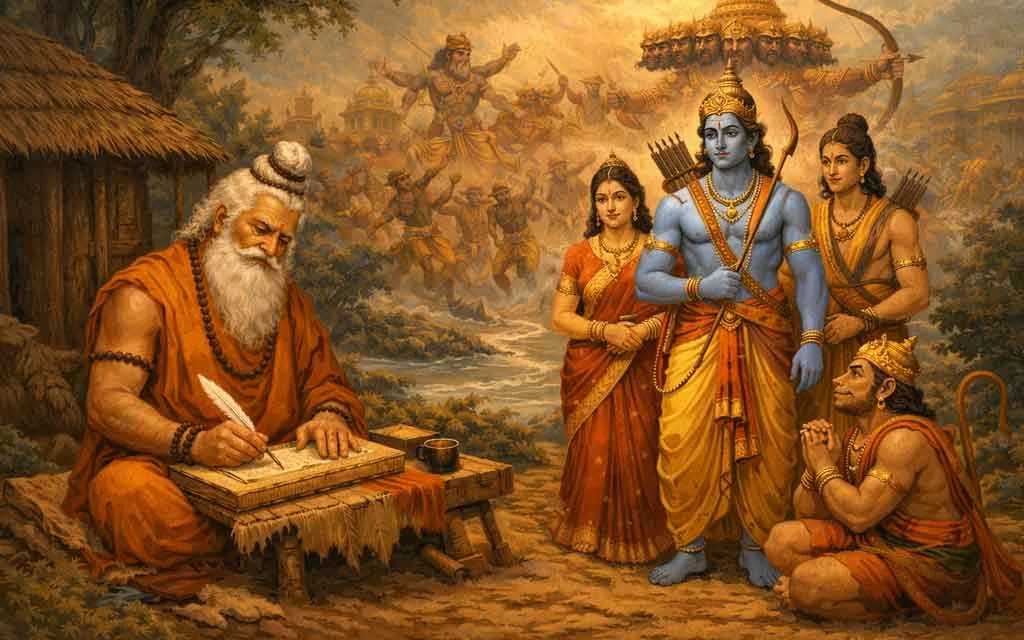
Hindu tradition ascribes it to the sage Valmiki, the adi kavi or first poet. The Bala Kanda tells how Brahma asked him to compose it after he spoke the first shloka by the Tamasa river (Bala Kanda, sargas 1 to 3). See the Bala Kanda summary.
How many kandas are in the Ramayana?
Seven: Bala, Ayodhya, Aranya, Kishkindha, Sundara, Yuddha and Uttara. See Ramayana: The Complete Guide.
How many verses does the Ramayana have?
Traditionally 24,000. The count depends on the edition; the critical edition prepared at Baroda (1960 to 1975) is shorter.
How many sargas are in each kanda?
In the IIT Kanpur edition: Bala 77, Ayodhya 119, Aranya 75, Kishkindha 67, Sundara 68, Yuddha 131 and Uttara 111, a total of 648. Other editions differ.
Which is the longest kanda?
The Yuddha Kanda, with 131 sargas in the IIT Kanpur edition. See the Yuddha Kanda summary.
Is the Uttara Kanda part of Valmiki's Ramayana?
Tradition counts it as Valmiki's. Many scholars regard it, and parts of the Bala Kanda, as later additions to an older core of five books. Both views are held by serious readers.
When was the Ramayana written?
Hindu tradition places Rama in the Treta Yuga. Scholars usually date the composition of the text between about the 5th century BCE and the early centuries CE, with the first and last books later than the core.
Why is it called the "first poem"?
Because, in the tradition, Valmiki's shloka by the Tamasa was the first verse of poetry, and the Ramayana the first poem (adi kavya) composed in it (Bala Kanda, sarga 2).
About the story
How long was Rama's exile?
Fourteen years, the term of Kaikeyi's second boon (Ayodhya Kanda, sarga 11). See the Ayodhya Kanda summary.
What were Kaikeyi's two boons?
That Bharata be crowned and that Rama live in the Dandaka forest for fourteen years. Dasharatha had promised her two boons after she saved his life in a war between the gods and the asuras (Ayodhya Kanda, sargas 9 and 11).
Why did Bharata put Rama's sandals on the throne?
Rama refused to return before the fourteen years were over, so Bharata ruled from Nandigrama as his representative, with Rama's sandals consecrated as king, and vowed to enter the fire if Rama did not return on time (Ayodhya Kanda, sargas 112 to 115; the vow at 2.112.25).
How did Ravana carry Sita away?
Ravana's uncle Maricha, as a golden deer, drew Rama and then Lakshmana away from the hut; Ravana came disguised as an ascetic and carried Sita off (Aranya Kanda, sargas 42 to 49). See the Aranya Kanda summary.
How long was Sita a captive in Lanka?
Valmiki gives no single figure. Ravana gave her twelve months to yield (3.56.24), and in the Sundara Kanda he says two months remain (5.22.8). See Sita: her life in the Ramayana.
Where did Hanuman find Sita?
In the Ashoka grove (Ashoka vatika) of Lanka, under a simsupa tree (Sundara Kanda, sargas 14 and 15). See the Sundara Kanda summary.
Why did Rama kill Vali?
To keep his promise to Sugriva. Dying, Vali accuses Rama of striking from hiding; Rama answers that Vali had taken his brother's wife and that he acted as the agent of King Bharata (Kishkindha Kanda, sargas 17 and 18). See the Kishkindha Kanda summary.
Who built the bridge to Lanka?
Nala, son of Vishvakarma, with the vanara army (Yuddha Kanda, 6.22.44).
Who killed Ravana, and how?
Rama, with the Brahmastra, after a long duel fought from Indra's chariot (Yuddha Kanda, sargas 103 to 111).
How many times did Hanuman bring the mountain of herbs?
Twice in Valmiki: once to revive Rama, Lakshmana and the army after Indrajit's Brahmastra (sarga 74), and once to heal Lakshmana after Ravana's javelin (sarga 102).
Where is the Aditya Hridayam in the Ramayana?
In the Yuddha Kanda, where the sage Agastya teaches it to Rama before the final duel (sarga 107 in the IIT Kanpur edition; numbered differently elsewhere).
What is and is not in Valmiki
Is the Lakshmana Rekha in Valmiki's Ramayana?
No. In Valmiki, Lakshmana leaves after Sita's harsh words (Aranya Kanda, sarga 45) and draws no line. The Lakshmana Rekha comes from later and regional tellings.
Did Shabari taste the berries before giving them to Rama?
Not in Valmiki, where she offers Rama fruits she has gathered and then enters the fire (Aranya Kanda, sarga 74). The tasting is a later devotional tradition.
Was Ahalya turned to stone?
Not in Valmiki. Gautama's curse makes her live unseen, fasting and lying in ashes, until Rama comes (1.48.29 to 30). The stone is a later tradition.
Did Ravana teach Lakshmana before he died?
This popular story is not in Valmiki's text. It comes from later tradition.
Did Sita go through a fire ordeal?
Yes, in Valmiki's Yuddha Kanda: she enters the fire and Agni returns her (sargas 119 to 121). Later Ramayanas, such as the Adhyatma Ramayana and the Ramcharitmanas, change the episode.
Versions and reading
Is the Ramcharitmanas the same as the Ramayana?
No. The Ramcharitmanas is Tulsidas's Awadhi poem of the 16th century. It tells the same story in seven kands, with many differences in detail and a strongly devotional emphasis.
What other Ramayanas are there?
Among many: Kamban's Tamil Ramavataram, the Sanskrit Adhyatma Ramayana, the Telugu Ranganatha and Molla Ramayanas, the Thai Ramakien and the Cambodian Reamker. See Ramayana variations across India.
Which kanda is read for parayanam?
The Sundara Kanda is the book most often read on its own as a devotional reading. Practices for the number of days and the accompanying puja differ by family and region.
Where should a beginner start?
Read a short retelling first, such as the Ramayana story in simple English, then follow the kanda summaries from the Ramayana guide, and then a complete translation of Valmiki.
How is the Ramayana different from the Mahabharata?
The Ramayana tells one hero's story with a clear ideal of dharma; the Mahabharata is about four times longer in its traditional count and dwells on hard moral choices in a family at war. See the Mahabharata guide.
Sources
- Valmiki Ramayana, Sanskrit text with English translation (Rashtriya Sanskrit Vidyapeetha, Tirupati), IIT Kanpur: heritage.iitk.ac.in/VRAM. Verse references checked on 12 November 2026.
- John Brockington, The Sanskrit Epics (Brill, 1998), for dating and the later layers.
- Paula Richman (ed.), Many Ramayanas (University of California Press, 1991), for the other versions.
Last reviewed: 12 November 2026.
Share this with family and friends
Send it on WhatsApp, post it, or copy the link.
More from Stories
- Bhima in the Mahabharata: Strength, Vows and Loyalty
- Yudhishthira in the Mahabharata: The King of Dharma
- Kunti in the Mahabharata: Mother of the Pandavas
- Vidura Niti: Selected Teachings with Sources
- Jatayu and Sampati: The Vulture Brothers of the Ramayana