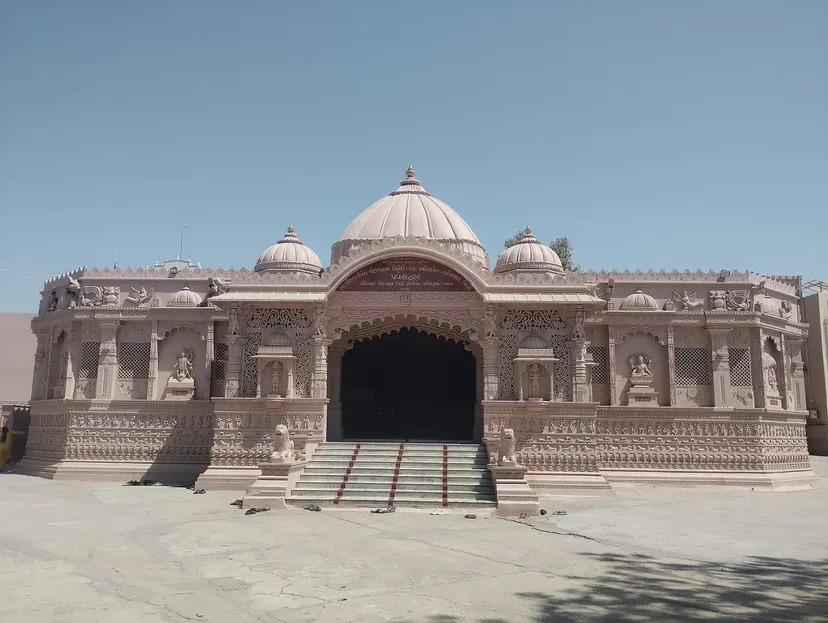
Rudra Mahalaya Temple
Shiva (as Rudra / Rudra-Mahakala) temple · Siddhpur, Patan, Gujarat, India
The Rudra Mahalaya, also called the Rudramal, at Siddhpur in Patan district of north Gujarat, was once one of the largest Shiva temples of western India. Begun in the 10th century and completed in the 12th by the Chaulukya (Solanki) king Jayasimha Siddharaja, it was demolished in the medieval period, and only a few towering fragments survive today.
The site is now a protected ruin, listed as a Monument of National Importance under the Archaeological Survey of India (ASI). Part of the old temple complex was converted into the town's congregational mosque (Jami Masjid), which is protected separately. Visitors come to see the scale and quality of the surviving pillars and gateway, not a functioning shrine.
Faith & Tradition
Religious Significance of Rudra Mahalaya Temple
The temple was dedicated to Shiva in his form as Rudra. In their 1903 survey for the ASI, The Architectural Antiquities of Northern Gujarat, James Burgess and Henry Cousens explain that the name Rudramal comes from Rudra-Mahalaya, 'the great abode of Rudra', and that the Jain chroniclers called it the temple of Rudra-Mahakala. A local ballad they recorded speaks of eleven shrines to the Rudras around the main temple.
Siddhpur itself, on the Sarasvati river, has long been a place of pilgrimage. Burgess records that it was earlier called Sristhala, and that, according to legend, it was renamed Siddhapura in honour of Siddharaja when he completed the Rudra Mahalaya. The town is known for the rite of shraddha for one's mother, performed at Bindu Sarovar, about two miles west of the town according to Burgess.
Heritage
History of Rudra Mahalaya Temple
According to Burgess and Cousens, the founder of the Chaulukya dynasty, Mularaja, began the temple about 944 CE, but the work was interrupted and left unfinished. Jayasimha Siddharaja, who came to the throne in 1094, took it up again and probably rebuilt it on a far larger scale; it was barely finished at his death in 1143. Wikipedia gives 943 CE for the start and 1140 CE for the consecration. Inscriptions recording these dates were seen by James Tod in the 1820s, but Burgess reported that they could no longer be found by 1903.
Burgess and Cousens record that the temple was demolished in two stages: first by the army of Ulugh Khan, Alauddin Khalji's general, in 1297 or 1298, and further by Ahmad Shah I of Gujarat in 1415, when part of the complex was turned into a mosque. Wikipedia similarly attributes the destruction to Alauddin Khalji and Ahmad Shah I.
A traditional ballad recorded by Tod and Burgess describes the temple as having 1,600 columns, thousands of images and hundreds of golden finials. Burgess himself treated these figures as exaggerations; they belong to tradition, not to measured fact.
Architecture and sacred features
From the remains, Burgess and Cousens reconstructed a walled court of about 230 by 300 feet, with the main temple in the centre: two or three storeys high, with a square hall (mandapa) about 50 feet across inside, porches on the east, north and south, and the sanctum on the west. The main entrance was on the east, with steps leading down to the Sarasvati river. Wikipedia describes the style as Maru-Gurjara (Solanki).
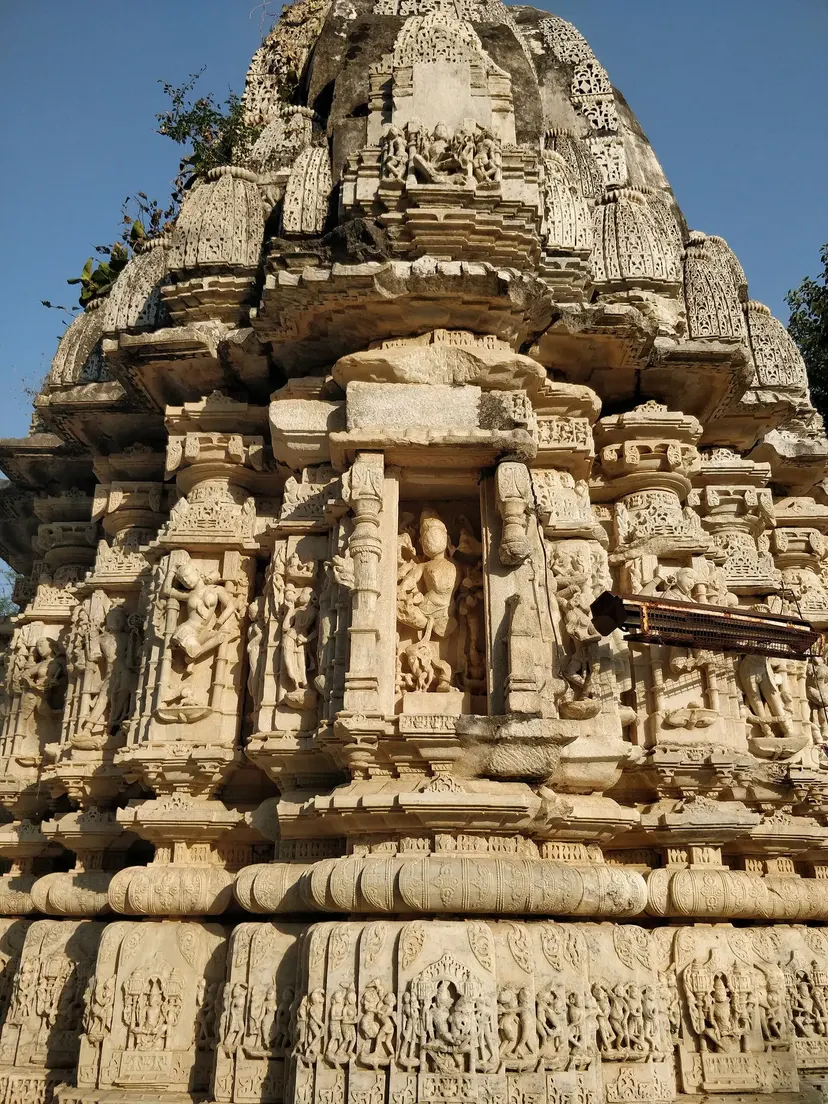
What survives are tall, richly carved pillars from the porches and hall, still carrying massive lintels, and a carved ceremonial gateway (torana). Burgess recorded a lintel about 27 feet long, with a second lintel above it rising some 42 feet from the ground. Wikipedia describes the remains as two toranas and four pillars of the central structure, with the western part of the complex used as the mosque.
Plan Your Visit
Darshan and Visitor Information
The Rudra Mahalaya is a protected archaeological ruin, not an active temple, and the adjoining Jami Masjid is a working mosque; be respectful of both. Access to parts of the site may be restricted, so confirm current opening and access arrangements with the Archaeological Survey of India before visiting. Do not climb on the pillars or fallen stones.
Timings and arrangements change with seasons and festivals. Confirm current details with Archaeological Survey of India before travelling. Last reviewed 1 November 2026.
Location
How to Reach Rudra Mahalaya Temple
Siddhpur is in north Gujarat, on the Sarasvati river. Outlook Traveller notes that Siddhpur has its own railway station and that the nearest airport is Ahmedabad. The ruins are in the town and can be reached by road.
Location: Siddhpur, Patan, Gujarat, India
Nearest airport: Ahmedabad (per Outlook Traveller)
Nearest railway station: Siddhpur
More in Hindu temples in Gujarat · Shiva (as Rudra / Rudra-Mahakala) temples · Temples in Patan District
Questions
Rudra Mahalaya Temple: Frequently Asked Questions
Who built the Rudra Mahalaya at Siddhpur?
It was begun by Mularaja, founder of the Chaulukya (Solanki) dynasty, around 944 CE and completed on a much larger scale by Jayasimha Siddharaja in the 12th century.
Is the Rudra Mahalaya an active temple?
No. It was demolished in the medieval period and survives only as a protected ruin. Part of the complex became the town's Jami Masjid.
What remains of the Rudra Mahalaya today?
Tall carved pillars with massive lintels from the porches and hall, a carved torana (gateway), and parts of the complex reused in the adjoining mosque.
Who destroyed the Rudra Mahalaya?
According to Burgess and Cousens (1903), it was demolished first by Ulugh Khan, Alauddin Khalji's general, in 1297–98, and further by Ahmad Shah I of Gujarat in 1415.
What does Rudra Mahalaya mean?
It means 'the great abode of Rudra', a name of Shiva. The shortened form Rudramal is also used.
How do I reach the Rudra Mahalaya?
The ruins are in Siddhpur town in Patan district, north Gujarat. Siddhpur has a railway station, and the nearest airport is Ahmedabad.
Sources and attribution
- James Burgess and Henry Cousens, Archaeological Survey of Western India vol. IX (1903), pp. 58–63 — The Architectural Antiquities of Northern Gujarat (Internet Archive scan)
- Outlook Traveller (Benny Joshua, 2017) — Siddhpur: Ghost Town
- Wikidata — Rudra Mahalaya Temple (Q13156158; ASI monument ID N-GJ-164)
- Wikipedia — Rudra Mahalaya Temple
Further reading: Rudra Mahalaya Temple on Wikipedia (CC BY-SA 4.0).
Spotted an error? Write to info@hindutone.com — see our editorial policy.