
Baijnath Temple (Vaidyanath Temple)
Shiva (as Vaidyanath, 'Lord of Physicians') temple · Baijnath, Kangra, Himachal Pradesh, India
The Baijnath Temple, in the town of Baijnath in Kangra district, Himachal Pradesh, is dedicated to Shiva as Vaidyanath, the 'Lord of Physicians'. It stands at the foot of the Dhauladhar range on the bank of the Binwa, a tributary of the Beas, and the town itself, once known as Kiragrama, takes its present name from the deity, according to the Kangra district administration.
Built in 1204 CE according to inscriptions on its walls, the temple is a protected monument of national importance under the Archaeological Survey of India (ASI), which is responsible for its upkeep. It is a well-known example of medieval North Indian Nagara temple architecture and draws a large number of pilgrims and visitors every year.
Faith & Tradition
Religious Significance of Baijnath Temple (Vaidyanath Temple)
Shiva is worshipped here as a lingam in the sanctum. The district administration notes that local devotees regard the Lord here as a healer, in keeping with the name Vaidyanath, and that the water of the nearby stream is considered to have medicinal value; these are beliefs of devotees rather than established facts.
The temple is closely tied to a legend of Ravana. According to the version given by the district administration and by Incredible India, Ravana performed severe penance to Shiva and was allowed to carry a lingam to Lanka on condition that he never set it down on the way. Near Baijnath he handed it to a shepherd, who could not bear its weight and placed it on the ground, where it became fixed. Incredible India adds that Shiva restored Ravana's heads, which he had offered in penance, and so came to be called Vaidyanath.
Because of this association with Ravana's devotion, Dussehra, which celebrates Rama's victory over Ravana, is traditionally not celebrated in Baijnath, as both the district administration and Wikipedia record. Maha Shivaratri and the monthly Shivaratri are the busiest occasions at the temple, according to Incredible India.
Heritage
History of Baijnath Temple (Vaidyanath Temple)
Two long inscriptions on the walls of the mandapa record the temple's history. According to Incredible India and the district administration, they state that in 1204 CE two local merchant brothers, Manyuka and Ahuka, built the present temple to house the lingam of Vaidyanatha, which had stood on the site earlier; Wikipedia adds that the inscriptions are in Sanskrit (Sharada script) and Pahari (Takri script) and name the ruler of the time, Jaya Chandra.
The temple has been repaired several times. Incredible India records that Sansar Chand II, the Katoch ruler of Kangra, carried out extensive repairs in the 18th century, and that the 1905 Kangra earthquake caused serious damage, after which the temple was restored. Wikipedia notes that the main temple survived the earthquake with comparatively minor damage, while smaller shrines in the compound were harmed more severely.
The ASI lists the 'Temple of Baijnath' at Baijnath among the centrally protected monuments of Himachal Pradesh. In 2025 The Tribune reported that prolonged heavy rain had caused cracks in retaining walls and leaks in the roof, and that the ASI, which is responsible for the temple's upkeep, was to begin repairs; the local Sub-Divisional Magistrate, who heads the temple trust, said there was no immediate threat to the monument.
Architecture and sacred features
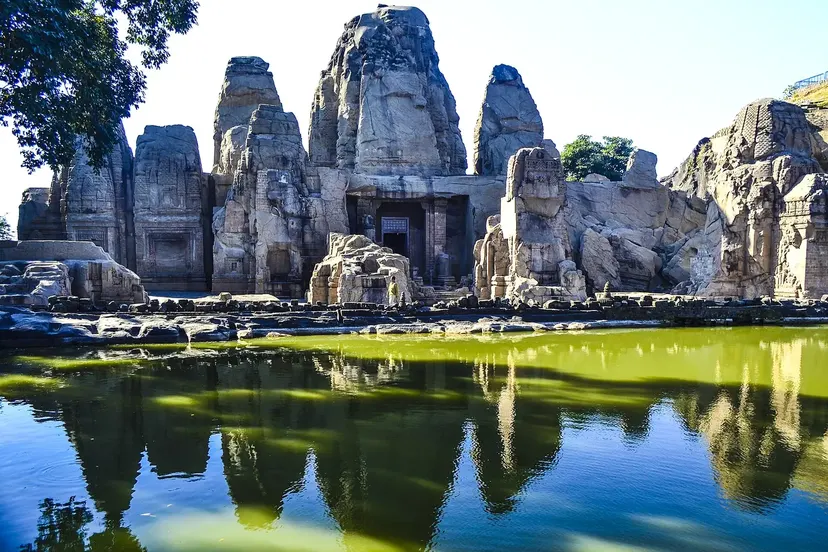
The temple is built in the Nagara style. A tall curved shikhara rises over the sanctum (garbhagriha), which is linked by a vestibule (antarala) to a pillared hall (mandapa) with a low pyramidal roof carried on four massive stone pillars, and an entrance porch on four columns, as described by The Tribune and the district administration. Balconies decorate the walls of the mandapa, and the complex is enclosed by a fortified wall, according to Incredible India.
The outer walls carry niches with images of deities, some of which Wikipedia notes are older than the present building, including Ganesha, Harihara, Kalyanasundara (the marriage of Shiva and Parvati) and Shiva overcoming the demon Andhaka. Smaller shrines in the courtyard are dedicated to Murlimanohar, Jamadagni, Bhairava and Narmadeshwar, according to Incredible India.
Plan Your Visit
Darshan and Visitor Information
The temple is an active place of worship as well as a protected monument, so treat the old carvings with care and follow the instructions of the temple staff and ASI notices. Crowds are heaviest on Maha Shivaratri. Confirm current timings and arrangements with the temple trust or the Kangra district administration before visiting.
Timings and arrangements change with seasons and festivals. Confirm current details with Temple trust headed by the Baijnath SDM; monument maintained by the ASI before travelling. Last reviewed 1 November 2026.
Sacred Calendar
Festivals at Baijnath Temple (Vaidyanath Temple)
Maha Shivaratri
The main festival of the temple, with special worship and large crowds; the monthly Shivaratri is also observed.
Dussehra (not celebrated)
By tradition Dussehra is not celebrated in Baijnath, out of respect for Ravana's devotion to Shiva in the temple's legend.
Location
How to Reach Baijnath Temple (Vaidyanath Temple)
Baijnath lies between Kangra and Mandi on National Highway 154, according to Wikipedia. The district administration gives the nearest airport as Gaggal (Kangra airport), about 56 km away, and the nearest railway station as Paprola on the narrow-gauge Kangra Valley line, which connects with Pathankot, Kangra, Palampur and Jogindernagar.
By road, the district administration gives Baijnath as about 51 km from Dharamshala, 184 km from Manali, 218 km from Shimla and 275 km from Chandigarh, with state and private buses serving the town.
Location: Baijnath, Kangra, Himachal Pradesh, India
Nearest airport: Gaggal (Kangra), about 56 km
Nearest railway station: Paprola (Kangra Valley narrow-gauge line)
More in Hindu temples in Himachal Pradesh · Shiva (as Vaidyanath, 'Lord of Physicians') temples · Temples in Baijnath (870) · Temples in Baijnath Tehsil · Temples in Kangra District
Questions
Baijnath Temple (Vaidyanath Temple): Frequently Asked Questions
Who built the Baijnath Temple?
According to the inscriptions in the mandapa, two local merchant brothers, Manyuka and Ahuka, built the present temple in 1204 CE to house a lingam that already stood on the site.
Why is Shiva called Vaidyanath at Baijnath?
Vaidyanath means 'Lord of Physicians'. Incredible India relates that Shiva restored the heads Ravana had offered in penance here; devotees also regard the Lord as a healer.
Why is Dussehra not celebrated in Baijnath?
Tradition holds that Ravana worshipped Shiva here and that the lingam came to rest at Baijnath during his journey to Lanka, so the festival of his defeat is not celebrated in the town.
Is Baijnath Temple protected by the ASI?
Yes. The 'Temple of Baijnath' is on the ASI's list of centrally protected monuments in Himachal Pradesh, and the ASI is responsible for its upkeep.
What is the architecture of Baijnath Temple?
It is a Nagara-style temple with a tall curved shikhara over the sanctum, a vestibule, a pillared mandapa with balconies and an entrance porch, inside a walled compound.
How do I reach Baijnath Temple?
The nearest airport is Gaggal, about 56 km away, and the nearest railway station is Paprola on the Kangra Valley line. Baijnath is about 51 km from Dharamshala by road.
Sources and attribution
- District Kangra, Government of Himachal Pradesh — Shiv Temple Baijnath
- Incredible India, Ministry of Tourism, Government of India — Baijnath Temple
- Archaeological Survey of India (Wayback Machine copy, May 2018) — Alphabetical List of Monuments – Himachal Pradesh
- The Tribune — Baijnath's 800-yr-old Shiva temple battles rain fury, faces structural strain (2 September 2025)
- Wikipedia — Baijnath Temple
Further reading: Baijnath Temple (Vaidyanath Temple) on Wikipedia (CC BY-SA 4.0).
Spotted an error? Write to info@hindutone.com — see our editorial policy.
Pilgrim Circuit