Brahmeswara Temple
Shiva (as Brahmeswara) temple · Bhubaneswar, Khordha, Odisha, India
The Brahmeswara Temple is an 11th-century Shiva temple in the old temple quarter of Bhubaneswar, the capital of Odisha. A lost inscription records that it was built by Kolavati Devi, mother of the Somavamsi king Udyotakesari, and the documentation of the Indira Gandhi National Centre for the Arts (IGNCA) dates it to 1058 CE.
It is both a protected monument of the Archaeological Survey of India (ASI) and a living temple: the IGNCA record notes that worship continues before a Shiva linga of black chlorite, and that the Lingaraja Temple Management Trust is associated with its upkeep. The temple stands beside the Tankapani road in the city's old temple quarter.
Faith & Tradition
Religious Significance of Brahmeswara Temple
Brahmeswara is one of the few Bhubaneswar temples whose date is known from an inscription rather than only from style. According to the IGNCA record, the inscription once fixed to the wall of the jagamohana stated that the temple was built in the 18th regnal year of Udyotakesari, which corresponds to 1058 CE. This makes it a fixed point for dating other temples; World History Encyclopedia notes that it helps to date the great Lingaraja temple on stylistic grounds.
Wikipedia records that the lost inscription also mentions Queen Kolavati offering women to the temple's service, which scholars have read as an early reference to the temple dancer (devadasi) tradition that later became important in Odisha's temples.
The IGNCA record lists Shivaratri, Kartika Purnima, Sankranti, Ekadasi and Sitalasasti among the occasions observed at the temple, and notes that family ceremonies such as engagements and thread ceremonies are also held here.
Heritage
History of Brahmeswara Temple
The IGNCA record assigns the temple to the Somavamsi period of Odisha's history. The dedicatory inscription was removed from Bhubaneswar to Calcutta in the early British period, as K. C. Panigrahi describes in Archaeological Remains at Bhubaneswar, and it has since been lost. A facsimile published by James Prinsep in 1838 is the only record of it that survives. Because the stone is no longer in place, some historians have questioned whether it belonged to this temple, but Wikipedia notes that the place and details it describes match this temple, and the attribution is generally accepted.
Sources convert the regnal year slightly differently: the IGNCA record and most accounts give 1058 CE, while Wikipedia also mentions 1060 CE and World History Encyclopedia about 1061 CE. All place the temple in the third quarter of the 11th century, which is also how the IGNCA record dates it on grounds of architecture and sculpture. The ASI has repaired and conserved the temple, and the IGNCA record describes it as in good condition.
Architecture and sacred features
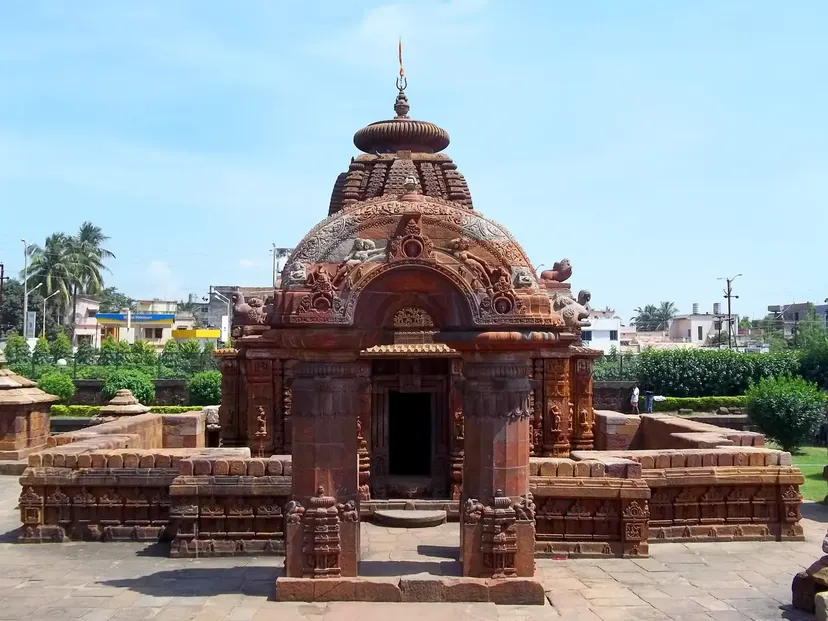
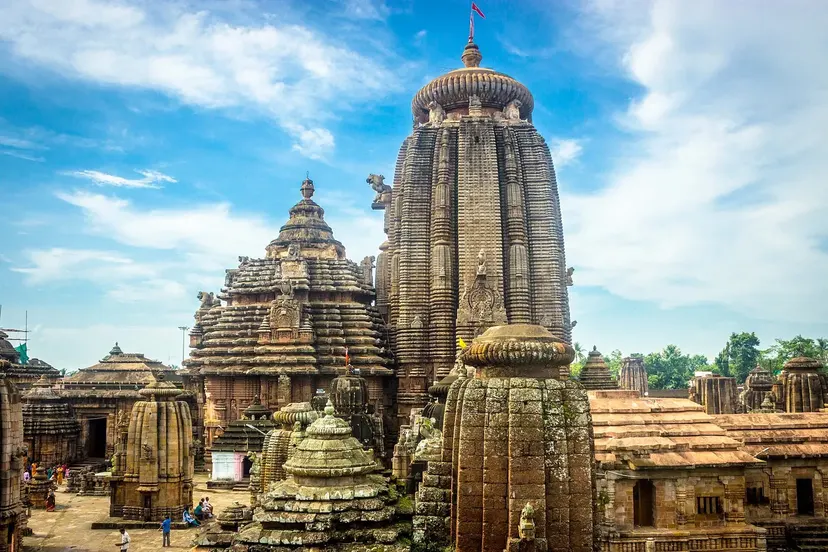
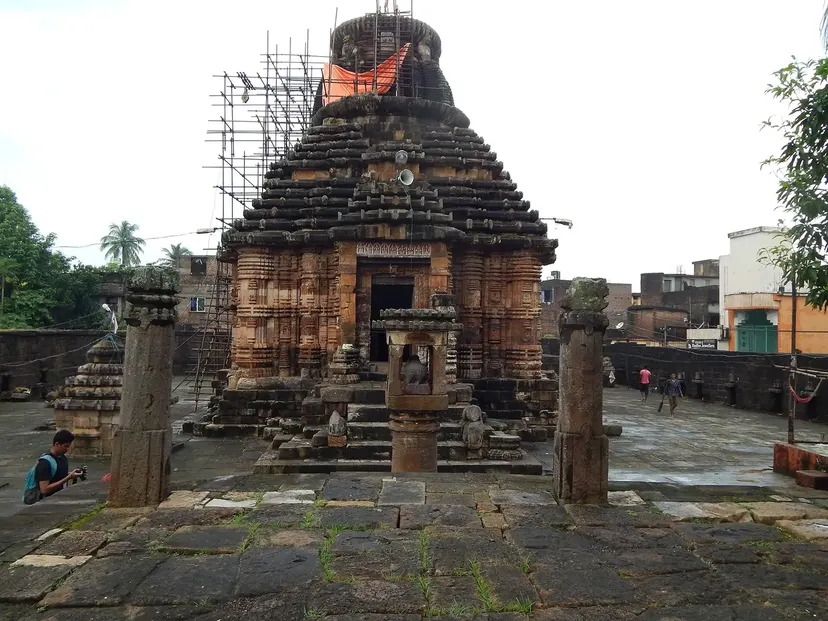
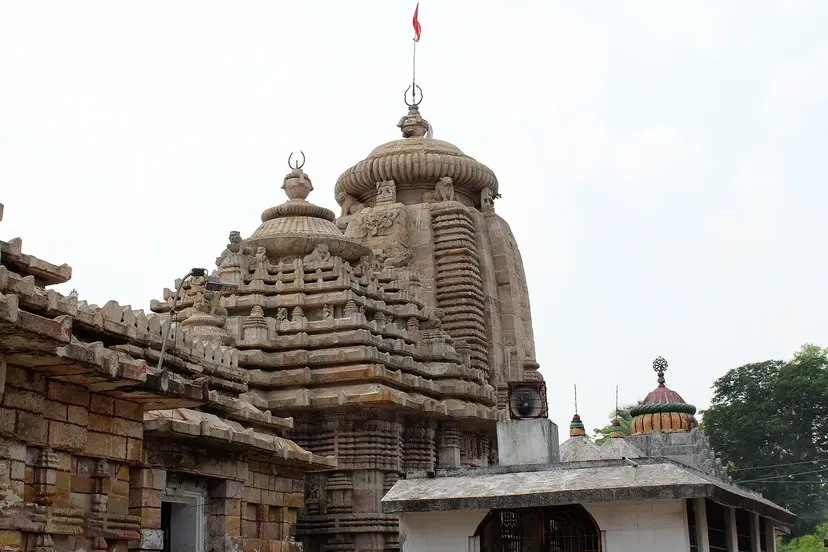
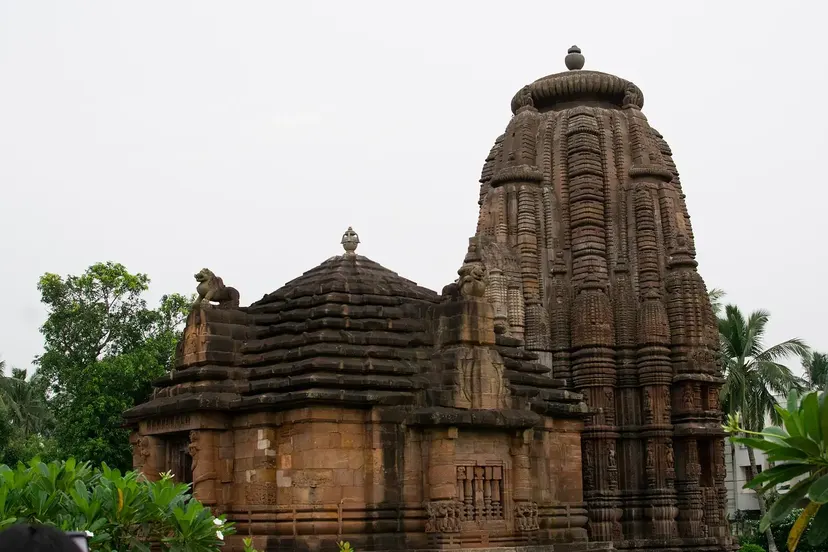
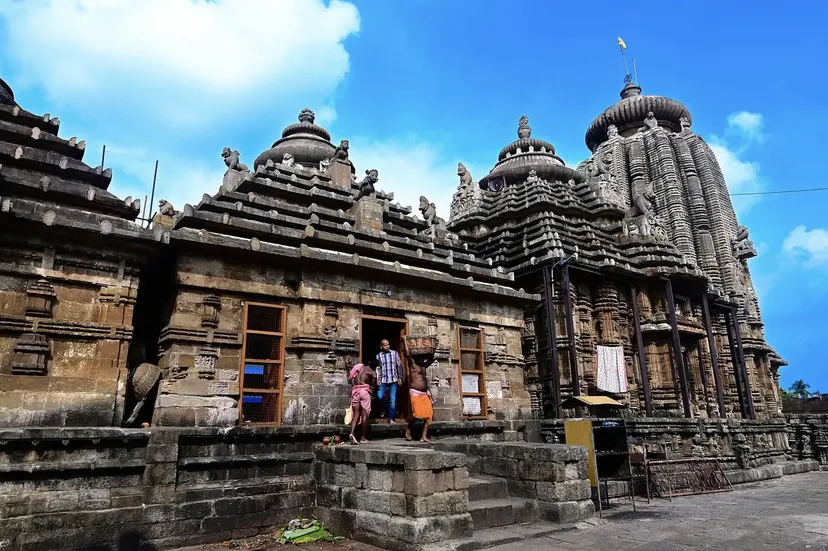
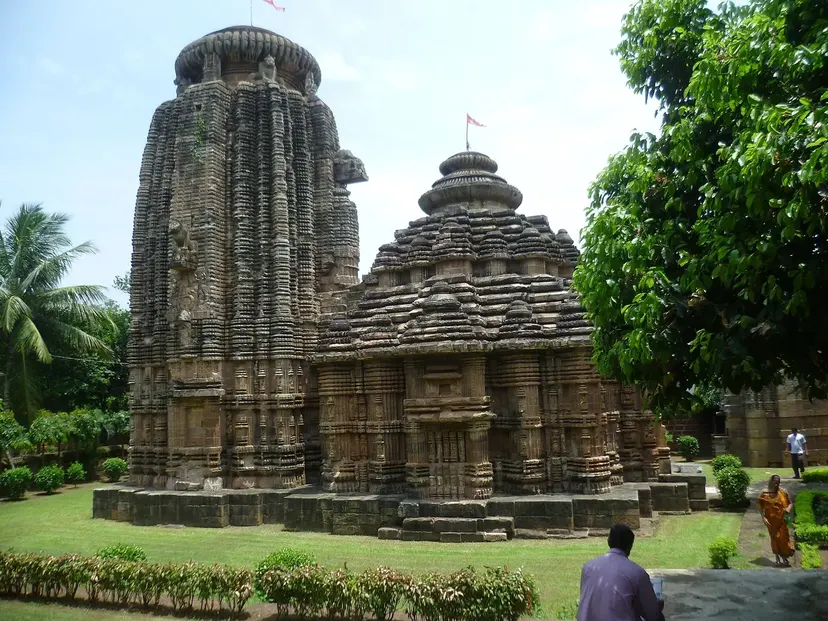
Brahmeswara is a panchayatana temple: the main shrine stands in the centre of a walled courtyard, with a smaller shrine at each of the four corners. The main tower (vimana) is of the curved rekha type and the porch (jagamohana) of the stepped pidha type, both in the Kalinga style of Odisha. The temple faces east and is built of sandstone blocks laid without mortar. The IGNCA record gives the inner compound wall as about 34.5 m by 23.9 m, and Wikipedia gives the height of the tower as about 19 m.
The outer walls are carved with guardian deities of the directions and with Nataraja, Ardhanarishvara, Ajaikapada, the musician form of Shiva, female figures, couples and scrollwork. Wikipedia notes the many musicians and dancers on the exterior and a figure of Chamunda on the western side. While the interior of the sanctum is plain, the ceiling of the jagamohana is carved, with a lotus medallion surrounded by friezes of a royal procession and a deer hunt; Wikipedia also records the use of iron beams in the structure.
Plan Your Visit
Darshan and Visitor Information
Brahmeswara is an active place of worship as well as a protected monument, so dress modestly and follow the instructions of the priests and ASI staff. Do not climb on or touch the carvings. Confirm current visiting arrangements with the temple management or the ASI Bhubaneswar Circle before travelling.
Timings and arrangements change with seasons and festivals. Confirm current details with Archaeological Survey of India (Bhubaneswar Circle); worship associated with the Lingaraja Temple Management Trust before travelling. Last reviewed 1 November 2026.
Sacred Calendar
Festivals at Brahmeswara Temple
Maha Shivaratri
Listed in the IGNCA record among the main observances at the temple.
Kartika Purnima
The full-moon day of Kartika is observed at the temple, according to the IGNCA record.
Location
How to Reach Brahmeswara Temple
The IGNCA record places the temple on the right side of the Tankapani road leading from Ravi Talkies square towards Tankapani, in Bhubaneswar's old town. Bhubaneswar has a railway station and Biju Patnaik International Airport, and the temple can be reached by road from anywhere in the city.
Location: Bhubaneswar, Khordha, Odisha, India
Nearest airport: Biju Patnaik International Airport, Bhubaneswar
Nearest railway station: Bhubaneswar
More in Hindu temples in Odisha · Shiva (as Brahmeswara) temples · Temples in Bhubaneswar (M.Corp.) P.S. Tahasil · Temples in Khordha District
Questions
Brahmeswara Temple: Frequently Asked Questions
Who built the Brahmeswara Temple?
According to its lost inscription, it was built by Kolavati Devi, mother of the Somavamsi king Udyotakesari, in the 18th year of his reign.
How old is the Brahmeswara Temple?
The IGNCA record dates it to 1058 CE; some sources convert the regnal year as 1060 or about 1061 CE. All place it in the 11th century.
Is worship still performed at Brahmeswara Temple?
Yes. It is a living Shiva temple with a black chlorite linga, while also being a protected monument of the ASI.
What is a panchayatana temple?
It is a temple plan with a main shrine in the centre and four smaller shrines at the corners of the courtyard, as at Brahmeswara.
What happened to the temple's inscription?
It was taken to Calcutta in the early British period and later lost. A facsimile published by James Prinsep in 1838 is the only surviving record.
Which festivals are celebrated at Brahmeswara Temple?
The IGNCA record lists Shivaratri, Kartika Purnima, Sankranti, Ekadasi and Sitalasasti.
Sources and attribution
- Indira Gandhi National Centre for the Arts (heritage documentation, ASI Bhubaneswar Circle monuments) — Brahmesvara Temple, Bhubaneswar (OR/KDA/BSR-24)
- K. C. Panigrahi, Archaeological Remains at Bhubaneswar (Orient Longmans, 1961; Kitab Mahal reprint 1981), pp. 41–42 — Archaeological Remains at Bhubaneswar (Internet Archive scan)
- World History Encyclopedia (Mark Cartwright, 2015) — Bhubaneswar
- Wikipedia — Brahmeswara Temple
Further reading: Brahmeswara Temple on Wikipedia (CC BY-SA 4.0).
Spotted an error? Write to info@hindutone.com — see our editorial policy.