Thiruvali–Thirunagari Divya Desam (Azhagiya Singar and Vedarajan Temples)
Vishnu (as Lakshmi Narasimha / Azhagiya Singar at Thiruvali and Vedarajan / Kalyana Ranganatha at Thirunagari) temple · Thiruvali and Thirunagari, near Sirkazhi, Mayiladuthurai, Tamil Nadu, India
Thiruvali–Thirunagari is the name given to a pair of Vishnu temples in Mayiladuthurai district, Tamil Nadu, near the town of Sirkazhi. At Thiruvali the Lord is worshipped as Azhagiya Singar, a form of Lakshmi Narasimha, and at Thirunagari as Vedarajan, whose festival image is known as Kalyana Ranganatha. Although the two shrines stand a few kilometres apart, the hymns of the Alvars refer to them together and they are counted as a single Divya Desam, one of the 108 sacred Vishnu temples of the Sri Vaishnava tradition.
The pair is closely bound up with Thirumangai Alvar, the last of the twelve Alvar poet-saints. Wikipedia describes Thiruvali as the capital of the region he ruled and the birthplace of his wife Kumudavalli, and Thirunagari as the place where the Lord is believed to have appeared to him. Both temples are maintained by the Hindu Religious and Charitable Endowments Department of the Government of Tamil Nadu, according to Wikipedia.
Faith & Tradition
Religious Significance of Thiruvali–Thirunagari Divya Desam (Azhagiya Singar and Vedarajan Temples)
Both shrines are praised in the Nalayira Divya Prabandham by Kulasekara Alvar and Thirumangai Alvar. Dinamalar's temple directory lists Thiruvali as the 34th and Thirunagari as the 35th of the 108 Divya Desams, while noting that their histories are told as one shared story. The temples follow the Tenkalai tradition of Sri Vaishnavism, according to Wikipedia.
Thiruvali is known as a Lakshmi Narasimha kshetram. According to legend recounted by Dinamalar, after Narasimha slew the demon Hiranya his anger did not subside, and Lakshmi calmed him by sitting on his thigh while he embraced her; the place name is explained as 'thiru' (Lakshmi) and 'aali' (embrace). A distinctive feature noted by both Wikipedia and Dinamalar is that Lakshmi sits on the deity's right, whereas in most Narasimha images she is on the left. Dinamalar adds that worship here is traditionally said to equal a visit to the five Narasimha shrines of the area, among which it names Kuraiyalur and Mangaimadam.
Thirunagari is honoured as the centre of the Thirumangai Alvar story. According to tradition told by Dinamalar, the young chieftain Neelan wished to marry Kumudavalli, who asked him to feed a thousand Vaishnavas; when his money ran out he turned to waylaying travellers, and when he tried to rob the Lord and Lakshmi, who were passing as a newly married couple, the Lord whispered the Ashtakshara mantra in his ear and transformed him into a devotee. Because the Lord appeared in bridal form, the festival deity is called Kalyana Ranganatha. Dinamalar records an annual festival at nearby Thevarajapuram that re-enacts this episode.
Heritage
History of Thiruvali–Thirunagari Divya Desam (Azhagiya Singar and Vedarajan Temples)
The exact date of the temples is not established. Wikipedia records that they are traditionally believed to have been built by the Cholas, with later additions such as pillared halls and major shrines attributed to the Vijayanagara and Thanjavur Nayak rulers in the 16th century. Since both temples are sung in the Nalayira Divya Prabandham, the shrines were already revered in the period of the Alvars, which Wikipedia places between roughly the 6th and 9th centuries CE. They are also mentioned in the later work 108 Tirupathi Anthathi by Divya Kavi Pillai Perumal Aiyangar.
Accounts differ on exactly where Thirumangai Alvar was born. Wikipedia's article on the Vedarajan temple calls Thirunagari his birthplace, while a Daily Thanthi feature on the Thirunangur festival names Thirukkuraiyalur, a village in the same area. The Daily Thanthi account also describes how a Chola king made him chieftain of Mangaimadam before the events that led to his conversion.
In temple tradition the Vedarajan shrine also has an earlier legend: Dinamalar describes how Kardama Prajapati, a son of Brahma, performed penance here seeking liberation, and is believed to have been reborn in later ages until he became the Alvar in the Kali Yuga.
Architecture and sacred features
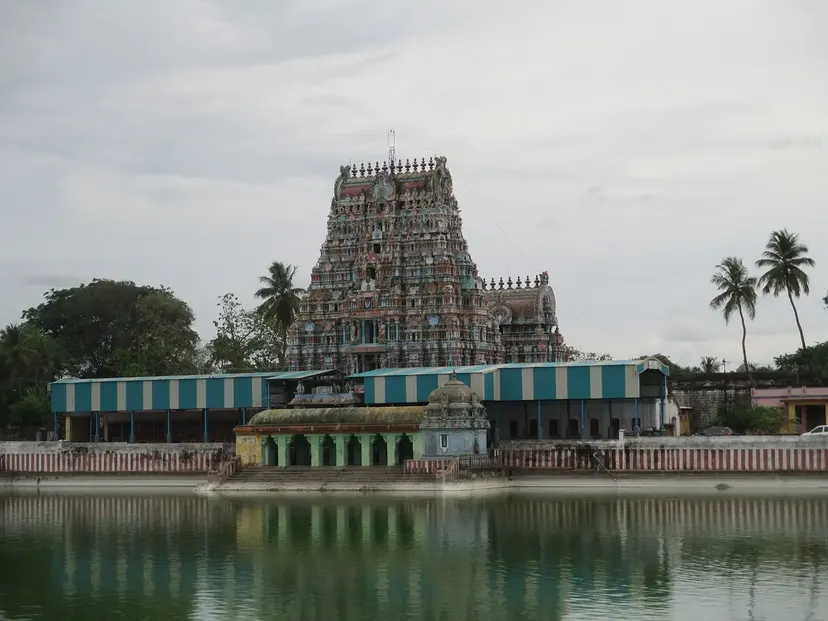
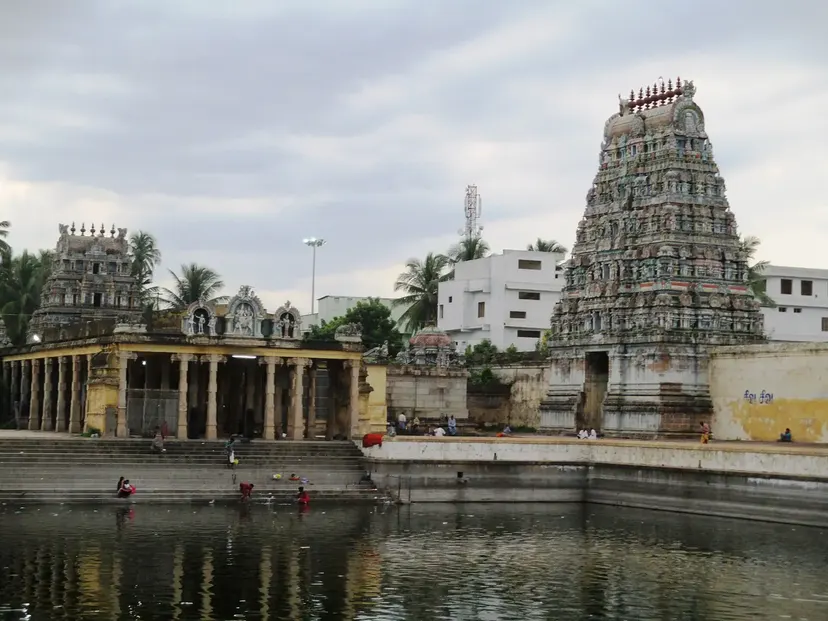
The Thirunagari temple is the larger of the two. According to Wikipedia it covers about two acres within high granite walls and is entered through a seven-tiered rajagopuram about 38 m tall. The sanctum is raised, and its vimana, which Dinamalar calls the Ashtakshara Vimanam, carries stucco images including the Dashavatara, Lakshmi Narasimha and Lakshmi Narayana. Thirumangai Alvar has a separate north-facing shrine in the same enclosure; Dinamalar notes that it has its own flagstaff, so the temple has two, and that the Alvar is shown holding a spear said to have been given to him by Thirugnanasambandar. Dinamalar describes the presiding deity Vedarajan as seated and facing west.
The Thiruvali temple is a smaller, west-facing shrine within a granite-walled enclosure of about half an acre, per Wikipedia. The granite image of Azhagiya Singar is seated with Lakshmi on his right lap. A south-facing shrine of Thirumangai Alvar stands outside the walls, opposite the Garuda mandapam, and the flagstaff and a four-pillared hall lie on the axis outside the compound wall.
Plan Your Visit
Darshan and Visitor Information
These are working temples under the Tamil Nadu HR&CE Department. They are small rural shrines and may close between the morning and evening worship periods, and crowds are very large during the Thirumangai Alvar festival in Thai. Dress modestly and follow the instructions of temple staff. Confirm current opening times, festival dates and any rules with the temple office or the HR&CE Department before travelling.
Timings and arrangements change with seasons and festivals. Confirm current details with Hindu Religious and Charitable Endowments Department, Government of Tamil Nadu (per Wikipedia) before travelling. Last reviewed 1 November 2026.
Sacred Calendar
Festivals at Thiruvali–Thirunagari Divya Desam (Azhagiya Singar and Vedarajan Temples)
Thirumangai Alvar Mangalasasana Utsavam and Thirunangur Garuda Sevai
The festival image of Thirumangai Alvar is taken from Thirunagari on a swan (Hamsa) vahana to Thirunangur, where the festival images of the eleven Thirunangur Divya Desams are brought out on Garuda vahanas and his hymns for each are recited.
Vaikasi Swathi festival
A ten-day festival celebrated at both shrines, according to Dinamalar and Wikipedia.
Pavitrotsavam
A purificatory festival listed for both temples.
Panguni Uthiram
Listed among the annual festivals of both shrines.
Location
How to Reach Thiruvali–Thirunagari Divya Desam (Azhagiya Singar and Vedarajan Temples)
Dinamalar places Thiruvali about 9 km from Sirkazhi on the road towards Poompuhar, and gives Sirkazhi as the nearest railway station and Tiruchirappalli as the nearest airport. Dinamalar gives the distance between the two shrines as about 2 km, while Wikipedia gives about 5 km; by map position they are roughly 3.7 km apart, so check locally before walking between them.
Dinamalar suggests Mayiladuthurai as a base for accommodation. Many pilgrims combine the two shrines with the eleven Thirunangur Divya Desams nearby.
Location: Thiruvali and Thirunagari, near Sirkazhi, Mayiladuthurai, Tamil Nadu, India
Nearest airport: Tiruchirappalli (per Dinamalar)
Nearest railway station: Sirkazhi (per Dinamalar)
More in Hindu temples in Tamil Nadu · Vishnu (as Lakshmi Narasimha / Azhagiya Singar at Thiruvali and Vedarajan / Kalyana Ranganatha at Thirunagari) temples · Temples in Thirunagiri · Temples in Sirkazhi Taluk · Temples in Mayiladuthurai District
Questions
Thiruvali–Thirunagari Divya Desam (Azhagiya Singar and Vedarajan Temples): Frequently Asked Questions
Why are Thiruvali and Thirunagari counted as one Divya Desam?
The Alvars' hymns refer to the two shrines together, so tradition counts them as a single Divya Desam even though they are separate temples a few kilometres apart.
Which deities are worshipped at Thiruvali and Thirunagari?
Thiruvali enshrines Azhagiya Singar, a seated Lakshmi Narasimha with Lakshmi on his right lap. Thirunagari enshrines Vedarajan, whose festival image is Kalyana Ranganatha.
What is the connection with Thirumangai Alvar?
Tradition holds that the chieftain Neelan was transformed into Thirumangai Alvar here when the Lord whispered the Ashtakshara mantra in his ear. Thiruvali is described as his capital and his wife Kumudavalli's birthplace, and both temples have shrines to him.
Was Thirumangai Alvar born at Thirunagari?
Sources differ. Wikipedia calls Thirunagari his birthplace, while a Daily Thanthi account names the nearby village of Thirukkuraiyalur.
Why is Lakshmi on the right side of Narasimha at Thiruvali?
This is noted as unusual, since Lakshmi usually sits on the left in Narasimha images. The local legend says she sat on his thigh to calm his anger after he killed Hiranya.
How do I reach Thiruvali–Thirunagari?
Dinamalar places Thiruvali about 9 km from Sirkazhi on the road to Poompuhar. Sirkazhi is the nearest railway station and Tiruchirappalli the nearest airport.
Sources and attribution
- Dinamalar — Arulmigu Azhagiya Singar Temple, Thiruvali (Tamil temple directory)
- Dinamalar — Arulmigu Vedharajan Temple, Thirunagari (Tamil temple directory)
- Daily Thanthi — Arutsevai arulum Thirunangur Garudasevai (Tamil)
- Wikipedia — Thiruvali-Thirunagari
- Wikipedia — Vedarajan temple, Thirunagari
- Wikipedia — Azhagiyasingar Temple, Thiruvali
Further reading: Thiruvali–Thirunagari Divya Desam (Azhagiya Singar and Vedarajan Temples) on Wikipedia (CC BY-SA 4.0).
Spotted an error? Write to info@hindutone.com — see our editorial policy.