Godavari Pilichindi: Sir Arthur Cotton, the Dowleswaram Anicut and a Telugu Story of Coming Home
The viral Telugu story Godavari Pilichindi (credited to Bhasha Bharati) retold in brief, with the real history behind it: Sir Arthur Cotton, the 1847–52 Dowleswaram anicut, the Sir Arthur Cotton Barrage and Cotton Museum, Annavaram and Kadiyam, and why the story moves NRI families.
The viral Telugu story Godavari Pilichindi (credited to Bhasha Bharati) retold in brief, with the real history behind it: Sir Arthur Cotton, the 1847–52 Dowleswaram anicut, the Sir Arthur Cotton Barrage and Cotton Museum, Annavaram and Kadiyam, and why the story moves NRI families.
In short: Godavari Pilichindi is a viral Telugu story about a Godavari father whose NRI son-in-law, moved by a visit to the Sir Arthur Cotton Museum at Dowleswaram, decides to come home and build a company in Rajahmundry. Behind it is real history: Cotton's 1847–1852 anicut on the Godavari, which turned the delta into Andhra's rice bowl.
The story in brief
"Godavari Pilichindi" (Godavari Called) is a short Telugu story that has been widely shared on WhatsApp and social media, credited to Bhasha Bharati; its author is not named. It is a quiet story, but many readers say it brought tears to their eyes. Here is its outline, retold in our own words.
Dakshinamurthy, an engineer from a Godavari village, has just married off his only daughter. Her husband, Kiran, grew up in Hyderabad and works in America, and the couple will fly back within a week. As is the custom in Godavari homes, the newly-weds are first taken for darshan of Sri Satyanarayana Swamy at Annavaram. On the drive home the family stops at the flower nurseries of Kadiyam, and then, at the daughter's request, at the Cotton Museum at Dowleswaram, near the barrage on the Godavari.
Dakshinamurthy had studied mechanical engineering in Chennai in the 1960s but chose to come back to his village, set up a workshop making farm tools and serve the people around him. He even had his daughter study agriculture, so that she too might do something for farmers. Now he quietly wonders why our brightest children must always go so far away.
At the museum he tells his son-in-law about Sir Arthur Cotton: a man not of our village, not of our country, not of our language, who still gave water to the delta and food to its people. "If our leaders and educated people did even a hundredth of what he did, would our country be like this?" he asks.
Ten days after the couple leave, Kiran phones from America. He wants to come back, start a software company in Rajahmundry with friends and give jobs to local people. "Cotton was not of our country or our language, yet he did so much for our land. Shouldn't I do at least a hundredth of that, and a tenth of what you have done for your village?" In the last line, the Godavari flows on, calmly calling her children to stay close to her lap.
Who was Sir Arthur Cotton?
Sir Arthur Thomas Cotton (15 May 1803 – 24 July 1899) was a British army officer and irrigation engineer of the Madras Engineers who spent most of his career in the Madras Presidency. In the Godavari districts he is still remembered as the architect of the delta, and you will find his statue or portrait in many villages, homes and offices.
Before the Godavari, he worked on the Kaveri. He studied the ancient Kallanai (Grand Anicut) built by the Chola king Karikala, learned from its foundations, and built the Upper Anicut at Mukkombu near Tiruchirappalli and the Lower Anicut at Anaikarai. It is one of history's quiet tributes: a 19th-century engineer learning from a dam built in Tamil country many centuries earlier.
The Dowleswaram anicut and the Godavari delta
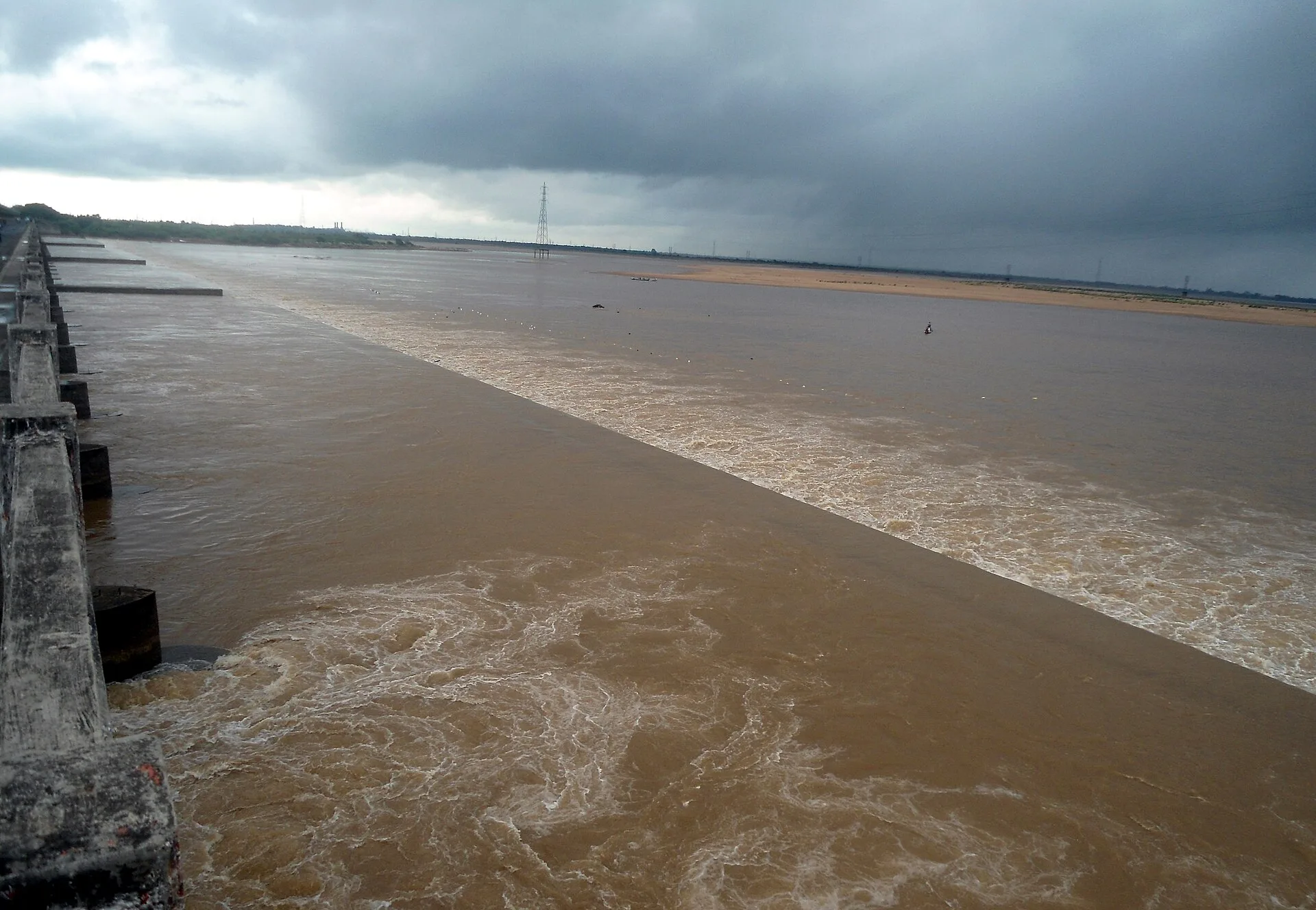
Cotton's best-known work is the anicut across the Godavari at Dowleswaram, near Rajamahendravaram (Rajahmundry), built between 1847 and 1852. The original weir was about 3.5 km long. With its canal network it turned the Godavari delta into one of the most productive rice-growing regions of India, still called the rice bowl of Andhra Pradesh, and helped end the famines the region had suffered.
Between 1970 and 1982 the old anicut was replaced by a modern barrage a little upstream. It was named the Sir Arthur Cotton Barrage and dedicated in 1982. It feeds the canals of East and West Godavari, where farmers raise two crops a year.
The story's line that Cotton was "only a tax officer" is a storyteller's simplification: he was an engineer by profession. Its heart is true, though. He argued tirelessly with the East India Company for irrigation when many officials saw it as an expense, and he finished the work against heavy odds.
Visiting the Cotton Museum
The Sir Arthur Cotton Museum stands beside the barrage at Dowleswaram, on the edge of Rajamahendravaram. It holds about a hundred photographs and drawings and around fifteen machines and tools used to build the anicut. A visit fits easily into a day that also includes Annavaram, a couple of hours away by road, and the Kadiyam nurseries close by.
- Annavaram: Sri Veera Venkata Satyanarayana Swamy on Ratnagiri hill, where many Godavari families bring newly-weds first. See our guide to Annavaram in Karthika Masam 2026.
- Kadiyam: hundreds of plant nurseries, a carpet of roses, chrysanthemums and saplings.
- Dowleswaram: the barrage, the Godavari at its widest and the Cotton Museum.
Why the story touches NRI families
The story speaks to two sets of feelings that many Telugu families know.
For parents in India, it is the quiet ache of a father who brought up his daughter to serve her own soil and now watches her leave for a country thousands of miles away. "If we are unwell, our child will not be with us; if we pine, she cannot see us," Dakshinamurthy thinks. The story does not blame anyone. It only asks whether a good life really needs a whole life to be uprooted.
For NRIs, it is a gentle invitation rather than a lecture. Kiran does not come back because he is told to. He comes back because a museum, a river and a father-in-law's example move him. Not everyone can return, and not everyone should, but the story asks each of us what we can do for the place that raised us: a school, a library, a clinic, jobs for local youth, or simply our time.
There is also a small, sharp scene about forgetting. Years earlier, Dakshinamurthy met an engineering graduate from Vizianagaram who did not know who Gurajada Apparao was, the Vizianagaram writer of *Kanyasulkam*. If a son of Vizianagaram can forget Gurajada, the father reasons, a Hyderabad-raised young man in America cannot be blamed for not knowing Cotton. The story's quiet answer is to take our children to these places and tell them.
A tribute in the Godavari tradition
The Godavari is worshipped as a mother: as *Godavari Matha*, at the Pushkaralu every twelve years, and in the daily *snana* and *arghya* of families along her banks. In the delta, gratitude to Cotton has become part of that devotion, and his portrait hangs in many homes and offices. The story's closing line, *"Cotton Dora, a crore salutations to you,"* sums up that feeling.
Above all, the story is about seva: Cotton's seva to a land not his own, Dakshinamurthy's seva to his village, and the seva Kiran chooses. As the Gita teaches, work done without thought of personal gain is itself worship.
Frequently asked questions
Who wrote the story Godavari Pilichindi?
The story circulates on WhatsApp and social media credited to Bhasha Bharati; the author's name is not given. If you know the author, please write to us so we can credit them.
Who was Sir Arthur Cotton?
Sir Arthur Thomas Cotton (1803–1899) was a British army officer and irrigation engineer of the Madras Engineers. He built the Dowleswaram anicut on the Godavari (1847–1852) and the Upper and Lower Anicuts on the Kaveri, and is revered in the Godavari delta as its architect.
When was the Dowleswaram anicut built?
Between 1847 and 1852. It was replaced between 1970 and 1982 by a modern barrage a little upstream, named the Sir Arthur Cotton Barrage.
Where is the Cotton Museum?
Beside the barrage at Dowleswaram, on the edge of Rajamahendravaram (Rajahmundry) in Andhra Pradesh. It displays photographs and the machines and tools used to build the anicut.
Why do Godavari newly-weds visit Annavaram?
Many families in the Godavari districts take newly married couples first for darshan of Sri Veera Venkata Satyanarayana Swamy at Annavaram, as a blessing for the new household.
Editor's note
Editor's note (20 October 2026): The story Godavari Pilichindi was shared with us by a reader; it circulates credited to Bhasha Bharati, without an author's name. We have retold its outline in our own words rather than reproducing it. If you are the author, write to us through the contact page for credit or removal. Historical facts about Sir Arthur Cotton and the Dowleswaram anicut follow published histories of the barrage.
Image credit: Adityamadhav83, CC BY-SA 3.0, via Wikimedia Commons (https://commons.wikimedia.org/wiki/File:Godavari_at_Dowleswaram_Barrage.jpg).
You might also like
Importance of Telugu Pronunciation, Grammar & Pedda Bala Siksha – Let Us Preserve Our Mother Tongue
Vat Savitri Vrat Story: The Power of a Wife's Devotion That Defeated Death Itself
Hindus Worldwide Must Be Safe in Public Places: Temple Security, Festival Safety and Daily Life