Bhagat Singh: Revolutionary, Writer and Self-Declared Atheist
Bhagat Singh (1907–1931) was a revolutionary of India's freedom struggle, hanged at Lahore at 23. Born into a Sikh family, he described himself as an atheist in his 1930 jail essay "Why I Am an Atheist".
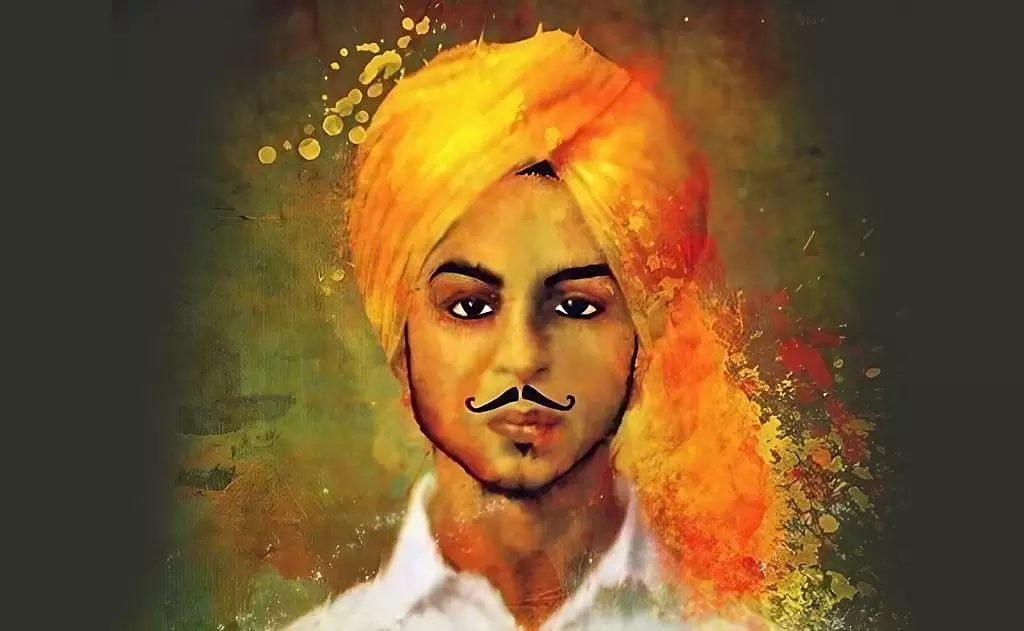
Bhagat Singh (1907–1931) was a revolutionary of India's freedom struggle who was hanged by the British at Lahore at the age of 23. He was born into a Sikh family in Punjab, and in his 1930 jail essay "Why I Am an Atheist" he described himself as an atheist. He was not a Hindu, and we do not describe him as one. He is honoured by Indians of every faith, and we include him among the Indian figures admired across faiths.
Correction (12 November 2026): An earlier version of this page was titled "Bhagat Singh: A Revolutionary with Deep Hindu Values". It said the Bhagavad Gita was a guiding influence on his revolutionary life and quoted words we could not trace to his own writings. We found no reliable source for those claims, and they misrepresented a man who declared himself an atheist. The page has been rewritten from the sources listed below. See our editorial and corrections policy.
| Key facts | |
|---|---|
| Born | September 1907 (27 or 28 September; sources differ), Banga, Lyallpur district, Punjab (now in Pakistan) |
| Parents | Kishan Singh and Vidya Vati |
| Died | 23 March 1931, Lahore Central Jail, executed with Rajguru and Sukhdev |
| Organisations | Naujawan Bharat Sabha (secretary, 1926); Hindustan Socialist Republican Association |
| Known for | The 1929 Central Legislative Assembly protest; his prison writings |
| Best-known essay | "Why I Am an Atheist" (written in Lahore jail, October 1930; published in The People, 27 September 1931) |
Early life
Bhagat Singh was born in September 1907 in Banga, a village in the Lyallpur district of Punjab, now in Pakistan, the second son of Kishan Singh and Vidya Vati. His family was already part of the national movement: at the time of his birth his father was in jail over the agitation against the Punjab canal colonisation law, a campaign in which his uncle Ajit Singh played a leading part.
After finishing the fifth class at his village school he went to the Dayanand Anglo-Vedic (DAV) School in Lahore. In his essay "Why I Am an Atheist" he later wrote that he grew up under the influence of his grandfather, an orthodox Arya Samajist, and that at school he said prayers daily. When Mahatma Gandhi called for a boycott of government-aided institutions during the Non-cooperation movement, he left and joined the National College in Lahore.
Revolutionary work
In March 1926 the Naujawan Bharat Sabha was formed in Punjab, and Bhagat Singh became its secretary. He also joined the Hindustan Republican Association, later renamed the Hindustan Socialist Republican Association.
On 30 October 1928 the Simon Commission reached Lahore. Police broke up the protest with a lathi charge, and the nationalist leader Lala Lajpat Rai, who was injured, died about two weeks later. In December 1928 Bhagat Singh and his comrades shot dead the British police officer John Saunders in Lahore, mistaking him for the officer they had meant to target; they described the act as revenge for Lajpat Rai's death.
On 8 April 1929 he and Batukeshwar Dutt threw two bombs into the Central Legislative Assembly in Delhi. The bombs were not meant to kill. They threw leaflets and offered themselves for arrest, and both were sentenced to transportation for life in the Assembly case.
Hunger strike and trial
In jail Bhagat Singh and other prisoners went on hunger strike for better treatment of political prisoners. The strike continued after the hearings in the Lahore Conspiracy Case, for the killing of Saunders, began on 10 July 1929, and it ended after the prisoner Jatindra Nath Das died on 13 September 1929 and improvements were promised.
In January 1930 he set out in writing his reasons for refusing to attend the court, and he did not want to offer a defence. On 7 October 1930 the death sentence was pronounced on Bhagat Singh, Sukhdev Thapar and Shivaram Rajguru.
Execution
The three were hanged in Lahore Central Jail on 23 March 1931. The police cremated the bodies secretly at Hussainiwala on the bank of the Sutlej. After Independence the site came to India, and a memorial stands there. India remembers the three men on 23 March as Shaheed Diwas (Martyrs' Day).
"Why I Am an Atheist"
In October 1930, in Lahore jail, he wrote the essay "Why I Am an Atheist". It was a reply to people who said he had become proud and had stopped believing in God. In it he explained that he had been brought up a believer, that his study and his revolutionary life had led him to reject belief in God, and that he would face death without the comfort of faith. He wrote that he had refused to pray even under pressure, and he argued that the suffering and injustice in the world were hard to reconcile with an all-powerful and good God. The essay was published after his death, on 27 September 1931, in the Lahore weekly The People.
Other writings
He wrote widely on politics, society and religion. His surviving writings include an essay on the language and script of Punjab, statements with B. K. Dutt in court, a letter of December 1929 defending the slogan "Long Live Revolution" (Inquilab Zindabad), a letter of 4 October 1930 objecting to a petition his father had sent to the tribunal on his behalf, and "To Young Political Workers" (February 1931). They are read today as part of India's political history.
Why this page is on HinduTone
HinduTone's Famous Hindus section is for people who were Hindu by their own statement or by uncontested record. Bhagat Singh was neither: he was born into a Sikh family and described himself as an atheist. We keep this page because readers look for him here, and we present him as he described himself: an Indian revolutionary admired across faiths.
Frequently asked questions
Was Bhagat Singh a Hindu?
No. He was born into a Sikh family, and in "Why I Am an Atheist" (1930) he described himself as an atheist.
When was Bhagat Singh executed?
On 23 March 1931 in Lahore Central Jail, together with Rajguru and Sukhdev.
What did Bhagat Singh do in the Central Legislative Assembly?
On 8 April 1929 he and Batukeshwar Dutt threw two bombs, not meant to kill, into the Assembly in Delhi, threw leaflets and offered themselves for arrest.
When did Bhagat Singh write "Why I Am an Atheist"?
In October 1930, in Lahore jail. It was first published on 27 September 1931, after his death, in The People.
Why is 23 March called Shaheed Diwas?
It is the day Bhagat Singh, Rajguru and Sukhdev were executed in 1931, and it is observed in India as Martyrs' Day in their memory.
Where was Bhagat Singh cremated?
At Hussainiwala, on the Sutlej, where the police cremated the three men secretly; a memorial now stands there.
Sources
- Bhagat Singh, "Why I Am an Atheist" (5–6 October 1930), text in the Bhagat Singh Internet Archive at marxists.org, from The People, 27 September 1931; list of his writings in the same archive.
- The Encyclopaedia of Sikhism (Punjabi University, Patiala), "Bhagat Singh (1907–1931)", eos.learnpunjabi.org.
- Encyclopaedia Britannica, "Bhagat Singh".
Last reviewed: 16 November 2026.
Related: Famous Hindus · Rani Lakshmibai · Mangal Pandey · V. D. Savarkar · Madan Mohan Malaviya
Share this with family and friends
Send it on WhatsApp, post it, or copy the link.
More from Famous Hindus
- Thiruvalluvar: Author of the Tirukkural, Life and Legacy
- Guru Ravidas: Life, Hymns, Begampura and Legacy
- Sree Narayana Guru: Life, Teachings and Reforms
- Akka Mahadevi: Life, Vachanas and Legacy
- Famous Hindus Born in March: Birthdays by Date