Diwali 2027 Lakshmi Puja Vidhi – Complete Puja Samagri, Mantras, Aarti and Rituals
Diwali 2027 Lakshmi Puja is performed on the evening of Friday 29 October in India and Thursday 28 October in the USA, UK, Canada and the UAE, beginning with Ganesh puja and followed by worship of Goddess Lakshmi with lamps, flowers, naivedya and aarti. This guide gives you a complete samagri checkl
Diwali 2027 Lakshmi Puja is performed on the evening of Friday 29 October in India and Thursday 28 October in the USA, UK, Canada and the UAE, beginning with Ganesh puja and followed by worship of Goddess Lakshmi with lamps, flowers, naivedya and aarti. This guide gives you a complete samagri checklist, a step-by-step household procedure, the core mantras with correct text, and practical advice for families performing the puja at home abroad. It is written so that a family without a priest can follow it calmly from start to finish.
Important: The right evening and time for Lakshmi Puja depend on your local Panchang, which is worked out from your city, its sunset and the tithi at that moment. Overseas dates are not the same as Indian dates, so check your city before you plan. The procedure below is a common household outline; your family's own tradition, or your priest's guidance, always comes first.
For the wider picture of the festival, from shopping to family gatherings, see our Diwali 2027 planning guide.
What Lakshmi Puja Is About
On the Amavasya night of Kartika, the darkest night of the lunar month, households light lamps and invite Goddess Lakshmi, the consort of Lord Vishnu and the giver of prosperity, auspiciousness and well-being, into a clean and welcoming home. Lord Ganesha is worshipped first, as at the start of almost every Hindu ritual, as the remover of obstacles. Many families also honour Goddess Saraswati and Lord Kubera on the same altar, and business families worship their account books.
The spirit of the puja is hospitality offered to the divine: the deity is welcomed, seated, offered water, cloth, fragrance, flowers, light and food, then praised with devotion. Keeping that shape in mind makes every step below easy to remember.
Lakshmi Puja Samagri Checklist
Gather everything a day ahead. Items marked "optional" depend on family custom.
| Item | Purpose | Notes |
|---|---|---|
| Lakshmi and Ganesha murti or picture | Focus of worship | Many families use a combined Lakshmi-Ganesha image |
| Low wooden stool (chowki) | Altar platform | Cover with a clean red or yellow cloth |
| Kalash (copper, brass or silver pot) | Kalash sthapana | With water, mango leaves and a coconut |
| Coconut with husk | Placed on the kalash | Wrap with a red thread or cloth if customary |
| Mango or betel leaves | Kalash and torans | Five or seven leaves for the kalash |
| Raw rice (akshata) | Offering and kalash base | Mixed with a little turmeric or kumkum |
| Turmeric, kumkum, sandalwood paste | Tilak and gandha | Chandan paste can be made from powder |
| Fresh flowers and garlands | Pushpa offering | Lotus is traditional for Lakshmi; marigold and rose are common |
| Diyas, cotton wicks, ghee or sesame oil | Deepa offering | At least one ghee lamp for the altar |
| Incense sticks or dhoop | Dhupa offering | Check ventilation indoors |
| Camphor and aarti plate | Aarti | Use a deep plate with a holder |
| Bell (ghanti) | Used during worship | Optional |
| Panchamrit ingredients | Abhishek or offering | Milk, curd, ghee, honey and sugar |
| Clean water and a small spoon (achamani) | Padya, arghya, achamana | Ganga jal if you have it |
| Red cloth or chunri | Vastra offering | Optional; a sari or cloth piece for the Goddess |
| Coins or a silver coin | Offered to Lakshmi | Often the coin bought on Dhanteras |
| Betel leaves and supari | Tambula offering | Optional, where customary |
| Fruits | Naivedya | Seasonal fruit, washed |
| Sweets | Naivedya | Kheer, laddu, batasha or homemade sweets |
| Puffed rice (kheel) and batasha | Naivedya | Common in north India |
| Account books, pen, ink | Chopda or bahi-khata pujan | For business families |
If you are still putting your list together, our Diwali 2027 shopping list groups puja items with decorations, clothes and food so nothing is forgotten.
Preparing the Home and the Puja Space
Preparation is part of the worship, not an errand before it. A few calm steps in the afternoon make the timed part of the evening much easier.
- Clean the house. Many families finish a thorough clean in the days before Diwali. On the day, sweep the entrance and the puja area again.
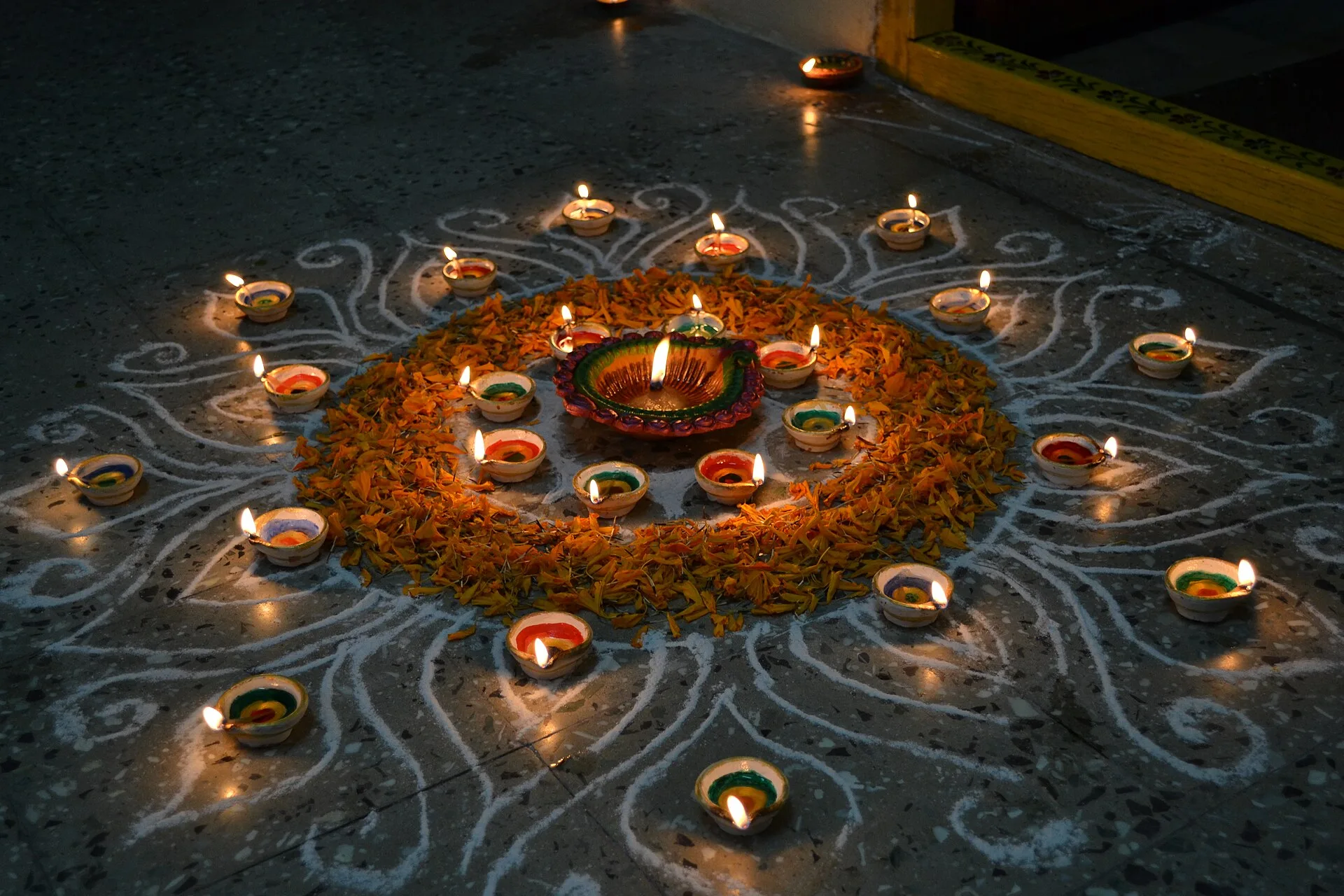
- Decorate the entrance. Draw a rangoli at the door; many families add small Lakshmi footprints pointing into the house, as if the Goddess is walking in. Hang a toran of mango leaves or marigolds.
- Choose the altar position. Where possible, place the chowki so that you face east or north while worshipping. In a small flat, any clean, quiet spot works.
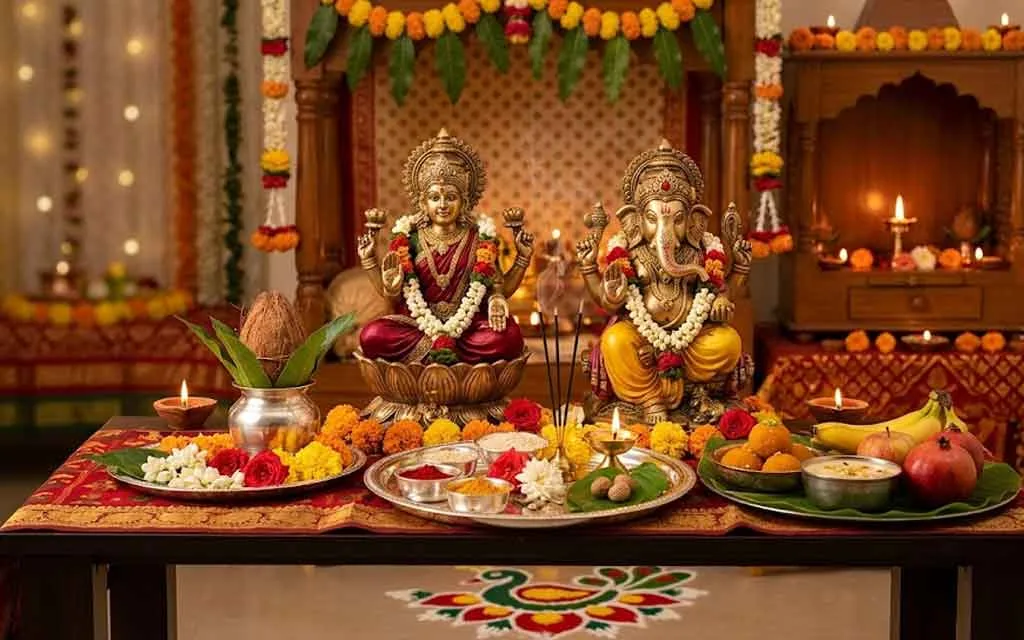
- Set the altar. Spread the cloth on the chowki. Make a small mound of rice in the centre for the kalash, and place Lakshmi and Ganesha side by side behind it. Families differ on which side each deity sits, so follow your own household's layout or your priest's advice.
- Bathe and dress. Everyone taking part bathes and wears clean, preferably new or festive, clothes.
- Keep everything within reach. Lay out the samagri on a tray so you do not have to get up during the puja.
Kalash Sthapana
The kalash represents fullness and the presence of the divine, and setting it up is usually the first ritual act.
- Fill the kalash about three-quarters with clean water. Add a pinch of akshata, a flower, a coin and, if you have it, a few drops of Ganga jal.
- Place five or seven mango leaves around the mouth of the kalash, tips facing outwards.
- Set the coconut on top of the leaves, with its tuft (the pointed end) upwards.
- Tie a red thread around the neck of the kalash and apply kumkum and turmeric marks to it.
- Place the kalash on the mound of rice on the altar, usually in front of or beside the deities.
Some families also place a small plate of rice beside the kalash and draw a swastika on it with kumkum; follow your household custom.
Ganesh Puja First
Before Lakshmi is worshipped, invoke Lord Ganesha so that the ritual proceeds without obstacle.
- Sit facing the altar, take a little water in the right palm and sip it (achamana) to purify yourself.
- Make a sankalpa: in your own words, state your name, the date, the place and your intention to perform Lakshmi Puja for the well-being of your family. Holding a little water, rice and a flower while you do this is common.
- Offer Ganesha water, tilak, akshata, red flowers and durva grass if available.
- Light incense and a small lamp, and offer a laddu or modak.
- Chant ॐ गं गणपतये नमः (Om Gam Ganapataye Namah) 11, 21 or 108 times, or as many times as you are comfortable with.
Lakshmi Puja Step by Step: A Common Household Procedure
Formal Lakshmi Puja follows the shodashopachara, or sixteen offerings, though the exact list and names vary between texts and regions. The outline below is a common household procedure built on that sequence, simplified for families who do not have a priest. It is not the only correct way.
- Dhyana (meditation). With folded hands, picture the Goddess seated on a lotus, radiant and gracious, and bring your attention fully to the altar.
- Avahana (invitation). Offer a flower and invite Lakshmi, in your own words or with her mantra, to be present in the murti or picture.
- Asana (seat). Offer a flower or a little akshata as a seat for the Goddess.
- Padya, arghya and achamana (water offerings). With the small spoon, offer water to wash the feet, water for the hands, and water to sip, pouring each offering gently into a plate.
- Snana (bath). Sprinkle water, or perform a small abhishek with panchamrit on a metal murti or coin, followed by clean water. For a picture, simply sprinkle a few drops near it.
- Vastra (cloth). Offer the red cloth or chunri, or a piece of red thread if you have no cloth.
- Gandha (fragrance). Apply sandalwood paste, turmeric and kumkum.
- Akshata and abharana. Offer akshata, and any jewellery or the silver coin bought for Dhanteras.
- Pushpa (flowers). Offer flowers and garlands; a lotus, if available, is the traditional favourite.
- Dhupa (incense). Wave the incense gently before the Goddess.
- Deepa (lamp). Show the ghee lamp before the Goddess.
- Naivedya (food). Place the sweets, fruit, kheel and batasha before the Goddess, sprinkle a little water around the plate, and offer them with a prayer.
- Tambula. Offer betel leaves, supari and a coin, where customary.
- Mantra japa. Chant the Lakshmi mantras below.
- Aarti. Perform aarti with camphor or a ghee lamp, as described in the next section.
- Pradakshina and namaskara. Turn around in place clockwise (or walk around the altar if there is space), then bow and offer a final flower, asking forgiveness for any mistakes in the puja.
Keep the main Lakshmi worship, roughly steps 1 to 15, inside your city's muhurat. Exact windows for 22 cities are in our article on Diwali 2027 dates and city-wise Lakshmi Puja timings.
Lakshmi Puja Mantras
Chant slowly and with attention; correct intention matters more than speed or count. A mala of 108 beads is helpful but not required.
- Lakshmi beej mantra: ॐ श्रीं महालक्ष्म्यै नमः (Om Shreem Mahalakshmyai Namah). This short mantra can be used during every offering above and for japa.
- Lakshmi Gayatri: ॐ महालक्ष्म्यै च विद्महे विष्णुपत्न्यै च धीमहि। तन्नो लक्ष्मीः प्रचोदयात्॥ (Om Mahalakshmyai cha vidmahe Vishnupatnyai cha dhimahi, tanno Lakshmih prachodayat). It asks to know the Great Lakshmi, meditate on the consort of Vishnu, and be inspired by her.
- For Kubera, if you include him on the altar: ॐ कुबेराय नमः (Om Kuberaya Namah).
- For Ganesha, at the start: ॐ गं गणपतये नमः (Om Gam Ganapataye Namah).
If you are unsure of pronunciation, it is perfectly acceptable to chant just the beej mantra, or to sit quietly and offer the puja with your own prayer. Families who follow a longer stotra or the Sri Sukta from their own tradition can of course include it.
Aarti
After the mantras, the family stands for aarti. The aarti sung in very many North Indian homes is Om Jai Lakshmi Mata; South Indian, Bengali, Gujarati and Maharashtrian homes often sing their own regional aartis and bhajans. Use whichever your family knows, or play a recording if no one remembers the words.
- Light camphor or a five-wick ghee lamp and move the plate in slow clockwise circles before the Goddess while the family sings.
- Pass the plate around; each person holds their palms over the flame for a moment and touches them to their eyes.
- Keep burning camphor well away from hair, dupattas and curtains.
Prasadam and Food Safety
After aarti, the naivedya becomes prasadam and is shared with everyone present, starting with elders and children. Many families also keep some aside for neighbours, domestic staff or temple visitors the next day.
A few food-safety points matter on a busy festival night:
- Panchamrit contains milk and curd. Make it fresh on the day, keep it cool, and finish it the same evening.
- Honey is part of panchamrit; do not give honey to babies under one year old.
- Milk sweets such as kheer, barfi and peda should be refrigerated once cool and eaten within a day or two.
- Allergies: many Diwali sweets contain nuts, ghee and milk. Tell guests what is in each sweet, especially children.
- Fruit used as naivedya should be washed before it is offered and before it is cut.
For home-style recipes for the offering plate, from laddus to kheer, see Diwali 2027 sweets and snacks recipes.
Regional Variations
Lakshmi Puja is not performed in exactly the same way across India, and some regions centre their Diwali on a different deity or day altogether. None of these is "more correct" than another; each is a living regional tradition.
Bengal: Kali Puja on Amavasya Night
In Bengal, Odisha and Assam, the Kartika Amavasya night is above all Kali Puja (Shyama Puja), worshipped late into the night, with lamps lit across the home. Many Bengali households perform their main Lakshmi Puja earlier in the season, on the full moon after Durga Puja (Kojagari Lakshmi Puja). Because Kali Puja depends on Amavasya being present around midnight, its date can differ from the Lakshmi Puja date in some years, so Bengali families should follow a Bengali Panjika or their local puja committee for 2027.
Gujarat: Chopda Pujan
Gujarati business families perform Chopda Pujan on Diwali, worshipping new account books (chopda) together with Lakshmi and Ganesha. A priest or the head of the family writes auspicious marks such as "Shubh" and "Labh" and a swastika in the new books, and the year's accounts symbolically begin under the Goddess's blessing. Diwali is the last day of the year in the Gujarati calendar, and the new year, Bestu Varas, follows. Today many families worship a ledger, a laptop or simply a notebook in the same spirit.
Maharashtra: Lakshmi Pujan
In Maharashtra, Diwali opens with Vasu Baras (Govatsa Dwadashi), when cows and calves are honoured, and Lakshmi Pujan is performed on the Amavasya evening, often including the household's cash, jewellery and account books. The following day is Diwali Padwa (Bali Pratipada), a day honouring the bond between husband and wife, and the festival closes with Bhau Beej. Our guide to Bali Pratipada and Diwali Padwa explains the day after Lakshmi Pujan.
South India: Deepavali on Naraka Chaturdashi Morning
In Tamil Nadu, Andhra Pradesh, Telangana, Karnataka and among South Indian communities in Singapore, Malaysia and elsewhere, Deepavali centres on the morning of Naraka Chaturdashi, marking Lord Krishna's victory over the demon Narakasura. Families wake before dawn for an oil bath (abhyanga snanam), wear new clothes, offer prayers, share sweets and savouries and light crackers where allowed. In India, Naraka Chaturdashi 2027 falls on Thursday 28 October in the New Delhi calendar; South Indian regional calendars should be checked for the exact Deepavali day. An evening Lakshmi Puja is also performed in many South Indian homes, especially business families, but it is not the centre of the festival as it is in the north. Our page on Naraka Chaturdashi and the abhyang snan covers that morning in detail.
Lakshmi Puja at Home for NRIs
Performing the puja in a flat in London, a house in New Jersey or an apartment in Dubai brings some practical questions that families in India rarely face.
Fire Safety and Smoke Alarms
- Never disable a smoke alarm. Instead, keep lamps, camphor and incense away from detectors, and open a window for ventilation.
- Camphor and dhoop smoke are the most common triggers. Use a single small camphor tablet, or a ghee lamp, for aarti.
- Battery or LED diyas are a sensible choice for windowsills, balconies, staircases and children's rooms. Keep one real ghee lamp on the altar if your building allows it, and place it on a metal plate.
- Rented homes and halls of residence may have rules against open flames; read your tenancy agreement or ask the building manager.
- Never leave a flame unattended, especially with children and pets around, and keep a damp cloth or small fire blanket nearby.
Timing on a Weeknight
In the USA, UK, Canada and the UAE, Lakshmi Puja 2027 falls on a Thursday evening, a working and school day. A few habits help:
- Set up the altar, kalash and samagri on Wednesday night or Thursday morning.
- Cook sweets at the weekend before, choosing ones that keep, and make panchamrit fresh on the evening itself.
- Aim to have everyone home and dressed by the start of Pradosh, then do the Ganesh puja just before the preferred muhurat.
- Keep the community celebration or extended-family dinner for the weekend that follows; the puja itself belongs on the correct evening.
Families who want ideas for that weekend gathering can look at our Diwali 2027 party planning guide.
Sourcing Samagri Abroad
Indian grocery stores in most large cities stock diyas, wicks, camphor, kumkum and incense before Diwali. Fresh lotuses are hard to find abroad; any fresh flower offered with devotion is acceptable, and betel or other clean green leaves can stand in for mango leaves on the kalash.
Muhurat Summary for Key Cities
The table below gives the preferred Vrishabha muhurat for selected cities, from HinduTone's own calculation rounded to the minute. Confirm with your local temple.
| City | Date | Preferred window (local time) |
|---|---|---|
| New Delhi | Friday 29 Oct 2027 | 6:35 PM – 7:06 PM IST |
| Hyderabad | Friday 29 Oct 2027 | 6:49 PM – 7:06 PM IST |
| Mumbai | Friday 29 Oct 2027 | 6:06 PM – 7:06 PM IST (Pradosh with Amavasya) |
| New York | Thursday 28 Oct 2027 | 6:47 PM – 8:35 PM EDT |
| Houston | Thursday 28 Oct 2027 | 7:36 PM – 9:13 PM CDT |
| London | Thursday 28 Oct 2027 | 6:19 PM – 7:57 PM BST |
| Toronto | Thursday 28 Oct 2027 | 7:01 PM – 8:47 PM EDT |
| Dubai | Thursday 28 Oct 2027 | 7:18 PM – 8:13 PM GST |
| Sydney | Friday 29 Oct 2027 | 8:45 PM – 9:27 PM AEDT |
| Singapore | Friday 29 Oct 2027 | 8:00 PM – 9:13 PM SGT |
Full tables for Chicago, Dallas, Los Angeles, San Francisco, Edison, Leicester, Birmingham, Brampton, Mississauga, Vancouver, Melbourne and Auckland are in the city-wise Lakshmi Puja timings for 2027 article.
Frequently Asked Questions
Can I perform Lakshmi Puja at home without a priest?
Yes. Many families perform Lakshmi Puja themselves using a simple household procedure like the one above. For an elaborate Vedic puja or a specific family vow, consult a knowledgeable priest.
Why is Ganesha worshipped before Lakshmi?
Ganesha is worshipped first at the start of most Hindu rituals as the remover of obstacles, so that the main puja proceeds smoothly. On Diwali he is also honoured together with Lakshmi as the giver of wisdom.
Which mantra should I chant for Lakshmi Puja?
The simplest is Om Shreem Mahalakshmyai Namah, which can be chanted throughout the offerings. The Lakshmi Gayatri is also widely used.
Is it acceptable to use LED or battery diyas?
Yes, especially in flats, near smoke alarms and around children. Many families keep one real ghee lamp on the altar for the puja and use LED diyas for decoration elsewhere.
What if I miss the Vrishabha muhurat?
Perform the puja within the wider Amavasya-in-Pradosh window for your city. Devotion and care matter more than a few minutes.
What is offered as naivedya for Lakshmi?
Common offerings are kheer, laddus, batasha, kheel, fruit and homemade sweets. Offer what your family traditionally prepares, made cleanly and with care.
Conclusion
Lakshmi Puja is, at heart, a welcome: a clean home, a lit lamp, a seat for the Goddess, simple offerings and a family gathered together. Whether you follow every step of the sixteen offerings or just light a lamp, chant her name and share prasadam, the puja is complete when it is done with sincerity and at the right time for your city.
Prepare the samagri early, keep the main worship within your local muhurat, and look after fire safety, especially in homes abroad. For dates, shopping, decorations and the rest of the five-day festival, our planning guide for Diwali 2027 brings it all together. Shubh Deepavali to you and your family.
Last updated: 9 November 2026.
Share this with family and friends
Send it on WhatsApp, post it, or copy the link.
More from Festivals
- Diwali 2027 Budget Planner – How to Celebrate Beautifully Without Overspending
- Diwali 2027 Party Planning Guide – Themes, Food, Games, Invitations and Decorations
- Diwali 2027 Activities for Kids – Crafts, Rangoli, Stories, Games and Family Traditions
- Eco-Friendly Diwali 2027 – Sustainable Decorations, Clay Diyas and Green Celebration Ideas
- Diwali 2027 Travel Guide – Best Places to Celebrate Diwali in India
You might also like

Diwali 2027 Date in USA, UK, Canada, Australia and India – City-Wise Lakshmi Puja Timings

Diwali 2027 Celebration in UK – London, Leicester, Birmingham and Manchester
Diwali 2027 Celebration in Canada – Toronto, Brampton, Mississauga and Vancouver