
Isha Upanishad: The 18 Verses Explained
Quick answer: The Isha Upanishad (also Ishavasya Upanishad) is one of the shortest and most important principal Upanishads: 18 verses that form the final chapter (40) of the Shukla Yajurveda's Vajasaneyi Samhita. It opens by saying that all this is pervaded by the Lord, and teaches enjoyment through
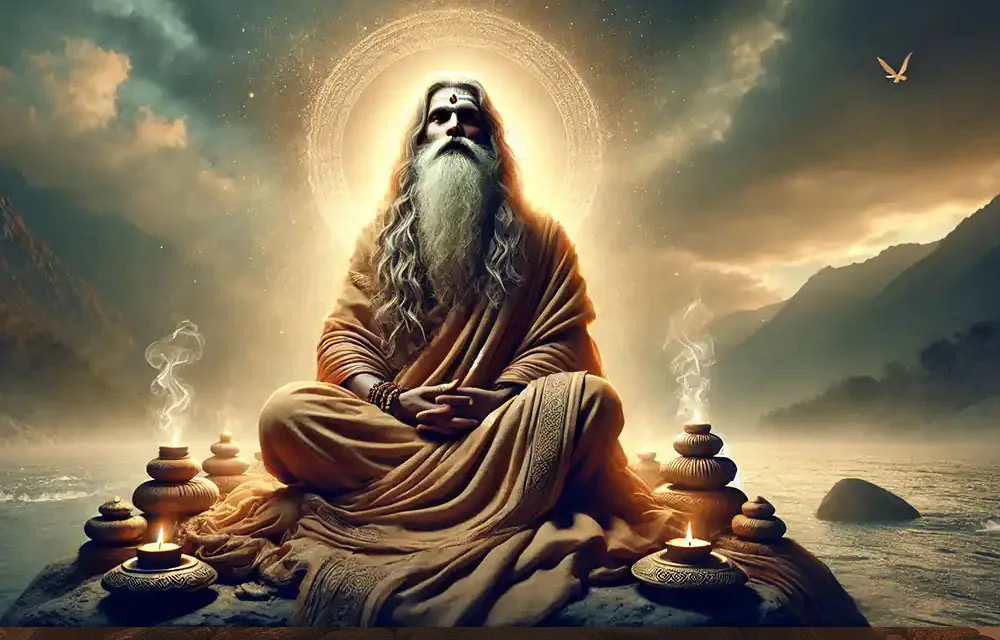
Quick answer: The Isha Upanishad (also Ishavasya Upanishad) is one of the shortest and most important principal Upanishads: 18 verses that form the final chapter (40) of the Shukla Yajurveda's Vajasaneyi Samhita. It opens by saying that all this is pervaded by the Lord, and teaches enjoyment through renunciation, action without attachment and seeing the one Self in all beings.
Because it is so short, the Isha is often the first Upanishad a student learns, and it stands first in the traditional list of ten principal Upanishads. Gandhiji, Sri Aurobindo and many others wrote about it. This guide explains its setting and walks through the 18 verses in groups, in plain English.
The Isha Upanishad at a Glance
| Feature | Details |
|---|---|
| Name | Isha or Ishavasya Upanishad, from its opening words isha vasyam |
| Veda | Shukla (White) Yajurveda |
| Place in the Veda | Chapter 40 of the Vajasaneyi Samhita, the only principal Upanishad found inside a Samhita |
| Length | 18 verses in the Kanva recension (used here); the Madhyandina recension has 17, in a slightly different order |
| Opening peace chant | Purnam adah purnam idam ("That is full, this is full") |
| Main themes | The Lord in all things; renunciation and enjoyment; work without attachment; the one Self in all; knowledge and ignorance; prayers at death |
| Classical commentaries | Adi Shankaracharya, Madhvacharya, Vedanta Desika and others |
| Dating | Tradition holds it to be part of the eternal Veda; historians generally place it among the later principal Upanishads in verse |
The Peace Chant: "That Is Full, This Is Full"
The Isha begins and ends with the famous peace chant (shanti mantra): that (the infinite) is full, this (the world) is full; from the full, the full comes forth; when the full is taken from the full, the full alone remains. The same verse appears at the start of Brihadaranyaka Upanishad 5.1. It sets the tone: the infinite is not diminished by the world that comes from it.
Verses 1–3: The Lord in Everything, and the Right Way to Live
- Verse 1. All this, whatever moves in this moving world, is pervaded (or "to be clothed") by the Lord. Therefore enjoy through renunciation (tena tyaktena bhunjitha). Do not covet anyone's wealth.
- Verse 2. Doing your work here, wish to live a hundred years. For you there is no other way than this: in this way, action does not cling to a person.
- Verse 3. Those who "slay the Self", who live in ignorance of it, go after death to sunless worlds wrapped in blinding darkness.
What it means: verse 1 is the heart of the Upanishad. Seeing everything as belonging to the Lord, you hold things lightly, enjoy them without greed and do not grasp what belongs to others. Verse 2 adds that this attitude is not a reason to stop working; a full life of work, done in the right spirit, does not bind. This is the same teaching the Bhagavad Gita later calls karma yoga.
Verses 4–8: The Nature of the Self
- Verses 4–5. The Self is one and unmoving, yet swifter than the mind; the senses cannot overtake it. It moves and it does not move; it is far and it is near; it is within all this and outside all this.
- Verse 6. One who sees all beings in the Self and the Self in all beings no longer shrinks from anyone.
- Verse 7. For one who sees all beings as the Self, who sees oneness, what delusion or sorrow can there be?
- Verse 8. He has gone everywhere: radiant, bodiless, without wound or sinew, pure, untouched by evil. The seer, the wise, the all-encompassing, the self-existent (svayambhu), he has rightly ordered all things through the endless years.
What it means: verses 6 and 7 are the Isha's ethical teaching. If the one Self lives in all beings, hatred and fear lose their ground. These verses are often quoted to explain why respect for all life is central to Hindu ethics.
Verses 9–14: Knowledge and Ignorance
These verses are the most debated in the Upanishad. They speak of two pairs:
- Verses 9–11: vidya (knowledge) and avidya (ignorance, or action). Those who follow only avidya enter blinding darkness; those who delight only in vidya enter a greater darkness. One who knows both together crosses death through avidya and attains immortality through vidya.
- Verses 12–14: sambhuti (the manifest) and asambhuti (the unmanifest), described in the same pattern. One who knows both together crosses death through the one and attains immortality through the other.
How teachers read them:
- Adi Shankaracharya reads avidya here as Vedic ritual action and vidya as meditation on deities. Combined, they lead to higher worlds, but liberation itself comes only from knowledge of the Self, taught in verses 1–8.
- Theistic commentators such as Madhvacharya and Vedanta Desika read these verses within their own schools, generally as teaching that right knowledge and right action support each other in reaching the Lord.
- Many modern readers see in them a call to balance: inner knowledge and outer action, the spiritual and the practical, rather than one without the other.
Verses 15–18: Prayers at the Time of Death
The last four verses are prayers, spoken as if at the end of life. The same four verses appear at Brihadaranyaka Upanishad 5.15.
- Verse 15. The face of truth is covered by a golden disc (hiranmayena patrena). O Pushan (the Sun as nourisher), uncover it, so that I who love truth may see.
- Verse 16. O Pushan, sole seer, Yama, Surya, son of Prajapati, spread out your rays and gather your light. I see your most blessed form. That Person yonder, I am he.
- Verse 17. Let my breath return to the immortal wind; let this body end in ashes. O mind, remember: remember what has been done.
- Verse 18. O Agni, lead us by the good path to fulfilment, you who know all our ways. Keep from us crooked wrongdoing. We offer you our many words of homage.
What it means: the Sun's dazzling disc becomes an image for everything that hides the truth. The seeker asks to see past it. The closing prayer to Agni, agne naya supatha, is still widely recited in Vedic worship.
Why the Isha Upanishad Matters
- A whole philosophy in 18 verses. It brings together the Lord, the Self, ethics, action and death in a few lines.
- It joins renunciation and engagement. Verse 1 asks for inner detachment; verse 2 asks for a full life of work. This balance runs through the Bhagavad Gita and much of later Hindu thought.
- It grounds respect for all beings. Verses 6–7 are among the clearest scriptural statements of seeing the one Self in all.
How to Study the Isha Upanishad
- Learn the peace chant and verse 1 by heart; many families recite them daily.
- Read a reliable translation with commentary, such as Swami Gambhirananda's translation of Shankara's commentary or Patrick Olivelle's annotated translation.
- Reflect on one group of verses at a time. The Isha is short, but each verse rewards slow reading.
- Study with a teacher if you can, especially verses 9–14.
Frequently Asked Questions
How many verses are in the Isha Upanishad?
Eighteen in the Kanva recension, the version most commonly studied and commented on. The Madhyandina recension has 17 verses in a slightly different order.
Which Veda does the Isha Upanishad belong to?
The Shukla (White) Yajurveda. It forms the 40th and last chapter of the Vajasaneyi Samhita.
What is the main message of the Isha Upanishad?
That all this is pervaded by the Lord, so we should enjoy life through renunciation, not covet, work without attachment and see the one Self in all beings.
What does "tena tyaktena bhunjitha" mean?
"Enjoy through renunciation", or "enjoy what is given up". Holding the world as the Lord's, you enjoy it without greed or possessiveness.
Is the Isha Upanishad connected with the Isha Foundation?
No. The Isha Upanishad is an ancient Vedic text. The modern Isha Foundation is a separate organisation that shares the word "Isha" (Lord).
Why is it called Ishavasya?
From its opening words, isha vasyam, "pervaded by the Lord".
Related Reading on HinduTone
- What Are the 108 Upanishads?
- Katha Upanishad: Nachiketa and Yama
- Brahman, Atman and Maya in Plain Words
- The Four Vedas Explained
- Bhagavad Gita Complete Guide
Sources
- Ishopanishad, Sanskrit text (Kanva recension, 18 verses), Sanskrit Wikisource: sa.wikisource.org, ईशोपनिषत्
- Swami Gambhirananda (tr.), Eight Upanishads, with the Commentary of Sankaracarya, Vol. 1, Advaita Ashrama, Kolkata (Isha Upanishad).
- Patrick Olivelle, The Early Upanishads: Annotated Text and Translation, Oxford University Press, 1998 (Isha Upanishad; Brihadaranyaka 5.1 and 5.15).
Last reviewed: 12 November 2026.
Share this with family and friends
Send it on WhatsApp, post it, or copy the link.
More from Hinduism
- Hinduism for Kids: A Simple Guide to What Hindus Believe
- A Hindu Day: Daily Practices from Waking to Sleep
- Vishishtadvaita Explained: Ramanuja's Philosophy of Qualified Non-Dualism
- The Swastika in Hinduism: Meaning and History
- Hindu Symbols and Their Meanings
You might also like
Om (Aum) Meaning: The Symbol, the Mandukya Upanishad's A-U-M, the Gita and How to Chant It
Katha Upanishad: The Story of Nachiketa and Yama and What It Teaches

Yajurveda: The Shukla and Krishna Recensions Explained
