Shankaragaurishvara Temple, Pattan
Shiva (as Shankaragaurisha) temple · Pattan, Baramulla, Jammu & Kashmir, India
The Shankaragaurishvara Temple is a ruined stone temple of Shiva at Pattan in Baramulla district of Jammu and Kashmir, on the road between Srinagar and Baramulla. It was built by King Shankaravarman of the Utpala dynasty, who ruled Kashmir from 883 to 902 CE, and it carries his name.
Pattan stands on the site of Shankarapattana, the town Shankaravarman founded as his capital. Beside the main temple is a smaller companion shrine, the Sugandhesha Temple, also dedicated to Shiva. Both are listed by the Archaeological Survey of India (ASI) as Monuments of National Importance.
Faith & Tradition
Religious Significance of Shankaragaurishvara Temple, Pattan
The two Pattan temples belong to the last great phase of Kashmir's early stone temples. A British Library catalogue note on an 1868 photograph of the site describes them as a late flowering of Kashmiri temple architecture: built on much the same plan as earlier temples, but with stones cut and carved with greater refinement and precision.
By Shankaravarman's time, the same note observes, Kashmir had become a major centre of Shaiva religion and philosophy. The temple is a physical record of that period, and of royal patronage in the Utpala capital.
Wikipedia records that worship is no longer conducted at the temple. It is visited today as a heritage site. Shankaravarman's father, Avantivarman, built the earlier pair of temples at Avantipur.
Heritage
History of Shankaragaurishvara Temple, Pattan
Shankaravarman succeeded Avantivarman, founder of the Utpala dynasty, in 883 CE. According to the British Library note and Outlook Traveller, he moved his capital from Avantipura to the new town of Shankarapattana and built two Shiva temples there. One, Shankaragaurishvara, was named after himself; the other, Sugandhesha, is said to be named after his queen.
An Outlook Traveller heritage feature reports the tradition that Shankaravarman took stone from the older capital of Parihaspora to build the Pattan temples. The same article notes the legend that his subjects later sought to erase his memory, which is why the town is now known simply as Pattan. These accounts are part of the site's lore and are not confirmed by excavation.
The ruins attracted early photographers and archaeologists. John Burke photographed the temple's west front in 1868, and the image was reproduced in Henry Hardy Cole's 1869 Archaeological Survey of India report, Illustrations of Ancient Buildings in Kashmir. Cole wrote that the temple was elaborately carved and that some details looked as sharp as when first cut.
Architecture and sacred features
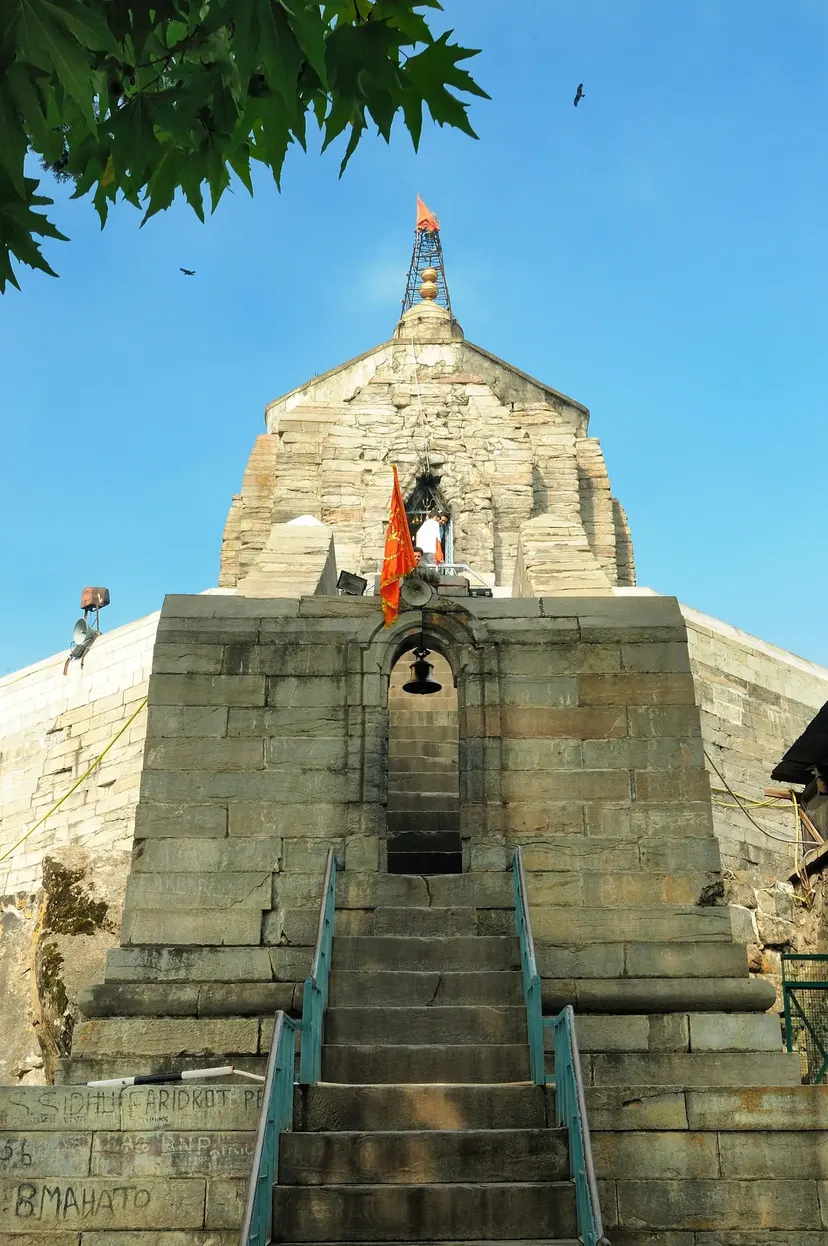
The British Library note says the temple follows much the same plan as earlier Kashmiri temples, and Wikipedia compares its style to the Shankaracharya Temple in Srinagar. The plinth stands within a colonnade inside a walled enclosure, whose remnants are still visible. Wikipedia describes a finely carved porch with pediments stacked one above another, and elaborately sculpted columns. Cole saw the repeated pediments and decorated porch pillars as evidence of Kashmiri builders moving towards greater ornament over time.
The structure is now badly damaged. Outlook Traveller found the remains hard to read, with a large, mutilated relief on one wall that is probably of Shiva. The smaller Sugandhesha Temple nearby follows the same plan and is better preserved; fluted columns, bracket capitals and other fragments lie in its courtyard.
Plan Your Visit
Darshan and Visitor Information
The Shankaragaurishvara and Sugandhesha temples are protected ASI monuments and fragile ruins: do not climb on the masonry or move carved fragments, and follow instructions from site staff. Confirm current access arrangements with the ASI (Srinagar Circle) before visiting.
Timings and arrangements change with seasons and festivals. Confirm current details with Archaeological Survey of India before travelling. Last reviewed 1 November 2026.
Location
How to Reach Shankaragaurishvara Temple, Pattan
Pattan is on the Srinagar–Baramulla road; the British Library note gives it as about 27 km from Srinagar. The Sugandhesha Temple is in the same town, so both shrines can be visited together.
Location: Pattan, Baramulla, Jammu & Kashmir, India
More in Hindu temples in Jammu & Kashmir · Shiva (as Shankaragaurisha) temples · Temples in Pattan
Questions
Shankaragaurishvara Temple, Pattan: Frequently Asked Questions
Who built the Shankaragaurishvara Temple?
King Shankaravarman of Kashmir's Utpala dynasty, who ruled from 883 to 902 CE. He named the temple after himself.
What is the Sugandhesha Temple?
It is the smaller companion Shiva temple at Pattan, also built by Shankaravarman and said to be named after his queen. It follows the same plan and is better preserved.
Why is the town called Pattan?
Pattan stands on the site of Shankarapattana, Shankaravarman's capital. Outlook Traveller reports a legend that his subjects dropped the king's name, leaving only 'Pattan'.
Is the Shankaragaurishvara Temple still used for worship?
Wikipedia records that worship is no longer conducted there. The temple is a ruin protected by the ASI.
How far is Pattan from Srinagar?
About 27 km, on the road from Srinagar to Baramulla, according to the British Library catalogue note.
Is the temple protected?
Yes. The ASI lists both the Sankaragaurisvara and Sugandhesa temples at Pattan as Monuments of National Importance in Jammu and Kashmir.
Sources and attribution
- Archaeological Survey of India — Alphabetical list of Monuments – Jammu & Kashmir (entries 10–11, Pattan; archived 2016)
- The British Library — Shankaragaurishvara Temple at Patan: view of the front or west face (John Burke, 1868; catalogue note quoting H. H. Cole, 1869)
- Outlook Traveller — Etched in time: ancient Shiva temples of Kashmir (Santosh Ojha)
- Wikipedia — Shankaragaurishvara Temple
Further reading: Shankaragaurishvara Temple, Pattan on Wikipedia (CC BY-SA 4.0).
Spotted an error? Write to info@hindutone.com — see our editorial policy.