
Jagdish Temple
Vishnu, worshipped as Jagannath (Jagdish-ji) temple · Udaipur, Rajasthan, India
Jagdish Temple is a large temple of Vishnu in the old city of Udaipur, Rajasthan, standing just outside the City Palace. It was built by Maharana Jagat Singh I of Mewar and has been in continuous worship since 1651. It was originally known as the temple of Jagannath Rai and is now popularly called Jagdish-ji.
The ENVIS eco-heritage centre and Wikipedia describe it as the largest temple in Udaipur. Raised on a high platform and covered with carving, it is both a working shrine and one of the city's best-known landmarks, and it is the starting point of Udaipur's annual Jagannath Rath Yatra.
Faith & Tradition
Religious Significance of Jagdish Temple
The sanctum holds a four-armed image of Vishnu carved from a single piece of black stone, worshipped here as Jagannath, Lord of the Universe. Wikipedia notes that local devotees regard the deity as Vishnu or Krishna. A brass image of Garuda, Vishnu's mount, faces the sanctum from the entrance, according to eSamskriti and Wikipedia.
Four smaller shrines around the main temple are dedicated to Ganesha, Surya, Shakti (the goddess) and Shiva, an arrangement recorded by both the ENVIS eco-heritage centre and Wikipedia. The ENVIS centre recounts a folk tradition that Maharana Jagat Singh, having missed the Rath Yatra at Puri, dreamt that Lord Jagannath asked him to build a temple in his own city.
The temple's Rath Yatra in the month of Ashadha is its biggest event. ETV Bharat reports that the deities Jagannath, Lakshmi and a third processional deity are taken out on a silver-clad chariot from Jagdish Chowk through the old city, preceded by a 21-gun salute in keeping with Mewar's royal traditions, and that members of the former Mewar royal family have taken part in the worship.
Heritage
History of Jagdish Temple
Maharana Jagat Singh I, who ruled Mewar from 1628 to 1653, completed the temple in 1651, according to the ENVIS eco-heritage centre, eSamskriti and Wikipedia. The ENVIS centre and eSamskriti record a construction cost of about 1.5 million rupees at the time.
Wikipedia records an inscription and a painting at the temple honouring the Charan warrior Naruji Barhat and twenty companions, who are remembered for defending the temple against Mughal forces; an information board at the site dates this episode to 1680. The temple's Rath Yatra procession is reported by ETV Bharat to use a centuries-old wooden chariot alongside the newer silver chariot.
Architecture and sacred features
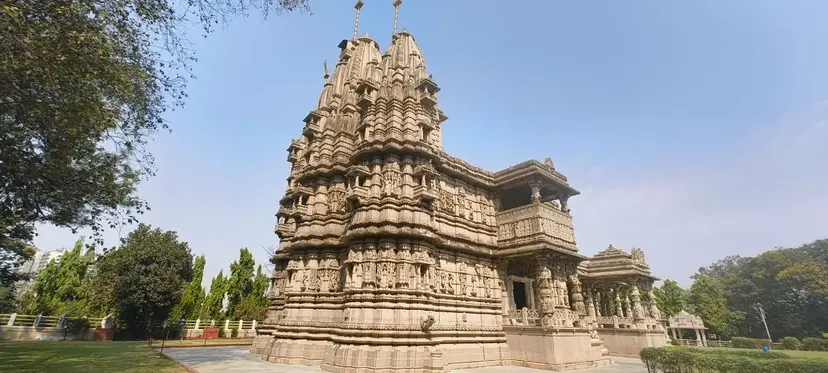
The temple is an example of the Maru-Gurjara style. Wikipedia describes a tall terrace carrying a double-storey mandapa (hall) joined to a double-storey sanctum with a covered ambulatory, with a pyramidal roof over the hall and a spire about 79 feet (24 m) high. The ENVIS centre and eSamskriti note that the first and second storeys each have about 50 carved pillars.
According to eSamskriti, two stone elephants flank the entrance, and the outer walls carry bands of carving: kirtimukha faces on the lowest level, then elephants and horses, and above them dancers, musicians, horsemen and other human figures.
Plan Your Visit
Darshan and Visitor Information
Jagdish Temple is an active place of worship, with devotees arriving from early morning, and crowds are heaviest during the Rath Yatra. Confirm current darshan timings, photography rules and dress expectations with the temple or the Rajasthan Devasthan Department before visiting.
Timings and arrangements change with seasons and festivals. Confirm current details with the temple administration before travelling. Last reviewed 1 November 2026.
Sacred Calendar
Festivals at Jagdish Temple
Jagannath Rath Yatra
Jagannath, Lakshmi and a processional deity are taken from Jagdish Chowk through the old city on a silver-clad chariot after a 21-gun salute, drawing very large crowds.
Location
How to Reach Jagdish Temple
The temple is in the heart of old Udaipur; the ENVIS centre gives its gateway as about 150 metres from the Bara Pol of the City Palace. A flight of 32 marble steps leads up to the main shrine, according to Wikipedia.
Location: Udaipur, Rajasthan, India
More in Hindu temples in Rajasthan · Vishnu, worshipped as Jagannath (Jagdish-ji) temples · Temples in Girwa Tehsil · Temples in Udaipur District
Questions
Jagdish Temple: Frequently Asked Questions
Who built Jagdish Temple in Udaipur?
Maharana Jagat Singh I of Mewar, who ruled from 1628 to 1653, built the temple; it has been in worship since 1651.
Which deity is worshipped at Jagdish Temple?
A four-armed image of Vishnu carved from a single black stone, worshipped as Jagannath. The temple was originally called the temple of Jagannath Rai.
What architectural style is Jagdish Temple?
It is built in the Maru-Gurjara style on a high terrace, with a double-storey hall and sanctum, about 50 carved pillars on each of the two main storeys and a spire about 79 feet high.
What other shrines are in the Jagdish Temple complex?
Four smaller shrines dedicated to Ganesha, Surya, Shakti and Shiva surround the main temple, and a brass Garuda faces the sanctum.
When is the Udaipur Rath Yatra held?
In the month of Ashadha (June–July), starting from the Jagdish Temple. Dates are announced each year.
Where is Jagdish Temple located?
In Udaipur's old city, about 150 metres from the Bara Pol gate of the City Palace.
Sources and attribution
- ENVIS Centre on Conservation of Ecological Heritage and Sacred Sites of India (C.P.R. Environmental Education Centre) — Udaipur
- eSamskriti — Jagdish Temple Udaipur
- ETV Bharat (Hindi) — Lord Jagannath Rath Yatra taken out in Udaipur in royal style
- ETV Bharat (Hindi) — Grand Rath Yatras of Lord Jagannath taken out in Udaipur and Jhalrapatan
- Wikipedia — Jagdish Temple, Udaipur
Further reading: Jagdish Temple on Wikipedia (CC BY-SA 4.0).
Spotted an error? Write to info@hindutone.com — see our editorial policy.
Pilgrim Circuit