
Shrinathji Temple, Nathdwara
Krishna as Shrinathji (the child Krishna lifting Govardhan) temple · Nathdwara, Rajsamand, Rajasthan, India
Shrinathji Temple in Nathdwara, Rajsamand district, Rajasthan, is the principal shrine of Shrinathji, a form of Krishna shown as a child holding up Govardhan hill. The town stands on the Banas river about 48 km north-east of Udaipur, according to Incredible India, the Union tourism ministry's site, and, the same site says, the name means 'gateway (dwar) of the Lord (nath)'.
The shrine is the central seat of the Pushtimarg, the Vaishnava tradition also called the Vallabha Sampradaya, founded by Vallabhacharya. It is run not as a conventional temple but as a haveli, a household in which the deity is cared for as a child. Since 1959 it has been administered by a statutory board under the Nathdwara Temple Act.
Faith & Tradition
Religious Significance of Shrinathji Temple, Nathdwara
Followers of the Pushtimarg believe the image is self-manifested. As the Supreme Court of India summarised the tradition in its 1963 judgment on the temple, devotees hold that Krishna revealed himself to Vallabha on Govardhan hill near Mathura as Devadamana, also called Shrinathji, and that Vallabha found the image there and had it installed for worship. Wikipedia records further legends about the image emerging from the hill and being bathed with milk by the people of Braj before it was recognised.
The image is a bas-relief carved from black stone. According to Wikipedia and Incredible India, Shrinathji's left hand is raised, as if lifting Govardhan, and the right hand rests at the waist; Wikipedia lists small carvings on the slab including cows, a lion, a snake, peacocks, a parrot and sages. Wikipedia's article on the deity says Vallabhacharya's son Vitthalnath gave the worship its institutional form, and that the inner sanctum opens for eight darshans a day: Mangala, Shringar, Gval, Rajbhog, Utthapan, Bhog, Sandhya and Shayan. The deity's dress (shringar) is changed through the day, Wikipedia adds.
Nathdwara is also the home of pichhwai painting. The Victoria and Albert Museum, which holds a Nathdwara pichhwai of the 19th or early 20th century, explains that these large painted cloths are hung behind the image of Shrinathji and changed for each festival of the year, while the image itself is dressed in fresh clothes and jewels for each period of worship.
Heritage
History of Shrinathji Temple, Nathdwara
The Supreme Court's 1963 judgment, drawing on older histories, records that a large temple for the image was built at Govardhan by a merchant named Pooranmal, that Vallabha's son Vitthalnath later moved the image to a temple of his own, and that the Mughal emperor Akbar granted land at Jatipura for the shrine in 1593, followed by a grant from Shah Jahan in 1633. When Aurangzeb's reign brought danger to the temples of Braj, the court notes, quoting James Tod's Annals of Rajasthan, Maharana Raj Singh of Mewar offered the deity protection. The image was taken towards Mewar, and when the wheel of its chariot sank into the ground at the small village of Siarh (Sihad), this was read as a sign that the deity wished to stay there.
According to the judgment, the image reached the site in about 1671, and the earliest document concerning it, an order of the Rana of Udaipur, dates from 1672. The temple's own website gives 1672 as the year the image was installed in a new temple at Sihad, now Nathdwara, after a journey from Govardhan that it says took 32 months, including a stay of about six months at Agra. Wikipedia adds that in 1802, under threat from the forces of Jaswant Rao Holkar, the deity was taken to Udaipur and then for some years to Ghasiyar before returning to Nathdwara.
Administration has changed several times. A 1934 firman of the Udaipur darbar, cited by the Supreme Court, declared the shrine a religious institution whose property belonged to the deity, with the Tilkayat (the head of the Goswami family) acting as its custodian, manager and trustee. Rajasthan's Nathdwara Temple Act of 1959 placed the temple under the Nathdwara Temple Board. In Tilkayat Shri Govindlalji Maharaj v. State of Rajasthan (1963) the Supreme Court held the temple to be a public temple and upheld the Act, apart from one provision on the qualifications of the Goswami.
Architecture and sacred features
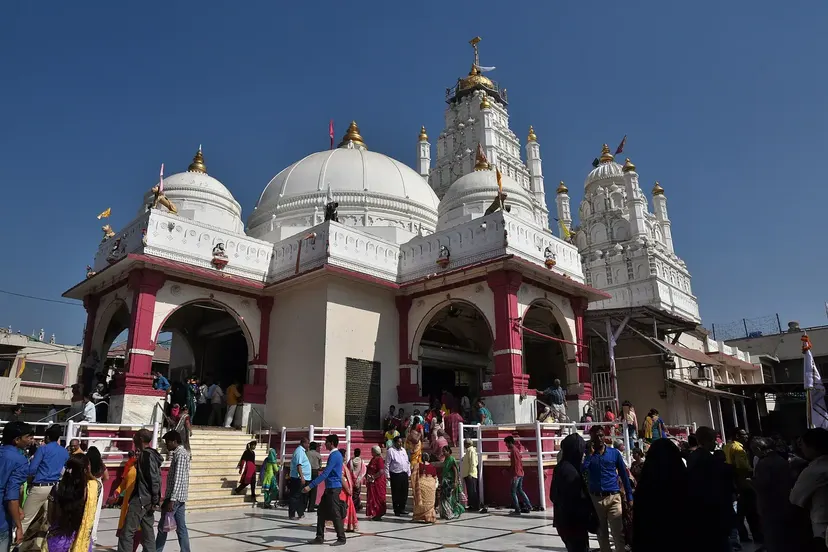
Wikipedia describes the complex as modelled on the house of Nanda, Krishna's foster father, in Gokul, which is why it is also called Nanda Bhavan. Like a large household, it includes stores for milk, betel, flowers and other offerings, a kitchen, a jewellery room, a treasury, stables and a sitting room, as well as subsidiary shrines of Madan Mohanji and Navneet Priyaji. A kalasha crowns the shikhara, from which seven flags are flown. Incredible India notes that the temple keeps a gaushala with more than 500 cows.
Plan Your Visit
Darshan and Visitor Information
The temple opens only for set darshan periods, and crowds are very large at festivals. Wikipedia notes that visitors leave mobile phones, shoes and socks outside, with lockers near the gate. Darshan times change with the season and the festival calendar, so confirm current timings and rules with the Nathdwara Temple Board before visiting.
Timings and arrangements change with seasons and festivals. Confirm current details with Nathdwara Temple Board, under the Nathdwara Temple Act, 1959 before travelling. Last reviewed 1 November 2026.
Sacred Calendar
Festivals at Shrinathji Temple, Nathdwara
Janmashtami
Krishna's birthday, one of the festivals that Wikipedia and Incredible India say draw the largest crowds to Nathdwara.
Annakut
The 'mountain of food' offered to Shrinathji in autumn; the Victoria and Albert Museum notes special pichhwais made for the festival.
Holi
Named by Incredible India among the festivals celebrated at the temple with great enthusiasm.
Location
How to Reach Shrinathji Temple, Nathdwara
Nathdwara lies about 48 km north-east of Udaipur, according to Incredible India and Wikipedia, and the temple is in the old town close to the Banas river. Check current road, rail and air connections through Udaipur before travelling.
Location: Nathdwara, Rajsamand, Rajasthan, India
More in Hindu temples in Rajasthan · Krishna as Shrinathji (the child Krishna lifting Govardhan) temples · Temples in Nathdwara · Temples in Nathdwara Tehsil · Temples in Rajsamand District
Questions
Shrinathji Temple, Nathdwara: Frequently Asked Questions
Who is Shrinathji?
Shrinathji is a form of Krishna as a child lifting Govardhan hill. He is the central deity of the Pushtimarg, the tradition founded by Vallabhacharya.
Why is the image at Nathdwara and not at Govardhan?
According to the Supreme Court's 1963 judgment and the temple's website, the image was moved from Govardhan during Aurangzeb's reign and given refuge by Maharana Raj Singh of Mewar. When the cart's wheel sank at Sihad, the deity was installed there in 1672.
Why is the temple called a haveli?
In the Pushtimarg the deity is served as a child living in a household, so the shrine is organised like a mansion, with kitchens, stores and living rooms. Wikipedia says it is modelled on Nanda's house in Gokul.
How many darshans are there each day?
Wikipedia lists eight: Mangala, Shringar, Gval, Rajbhog, Utthapan, Bhog, Sandhya and Shayan. Timings change, so check with the temple board.
Who manages the Shrinathji Temple?
Since 1959 the Nathdwara Temple Board has managed it under Rajasthan's Nathdwara Temple Act. The Supreme Court upheld the Act in 1963.
What is a pichhwai?
A large painted cloth hung behind the image of Shrinathji and changed for each festival, according to the Victoria and Albert Museum. Nathdwara is known as the centre of this art.
Sources and attribution
- Supreme Court of India (JUDIS) — Tilkayat Shri Govindlalji Maharaj v. The State of Rajasthan and Others, 21 January 1963 (AIR 1963 SC 1638)
- Shrinathji Temple, Nathdwara (temple website blog) — Shrinathji Arrival at Nathdwara (20 March 2013)
- Incredible India, Ministry of Tourism, Government of India — Nathdwara
- Victoria and Albert Museum — Painting (pichwai of Srinathji), Nathdwara, 1800–1920, IS.1-2026
- Wikipedia — Shrinathji Temple
- Wikipedia — Shrinathji
- Wikipedia — Nathdwara
Further reading: Shrinathji Temple, Nathdwara on Wikipedia (CC BY-SA 4.0).
Spotted an error? Write to info@hindutone.com — see our editorial policy.
Pilgrim Circuit