
Pancha Bhoota Sthalams: The Five Elemental Shiva Temples of South India, Legends and Pilgrimage Guide
A guide to the Pancha Bhoota Sthalams, the five Shiva temples of South India that represent the five elements: Ekambareswarar at Kanchipuram (earth), Jambukeswarar at Thiruvanaikaval (water), Arunachaleswarar at Tiruvannamalai (fire), Srikalahasti (air) and Nataraja at Chidambaram (space). Legends as commonly told, architecture basics, the Karthigai Deepam link and how pilgrims plan the circuit.
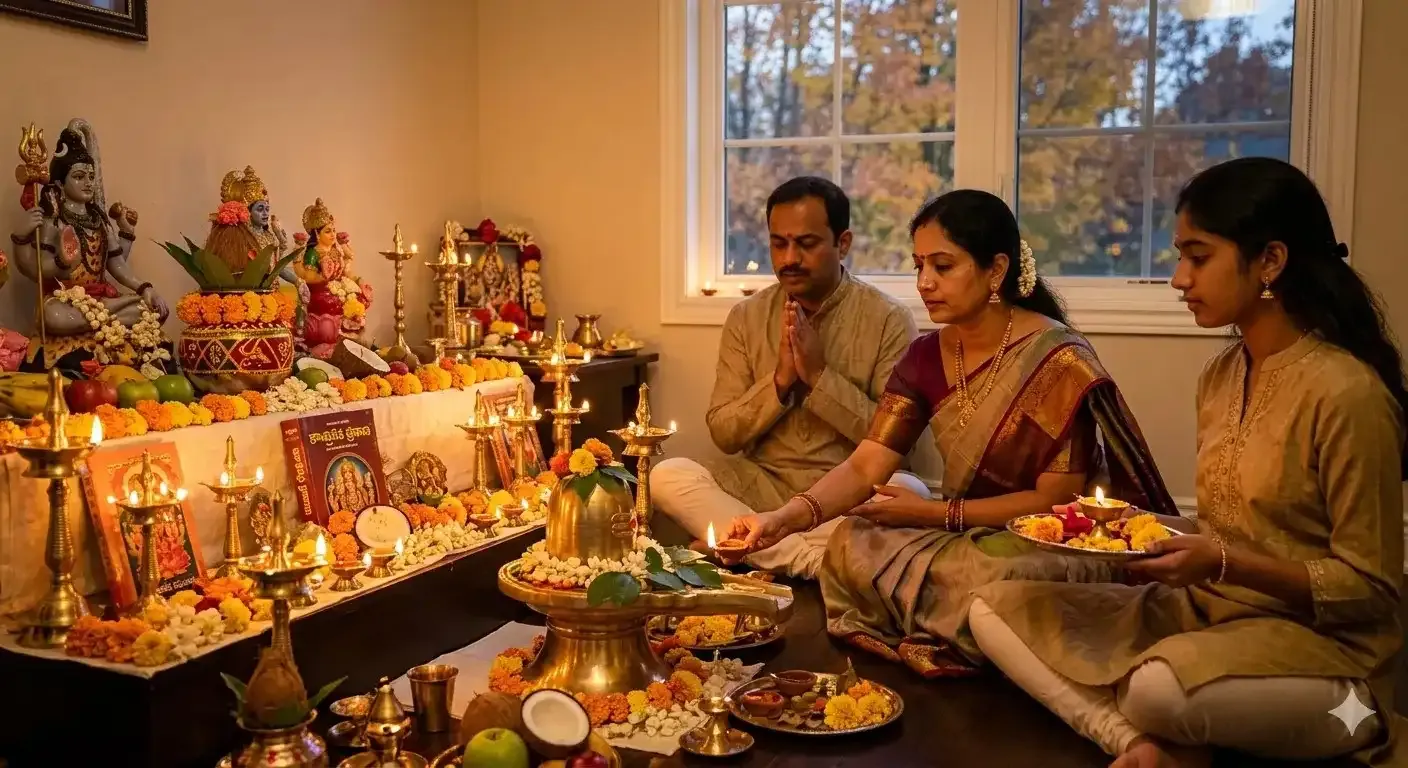
A guide to the Pancha Bhoota Sthalams, the five Shiva temples of South India that represent the five elements: Ekambareswarar at Kanchipuram (earth), Jambukeswarar at Thiruvanaikaval (water), Arunachaleswarar at Tiruvannamalai (fire), Srikalahasti (air) and Nataraja at Chidambaram (space). Legends as commonly told, architecture basics, the Karthigai Deepam link and how pilgrims plan the circuit.
Quick answer: The Pancha Bhoota Sthalams are five Shiva temples in South India, each linked to one of the five elements: Ekambareswarar, Kanchipuram (earth); Jambukeswarar, Thiruvanaikaval (water); Arunachaleswarar, Tiruvannamalai (fire); Srikalahasti (air); and Nataraja, Chidambaram (space). Four are in Tamil Nadu and Srikalahasti is in Andhra Pradesh. Devotees believe that worshipping Shiva in all five forms honours him as the whole of creation. Tiruvannamalai is most famous for Karthigai Deepam, which Drik Panchang lists on Tuesday 24 November 2026, the same day as Kartika Purnima.
This guide has been restored at its original hindutone.com address. It covers the meaning of the five elements, each temple's legend as commonly told, the main features of its architecture and general planning advice. We do not give darshan timings, ticket prices or distances, because they change. Please check each temple's official website before you travel.
Shiva as the five elements
Hindu philosophy describes the physical world as made of five great elements, the pancha mahabhutas: earth, water, fire, air and space. The Pancha Bhoota Sthalams teach that Shiva is present in each of them. In every one of these temples, the linga is identified with one element, and many of the legends and rituals reflect it. The sand linga of Kanchipuram stands for earth. The spring in the sanctum at Thiruvanaikaval stands for water. The column of fire at Tiruvannamalai stands for fire. The flickering lamp at Srikalahasti stands for air. The empty space at Chidambaram stands for akasha, the space that holds everything.
All five temples are ancient and are praised in the Tevaram hymns of the Tamil Shaiva saints, which makes them Paadal Petra Sthalams for Tamil devotees. Srikalahasti is also deeply loved by Telugu devotees.
The five temples at a glance
| Element | Temple | Town | State |
|---|---|---|---|
| Earth (Prithvi) | Ekambareswarar | Kanchipuram | Tamil Nadu |
| Water (Appu / Jala) | Jambukeswarar | Thiruvanaikaval, near Tiruchirappalli | Tamil Nadu |
| Fire (Agni) | Arunachaleswarar | Tiruvannamalai | Tamil Nadu |
| Air (Vayu) | Srikalahasteeswara | Srikalahasti, Tirupati district | Andhra Pradesh |
| Space (Akasha) | Nataraja (Thillai Nataraja) | Chidambaram | Tamil Nadu |
1. Ekambareswarar, Kanchipuram: earth
Kanchipuram is one of the seven sacred cities of India, and Ekambareswarar is its largest Shiva temple. Here Shiva is worshipped as the Prithvi linga, the linga of earth. As the legend is commonly told, Goddess Parvati made a linga of sand under a mango tree on the bank of the river and worshipped it. When a flood came, she embraced the linga to protect it, and Shiva appeared before her. The name "Ekambareswarar" is often explained as the Lord of the single mango tree.
The temple is known for its very tall rajagopuram, its large pillared halls and the sacred mango tree in the inner courtyard, which devotees treat with great reverence. Because the main linga is believed to be made of sand, it is commonly said that it is not bathed with water in the usual way. The temple grew over many centuries, with contributions from Pallava, Chola and Vijayanagara rulers. See our Ekambareswarar temple guide for more.
2. Jambukeswarar, Thiruvanaikaval: water
Thiruvanaikaval lies near Tiruchirappalli, close to the famous Srirangam temple on the island between the Kaveri and Kollidam rivers. Shiva is worshipped here as the Appu linga, the linga of water. A well-known feature is that water seeps up in the sanctum from an underground source, and devotees see this as a sign of the water element. The goddess is Akilandeswari.
As commonly told, Parvati made a linga from the water of the Kaveri under a jambu (jamun or naaval) tree, which gives the temple its name. Another popular story tells of an elephant that worshipped the linga with water and a spider that built a web over it to protect it from falling leaves. The two quarrelled, and both died. The spider was later born as the Chola king Kochenga Chola, who is remembered for building temples where the sanctum is raised so that elephants cannot enter. The name Thiruvanaikaval itself refers to the sacred elephant. The temple has five large enclosures and long corridors of carved pillars. Read more in our Jambukeswarar temple guide.
3. Arunachaleswarar, Tiruvannamalai: fire
Tiruvannamalai sits at the foot of the hill of Arunachala, which devotees revere as Shiva himself. Arunachaleswarar is the Agni linga, the linga of fire, and the goddess is Unnamulai Amman. The temple is one of the largest in India, with tall gopurams on all four sides and several enclosures.
The main legend, as commonly told, is the Lingodbhava story. Brahma and Vishnu argued about who was greater. Shiva appeared between them as an endless column of fire. Brahma flew up as a swan to find its top, and Vishnu dug down as a boar to find its base, but neither could find an end. They accepted Shiva's supremacy, and at their request the column of fire became the hill of Arunachala.
Devotees walk around the hill barefoot in a practice called girivalam, especially on full-moon nights. The town is also linked with many saints, including the twentieth-century sage Ramana Maharshi. Our Arunachaleswara temple guide covers the temple in more detail.
Karthigai Deepam at Tiruvannamalai
Karthigai Deepam is the greatest festival of Tiruvannamalai. It recalls the column of fire from the Lingodbhava story. On the festival day, a lamp is lit in the temple early in the morning, and in the evening the Maha Deepam is lit on top of the Arunachala hill, where it is visible from far away. Drik Panchang lists Karthigai Deepam and Kartika Purnima on Tuesday 24 November 2026 (New Delhi reckoning; the Tamil date depends on the Krittika nakshatra in the month of Karthigai). Follow the temple's official announcement for the festival schedule. See our Karthigai Deepam 2026 guide for the date, story and home rituals. Huge crowds gather on this day, so plan early.
4. Srikalahasti, Andhra Pradesh: air
Srikalahasti stands on the bank of the Swarnamukhi river in the Tirupati district of Andhra Pradesh. Shiva is worshipped as Srikalahasteeswara, the Vayu linga, the linga of air. A commonly told sign of the air element is a lamp in the sanctum whose flame keeps flickering, even though there is no window or draught. The goddess is Gnana Prasunambika.
The name of the town joins three words: Sri (spider), Kala (serpent) and Hasti (elephant). As the legend is told, all three worshipped the linga here in their own way and were granted liberation. The temple is also linked with Kannappa, a hunter whose devotion was so complete that he offered his own eyes to Shiva. Today Srikalahasti is widely known for Rahu-Ketu puja. The temple has a tall gopuram and is set against rocky hills. Many pilgrims combine it with a visit to Tirumala.
5. Nataraja, Chidambaram: space
Chidambaram is the home of Shiva as Nataraja, the Lord of Dance. It represents akasha, space, the subtlest of the five elements. As commonly told, Shiva performed his cosmic dance, the Ananda Tandava, here before the sages Patanjali and Vyaghrapada. The Nataraja image shows this dance of creation, preservation and dissolution.
The temple is famous for the gold-covered roof of its inner hall, the Chit Sabha, and for the Chidambara Rahasyam, the "secret of Chidambaram". Behind a curtain there is an empty space hung with golden bilva leaves, which represents Shiva as formless space. Worship is conducted by a hereditary community of priests, the Dikshitars. The temple complex also has a shrine of Govindaraja Perumal (Vishnu), and its gopurams carry carvings of the classical dance poses. Arudra Darshanam in the Tamil month of Margazhi is one of its greatest festivals. See our Chidambaram Nataraja temple guide.
How pilgrims plan the Pancha Bhoota circuit
There is no fixed route, and devotees visit the five temples in many ways. Some general patterns:
- Chennai as a base: Kanchipuram and Srikalahasti are often visited from Chennai. Many pilgrims add Tirumala on the same trip to Srikalahasti.
- Central Tamil Nadu: Tiruvannamalai is inland, and Chidambaram is near the coast. Pilgrims often visit them on separate days.
- Tiruchirappalli: Thiruvanaikaval is usually visited together with the Srirangam Ranganathaswamy temple.
- Time: most families allow several days, because the temples are spread across two states and are large. Rushing through all five is tiring, especially for elders.
- Festival days: Karthigai Deepam at Tiruvannamalai, Arudra Darshanam at Chidambaram and Maha Shivaratri at all five draw very large crowds. Choose ordinary days for a calmer darshan.
- Transport: pilgrims use trains, state buses, tour packages and private cars. Check current options with operators; we do not list routes or fares.
Please check each temple's official website for current timings, dress rules and festival arrangements before you set out.
Tips for NRIs and first-time visitors
- Dress: wear traditional or modest clothing. Some Tamil Nadu temples have dress rules for the inner shrines; follow local instructions.
- Footwear and phones: footwear must be left outside, and photography is usually not allowed inside the sanctum.
- Offerings: bilva leaves, flowers, coconut and a small lamp are traditional. Buy prasadam only from official temple counters.
- Learn the stories first: reading the legends with children before the trip makes each temple more meaningful.
- From abroad: if you cannot travel, you can light a lamp at home on Karthigai Deepam and chant "Om Namah Shivaya" while remembering the five elements.
Frequently asked questions
What are the Pancha Bhoota Sthalams?
They are five Shiva temples, each associated with one of the five elements: Ekambareswarar at Kanchipuram (earth), Jambukeswarar at Thiruvanaikaval near Tiruchirappalli (water), Arunachaleswarar at Tiruvannamalai (fire), Srikalahasti in Andhra Pradesh (air) and Nataraja at Chidambaram (space). Four are in Tamil Nadu and one is in Andhra Pradesh.
What does "Pancha Bhoota" mean?
"Pancha" means five and "bhoota" means element. In Hindu thought, the physical world is made of five elements: earth (prithvi), water (apas or appu), fire (agni), air (vayu) and space (akasha). "Sthalam" means a sacred place.
Is there a fixed order for visiting the five temples?
There is no single fixed order. Some pilgrims like to follow the order of the elements, from earth to space, but most choose a route based on where they start and how they travel. What matters most is devotion, not the sequence.
Why is Tiruvannamalai special during Karthigai Deepam?
Arunachaleswarar is the fire linga, and the hill of Arunachala is itself revered as Shiva. On Karthigai Deepam, a great lamp, the Maha Deepam, is lit on top of the hill. Drik Panchang lists Karthigai Deepam and Kartika Purnima on Tuesday 24 November 2026; follow the temple's own announcement for the festival schedule.
What is the Chidambara Rahasyam?
It is the "secret of Chidambaram". As commonly described, a curtain near the Nataraja shrine is drawn aside to show an empty space hung with golden bilva leaves. It represents Shiva as formless space, the akasha element itself.
Where can I find darshan timings for these temples?
Timings, special darshan arrangements and festival schedules change, so we do not list them. Please check each temple's official website or the Tamil Nadu and Andhra Pradesh endowments departments before you travel.
Editor's note
Editor's note (6 October 2026): This guide has been restored at its original address after the earlier version was lost. It covers well-established facts about the five Pancha Bhoota temples, with legends as they are commonly told; local temple traditions may tell details differently. The Karthigai Deepam date is from Drik Panchang (New Delhi). We have deliberately not given darshan timings, ticket prices or distances, which change. Please check each temple's official website before you travel.
Related guides
You might also like
Shiva Temples in Canada for Karthika Masam 2026: Where to Worship on the Five Somavarams
Pancharama Kshetras Guide: The Five Shiva Temples of Andhra Pradesh for Karthika Masam 2026
Shiva Temples in the UK for Karthika Masam 2026: Where to Worship on Somavarams and Karthika Pournami