Karthika Masam Temples in Karnataka: Dharmasthala Laksha Deepotsava and Shiva Temples for 2026
A guide to Karthika Masam temples in Karnataka for 2026: Dharmasthala Manjunatha and its Laksha Deepotsava, Murudeshwar, Gokarna Mahabaleshwara, Nanjangud Srikanteshwara, Kukke Subramanya and Male Mahadeshwara Hills, with districts, legends, Karthika deepotsava traditions and the 2026 dates (10 November to 8 December).
Quick answer: Karthika Masa 2026 runs from Tuesday 10 November to Tuesday 8 December 2026 in Karnataka (amanta calendar), with Karthika Pournami (Karthika Hunnime) on Tuesday 24 November 2026. North India counts the same lunar month differently (purnimanta), so its Kartik runs 27 October to 24 November. The best-known Karthika Masam temples in Karnataka are Dharmasthala Manjunatha, Murudeshwar, Gokarna Mahabaleshwara, Nanjangud Srikanteshwara, Kukke Subramanya and Male Mahadeshwara Hills. Dharmasthala is famous for its Laksha Deepotsava, a festival of one lakh lamps held in Karthika. Its exact dates are announced by the temple each year.
Last updated: 30 October 2026
This guide covers each temple's deity, district and legend as commonly told, and the Karthika deepotsava traditions of Karnataka. New on 30 October 2026: a date-by-country table for Kannadigas abroad, a note on the amanta and purnimanta calendars, and the four Karthika Mondays. We do not give darshan timings, seva prices or event dates that the temples announce themselves. Please check each temple's official website before you travel.
Karthika Masa 2026 in Karnataka: dates and deepotsava traditions
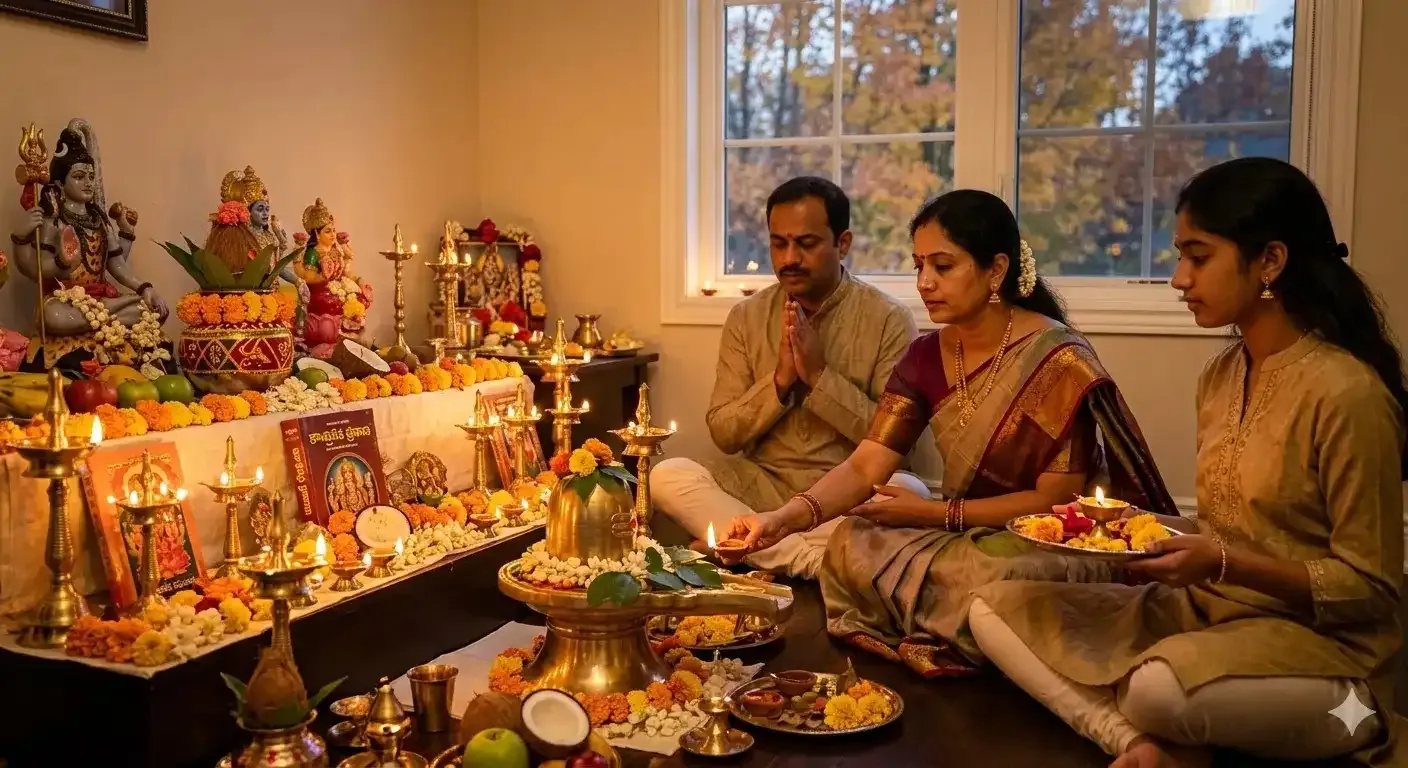
In Karnataka, Karthika masa is the month of lamps. Across the state, temples hold Karthika deepotsava, when rows of clay lamps are lit around the shrine, on the steps of temple tanks and along the outer walls. Families light lamps at home every evening, and many hang a lamp high outside the house. Mondays (Karthika Somavara) are kept for Shiva worship, and Karthika Hunnime is one of the brightest nights of the year.
- Karthika Masa begins: Tuesday 10 November 2026 (Kartika Shukla Pratipada), in the amanta calendar.
- Karthika Somavara: every Monday of the month, with special abhisheka and lamp offerings at Shiva temples.
- Karthika Hunnime (Pournami): Tuesday 24 November 2026.
- Karthika Masa ends: Tuesday 8 December 2026 (Amavasya).
Many temples hold their own Laksha Deepotsava or deepotsava on a day of their choosing within the month, so dates differ from temple to temple. See our Karthika Masam 2026 guide for the meaning of the month and its observances.
Karthika Masa 2026 dates by country
Karthika dates are the same lunar days everywhere, but the calendar date can shift by one day depending on where the tithi is running at your local sunrise. The table follows the HinduTone panchang calculator, which matched Drik Panchang on every tithi we checked. India's dates are from Drik Panchang. Always confirm with your local temple.
| Country or region | Karthika Masa begins (amanta) | Karthika Pournami | Karthika Masa ends (Amavasya) |
|---|---|---|---|
| India (IST) | Tue 10 Nov | Tue 24 Nov | Tue 8 Dec |
| USA, Canada, UK, Brazil | Mon 9 Nov (Pratipada is under way at local sunrise) | Tue 24 Nov | Tue 8 Dec |
| UAE, Germany and most of Europe, South Africa | Tue 10 Nov | Tue 24 Nov | Tue 8 Dec |
| Singapore, Malaysia | Tue 10 Nov | Tue 24 Nov | Tue 8 Dec |
| Australia (Sydney) | Tue 10 Nov | Tue 24 Nov | Wed 9 Dec |
Clock changes: the UK and most of Europe, and Ontario, Quebec and the Atlantic provinces, moved to winter time on the weekend of 25 October (Europe) and 1 November (North America). From November 2026 most of British Columbia, Alberta and Manitoba keep daylight time all year, so their clocks do not fall back. The dates above do not depend on the clock change, but any sunrise or lamp-lighting time you read off a phone should be checked against it.
Amanta and purnimanta: why North Indian friends say Kartik started on 27 October
Karnataka, Andhra Pradesh, Telangana, Maharashtra and Gujarat divide the lunar year from new moon to new moon (amanta). In this system Karthika begins the day after Deepavali Amavasya and ends on the next Amavasya, so the full moon, Karthika Hunnime, falls in the middle of the month. North India and Nepal use the purnimanta system, which divides the year from full moon to full moon. There, Kartik began on Tuesday 27 October 2026 and ends with Kartik Purnima on 24 November, and Margashirsha begins on 25 November. The full-moon day of 24 November is the same night in both systems; only the name of the month around it differs.
For a Kannadiga family this means that Karthika Somavara, the lamp-lighting and the deepotsava calendar of your home temple follow the amanta dates in the table, while a friend in Delhi or Varanasi may already be several weeks into Kartik.
The four Karthika Mondays in 2026
| Karthika Somavara | Date (India) | Note |
|---|---|---|
| First | Monday 16 November | Also Vrishchika Sankranti |
| Second | Monday 23 November | Vaikuntha Chaturdashi; Purnima begins late that night |
| Third | Monday 30 November | Waning fortnight, usually quieter at temples |
| Fourth | Monday 7 December | Masik Shivaratri, the last Karthika Monday |
Dates are from Drik Panchang for India. See the full Karthika Somavaram 2026 guide for tithi and nakshatra timings, and the Karthika Pournami 2026 guide for the full-moon night.
The temples at a glance
| Temple | Deity | Town | District |
|---|---|---|---|
| Sri Kshetra Dharmasthala | Manjunatha (Shiva) | Dharmasthala | Dakshina Kannada |
| Murudeshwara temple | Murudeshwara (Shiva) | Murudeshwar | Uttara Kannada |
| Mahabaleshwara temple | Mahabaleshwara (Atmalinga) | Gokarna | Uttara Kannada |
| Srikanteshwara temple | Srikanteshwara (Nanjundeshwara) | Nanjangud | Mysuru |
| Kukke Subramanya temple | Subrahmanya | Subrahmanya | Dakshina Kannada |
| Male Mahadeshwara temple | Mahadeshwara (Madappa) | MM Hills | Chamarajanagar |
Karnataka temples to visit in Karthika Masa
1. Dharmasthala Manjunatha and the Laksha Deepotsava
Sri Kshetra Dharmasthala stands on the Nethravathi river in Belthangady taluk of Dakshina Kannada. Lord Manjunatha, a form of Shiva, is worshipped by Madhva Vaishnava priests, while the temple is administered by the Jain Heggade family, whose head serves as the Dharmadhikari. This harmony of traditions, together with free annadana for every pilgrim, makes Dharmasthala one of the most respected temples in South India.
The temple's great Karthika event is the Laksha Deepotsava, when the temple and the town are lit with lamps over several days and the deity is taken out in procession. The festival is traditionally accompanied by a gathering on religious harmony and a literary gathering. The exact dates are announced by the temple each year, so please check the official Dharmasthala website before planning. Read our full Dharmasthala Manjunatha temple guide.
2. Murudeshwar
Murudeshwar is a coastal town in Bhatkal taluk of Uttara Kannada, where the temple stands on Kanduka Giri, a small hill with the Arabian Sea on three sides. It is famous for a giant seated statue of Lord Shiva, often described as one of the tallest in the world, and for a very tall gopuram. According to the Atmalinga legend, a piece of the cloth covering the Atmalinga fell here when Ravana tried to pull it out at Gokarna. A lamp offered to Shiva beside the sea on a Karthika evening is a memorable experience. See our Murudeshwara temple guide.
3. Gokarna Mahabaleshwara
Gokarna, in Kumta taluk of Uttara Kannada, is one of the holiest Shiva kshetras on the west coast. The Mahabaleshwara temple enshrines the Atmalinga. In the well-known legend, Ravana obtained the Atmalinga from Shiva on the condition that it must not be placed on the ground. Lord Ganesha, disguised as a cowherd boy, placed it down at Gokarna, and it could not be moved again. Ravana's great effort to lift it gave the Lord the name Mahabala, the mighty one. Devotees bathe in the sea and at Kotitirtha before darshan. Gokarna is also known for its ancestral rites.
4. Nanjangud Srikanteshwara
Nanjangud, on the Kapila (Kabini) river in Mysuru district, is home to the Srikanteshwara temple, also called Nanjundeshwara. The name recalls Shiva drinking the poison (nanju) that rose from the churning of the ocean, which turned his throat blue. The temple is very large, with a tall gopuram, and it is often called the Dakshina Kashi of Karnataka. It is a short trip from Mysuru, and devotees visit in large numbers on Karthika Mondays. Many families also combine it with a visit to the Chamundeshwari temple on Chamundi Hills.
5. Kukke Subramanya
Kukke Subramanya, on the Kumaradhara river in Sullia taluk of Dakshina Kannada, is dedicated to Lord Subrahmanya, worshipped here together with the serpent king Vasuki. It is one of the most important temples in India for Naga worship and for rites to remove Sarpa dosha. Its biggest festival, Champa Shashti, falls in the next month, Margashira, so it is not part of Karthika. Even so, many devotees visit in Karthika, often on the same trip as Dharmasthala. Check the temple's official website for festival dates.
For more on this shrine, read our Kukke Subramanya temple guide.
6. Male Mahadeshwara Hills
The Male Mahadeshwara temple stands at MM Hills in Hanur taluk of Chamarajanagar district, in forested hills near the Tamil Nadu border. Mahadeshwara, lovingly called Madappa, was a Shaiva saint whom devotees worship as a form of Lord Shiva, and he is pictured riding a tiger. The temple's great festivals fall around Deepavali, Maha Shivaratri and Ugadi, and lamp worship is popular in Karthika. See our Male Mahadeshwara temple guide.
Planning a Karthika temple trip in Karnataka
- Coastal circuit: Dharmasthala and Kukke Subramanya are often combined, and Udupi and Mangaluru are nearby. Gokarna and Murudeshwar lie further north on the Uttara Kannada coast and pair well together.
- Mysuru circuit: Nanjangud is an easy trip from Mysuru, and MM Hills can be added if you allow a full day.
- Deepotsava dates: each temple announces its own deepotsava dates. Always confirm on the temple's official website.
- Crowds: Mondays, Karthika Hunnime and deepotsava nights are the busiest. Book accommodation early if you plan to attend a deepotsava.
- Timings: special Karthika arrangements change each year. Check the temple's official website before you travel.
Tips for NRIs visiting in Karthika
- Dress: traditional or modest clothing is expected. Some coastal Karnataka temples ask men to remove shirts before entering the sanctum; follow local instructions.
- Annadana: several of these temples serve free meals to pilgrims. Respect the queue and the rules of the dining hall.
- Elders and children: deepotsava nights are crowded. Keep children close and agree on a meeting point.
- From abroad: if you cannot travel this year, light a row of lamps at home on Karthika Hunnime and on Mondays, and take part in deepotsava events at your local temple.
Also read: Famous temples in Karnataka: source-checked guide.
Frequently asked questions
When is Karthika Masa 2026 in Karnataka?
Karthika Masa 2026 begins on Tuesday 10 November 2026 and ends on Tuesday 8 December 2026 (Amavasya), following the amanta calendar used in Karnataka. Karthika Pournami (Karthika Hunnime) is on Tuesday 24 November 2026.
When does Karthika Masa 2026 start for Kannadigas in the USA, UK or Australia?
The lunar month is the same, but the start date depends on sunrise where you live. Pratipada is already under way at local sunrise on Monday 9 November 2026 in the USA, Canada, the UK and Brazil, so many families there start on 9 November. In the UAE, Germany, Singapore, Malaysia and Australia the start is Tuesday 10 November, as in India. Karthika Hunnime is Tuesday 24 November everywhere in our table. Follow your local temple if it announces a different day.
When is the Dharmasthala Laksha Deepotsava in 2026?
The Laksha Deepotsava at Dharmasthala is held during Karthika masa, and its exact dates are announced by the temple each year. Please check the official Dharmasthala website for the 2026 announcement before you plan your trip.
What is Laksha Deepotsava?
Laksha Deepotsava means a festival of one lakh (one hundred thousand) lamps. At Dharmasthala and at several other Karnataka temples, rows of lamps are lit around the temple and the town during Karthika, and the festival is accompanied by processions and cultural and religious gatherings.
Is Kukke Subramanya Champa Shashti in Karthika?
No. Champa Shashti, the most important festival at Kukke Subramanya, falls in the following month, Margashira. Kukke is still visited by many devotees during Karthika, and some families plan one trip that covers both months. Check the temple's official website for the dates.
Which Karthika temples in Karnataka are linked to the Atmalinga legend?
Gokarna and Murudeshwar are both linked to the Atmalinga legend. In the story, Ganesha tricked Ravana into placing the Atmalinga on the ground at Gokarna. When Ravana tried to pull it out, pieces of its covering were scattered, and one of them is said to have fallen at Murudeshwar.
Is Karthika the same month as Kartik in North India?
Yes, it is the same lunar month with a different counting method. Karnataka uses the amanta calendar, so Karthika runs from 10 November to 8 December 2026. North India uses the purnimanta calendar, where Kartik began on 27 October and ends with Kartik Purnima on 24 November. The full-moon night of 24 November is the same in both.
Editor's note
Editor's note (30 October 2026): We updated this guide on 30 October 2026. Changes: a date-by-country table (India, USA, Canada, UK, UAE, Europe, Singapore, Malaysia, Australia), a note on the amanta and purnimanta calendars, a table of the four Karthika Mondays, a link to the Kukke Subramanya guide and two new questions. No date has changed. The 6 October 2026 note follows.
Editor's note (6 October 2026): This guide has been restored at its original address after the earlier version was lost. It covers well-established facts about these Karnataka temples and their legends as commonly told. Karthika Masa 2026 dates follow the Drik Panchang amanta month. The Dharmasthala Laksha Deepotsava dates are announced by the temple each year, so we have not given a date. We have also not given darshan timings, seva prices, distances or transport details, which change. Please check each temple's official website before you travel.
Related guides
- Karthika Masam 2026
- Dharmasthala Manjunatha temple guide
- Murudeshwara temple guide
- Male Mahadeshwara temple guide
- Kotilingeshwara temple guide
- Karthika Pournami 2026
- Karthika Snanam and Deepa Daanam 2026
- Karthika Masam 2026: Shiva temples in Andhra Pradesh
- Karthika Somavaram 2026: the four Mondays
- Vaikuntha Chaturdashi 2026: Hari-Hara Milan
- Kukke Subramanya temple guide
Share this with family and friends
Send it on WhatsApp, post it, or copy the link.
More on Karnataka
- Kittur Rani Chennamma: The Queen Who Resisted the East India Company in 1824
- Sakkare Acchu Recipe (Karnataka Sugar Moulds for Sankranti)
- Ellu Bella Recipe (Karnataka Sankranti Mix)
- Diwali 2026 in Mysuru: Deepavali Date, Lakshmi Puja Muhurat, Balipadyami, Chamundi Hill and Cracker Timings
- Bengaluru to Tirumala: How to Reach by Train, Bus and Car (2026 Guide)
- Hanuman Jayanti 2027: Date (Chaitra Purnima), Puja Vidhi, Telugu, Tamil and Karnataka Dates and Dates Abroad
More from Temples
- Mannarpolur Sri Alaghu Mallari Krishnaswamy Temple: Krishna with Jambavati and the Syamantaka Legend
- Why Is Sabarimala Temple Open Only on Certain Days? The Calendar, the Reasons and the 2026-27 Season
- Kateel Sri Durgaparameshwari Temple: History, Legend, Timings and Prabhas's Visit
- Hindu Temples in Pakistan After the 1947 Partition: The Forgotten Religious Heritage of Hindus
- Anjaneri Hills, Nashik: The Traditional Birthplace of Lord Hanuman and the Anjani Mata Temple
You might also like
Famous Temples in Karnataka: A Source-Checked Guide to Kukke, Kollur, Mysuru, Melukote, Hampi and More
25 Famous Shiva Temples in South India to Visit During Karthika Masam 2026
Srisailam Karthika Masam 2026: Dates, Darshan Rules, Karthika Pournami Deepotsavam and Pilgrimage Guide