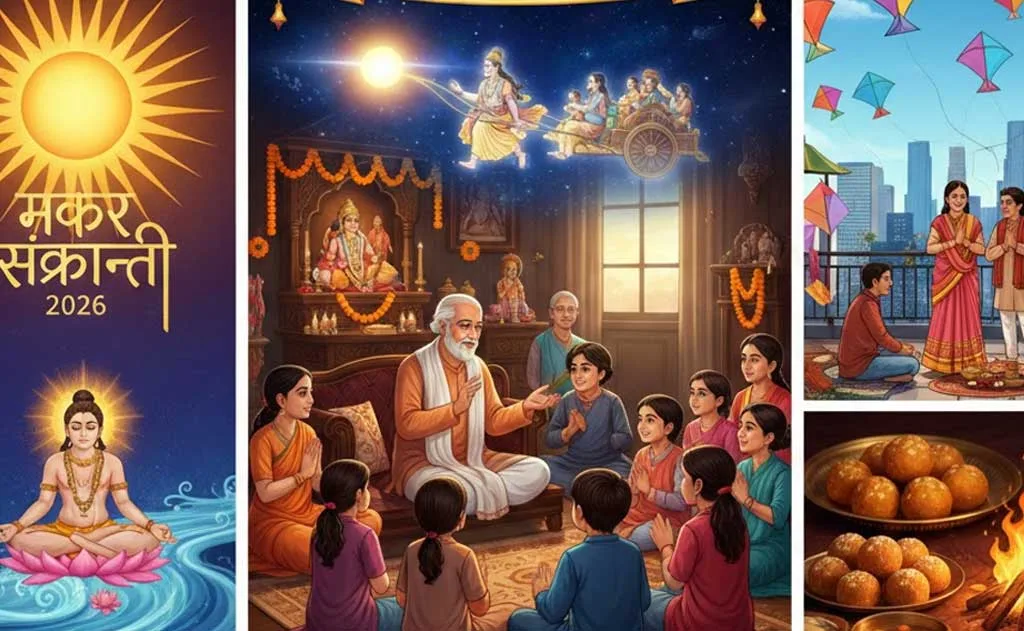
Makar Sankranti in Rajasthan: Kites, Holy Dips, Daan and Winter Sweets
Quick answer: In Rajasthan, Makar Sankranti is a day of rooftop kite flying, above all in Jaipur, along with a holy dip at Pushkar, Galta and other sacred waters, feeding cows with fodder and jaggery, and giving daan. Women traditionally give 13 or 14 items as gifts or charity. Families eat pheeni,
Quick answer: In Rajasthan, Makar Sankranti is a day of rooftop kite flying, above all in Jaipur, along with a holy dip at Pushkar, Galta and other sacred waters, feeding cows with fodder and jaggery, and giving daan. Women traditionally give 13 or 14 items as gifts or charity. Families eat pheeni, gajak, til ladoo and hot pakodi on the roof, and the evening ends with lanterns and fireworks.
Makar Sankranti 2027 in Rajasthan: key facts
| 2027 (India) | |
|---|---|
| Makar Sankranti | Friday 15 January 2027 (panchang) |
| Moment the Sun enters Makara | 9:14 PM IST on Thursday 14 January 2027 (Drik Panchang) |
| Rajasthan 2027 holiday list | Check the state government's list when published |
| Jaipur kite festival | Organised each year at Jal Mahal by the Rajasthan Tourism Department; check Rajasthan Tourism for the 2027 date |
The Sun enters Makara (Capricorn) after sunset on Thursday 14 January 2027, so panchangs place Makar Sankranti on Friday 15 January. Some families and government lists keep 14 January; follow your family priest or local panchang. Full timings are in our Makar Sankranti 2027 guide.
Kites over Jaipur
Kite flying is the face of Sankranti in Rajasthan, and Jaipur is its capital. In the days before the festival, kite and string sellers in the old city's bazaars, such as Chandpole Bazar and around Choti Chaupad, report their busiest trade of the year (Outlook, 2022). On the day itself the roofs of the walled city fill from morning. A Jaipur kite seller told Outlook: "Flying kites has been the tradition of Sankranti every year in Jaipur."
Kite duels are the heart of it. When a string cuts a rival kite, the cry goes up: "Woh kaata!" ("That one's cut!"), which Rajasthan Patrika reported echoing across Jaipur's roofs in 2026. Outlook recorded other rooftop calls used during duels, such as "dheel dena" and "pench ladana", both about how the string is let out and crossed with a rival's. Running after the cut kites that drift down, "patang lootna", is part of the fun for children and adults alike (Rajasthan Patrika, 2026).
As dusk falls, the sky changes. Families send up lit paper lanterns and lantern kites, and set off fireworks from the roofs, so that Rajasthan Patrika compared the night of Sankranti in 2026 to Diwali. The Tourism Department also stages fireworks in the old city; in 2026 PTI reported a display near Hawa Mahal.
The Kite Festival at Jal Mahal
The Rajasthan Tourism Department organises an official Kite Festival at Jal Mahal, the palace in Man Sagar Lake on Amber Road, on Makar Sankranti. Incredible India (Ministry of Tourism) lists the organiser as the Tourist Reception Centre, Jaipur, and describes kite flying by day and the Patang Atish Utsav, with illuminated kites and performances, as evening falls. All India Radio reported the 2025 festival there with a kite exhibition, and in 2026 the Chief Minister opened it by flying a kite (PTI and Rajasthan Patrika). Check Rajasthan Tourism for the 2027 programme before you travel.
Kite safety and birds
Sharp kite string injures many birds every Sankranti. In Jaipur, veterinary polyclinics have stayed open all day on Sankranti to treat injured birds (All India Radio, 2025), and social organisations run bird-rescue camps (PTI, 2026). Use plain cotton string; the National Green Tribunal banned nylon and synthetic manja in 2017. Read our kite-flying safety guide before you go up to the roof.
Holy dips at Pushkar, Galta and other sacred waters
Sankranti morning begins, for many, with a bath in sacred water. All India Radio named the main places in 2025: Pushkar lake in Ajmer, Kolayat in Bikaner, Galta in Jaipur and Beneshwar Dham in Dungarpur. PTI reported large crowds at Pushkar Sarovar and Galta Tirth again in 2026. Bathing is followed by prayers to the Sun and visits to temples; in Jaipur, PTI named Govind Devji and Tadkeshwarji. For the meaning of the bath, see Sankranti snanam: the holy bath.
Daan: cows, the needy and gifts between women
Giving is central. Rajasthan Patrika's Jaipur report (2026) describes people feeding cows with fodder and jaggery early in the morning as daan. Its Ajmer report (2020) describes cows and calves being fed green fodder, collection points set up at gaushalas, and clothes and saris bought for giving away.
Women's gifting has a special form. Rajasthan Patrika's Ajmer report (2020) describes women giving 13 items to 13 married women ("suhagins") for the well-being of the household. Its Jaipur report (2026) and Outlook (2022) describe women giving 14 items. Both counts are reported, and families follow their own custom; the items are usually things for the household, make-up or food. Families also buy clothes and sweets for newly married women and for girls of the family at Sankranti (Rajasthan Patrika, 2020). For what is traditionally given on Sankranti across India, see our Sankranti daan guide.
What Rajasthan eats on Sankranti
Rajasthan's Sankranti table is about winter sweets made with sesame and jaggery, and fried snacks for the roof.
- Pheeni (feeni): a fine, thread-like fried sweet. Rajasthan Patrika (2026) describes "hot pakodi, pheeni and tea" on Jaipur's rooftops; Outlook (2022) lists pheeni with ghevar and gajak.
- Gajak: a brittle sesame sweet made with jaggery or sugar. Named in both Patrika reports and in Outlook.
- Til ladoo: sesame-and-jaggery balls, offered to the deity as bhog and shared (Rajasthan Patrika, Ajmer 2020). Our tilgul ladoo recipe and chikki recipe are close home versions.
- Rewri and groundnuts: small sesame-and-sugar sweets and roasted peanuts, part of the offering (Rajasthan Patrika, Ajmer 2020).
- Ghevar: a festive Rajasthani sweet, named among Sankranti treats in Jaipur (Outlook, 2022).
- Pakodi and halwa: hot fritters on the roof, and halwa and pakodi distributed to others as part of the day's giving (Rajasthan Patrika, 2020 and 2026).
For sesame and jaggery sweets from other states, see Sankranti recipes by state.
How Rajasthan's Sankranti compares with its neighbours
Rajasthan shares its kite passion with Gujarat, where Uttarayan is the great kite festival. To the north, Punjab and Haryana keep Lohri the night before with a bonfire, and Haryana and Delhi families keep Sakrat. Rajasthan's own mix of rooftop kites, cows fed with jaggery, sacred-lake bathing and women's 13- or 14-item gifting gives it a character of its own.
FAQ
Is Makar Sankranti on 14 or 15 January 2027 in Rajasthan?
The panchang places it on Friday 15 January 2027, because the Sun enters Makara at 9:14 PM IST on Thursday 14 January, after sunset. Some families and lists keep 14 January; follow your local panchang.
Where is the Jaipur kite festival held?
At Jal Mahal on Amber Road, Jaipur, organised by the Rajasthan Tourism Department on Makar Sankranti. Check Rajasthan Tourism for the 2027 programme.
What do women give on Makar Sankranti in Rajasthan?
Women traditionally give 13 or 14 items, such as household goods, make-up or food. One Rajasthan Patrika report describes 13 items to 13 married women; other reports say 14 items.
What sweets are eaten on Makar Sankranti in Rajasthan?
Pheeni, gajak, til ladoo, rewri and ghevar, with hot pakodi on the roof.
Where do people take a holy dip in Rajasthan on Sankranti?
Pushkar (Ajmer), Galta (Jaipur), Kolayat (Bikaner) and Beneshwar Dham (Dungarpur) are the best-known places.
What does "Woh kaata" mean?
"That one's cut!" It is the cry when a kite string cuts a rival kite during a rooftop kite duel.
Sources
- PTI, "Makar Sankranti celebrated in Jaipur", The Week, 14 January 2026: https://www.theweek.in/wire-updates/national/2026/01/14/makar-sankranti-celebrated-in-jaipur-taarak-mehta-ka-ooltah-chashmah-cast-joins-for-kite-flying.amp.html (accessed 12 November 2026).
- Rajasthan Patrika (Jaipur), Makar Sankranti report, 14 January 2026: https://www.patrika.com/jaipur-news/makar-sankranti-jaipur-soars-with-kites-by-day-fireworks-by-night-as-cm-bhajanlal-sharma-flies-kite-at-jal-mahal-20260035 (Hindi; accessed 12 November 2026).
- Rajasthan Patrika (Ajmer), Makar Sankranti worship and daan, 14 January 2020: https://www.patrika.com/ajmer-news/makar-sankranti-traditional-worship-and-donation-5642488/ (Hindi; accessed 12 November 2026).
- Outlook, "Makar Sankranti: Kites Soar High Amid Omicron Scare", 14 January 2022: https://www.outlookindia.com/national/india-news-makar-sankranti-kites-soar-high-amid-omicron-scare-news-409699 (accessed 12 November 2026).
- All India Radio (News On AIR), "Rajasthan celebrates Makar Sankranti with devotion and festivities", 14 January 2025: https://newsonair.gov.in/rajasthan-celebrates-makar-sankranti-with-devotion-and-festivities (accessed 12 November 2026).
- Incredible India (Ministry of Tourism, Government of India), "Kite Festival", Jaipur: https://www.incredibleindia.gov.in/en/festivals-and-events/rajasthan/kite-festival (accessed 12 November 2026).
- Rajasthan Tourism (Government of Rajasthan): https://www.tourism.rajasthan.gov.in/ (site did not load on 12 November 2026; check for the 2027 programme).
- National Green Tribunal, Principal Bench, judgment of 11 July 2017 in Khalid Ashraf v. Union of India, O.A. 384 of 2016, copy hosted by the Government of Puducherry: https://dste.py.gov.in/ppcc/pdf/Legal/Hon%E2%80%99ble%20NGT%20Orders/384%20of%202016%20dt.%2011.07.2017.pdf (accessed 12 November 2026).
- Drik Panchang, Makar Sankranti 2027 (moment of the Sun's entry into Makara), via our 2027 date data (accessed November 2026).
Last reviewed: 12 November 2026.
Related guides
Share this with family and friends
Send it on WhatsApp, post it, or copy the link.
More from Festivals
- Haridwar Makar Sankranti Snan: A Guide to Har Ki Pauri, the Ganga Aarti and the Ardh Kumbh
- Magh Mela at Prayagraj: A Guide to the Sangam, Kalpvas and the Bathing Days
- Gangasagar Mela: A Guide to the Makar Sankranti Pilgrimage at Sagar Island
- Sankranti and Pongal Wishes in 9 Indian Languages
- Pongal and Makar Sankranti Wishes and Messages
You might also like
Makar Sankranti and Pongal in Canada: Times by Province, Tamil Heritage Month and Winter Tips
Pongal and Makar Sankranti in the UAE and the Gulf
Makar Sankranti and Pongal in Australia: A Midsummer Festival Guide