Navratri 2026 for Mothers and Pregnant Women: Gentle Devotion, Children and Skandamata
Navratri 2026 (11 to 19 October in India) for mothers, mothers-to-be and new mothers: shared aarti and story time with children, Skandamata as the mother-goddess on Thursday 15 October, Kanya Pujan with daughters, and gentle devotion without strict fasting during pregnancy and breastfeeding. Always consult your doctor before any fast.
Navratri 2026 (11 to 19 October in India) for mothers, mothers-to-be and new mothers: shared aarti and story time with children, Skandamata as the mother-goddess on Thursday 15 October, Kanya Pujan with daughters, and gentle devotion without strict fasting during pregnancy and breastfeeding. Always consult your doctor before any fast.
Quick answer: Navratri 2026 runs from Sunday 11 October to Monday 19 October in India (Drik Panchang). For mothers, the festival can be shared with children through a short aarti, a bedtime Navadurga story and Kanya Pujan on Monday 19 October (Ashtami and Navami). Day 5, Thursday 15 October, honours Skandamata, the mother-goddess. If you are pregnant or breastfeeding, many families advise against strict fasting: devotion without fasting and light sattvic meals are a complete way to observe Navratri. Always consult your doctor before any fast.
Every family does this differently. Nothing on this page is a rule, and nothing here is medical advice. Take what feels right for you and your little ones.
Devotion with young children
Mothers often worry that with small children there is no time for "proper" puja. In many homes, though, Navratri is exactly when children first learn to love the Goddess, simply by being near their mother at the lamp.
- Shared aarti: five minutes in the evening, with children ringing the bell, clapping and offering a flower. Keep the lamp and matches out of reach.
- Story time: one short story each night, one for each form of Durga. Try our Navratri stories for kids: one story every night.
- One name a day: older children can learn the day's short naam mantra. Toddlers can simply say "Jai Mata Di".
- Colour game: let children pick something in the day's colour, from a toy to a T-shirt, using the Navratri 2026 colours list.
- Crafts: paper diyas, a cardboard kalash or a rangoli with rice. See fun Navratri activities for kids.
- Garba: children love the circle. Go early, stay near the edge and leave before the late crowd. See Garba for beginners, etiquette and kids.
Here is a simple mantra for the first day, to Shailaputri. Each day only the Devi's name changes.
ॐ देवी शैलपुत्र्यै नमः॥
Om Devi Shailaputryai Namah
For explaining the festival to older children, see Explaining Navratri and Dussehra to children: a parent's guide.
Skandamata: the mother-goddess of Day 5
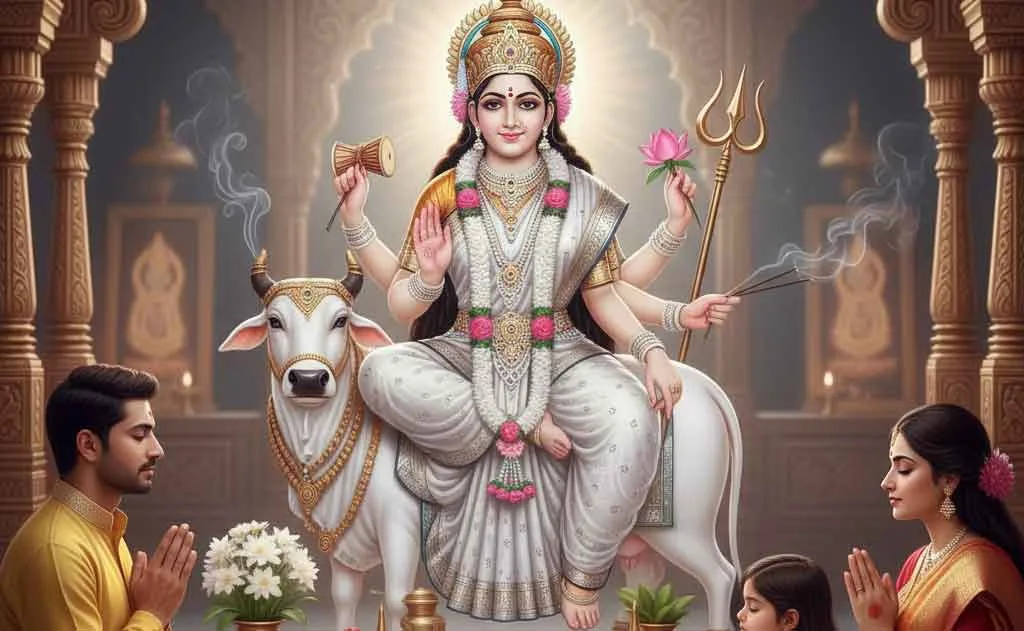
On the fifth day of Navratri (Thursday 15 October 2026 in India), devotees honour Skandamata, "the mother of Skanda". Skanda, also called Kartikeya or Murugan, is the son of Shiva and Parvati and the commander of the gods. Skandamata is usually shown seated on a lion, holding lotuses, with the child Skanda on her lap.
Many mothers feel a special closeness to her. She is strong enough to ride a lion and tender enough to hold a child. Traditionally she is worshipped with a simple offering; bananas are a common bhog for this day, and yellow is the popular colour custom for a Thursday.
Her naam mantra:
ॐ देवी स्कन्दमातायै नमः॥
Om Devi Skandamatayai Namah
It means "Salutations to Goddess Skandamata." Some mothers chant it 11 or 21 times with their child sitting beside them, then tell the story of how Skanda was born to defeat the demon Tarakasura.
Kanya Pujan with your daughters
On Ashtami or Navami, many families honour young girls as forms of the Devi: washing their feet, applying kumkum, offering a meal of halwa, puri and chana, and giving a small gift. In India both Ashtami and Navami fall on Monday 19 October 2026.
- If you have a daughter, this can be her day too. Many mothers include their own daughters alongside invited girls.
- Explain it simply: "Today we honour you because the Goddess lives in every girl."
- Keep the gift age-appropriate: a book, stationery, bangles or a small toy.
- Some families also include a young boy, often seen as a form of Bhairava or Hanuman. Customs vary.
- Full vidhi: Kanya Pujan 2026: date and Ashtami/Navami vidhi. Recipes: Kanya Pujan prasad: halwa, puri and chana.
For pregnant women: devotion without strict fasting
Many pregnant women want to keep Navratri as they always have, and many families gently advise against strict fasting during pregnancy. The good news is that fasting was never the only way to honour the Devi.
Please consult your doctor before any fast, whether it is a full fast, a single-meal fast, a fruit-only fast or simply changing your usual diet for nine days. Your doctor knows your health and your pregnancy.
Ways many pregnant women observe Navratri without strict fasting:
- Keep the puja: light the lamp, offer flowers and chant the day's naam mantra. Sit comfortably, with a cushion or a chair; there is no need to sit on the floor.
- Sattvic meals: many women simply avoid onion, garlic, meat and alcohol for nine days and eat their normal, regular meals.
- Offer, rather than give up: offer the day's bhog to the Devi and share the prasad.
- Listening as devotion: listen to the Devi Mahatmya or a stotra being recited when you are tired.
- A gentle sankalpa: some women dedicate a small daily act, such as a kind word or a prayer for their baby, in place of a fast.
- Rest is allowed: skip late-night Garba if you are tired, and avoid crowds if your doctor has advised it.
A short prayer many women recite:
सर्वमङ्गलमाङ्गल्ये शिवे सर्वार्थसाधिके। शरण्ये त्र्यम्बके गौरि नारायणि नमोऽस्तु ते॥
Sarva-mangala-mangalye shive sarvartha-sadhike, sharanye tryambake gauri narayani namostu te.
It means, in short: "O auspicious one, the giver of all good, who fulfils every aim, the refuge, the three-eyed Gauri, Narayani, salutations to you."
For what is usually eaten on a Navratri vrat, see Navratri fasting rules 2026, and for a full non-fasting plan, see Navratri without fasting: a devotional routine. If your doctor is comfortable with vrat foods, ideas such as makhana kheer or samak rice khichdi can be eaten as part of regular meals.
For new and breastfeeding mothers
Traditions around new mothers vary widely. In some families a new mother rests for a period after childbirth and does not perform formal puja; in others she is encouraged to pray whenever she likes. Follow your family's custom and your own comfort.
- Many families advise breastfeeding mothers to eat and drink regularly; consult your doctor before any form of fasting.
- Let someone else set up the kalash or cook the bhog this year. Joining the aarti is enough.
- Hold your baby during the evening aarti, or let them sleep while you chant softly.
- If you cannot sit for long, a single naam mantra said with love is a complete offering.
A gentle 9-day plan for mothers
Dates are for India (Drik Panchang). Colours follow the popular weekday custom; for Days 8 and 9, lists differ.
| Day and date | Devi | Colour (custom) | With children | Gentle practice |
|---|---|---|---|---|
| 1: Sun 11 Oct | Shailaputri | Orange | Set up the altar together | Light the lamp; first story |
| 2: Mon 12 Oct | Brahmacharini | White | Story of patience | Naam mantra 11 times |
| 3: Tue 13 Oct | Chandraghanta | Red | Let them ring the bell | Offer milk or kheer |
| 4: Wed 14 Oct | Kushmanda | Royal blue | Draw the sun together | Short evening aarti |
| 5: Thu 15 Oct | Skandamata | Yellow | Child sits with you for puja | Pray for your children |
| 6: Fri 16 Oct | Katyayani | Green | Paper diya craft | Offer honey |
| 7: Sat 17 Oct | Kalaratri | Grey | A gentle protection story | Rest; early Garba if you wish |
| 8: Sun 18 Oct | Mahagauri | Lists differ | Help prepare prasad | Saddula Bathukamma for Telangana families |
| 9: Mon 19 Oct | Siddhidatri | Lists differ | Kanya Pujan | Ashtami and Navami puja |
Dussehra follows on Tuesday 20 October 2026, and Diwali on Sunday 8 November 2026. For the full festival overview, see the Navratri 2026 complete guide for NRIs and the diaspora.
Mothers abroad
- Follow your local temple's calendar. Drik Panchang lists Durga Ashtami on Sunday 18 October in the USA, Canada and the UK, which can make Kanya Pujan easier to arrange on a weekend.
- Never convert India's puja times into your time zone; look up muhurats for your own city.
- A video call with grandparents during the evening aarti helps children feel connected to family traditions.
- More tips: Navratri 2026 for Indian women abroad.
Frequently asked questions
Can pregnant women fast during Navratri?
This is a question for your doctor, not a website. Many families advise pregnant women not to keep strict or waterless fasts, and many women observe Navratri fully through puja, mantra and light sattvic meals instead. Always consult your doctor before any fast, including a partial or fruit-only fast.
Can breastfeeding mothers keep the Navratri vrat?
Many families advise new and breastfeeding mothers to eat regularly and skip strict fasting. If you want to observe a vrat in some form, discuss it with your doctor first. Devotion without fasting is a complete and respected way to keep Navratri.
Which Navratri day is especially for mothers?
Day 5, honouring Skandamata, the mother of Skanda (Kartikeya). In 2026 it falls on Thursday 15 October in India. She is usually shown seated on a lion with the child Skanda on her lap, and many mothers pray to her for their children's wellbeing.
Can a new mother do puja during Navratri?
Traditions vary a great deal. Some families observe a period of rest after childbirth during which the new mother does not perform formal rituals, while others encourage simple prayer at any time. Follow your family's custom, rest well, and remember that a prayer said quietly from bed is still a prayer.
How do I involve toddlers in Navratri puja?
Keep it short and hands-on: let them ring the bell, offer a flower or fruit, and clap along to the aarti. Keep lamps, camphor and matches well out of reach. A three-minute story at bedtime is often more memorable than a long puja.
When are Ashtami, Navami and Dussehra in 2026?
In India, Drik Panchang lists Durga Ashtami and Maha Navami both on Monday 19 October 2026 and Dussehra on Tuesday 20 October. Abroad, Drik lists Durga Ashtami on Sunday 18 October in the USA, Canada and the UK; follow your local temple.
Editor's note (8 October 2026)
This page has been restored at its original address and rewritten for 2026. India dates are from Drik Panchang. Descriptions of Skandamata and Kanya Pujan follow common tradition, which varies by region and family. This page does not give medical advice and makes no health claims: if you are pregnant, breastfeeding, recently delivered or managing any health condition, consult your doctor before any fast or change in diet.
Related guides
- Navratri 2026 for women: Devi worship, daily rituals, colours and fasting
- Navratri daily routine for women 2026
- Navratri 2026 for working women: office routine
- 9 days, 9 Devi qualities: Navratri journal prompts
- Ahoi Ashtami 2026: mother's vrat katha and puja vidhi
- Dussehra 2026 for women: Shakti puja and new beginnings
You might also like
Navratri 2026 for Working Women: A Realistic Office-Day Routine for 11 to 19 October
Navratri 2026 for Indian Women Abroad: A Practical Guide for the USA, Canada, UK and Australia
Navratri Daily Routine for Women 2026: Morning Puja, Evening Prayer and a 9-Day Plan